Where Micronesia Keeps Its Strangest Heritage
The Federated States of Micronesia does not have a large circuit of purpose-built oddity museums. Its most unusual collections are scattered across four island states—Yap, Chuuk, Pohnpei and Kosrae—and often sit outside conventional galleries.
Page outline Jump by section
Introduction
This dispersed character is important. In Micronesia, unusual heritage is frequently preserved where it was used, built, abandoned or sunk. A visitor may therefore encounter a culturally active object rather than a museum specimen, a sacred landscape rather than a reconstructed exhibition, or a war grave marketed as a diving attraction. The most rewarding places combine strangeness with strong local meaning; the least reliable accounts are those that strip away that context and replace it with tales of aliens, vanished super-civilisations or unexplained technology.
Where are the country’s strangest collections?
The clearest answer is that each state offers a different kind of curiosity culture:
- Yap preserves giant stone currency in open-air village banks and cultural settings.
- Chuuk contains one of the world’s most extraordinary concentrations of submerged Second World War wreckage, alongside bunkers, guns and small war-history displays.
- Pohnpei is dominated by Nan Madol, a ruined ceremonial centre whose architecture, oral traditions and supernatural reputation have attracted both serious archaeology and extravagant speculation.
- Kosrae has a modest state museum and the monumental ruins of Lelu, where archaeology, chiefly history and island storytelling meet.
These are not equivalent attractions. Some are public museums, some are working heritage landscapes, some require local permission or guides, and some—particularly wreck sites—carry safety, ownership and memorial concerns. Opening arrangements for small museums can also be irregular, so published listings should not be treated as guarantees.
Yap’s stone money banks
Yap’s great stone discs are among the most visually improbable forms of wealth anywhere in the world. Usually called stone money in English, they range from manageable pieces to enormous pierced discs too heavy to move casually. Many stand beside paths, meeting grounds or houses rather than behind glass. UNESCO’s tentative World Heritage listing identifies the Mangyol Stone Money Bank and O’Keefe Island as key parts of a wider landscape connecting Yap with the limestone sources and historical quarrying routes of Palau.[UNESCO World Heritage Centre]whc.unesco.orgWorld Heritage Centre Yapese Disk Money Regional SitesIn Yap State two sites namely Mangyol Stone Money Bank and O'Keefe Island have been nominated…. Despite the history of transformations…
A stone money bank is therefore not a bank in the modern architectural sense. It is an open-air arrangement of recognised valuables whose owners, histories and social importance are known within the community. The largest stones did not need to change physical location every time ownership changed. Their value rested partly on shared knowledge: who commissioned them, where they came from, how difficult or dangerous their transport had been, and what relationships or ceremonies were attached to them. Smaller forms of stone and other traditional valuables could be used more directly, while major discs were associated with substantial exchanges and culturally significant occasions.[bankofcanadamuseum.ca]bankofcanadamuseum.carai big moneyRai: big money16 Jul 2024 — Rai are stone currency from the island of Yap in Micronesia. Also referred to as fei, they are all roughly th…
This makes the banks unusual in two ways. They resemble outdoor sculpture parks, but the objects were not created primarily as art. They resemble archaeological displays, yet many stones remain embedded in systems of ownership and memory. Treating them simply as oversized coins misses the point: the visible stone is part of a social record.
Visitors should also be wary of the familiar claim that Yapese stone money was an early version of cryptocurrency. Economists and commentators use the comparison because ownership could be remembered without moving the physical object. It is an engaging analogy, but it can flatten the cultural differences between a community-based system of relationships and a modern digital network. Recent financial commentary itself acknowledges that outsiders have repeatedly extracted abstract lessons from Yap while paying less attention to local history and practice.[AnthroSource]anthrosource.onlinelibrary.wiley.comOpen source on wiley.com.
Yap’s Living History Museum has been described as an ethnographic or living museum rather than a conventional building filled with cases. Documentation of its current public programme is limited, so travellers should verify local access rather than assuming fixed museum hours. The more dependable experience is the wider cultural landscape: traditional buildings, dance and craft traditions, and stone money sites encountered with local guidance.
Chuuk Lagoon: museum, dive site and war grave
Chuuk’s most extraordinary “collection” lies underwater. The lagoon contains dozens of Japanese ships, aircraft and associated objects sunk during American attacks in 1944, when the former Japanese naval base was devastated. The wrecks include cargo holds containing vehicles, bottles, machinery and military supplies. Coral growth and marine life now cover much of this material, creating a spectacle that is simultaneously archaeological site, ecological habitat, commercial diving destination and human grave.[micsem.org]micsem.orgOpen source on micsem.org.
Calling Chuuk Lagoon an underwater museum is useful, but incomplete. Unlike a curated gallery, the collection was created by violence and sudden destruction. Objects remain in complicated relationships with the dead, with descendants, with Japanese imperial history and with Chuukese experiences of occupation and war. Academic work on the lagoon stresses that different groups assign different values to the wrecks: divers may see adventure and preservation, heritage specialists see an archaeological record, tourism businesses see an economic resource, and others regard particular vessels as war graves.[JCU Research Online]researchonline.jcu.edu.auOpen source on edu.au.
For visitors, the strangeness comes from the apparent suspension of ordinary life. Trucks, crockery, ammunition, medical equipment and bottles can remain recognisable inside ships that have become artificial reefs. Yet these are not props. Responsible operators discourage souvenir removal and expect divers to behave respectfully around human remains and memorial locations. The wrecks also present ordinary diving hazards, including enclosed spaces, sharp metal, unstable structures and depth-related risks.
Preservation is becoming more difficult. Salt water steadily weakens the vessels, while remaining fuel and hazardous cargo create environmental concerns. Recent reporting has described the wreck fleet as a potential pollution threat as corrosion advances. This means the lagoon cannot be understood as a permanently frozen time capsule: its celebrated state of preservation is temporary, and the future of the collection involves difficult choices about documentation, tourism, memorial treatment and environmental protection.[ABC News]abc.net.auOpen source on abc.net.au.
Chuuk also has wartime remains on land. Japanese command bunkers, communications facilities, caves, guns and overgrown structures survive on several islands, especially around Weno and Tonoas. Current research and mapping projects are recording these sites before development and tropical decay erase them. They are generally less polished than a formal military museum, which is precisely what makes them affecting: concrete chambers and fortifications appear amid village landscapes and dense vegetation rather than within a controlled exhibition.[Nippon]nippon.comOpen source on nippon.com.
The Kimiuo Aisek Memorial Museum has been associated with Chuukese ethnographic material and wartime objects, but reliable current visitor information is limited. Chuuk’s official tourism material cautiously lists the state museum with the qualification “if open”, a useful warning that access to small institutions may change without extensive online notice.[Visit Chuuk]visitchuuk.comVisit Chuuk Popular Landmarks | Visit ChuukVisit Chuuk Popular Landmarks | Visit Chuuk
Nan Madol: archaeology versus invented mystery
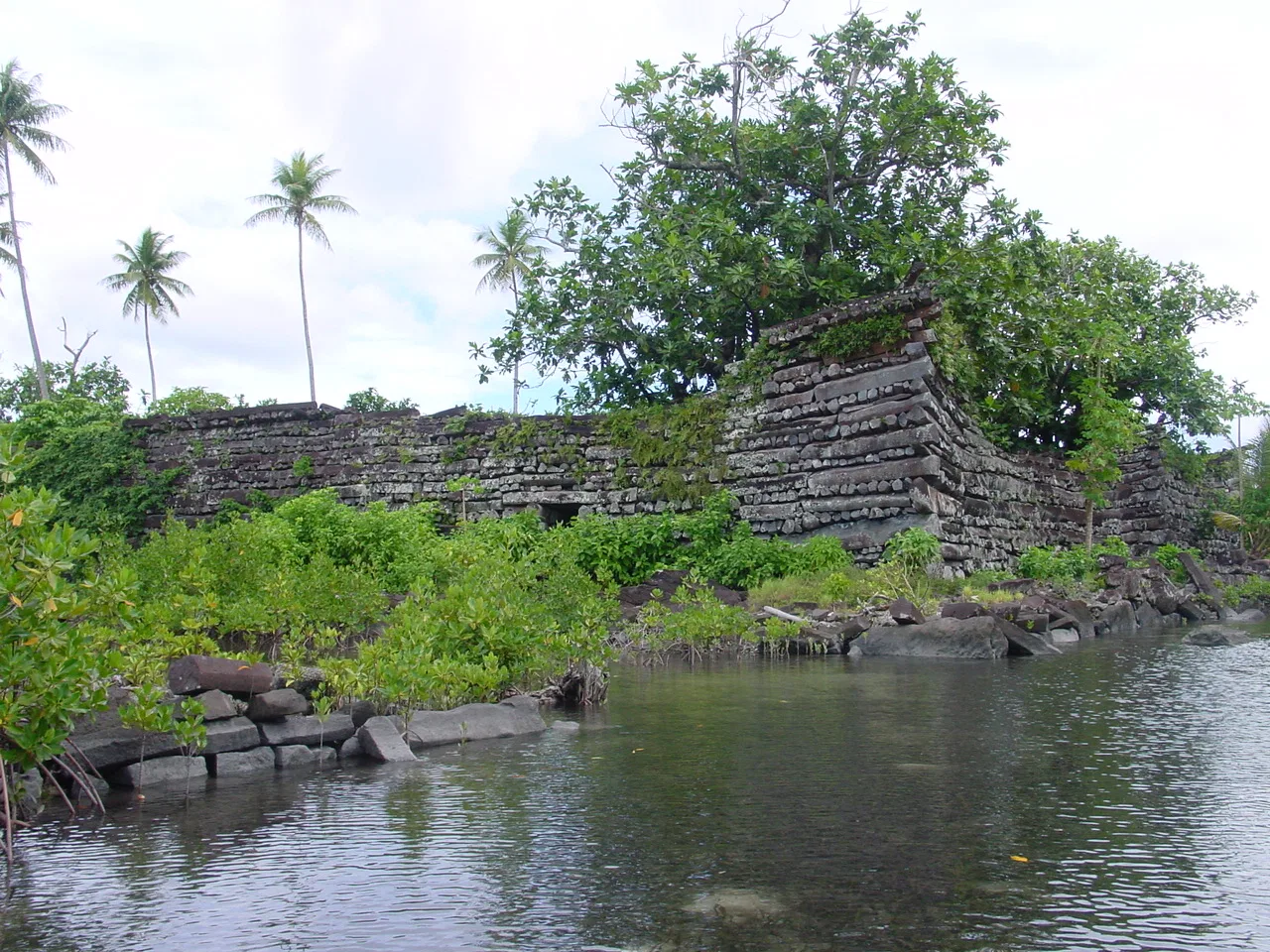
Nan Madol is the Federated States of Micronesia’s best-known uncanny landscape. Built on a reef off Pohnpei, it consists of more than 90 artificial islets—UNESCO describes more than 100 islets in the wider complex—formed from coral fill and massive basalt walls. Between roughly 1200 and 1500, the complex served as the ceremonial, political and mortuary centre of the Saudeleur dynasty. Palaces, tombs, ritual spaces and elite residences were separated by tidal canals, producing the often-used description “Venice of the Pacific”.[unesco.org]whc.unesco.orgOpen source on unesco.org.
The site is genuinely mysterious in the ordinary archaeological sense: many questions remain about labour, political power, construction sequences and daily life. It does not need fictional enhancement. Scientific survey, radiometric dating, architectural analysis and geological work provide a substantial explanation for its development. Research has identified basalt sources and established a chronology for monumental building, while field surveys have mapped the islets and structures in detail.[nach.gov.fm]nach.gov.fmOpen source on nach.gov.fm.
Oral traditions remain central rather than incidental. Stories describe founding brothers, sacred authority, conflict, supernatural assistance and the eventual overthrow of Saudeleur rule. Some traditions include extraordinary events, but this does not make them disposable fantasy. Archaeologists have found points of correspondence between oral accounts and physical evidence. One frequently cited example concerns channels associated with sacred eels and ritual turtle offerings: excavation reportedly identified relevant canal features and turtle remains.[The Metropolitan Museum of Art]metmuseum.orgThe Metropolitan Museum of Art Nan MadolThe Metropolitan Museum of Art Nan Madol
Problems arise when outside writers convert culturally rooted narratives into claims about levitation, lost continents or extraterrestrial builders. Such theories typically begin with a false premise that local societies could not have organised monumental construction. No credible archaeological evidence requires alien technology or a vanished global civilisation. The basalt architecture is extraordinary, but extraordinary labour, authority and engineering are not the same as the inexplicable.
Nan Madol is also a cautionary example of how “mystery tourism” can obscure conservation. UNESCO inscribed it on both the World Heritage List and the List of World Heritage in Danger in 2016. Vegetation, siltation, storm exposure and inadequate conservation capacity threaten the structures. The most consequential mystery is therefore not who secretly built it, but whether a fragile ceremonial landscape can be preserved while respecting local authority and improving visitor management.[UNESCO World Heritage Centre]whc.unesco.orgOpen source on unesco.org.
Pohnpei formerly had the Lidorkini Museum in Kolonia, whose collection reportedly included adzes, shell pounders, beads and pottery fragments from Nan Madol, as well as Japanese wartime material. It closed around 2012. This matters because it removed one of the few places where visitors could examine portable archaeological finds in a conventional interpretive setting. Nan Madol consequently carries even more of the public burden of explaining Pohnpei’s ancient history, although an exposed archaeological site cannot substitute fully for a staffed museum.[Wikipedia]WikipediaOpen source on wikipedia.org.
Kosrae’s museum and ruined city
Kosrae offers a quieter but valuable pairing of indoor collection and monumental landscape. The Kosrae State Museum, run within the state’s historic-preservation framework, states that its displays cover the island’s historical periods. Its holdings include beads, craft tools, shell graters, a weaving loom and Second World War material. The combination is modest but revealing: domestic technologies, exchange objects, archaeology and colonial conflict are interpreted within one local institution rather than separated into specialist museums.[Kosrae State Government]hpo.kosraestate.gov.fmKosrae State GovernmentMuseum | Kosrae State Historic Preservation OfficeOur museum devotes itself to all historical timelines related to…
The museum’s unusual quality lies less in any single grotesque or sensational object than in the survival of materials rarely seen in larger international collections with much local explanation. A shell grater or loom may look ordinary until it is connected to food preparation, gendered knowledge, resource use and changing island life. The wartime material then introduces a sharply different layer of outside military power.
Nearby Lelu is Kosrae’s great archaeological curiosity. Its walls, compounds, canals and coral tombs preserve the remains of a chiefly centre that developed before European colonisation. The ruins are sometimes compared with Nan Madol, but they should not be treated as a lesser copy. Each belonged to a distinct island society and political history, even though archaeologists have considered possible architectural and regional connections.[npgallery.nps.gov]npgallery.nps.govNP Gallery Asset DetailNP Gallery Asset Detail
Local heritage work connects Lelu and other Kosraean sites with oral narratives, including stories in which human history, chiefly succession and non-human beings occupy the same remembered landscape. The Kosrae State Historic Preservation Office presents such traditions alongside archaeological and preservation work rather than forcing visitors to choose between “myth” and “fact”. That approach is especially useful for strange-history travellers: it allows a story to remain culturally meaningful without turning every supernatural element into a literal scientific claim.[Kosrae State Government]hpo.kosraestate.gov.fmOpen source on kosraestate.gov.fm.
Research access and activity at protected Kosraean sites may require permission from state and national authorities. Ordinary tourist visits are different from formal investigation, but the rule underlines a broader point: these ruins are managed cultural places, not abandoned playgrounds for relic hunting.[Kosrae State Government]hpo.kosraestate.gov.fmOpen source on kosraestate.gov.fm.
Why the collections feel different from Western museums
Micronesia’s unusual heritage is frequently inseparable from land, sea, lineage and community authority. Stone money remains meaningful because people recognise ownership and history. Nan Madol and Lelu are not merely architectural remains but places carried through oral traditions. Chuuk’s wrecks cannot be detached from death, occupation and environmental risk. Even small museums often combine archaeology, everyday tools and twentieth-century conflict because island history does not divide neatly into the departments familiar from large metropolitan institutions.
This creates a different standard of credibility. A polished display case is not automatically more authoritative than a locally guided landscape, and an oral account is not automatically less useful than a written colonial record. At the same time, respect for tradition does not require accepting modern pseudohistory. The strongest interpretation keeps several categories clear:
- Archaeological findings are based on survey, excavation, material analysis and dating.
- Oral traditions preserve cultural memory, values and explanations whose relationship to material history may vary.
- Devotional or sacred understandings concern the continuing status of a place or object within a community.
- Tourism language may simplify, romanticise or exaggerate.
- Fortean and conspiracy claims require evidence and should not be confused with local belief merely because both involve supernatural themes.
The result is a country where the most memorable “museum” may be a row of immovable wealth under trees, a royal tomb reached through tidal channels, a rusting command bunker in the forest or a cargo ship resting beneath the lagoon. Their strangeness is real, but it comes from the histories they preserve—not from invented ancient astronauts or manufactured mystery.

Planning a responsible visit
Visitors should verify access locally, particularly for small museums and remote heritage sites. Published opening information can be sparse, and some locations depend on guides, landowner permission, tides, boats or weather. The National Archives, Culture and Historic Preservation system and the individual state preservation offices are more reliable starting points than copied travel listings. The national cultural-research policy also emphasises local participation, training and respect for the country’s authority over archaeological and ethnographic work.[nach.gov.fm]nach.gov.fmOpen source on nach.gov.fm.
At village sites, visitors should ask before photographing people, ceremonies, traditional buildings or privately held objects. Stone money visible from a road is not ownerless public sculpture. At ruins, nothing should be moved or collected. In Chuuk Lagoon, divers should use qualified operators, avoid penetration beyond their training, leave artefacts untouched and remember that some wrecks contain human remains.
The Federated States of Micronesia rewards travellers who accept that its curiosity culture is not organised as a neat chain of attractions. Its most unusual collections remain embedded in the environments and communities that give them meaning. That makes them less predictable than conventional museums, but also far more difficult to reduce to mere curiosities.
Amazon book picks
Further Reading
Books and field guides related to Where Micronesia Keeps Its Strangest Heritage. Use these as the next step if you want deeper reading beyond the article.
1491
Rating: 4.0/5 from 20 Google Books ratings
In this groundbreaking study, Mann shows how a new generation of anthropologists and archaeologists, using new research techniques, have...
The Cambridge History of the Pacific Islanders
An authoritative and comprehensive history of the Pacific islanders from 40,000 BC to the present day.
Pacific Worlds: A History of Seas, Peoples, and Cultures
Asia, the Pacific Islands and the coasts of the Americas have long been studied separately. This essential single-volume history of the P...
eBay marketplace picks
Marketplace Samples
Live-tested eBay searches with available results related to this page.
Selected fromMicronesia map print oneBay.co.uk.
Endnotes
1.
Source: dfat.gov.au
Link:https://www.dfat.gov.au/geo/federated-states-of-micronesia/federated-states-of-micronesia-country-brief
Source snippet
Federated States of Micronesia (FSM) country briefThe Federated States of Micronesia (FSM) — made up of the four island states of Yap...
2.
Source: hpo.kosraestate.gov.fm
Link:https://hpo.kosraestate.gov.fm/museum/
Source snippet
Kosrae State GovernmentMuseum | Kosrae State Historic Preservation OfficeOur museum devotes itself to all historical timelines related to...
3.
Source: micsem.org
Link:https://micsem.org/book/truk-underwater-archaeology/
Source snippet
The major part of this monograph describes briefly the Japanese period before the war, the early successes by Japan, and the Allied effor...
4.
Source: whc.unesco.org
Title: World Heritage Centre Yapese Disk Money Regional Sites
Link:https://whc.unesco.org/en/tentativelists/1994/
Source snippet
In Yap State two sites namely Mangyol Stone Money Bank and O'Keefe Island have been nominated.... Despite the history of transformations...
5.
Source: bankofcanadamuseum.ca
Title: rai big money
Link:https://www.bankofcanadamuseum.ca/2024/07/rai-big-money/
Source snippet
Rai: big money16 Jul 2024 — Rai are stone currency from the island of Yap in Micronesia. Also referred to as fei, they are all roughly th...
6.
Source: micsem.org
Link:https://www.micsem.org/pubs/books/trukunder.htm
7.
Source: nippon.com
Link:https://www.nippon.com/en/japan-topics/g02458/mapping-a-wartime-past-in-paradise-interactive-chart-shows-japanese-relics-on-tonoas-chuuk.html
8.
Source: whc.unesco.org
Link:https://whc.unesco.org/en/list/1503/
9.
Source: nps.gov
Title: nan madol
Link:https://www.nps.gov/places/nan-madol.htm
10.
Source: nach.gov.fm
Link:https://nach.gov.fm/wp-content/uploads/2019/01/mccoy-alderson-and-tohmpson-2015-a-new-archaeological-field-survey-of-the-site-of-nan-madol-pohnpei.pdf
11.
Source: nach.gov.fm
Link:https://nach.gov.fm/wp-content/uploads/2019/01/earliest_direct_evidence_of_monument_building_at_the_archaeological_site_of_nan_madol_pohnpei_micronesia_identified_using_230thu_coral_dating_an.pdf
12.
Source: whc.unesco.org
Link:https://whc.unesco.org/en/news/1524
13.
Source: whc.unesco.org
Link:https://whc.unesco.org/en/list/1503/assistance/
14.
Source: whc.unesco.org
Link:https://whc.unesco.org/en/statesparties/fm
15.
Source: Wikipedia
Link:https://en.wikipedia.org/wiki/Lidorkini_Museum
16.
Source: Wikipedia
Title: List of museums in the Federated States of Micronesia
Link:https://en.wikipedia.org/wiki/List_of_museums_in_the_Federated_States_of_Micronesia
17.
Source: npgallery.nps.gov
Title: NP Gallery Asset Detail
Link:https://npgallery.nps.gov/AssetDetail/NRIS/83004524
18.
Source: hpo.kosraestate.gov.fm
Link:https://hpo.kosraestate.gov.fm/
19.
Source: hpo.kosraestate.gov.fm
Link:https://hpo.kosraestate.gov.fm/sites/
20.
Source: nach.gov.fm
Link:https://nach.gov.fm/wp-content/uploads/2018/05/the-federated-states-of-micronesia-cultural-research-policy_5-30-18.pdf
21.
Source: yapstate.gov.fm
Title: fm Public Releases | Yap State Government
Link:https://www.yapstate.gov.fm/publicreleases/page/53
22.
Source: pohnpeistate.gov.fm
Title: fm Sacred Stone from Nan Madol Returned After 23 Years
Link:https://pohnpeistate.gov.fm/2025/06/09/sacred-stone-from-nan-madol-returned-after-23-years/
23.
Source: irma.kosraestate.gov.fm
Link:https://irma.kosraestate.gov.fm/
24.
Source: Wikipedia
Title: Nan Madol
Link:https://en.wikipedia.org/wiki/Nan_Madol
25.
Source: Wikipedia
Link:https://en.wikipedia.org/wiki/Micronesia
26.
Source: Wikipedia
Link:https://en.wikipedia.org/wiki/NaN
27.
Source: Wikipedia
Title: Federated States of Micronesia
Link:https://en.wikipedia.org/wiki/Federated_States_of_Micronesia
28.
Source: cfsm.gov.fm
Link:https://www.cfsm.gov.fm/wp-content/uploads/2025/03/SCR-NO.-23-77.pdf
29.
Source: cfsm.gov.fm
Link:https://www.cfsm.gov.fm/wp-content/uploads/2025/03/SCR-NO.-23-23.pdf
30.
Source: tci.gov.fm
Title: fsmmip environmental social management framework final
Link:https://tci.gov.fm/documents/pmu/maritime-investment-project/fsmmip-environmental-social-management-framework-final.pdf
31.
Source: cfsm.gov.fm
Link:https://www.cfsm.gov.fm/19th-cfsm-resolutions/
32.
Source: tci.gov.fm
Title: digitalfsm esmp 12 nov rm PF no track
Link:https://tci.gov.fm/documents/communications/digitalfsm/digitalfsm-esmp-12-nov-rmPF-no-track.pdf
33.
Source: nach.gov.fm
Title: the archaeology of nan madol and temwen island 19aug2015
Link:https://nach.gov.fm/wp-content/uploads/2019/01/the-archaeology-of-nan-madol-and-temwen-island_19aug2015.pdf
34.
Source: tci.gov.fm
Title: digital fsm esmp final 2019
Link:https://tci.gov.fm/documents/communications/digitalfsm/digital-fsm-esmp-final-2019.pdf
35.
Source: dofa.gov.fm
Title: FSM Infrastructure Development Plan 2016 2025
Link:https://dofa.gov.fm/wp-content/uploads/2025/07/FSM-Infrastructure-Development-Plan-2016-2025.pdf
36.
Source: yapstate.gov.fm
Link:https://www.yapstate.gov.fm/
37.
Source: hpo.kosraestate.gov.fm
Link:https://hpo.kosraestate.gov.fm/about/
38.
Source: nach.gov.fm
Link:https://nach.gov.fm/nan-madol/
39.
Source: whc.unesco.org
Link:https://whc.unesco.org/en/list/1503/gallery/
40.
Source: whc.unesco.org
Link:https://whc.unesco.org/en/documents/141512
41.
Source: whc.unesco.org
Link:https://whc.unesco.org/en/decisions/8686/
42.
Source: whc.unesco.org
Link:https://whc.unesco.org/en/documents/141513
43.
Source: whc.unesco.org
Link:https://whc.unesco.org/en/documents/115622
44.
Source: whc.unesco.org
Link:https://whc.unesco.org/en/decisions/6800/
45.
Source: whc.unesco.org
Link:https://whc.unesco.org/en/list/1503/maps/
46.
Source: whc.unesco.org
Link:https://whc.unesco.org/en/news/1899
47.
Source: whc.unesco.org
Link:https://whc.unesco.org/en/documents/141521
48.
Source: whc.unesco.org
Link:https://whc.unesco.org/en/events/997/
49.
Source: whc.unesco.org
Link:https://whc.unesco.org/en/news/1787
50.
Source: whc.unesco.org
Link:https://whc.unesco.org/en/documents/168115
52.
Source: whc.unesco.org
Link:https://whc.unesco.org/fr/soc/4312/
53.
Source: whc.unesco.org
Link:https://whc.unesco.org/uploads/nominations/1503.pdf
54.
Source: anthrosource.onlinelibrary.wiley.com
Link:https://anthrosource.onlinelibrary.wiley.com/doi/abs/10.1002/sea2.12154
55.
Source: visitchuuk.com
Title: Visit Chuuk Wreck Diving | Visit Chuuk
Link:https://visitchuuk.com/things-do/wreck-diving
56.
Source: researchoutput.csu.edu.au
Link:https://researchoutput.csu.edu.au/en/publications/chuuk-lagoon-the-gibraltar-of-the-pacific/
57.
Source: researchonline.jcu.edu.au
Link:https://researchonline.jcu.edu.au/2068/
58.
Source: abc.net.au
Link:https://www.abc.net.au/news/2025-10-17/war-relics-threat-for-federated-states-of-micronesia/105884710
59.
Source: visitchuuk.com
Title: Visit Chuuk Popular Landmarks | Visit Chuuk
Link:https://visitchuuk.com/things-do/popular-landmarks
60.
Source: metmuseum.org
Title: The Metropolitan Museum of Art Nan Madol
Link:https://www.metmuseum.org/essays/nan-madol
61.
Source: museum-explorer.com
Title: Stone Money
Link:https://museum-explorer.com/stone-money/
62.
Source: metmuseum.org
Title: Nan Madol
Link:https://www.metmuseum.org/zh/essays/nan-madol
63.
Source: visitchuuk.com
Title: Visit Chuuk
Link:https://visitchuuk.com/
64.
Source: metmuseum.org
Link:https://www.metmuseum.org/essays/micronesia
65.
Source: smarthistory.org
Title: nan madol
Link:https://smarthistory.org/nan-madol/
66.
Source: sites.google.com
Title: federated states of micronesia
Link:https://sites.google.com/k12.hi.us/multilingualmarauders/cultural-resources/federated-states-of-micronesia
67.
Source: pages.uoregon.edu
Title: Nan Madol
Link:https://pages.uoregon.edu/wsayres/pohnpei/NanMadol.html
68.
Source: ebsco.com
Link:https://www.ebsco.com/research-starters/social-sciences-and-humanities/federated-states-micronesia
Additional References
69.
Source: academia.edu
Link:https://www.academia.edu/17289234/An_Inventory_of_the_Stone_Money_Banks_on_the_island_of_Yap_the_7_registered_sites
Source snippet
An Inventory of the Stone Money Banks on the island of YapThe research reveals that stone money's value lies in ownership and the...
70.
Source: ft.com
Link:https://www.ft.com/content/122b53cc-98b1-4cff-9051-40feb5568d07
Source snippet
They delve into the example of the island of Yap in Micronesia, where massive stone disks known as rai stones served as money—despite bei...
71.
Source: repository.si.edu
Title: those owned by the Chase Manhattan Bank in New York
Link:https://repository.si.edu/bitstream/handle/10088/2422/SSHT-0023_Hi_res.pdf?isAllowed=y&sequence=1
Source snippet
Smithsonian Research OnlineTHE STONE MONEY OF YAP - Smithsonian Research Onlinethose owned by the Tokyo National Museum, the Lannan Found...
72.
Source: youtube.com
Title: 82 Years Later Operation Hailstone The Wrecks of Chuuk Lagoon
Link:https://www.youtube.com/watch?v=19-eXhgRoyk
Source snippet
Stone Money of Yap: The Island Where Wealth Was Too Heavy to Steal...
73.
Source: youtube.com
Title: Marine Archaeology Is Rewriting Nan Madol’s Mysterious Ruins
Link:https://www.youtube.com/watch?v=qxPaYCHBD4Y
Source snippet
82 Years Later Operation Hailstone The Wrecks of Chuuk Lagoon...
74.
Source: researchgate.net
Link:https://www.researchgate.net/publication/301729978_Federated_states_of_Micronesia
75.
Source: researchgate.net
Link:https://www.researchgate.net/publication/351762510_Micronesian_Archaeoastronomy_Expedition_Kosrae_and_Pohnpei_the_Federated_States_of_Micronesia
76.
Source: micronesiatour.com
Link:https://micronesiatour.com/events/day-museum
77.
Source: researchgate.net
Link:https://www.researchgate.net/publication/283711318_A_New_Archaeological_Field_Survey_of_the_Site_of_Nan_Madol_Pohnpei
78.
Source: newsletter.cseas.kyoto-u.ac.jp
Link:https://newsletter.cseas.kyoto-u.ac.jp/en/nl-83/ishii/