Where Saudi Arabia Keeps Its Strangest Objects
Saudi Arabia does not yet have a famous museum devoted to witchcraft, cryptids, crime or medical horrors.
Page outline Jump by section
Introduction
The most revealing places are often not conventional national museums. They are collector-led houses packed with thousands of objects, pilgrimage exhibitions where historic doors and mosque fittings retain religious significance, and heritage rooms that turn ordinary possessions into evidence of vanished ways of life. Saudi Arabia’s Museums Commission lists both public institutions and a large licensed private sector; broader official summaries have counted hundreds of museums, including private and university collections, although the totals vary with licensing standards and closures.[moc.gov.sa]museums.moc.gov.saA46 SAMoCA @ Jax Tariq 1 Tariq Abdulhakim Museum…
For curious travellers, the country therefore rewards a different expectation. The unusual is less likely to mean theatrical monsters or sensational mysteries than overwhelming accumulation, intimate personal curation and the uneasy meeting of archaeology, devotion, modern nation-building and tourism.
Why private collections matter so much
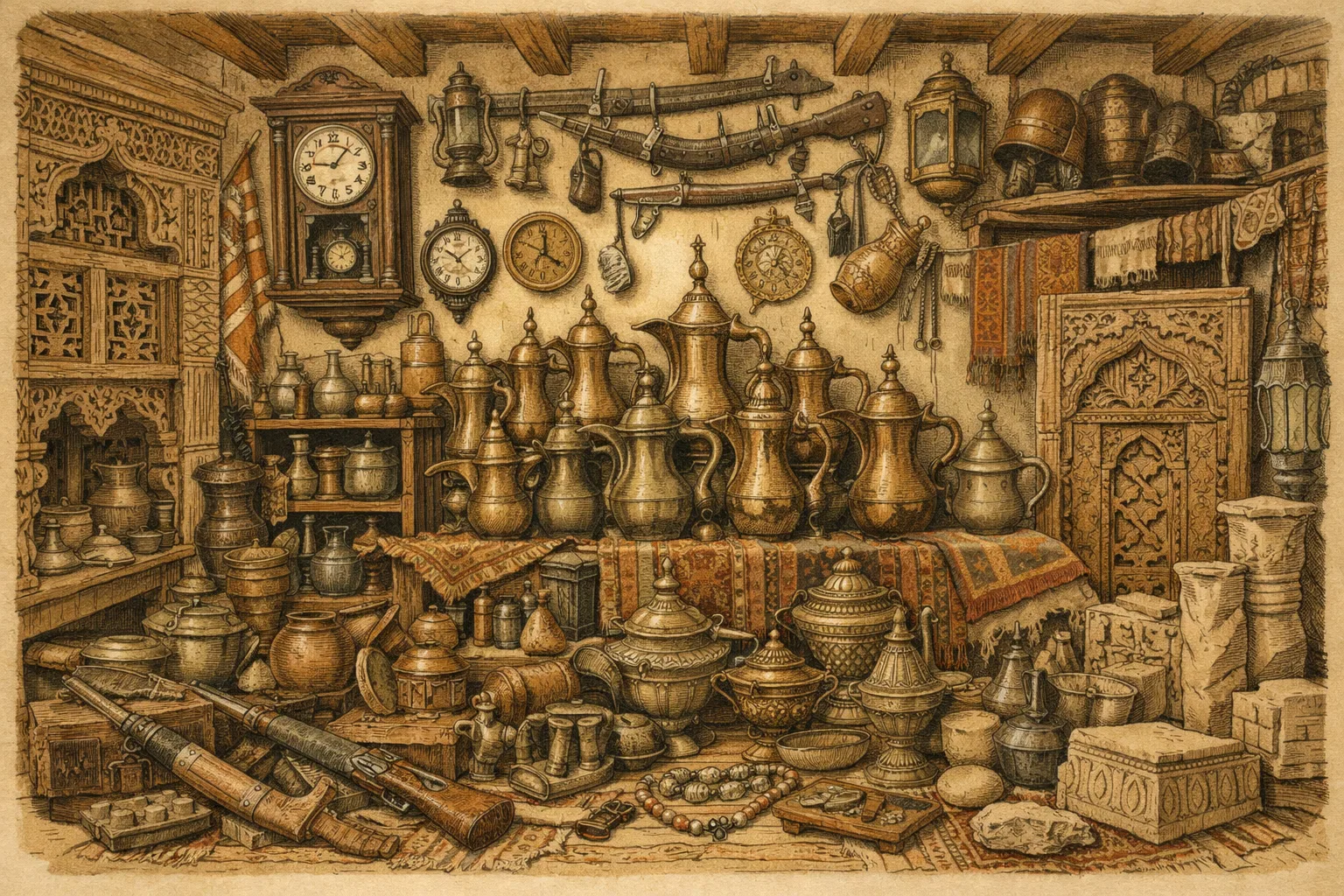
A defining feature of Saudi curiosity culture is the privately founded heritage museum. These collections commonly begin as one person’s attempt to rescue tools, clothes, coins, manuscripts, weapons, household vessels and shop signs that were disappearing during rapid urban and economic change. Over time, garages, farms and family houses become room-sized cabinets of memory.
The Alfelwah and Aljowharah Museum in the Eastern Province is a strong example. Its displays include manuscripts, coins, traditional crafts, antique arms and personal possessions from different periods. What makes it unusual is not one macabre or mysterious object but the density and variety of material gathered under one private vision. It belongs to a museum tradition in which comprehensiveness is emotional rather than strictly academic: the collector attempts to save an entire remembered world.[Visit Saudi]visitsaudi.comVisit SaudiAlfelwah and Aljowharah Museum | Culture & HistoryThe museum is known for its extensive displays, which include traditional cr…
Similar projects appear across the country. A private museum reported in Tabuk in 2024 occupied roughly 2,200 square metres and contained more than 10,000 heritage pieces gathered over about 25 years. In northern Saudi Arabia, collector-led museums have recreated such spaces as a bride’s room, a traditional beauty room and domestic interiors furnished with old textiles, cosmetics, utensils and copperware. These are not neutral storage displays. They stage everyday life so visitors can imagine how objects were used.[Arab News]arabnews.comThe collection includes ancientArab NewsTabuk collector opens museum featuring Saudi heritage…March 13, 2024 — 13 Mar 2024 — Spanning an area of about 2,200 square m…
The scale can be startling. One collector profiled in 2026 said he had assembled more than 12,000 items over 37 years, ranging from traditional tools and early coins to objects presented as archaeological material. Such collections can be vivid and knowledgeable, but visitors should distinguish enthusiasm from formal provenance research. A licence or public opening does not automatically mean that every object has a published excavation history, scientific date or fully documented chain of ownership.[The Urban Activist]theurbanactivist.comheritage museum cultural transformation saudi arabiaThe Urban ActivistA One-Man Museum to Understand Saudi Arabia24 Feb 2026 — The collection features heritage artifacts and traditional too…
That tension is central to their fascination. Private museums preserve things that state institutions might once have judged too repetitive, recent or ordinary: coffee pots, radios, sewing equipment, cosmetics, packaging, school materials and worn domestic furniture. At the same time, crowded displays and personal labels may make it difficult to separate authenticated antiquities from inherited possessions, replicas or objects bought through the antiques trade.

Sacred objects that are not merely curiosities
Saudi Arabia’s most distinctive unusual collections are connected to Makkah and Madinah. Here, fragments of doors, columns, screens, clocks, textiles and architectural fittings are displayed not simply because they are old, but because they once formed part of places central to Islamic religious life.
The Exhibition of the Two Holy Mosques Architecture in Makkah traces changes to the Grand Mosque and the Prophet’s Mosque through models, photographs, documents and surviving architectural elements. Its holdings include rare fittings associated with the Kaaba and earlier phases of mosque construction. Recent displays have highlighted historic components of the Kaaba’s door and objects connected with services and crowd management at the Grand Mosque.[Saudi Press Agency]spa.gov.saOpen source on spa.gov.sa.
This creates a very different museum atmosphere from a conventional decorative-arts gallery. A carved panel or metal fitting may be simultaneously architectural evidence, a record of royal patronage and an object treated with profound reverence. Labelling it merely an “oddity” would miss the point. Its power comes from having crossed the boundary between active sacred structure and preserved historical witness.
The Holy Quran Museum in Makkah’s Hira Cultural District similarly uses rare manuscripts and interactive displays to explain the history of Quranic writing, preservation and scholarship. The nearby Revelation Exhibition places these materials within the religious history associated with the area. These are modern, carefully presented visitor attractions, but they remain devotional and educational rather than sceptical investigations of belief.[spa.gov.sa]spa.gov.saOpen source on spa.gov.sa.
The Islamic Arts Biennale has pushed this approach in a more experimental direction. Staged in Jeddah’s vast Western Hajj Terminal, it has combined historic sacred objects with contemporary installations, manuscripts, textiles and material from institutions in Saudi Arabia and abroad. The setting is itself unusual: a working pilgrimage gateway temporarily becomes a museum-scale meditation on faith, movement and memory. Displays have included objects associated with Makkah and Madinah alongside modern works that interpret prayer, pilgrimage and sacred space.[The Times]thetimes.co.ukOpen source on thetimes.co.uk.
Visitors should also understand the access issue. Non-Muslims may not enter Makkah, so its clock, Quran and sacred-architecture museums are not available to every international traveller. Seasonal Hajj controls can also restrict entry for residents and other visitors, making advance checking essential even for eligible Muslim visitors.[discoversaudi.sa]discoversaudi.saOpen source on discoversaudi.sa.
The giant clock as a museum of time and the heavens
High inside Makkah’s monumental Clock Tower is one of Saudi Arabia’s most conceptually unusual museums. Rather than concentrating only on the tower’s machinery, the Clock Tower Museum connects mechanical timekeeping with astronomy, cosmology and the observation of the lunar crescent.
The museum occupies several levels devoted to the Makkah clock, methods of measuring time and humanity’s changing understanding of the universe. Interactive screens and technical displays explain the tower’s construction and clock mechanisms, while the associated astronomy centre presents crescent observation as both a scientific practice and an activity with direct religious importance.[discovermakkah.sa]discovermakkah.saOpen source on discovermakkah.sa.
That combination gives the museum its distinctive character. In most clock museums, time is industrial or mechanical. Here it is also liturgical. The movement of the Moon affects the Islamic calendar, so observational astronomy is tied to the timing of religious months and festivals. The museum therefore joins engineering, cosmology and devotion within one of the world’s most conspicuous modern religious buildings.
It is polished and strongly interpretive rather than a dusty specialist collection. Visitors should expect immersive digital presentation and a carefully constructed narrative about science, faith and Saudi stewardship, not unrestricted access to a working research laboratory. An official online booking service was still being promoted in 2026, but availability and entry arrangements should be checked before travel.[MyGov]my.gov.saMy Gov Musem Booking | National Platform (National PortalMy Gov Musem Booking | National Platform (National Portal
Railway ruins, forts and objects of confinement
Saudi Arabia’s railway and fortress museums offer a darker form of curiosity: abandoned machinery, military architecture and buildings whose functions changed as political power shifted.
The Hejaz Railway was created in the early twentieth century to carry pilgrims towards the holy cities and strengthen Ottoman control over distant territories. Surviving stations, locomotives, tracks and workshops now form a scattered material archive across north-western Saudi Arabia. Unlike a neatly enclosed transport museum, the railway is often encountered through a landscape of stone buildings and heavy machinery whose original network was broken by war and political change.
At Madain Salih, railway remains sit close to the monumental tombs of an earlier Nabataean civilisation, creating an extraordinary layering of histories. Ottoman industrial infrastructure, pilgrimage history and ancient funerary architecture occupy the same desert region. The result is less a single cabinet of curiosities than an archaeological landscape in which different empires seem to have left collections beside one another.
Masmak Fort in Riyadh offers another example of a building with a complicated afterlife. Constructed in the nineteenth century, it became closely associated with the capture of Riyadh in 1902 and the formation of the modern Saudi state. It was also used for storing arms and later served as a prison before becoming a museum. Its thick walls, defensive openings and preserved weapons give visitors a physical encounter with conflict and confinement, although its interpretation is primarily national and historical rather than a museum of punishment or crime.[Wikipedia]WikipediaMuseums in RiyadhMuseums in Riyadh
These places matter because Saudi Arabia has relatively few public museums devoted specifically to prisons, executions or criminal history. Forts and military sites carry some of that material indirectly. Their cells, armour, ammunition stores and defensive structures survive, but they are generally interpreted through state formation, local resistance or security rather than through the experiences of prisoners.

Archaeology that overturned the empty-desert myth
For many visitors, Saudi Arabia’s strangest objects are archaeological: monumental stone figures, enigmatic inscriptions, colossal tomb façades and evidence of settlements that do not fit the popular image of Arabia as historically isolated.
The Saudi National Museum houses more than 4,000 objects covering human presence in the peninsula from prehistoric periods to modern history. Its most curiosity-rich material includes rock art, ancient sculpture, inscribed stones, burial objects and artefacts from trade centres that linked Arabia with Mesopotamia, the Mediterranean, Africa and southern Asia.[engage.moc.gov.sa]engage.moc.gov.saOpen source on moc.gov.sa.
The significance of these objects is not that they are unexplained anomalies. Most belong to archaeological contexts that scholars can investigate through inscriptions, architecture, material analysis and comparison. Their surprise lies in how strongly they contradict older stereotypes. Northern and north-western Arabia contained oasis kingdoms, caravan settlements and communities with their own religious practices long before Islam.
AlUla and Hegra provide the most dramatic open-air version of this discovery. Rock-cut Nabataean tombs dominate the landscape, but they sit within a broader archaeological zone containing inscriptions, ritual spaces, settlements and routes associated with long-distance trade. The so-called “lonely castle”, an isolated monumental tomb façade, is visually mysterious because it appears unfinished and detached from the larger clusters. Its oddness is architectural, not paranormal: it demonstrates the labour and planning behind a tomb whose carving was never completed.
Saudi museum development around AlUla is still evolving. Ambitious cultural institutions and future museums have been announced, rescheduled and revised as part of the region’s tourism transformation. Reporting in 2026 indicated that some projects, including proposed museums devoted to incense and horses, had moved to later target dates. Travellers should therefore separate existing archaeological attractions and temporary exhibitions from future institutions shown in development plans.[Le Monde.fr]lemonde.frFinancial challenges, including declining oil revenue, have led to cutbacks in cultural expenditure and delays in high-profile internatio…
Folklore without a monster museum
Saudi Arabia has rich traditions involving supernatural beings, protective practices, uncanny desert places and oral storytelling, but these are not presently gathered into a prominent, well-documented public “museum of monsters” or museum of witchcraft. Searches for such an attraction often produce results from neighbouring Gulf countries, commercial horror entertainment or unsupported travel listings rather than a verified Saudi institution.
That absence is meaningful. Public museums in Saudi Arabia tend to place folklore within regional heritage: clothing, jewellery, poetry, crafts, marriage customs, domestic ritual, hospitality and traditional architecture. Supernatural beliefs may appear indirectly through oral history, manuscripts, religious explanation or objects whose protective use is recorded, but they are not usually dramatised as occult spectacle.
This is partly a matter of classification. An object that a European curiosity cabinet might call magical could be presented in an Islamic collection as calligraphy, devotional practice, medicine, manuscript culture or protection from harm. Comparable Islamic metalwork collections outside Saudi Arabia, for example, describe inscribed “magic bowls” intended to protect users from fear, evil or supernatural beings. The category exists historically, but it should not be assumed that every inscribed vessel or amulet in a Saudi heritage display has the same purpose without a reliable label or provenance.[Islamic Art Museum]islamicart.museumwnf.orgIslamic Art Museum Magic BowlIslamic Art Museum Magic Bowl
For readers seeking cryptids, haunted artefacts or theatrical occult displays, Saudi Arabia is therefore a thin-evidence destination. Its stronger strange-history appeal comes from the boundary between ordinary and sacred objects, the intensity of private collecting, and archaeological landscapes that once seemed mysterious because so little of their history was widely known.
What visitors should expect
Saudi Arabia’s unusual collections range from professionally managed national institutions to family museums that may depend on the owner’s availability. The experience can vary greatly.
A practical hierarchy helps:
- Major public institutions usually offer fixed hours, formal interpretation, ticketing and bilingual visitor information.
- Private licensed museums may contain the most eccentric displays, but advance contact can be necessary. Makkah’s Al Aseel House Museum, for example, explicitly asks visitors to arrange contact beforehand.[اكتشف مكة]discovermakkah.saOpen source on discovermakkah.sa.
- Sacred collections should be approached as religious heritage, not as exotic curiosities. Access, photography and behaviour may be more controlled.
- Temporary exhibitions and development projects should not be confused with permanent museums. Saudi Arabia’s cultural sector is expanding rapidly, and announced opening dates can move.
- Collector claims deserve respectful caution. Numbers of objects, rarity and dating are sometimes reported through owner interviews or promotional material rather than published catalogues.
The most rewarding approach is to ask what kind of authority each display claims. Is it an archaeological museum presenting excavated material? A devotional exhibition preserving sacred architecture? A private collector arranging inherited objects? A tourist reconstruction of domestic life? Each can be valuable, but they answer different questions.
Saudi Arabia’s curiosity culture is not built around grotesque spectacle. It is built around preservation under pressure: possessions rescued from disappearing homes, railway machinery left by a collapsed imperial route, mosque fragments transferred from sacred buildings, and ancient objects brought into new national narratives. Its strangest museums are compelling because they show how quickly an everyday tool can become heritage, how a structural fragment can remain holy, and how one collector’s crowded room can become an unofficial archive of a changing country.
Amazon book picks
Further Reading
Books and field guides related to Where Saudi Arabia Keeps Its Strangest Objects. Use these as the next step if you want deeper reading beyond the article.
The Museum of Innocence
The Museum of Innocence - set in Istanbul between 1975 and today - tells the story of Kemal, the son of one of Istanbul's richest familie...
A History of the Arab Peoples
Hourani, the distinguished historian and interpreter, has written a masterwork--a panoramic view encompassing twelve centuries of Arab hi...
Cabinets of Curiosities
"Maurie`s' tour of strange objects is entertaining and fascinating." --Antiques And The Arts Weekly
The Penguin Atlas of Ancient History
First published 1967. Subjects: Maps, Atlases, Ancient Geography, History, ancient, Geography, ancient.
eBay marketplace picks
Marketplace Samples
Live-tested eBay searches with available results related to this page.
Selected fromSaudi heritage decor oneBay.co.uk.
Endnotes
1.
Source: museums.moc.gov.sa
Link:https://museums.moc.gov.sa/en
Source snippet
A46 SAMoCA @ Jax Tariq 1 Tariq Abdulhakim Museum...
2.
Source: saudipedia.com
Link:https://saudipedia.com/en/museums-in-the-kingdom
Source snippet
Museums in the KingdomAdditionally, over two hundred private museums have been licensed, along. The total number of museums rea...
3.
Source: museums.moc.gov.sa
Title: هيئة المتحفMuseums and exhibitions
Link:https://museums.moc.gov.sa/en/Museums
Source snippet
Private Licensed Museums(120) Public Museums(11) ir Abha Private Licensed Museums. Al Madinah Al Munawwarah Medina Private Licensed Mu...
4.
Source: spa.gov.sa
Link:https://www.spa.gov.sa/N2482460
5.
Source: spa.gov.sa
Link:https://spa.gov.sa/en/N2605597
6.
Source: spa.gov.sa
Link:https://spa.gov.sa/en/N2608405
7.
Source: spa.gov.sa
Link:https://spa.gov.sa/en/N2590013
8.
Source: pep.gov.sa
Link:https://www.pep.gov.sa/en/node/988
9.
Source: rcmc.gov.sa
Link:https://www.rcmc.gov.sa/en-us/discover-makkah/mecca-landmarks/archaeological-landmarks/%D8%AD%D9%8A-%D8%AD%D8%B1%D8%A7%D8%A1-%D8%A7%D9%84%D8%AB%D9%82%D8%A7%D9%81%D9%8A
10.
Source: discoversaudi.sa
Link:https://discoversaudi.sa/en/ksa-tourist-visa
11.
Source: pep.gov.sa
Link:https://pep.gov.sa/en/news/925
12.
Source: pep.gov.sa
Link:https://pep.gov.sa/en/news/926
13.
Source: rcmc.gov.sa
Link:https://www.rcmc.gov.sa/en-us/discover-makkah/mecca-landmarks/archaeological-landmarks/%D9%85%D8%B1%D8%A7%D9%83%D8%B2-%D9%88%D9%85%D8%AA%D8%A7%D8%AD%D9%81-%D8%A8%D8%B1%D8%AC-%D8%A7%D9%84%D8%B3%D8%A7%D8%B9%D8%A9
14.
Source: my.gov.sa
Title: My Gov Musem Booking | National Platform (National Portal)
Link:https://my.gov.sa/en/services/2159624
15.
Source: Wikipedia
Title: Museums in Riyadh
Link:https://en.wikipedia.org/wiki/Museums_in_Riyadh
16.
Source: engage.moc.gov.sa
Link:https://engage.moc.gov.sa/national_museum/collections/
17.
Source: spa.gov.sa
Link:https://www.spa.gov.sa/en/N2627755
18.
Source: spa.gov.sa
Link:https://www.spa.gov.sa/en/N2619875
19.
Source: spa.gov.sa
Link:https://www.spa.gov.sa/N2619793
20.
Source: my.gov.sa
Title: Private Museums | National Platform (National Portal)
Link:https://my.gov.sa/en/services/789093
21.
Source: spa.gov.sa
Link:https://www.spa.gov.sa/en/N2599458
22.
Source: spa.gov.sa
Link:https://www.spa.gov.sa/en/N2597456
23.
Source: spa.gov.sa
Link:https://www.spa.gov.sa/en/N2596426
24.
Source: spa.gov.sa
Link:https://www.spa.gov.sa/en/N2594059
25.
Source: my.gov.sa
Title: New Visitor | National Platform (National Portal)
Link:https://my.gov.sa/en/content/new-visitor
26.
Source: pep.gov.sa
Link:https://www.pep.gov.sa/index.php/ar/news/925
27.
Source: spa.gov.sa
Link:https://spa.gov.sa/en/N2548896
28.
Source: spa.gov.sa
Title: Rafha Heritage Museum: A Living Archive of Saudi History and Culture
Link:https://spa.gov.sa/en/N2531916
29.
Source: spa.gov.sa
Title: Prophet’s Mosque Preserves 80-Year-Old Solar Heritage Clock
Link:https://spa.gov.sa/en/N2523989
30.
Source: spa.gov.sa
Title: Two Holy Mosques Exhibition Welcomes Visitors for Founding Day Celebrations
Link:https://www.spa.gov.sa/en/N2521026
31.
Source: rcmc.gov.sa
Title: مراكز ومتاحف برج الساعة
Link:https://www.rcmc.gov.sa/discover-makkah/makkah-landmarks/archaeological-landmarks/%D9%85%D8%B1%D8%A7%D9%83%D8%B2-%D9%88%D9%85%D8%AA%D8%A7%D8%AD%D9%81-%D8%A8%D8%B1%D8%AC-%D8%A7%D9%84%D8%B3%D8%A7%D8%B9%D8%A9
32.
Source: rcmc.gov.sa
Title: Exhibition of the Two Holy Mosques Architecture
Link:https://www.rcmc.gov.sa/en-us/discover-makkah/mecca-landmarks/archaeological-landmarks/%D9%85%D8%AA%D8%AD%D9%81-%D8%B9%D9%85%D8%A7%D8%B1%D8%A9-%D8%A7%D9%84%D8%AD%D8%B1%D9%85%D9%8A%D9%86-%D8%A7%D9%84%D8%B4%D8%B1%D9%8A%D9%81%D9%8A%D9%86
33.
Source: pep.gov.sa
Link:https://pep.gov.sa/en/news/845
34.
Source: travel.state.gov
Title: hajj and umrah pilgrimage travel
Link:https://travel.state.gov/en/international-travel/planning/safety-tips/hajj-and-umrah-pilgrimage-travel.html
35.
Source: spa.gov.sa
Title: House of Islamic Arts Showcases 1,000 Rare Artifacts Spanning Islamic History
Link:https://www.spa.gov.sa/en/N2354458
36.
Source: spa.gov.sa
Link:https://www.spa.gov.sa/en/N2325158
37.
Source: spa.gov.sa
Link:https://www.spa.gov.sa/en/N2309300
38.
Source: spa.gov.sa
Title: Tourism Ministry Tightens Hajj Season Booking Regulations for Makkah
Link:https://www.spa.gov.sa/en/N2305286
39.
Source: spa.gov.sa
Link:https://spa.gov.sa/en/N2297080
40.
Source: spa.gov.sa
Title: Prophet’s Mosque Expansion Exhibition Showcases Architectural Heritage
Link:https://www.spa.gov.sa/en/N2285283
41.
Source: spa.gov.sa
Title: ‘Visit Saudi’: Guide to Tourism and Entertainment in Saudi Arabia
Link:https://www.spa.gov.sa/en/N2086588
42.
Source: saudipedia.com
Title: List of Halls at Jeddah Museum
Link:https://saudipedia.com/en/list-of-halls-at-jeddah-museum
43.
Source: saudipedia.com
Title: What Are the Contents of the Exhibition of the Two Holy Mosques Architecture?
Link:https://saudipedia.com/en/what-are-the-contents-of-the-exhibition-of-the-two-holy-mosques-architecture
44.
Source: uqn.gov.sa
Link:https://uqn.gov.sa/?p=10742
45.
Source: spa.gov.sa
Title: Museums Commission Launches its Official Website
Link:https://www.spa.gov.sa/w1575911?lang=en&newsid=2244926
46.
Source: saudipedia.com
Title: Exhibition of the Two Holy Mosques Architecture
Link:https://saudipedia.com/en/exhibition-of-the-two-holy-mosques-architecture
47.
Source: saudipedia.com
Title: Al-Jawf Museum
Link:https://saudipedia.com/en/al-jawf-museum
48.
Source: spa.gov.sa
Link:https://www.spa.gov.sa/1923031
49.
Source: moc.gov.sa
Title: The report on the state of culture 2024
Link:https://www.moc.gov.sa/-/media/Project/Ministries/Moc/Publications/The-report-on-the-state-of-culture-2024.pdf
50.
Source: moc.gov.sa
Link:https://www.moc.gov.sa/-/media/Project/Ministries/Moc/Qiyas/OpenData/List-of-public-and-private-museums-%282%29.pdf
51.
Source: moc.gov.sa
Link:https://www.moc.gov.sa/-/media/Project/Ministries/Moc/Publications/Files/publications-EN/Guide-To-Acquiring-Artworks-1.pdf
52.
Source: museums.moc.gov.sa
Link:https://museums.moc.gov.sa/-/media/Project/Ministries/Commission/architecturedesign/files/MOC_Report_on_State_of_Culture_0-1649920876.pdf
53.
Source: moc.gov.sa
Title: Report on the State of Culture 2020 Digitalization of Culture
Link:https://www.moc.gov.sa/-/media/Project/Ministries/Moc/Publications/Files/publications-EN/Report-on-the-State-of-Culture-2020-Digitalization-of-Culture.pdf
54.
Source: moc.gov.sa
Title: The Report on the State of Culture in the Kingdom of Saudi Arabia 2021
Link:https://www.moc.gov.sa/-/media/Project/Ministries/Moc/Publications/Files/publications-EN/The-Report-on-the-State-of-Culture-in-the-Kingdom-of-Saudi-Arabia-2021.pdf
55.
Source: culinary.moc.gov.sa
Link:https://culinary.moc.gov.sa/-/media/Project/Ministries/Commission/culinaryarts/Culinary-Arts-Books/CAMELS-POTENTIAL.pdf
56.
Source: engage.moc.gov.sa
Link:https://engage.moc.gov.sa/artresidency/
57.
Source: museums.moc.gov.sa
Link:https://museums.moc.gov.sa/
58.
Source: museums.moc.gov.sa
Link:https://museums.moc.gov.sa/ar/
59.
Source: engage.moc.gov.sa
Link:https://engage.moc.gov.sa/national_museum/my-visit/
60.
Source: engage.moc.gov.sa
Link:https://engage.moc.gov.sa/national_museum/book-your-tickets/
61.
Source: engage.moc.gov.sa
Link:https://engage.moc.gov.sa/national_museum/contact-us/
62.
Source: engage.moc.gov.sa
Link:https://engage.moc.gov.sa/national_museum/faq-page/
63.
Source: engage.moc.gov.sa
Link:https://engage.moc.gov.sa/national_museum/terms-conditions/
64.
Source: engage.moc.gov.sa
Link:https://engage.moc.gov.sa/national_museum/group-visits/
65.
Source: Wikipedia
Title: Museums in Saudi Arabia
Link:https://en.wikipedia.org/wiki/Museums_in_Saudi_Arabia
66.
Source: GOV.UK
Title: www.gov.uk Safety and security
Link:https://www.gov.uk/foreign-travel-advice/saudi-arabia/safety-and-security
67.
Source: moi.gov.sa
Link:https://www.moi.gov.sa/wps/portal/Home/emirates/easternprovince/contents/%21ut/p/z0/fYy9DoIwFEZfBQZHcm9LJThWI8GfxbhAl-aGNFiDRUqDPr4QRxOXLzknJx8oqBnf5BuRpgKhAuVosi0F2zvqZq5VpvEgRMkEP2FZMJSX3XnPs4KjXMOVPBxB_Y_mF3sfBiVBNb0L5h2gMjQG41309P1kXWNW-GuceY3fjcg3Nzst1Rj0YjTHBHnCkeWkjYOH2natjOMPbHr58A%21%21/
68.
Source: visitsaudi.com
Link:https://www.visitsaudi.com/en/eastern-province/attractions/alfelwah-and-aljowharah-museum
Source snippet
Visit SaudiAlfelwah and Aljowharah Museum | Culture & HistoryThe museum is known for its extensive displays, which include traditional cr...
69.
Source: arabnews.com
Title: The collection includes ancient
Link:https://www.arabnews.com/node/2476366/saudi-arabia
Source snippet
Arab NewsTabuk collector opens museum featuring Saudi heritage...March 13, 2024 — 13 Mar 2024 — Spanning an area of about 2,200 square m...
Published: March 13, 2024
70.
Source: arabnews.com
Title: saudi arabia
Link:https://www.arabnews.com/node/2545886/saudi-arabia
Source snippet
A bride's room, replete with traditional outfits and wool...Read more...
71.
Source: theurbanactivist.com
Title: heritage museum cultural transformation saudi arabia
Link:https://theurbanactivist.com/culture/heritage-museum-cultural-transformation-saudi-arabia/
Source snippet
The Urban ActivistA One-Man Museum to Understand Saudi Arabia24 Feb 2026 — The collection features heritage artifacts and traditional too...
72.
Source: thetimes.co.uk
Link:https://www.thetimes.co.uk/article/in-the-shadow-of-a-saudi-airport-a-radical-arts-festival-is-taking-place-z76v5b057
73.
Source: discovermakkah.sa
Link:https://www.discovermakkah.sa/en/places-worth-visiting/landmarks/clock-tower-museum
74.
Source: lemonde.fr
Link:https://www.lemonde.fr/en/culture/article/2026/02/14/saudi-arabia-rethinks-its-cultural-policy-as-foreign-interests-vie-for-funding_6750479_30.html
Source snippet
Financial challenges, including declining oil revenue, have led to cutbacks in cultural expenditure and delays in high-profile internatio...
75.
Source: islamicart.museumwnf.org
Title: Islamic Art Museum Magic Bowl
Link:https://islamicart.museumwnf.org/database_item.php?id=object%3BEPM%3Bqt%3BMus22%3B22%3Ben
76.
Source: discovermakkah.sa
Link:https://www.discovermakkah.sa/en/places-worth-visiting/landmarks/beit-al-asil-museum
77.
Source: arabnews.com
Title: Al-Tayebat museum in Jeddah celebrates national heritage | Arab News
Link:https://www.arabnews.com/node/2648417/saudi-arabia
78.
Source: arabnews.fr
Link:https://www.arabnews.fr/node/506182/culture
79.
Source: ksa.com
Title: Tayebat Museum: Jeddah’s Landmark of National Identity and History – KSA.com
Link:https://www.ksa.com/culture/tayebat-museum-jeddahs-landmark-of-national-identity-and-history/
80.
Source: discovermakkah.sa
Link:https://www.discovermakkah.sa/en/places-worth-visiting/landmarks/exhibition-of-the-architecture-of-the-two-holy-mosques
81.
Source: discovermakkah.sa
Link:https://www.discovermakkah.sa/places-worth-visiting/landmarks/clock-tower-museum
82.
Source: discovermakkah.sa
Link:https://www.discovermakkah.sa/en/about-makkah/faq
83.
Source: discovermakkah.sa
Link:https://www.discovermakkah.sa/en/plan-your-trip/at-a-glance/tourist-code-of-conduct
84.
Source: discovermakkah.sa
Link:https://www.discovermakkah.sa/en/places-worth-visiting/landmarks/international-museum-of-the-prophet-s-biography-and-islamic-civilization
85.
Source: discovermakkah.sa
Link:https://www.discovermakkah.sa/en/places-worth-visiting/landmarks/hara-cultural-district
86.
Source: saudiarabiamuseums.com
Link:https://saudiarabiamuseums.com/en/about
87.
Source: vision2030.ai
Link:https://vision2030.ai/institutions/moc/
88.
Source: visa.visitsaudi.com
Title: Terms Conditions
Link:https://visa.visitsaudi.com/Home/TermsConditions
Additional References
89.
Source: facebook.com
Link:https://www.facebook.com/ArabNews/posts/saudi-museums-commission-launches-transformational-agenda/1022924296539251/
90.
Source: facebook.com
Link:https://www.facebook.com/ArabNews/posts/the-red-sea-undiscovered-presents-little-known-saudi-traditions/10160113173187125/
91.
Source: reddit.com
Link:https://www.reddit.com/r/ArtefactPorn/comments/kuapfs/a_book_of_magic_with_spells_and_occult_diagrams/
92.
Source: elm.sa
Link:https://elm.sa/en/about-us/why-elm/case-studies/Pages/Clock-Tower-Museum-A-Journey-Like-No-Other.aspx
93.
Source: towervisitors.com
Link:https://towervisitors.com/en/
94.
Source: naturalis.nl
Link:https://www.naturalis.nl/en/museum/galleries/dinosaur-era
95.
Source: ksaart.com
Link:https://www.ksaart.com/discovering-the-rich-heritage-top-museums-in-saudi-arabia/
96.
Source: facebook.com
Link:https://www.facebook.com/stevebackshallofficial/posts/majilis-al-jinn-the-gathering-place-of-genies-was-the-second-largest-chamber-in-/1215932309893347/
97.
Source: saudiarabiamuseums.com
Link:https://saudiarabiamuseums.com/en/museums
98.
Source: exploringsaudi.com
Link:https://www.exploringsaudi.com/saudi-arabia-travel-information/jeddah-attraction/tayebat-museum