Within Britain's Strange Museums
When Does Medical Display Become Exploitation?
Britain's medical collections reveal how preserved bodies advanced teaching while exposing unresolved questions about consent, dignity and ownership.
On this page
- The Hunterian tradition of anatomical teaching
- Pathology, surgery and professional authority
- Consent, dignity and repatriation
Page outline Jump by section
Introduction
Britain’s medical museums occupy an unusual place within the country’s landscape of curious collections. They preserve anatomical specimens, diseased organs, skeletons and surgical preparations that helped transform medicine from craft into science, yet many of these collections were assembled long before modern ideas of informed consent, patient autonomy and cultural sensitivity existed. As a result, they are simultaneously museums of medical progress and places where visitors confront difficult questions about dignity, ownership and the treatment of the dead.

Rather than hiding these tensions, many leading British institutions now present them as part of the story. Displays increasingly explain how specimens were collected, acknowledge that many individuals never consented to public display, and set out the ethical standards that now govern care, research, photography and, where appropriate, repatriation. The museums remain important educational resources, but the emphasis has shifted from celebrating anatomical collections alone to examining how medicine itself has changed.[hunterianmuseum.org]hunterianmuseum.orgOpen source on hunterianmuseum.org.
When Does Medical Display Become Exploitation?
The central ethical question is not simply whether human remains should be displayed. It is whether their display serves a legitimate educational purpose while treating the individual with respect.
Medical museums argue that preserved specimens continue to teach anatomy, pathology and the history of disease in ways that photographs or models cannot always replicate. Students, surgeons and the public can observe real evidence of illness, injury and surgical practice across centuries. Yet the same specimens can also appear unsettling when separated from the people whose bodies they once formed.
Modern museum ethics therefore focus on several overlapping principles:
- Educational value over spectacle. Human remains should help visitors understand medicine, disease or history rather than function as shock exhibits.
- Respect for individuals. Museums increasingly remind visitors that every specimen belonged to a real person rather than an anonymous object.
- Transparency. Institutions explain when collections originated before modern consent standards and acknowledge historical shortcomings.
- Proportionate display. Particularly sensitive material may receive additional review, contextual interpretation or restricted access.[museumsgalleriesscotland.org.uk]museumsgalleriesscotland.org.ukMuseums Galleries ScotlandIntroduction to human remains in museums - Museums Galleries ScotlandMarch 26, 2024…
These principles represent a significant departure from nineteenth-century collecting, when anatomical specimens were often valued primarily as scientific resources.
The Hunterian Tradition of Anatomical Teaching
The most influential medical collection in Britain is the Hunterian Museum at the Royal College of Surgeons of England in London. Built around the work of eighteenth-century surgeon and anatomist John Hunter, it preserves thousands of anatomical preparations alongside surgical instruments and medical archives.
Hunter’s collection fundamentally changed surgical education. Instead of relying solely on written descriptions, students could examine preserved organs, congenital abnormalities and pathological conditions directly. The collection became one of the foundations of modern anatomical teaching.
However, the museum also illustrates the ethical legacy of early anatomy. Many specimens entered the collection before informed consent became an accepted principle. The museum openly acknowledges this history, recognising that many people represented in its displays never agreed to their remains being preserved or exhibited. Visitors are warned that they will encounter human remains, including foetal material, and are asked not to share close-up photographs of specimens on social media out of respect for the individuals concerned.[Hunterian Museum]hunterianmuseum.orgOpen source on hunterianmuseum.org.
The Hunterian’s interpretation increasingly presents the collections as evidence not only of medical achievement but also of changing professional values. Rather than avoiding uncomfortable history, the museum incorporates questions about consent, medical authority and the responsibilities of modern institutions into the visitor experience.[Hunterian Museum]hunterianmuseum.orgOpen source on hunterianmuseum.org.
Pathology, Surgery and Professional Authority
Scotland’s Surgeons’ Hall Museums in Edinburgh demonstrate how medical collections developed alongside the professionalisation of surgery.
Founded around one of Europe’s oldest surgical colleges, the museum contains extensive collections of pathology, anatomy and surgical instruments accumulated over more than three centuries. The displays illustrate diseases that are now rare, the development of surgical techniques and the evolution of medical education.[museum.rcsed.ac.uk]museum.rcsed.ac.ukAbout Surgeons’ Hall Museum EdinburghAbout Surgeons’ Hall Museum Edinburgh
Like the Hunterian, Surgeons’ Hall now places ethical interpretation alongside scientific interpretation. Its published policies explain that:
- many remains entered the collection before contemporary consent standards;
- visitors may find displays emotionally challenging;
- culturally sensitive material receives additional ethical scrutiny;
- photography involving human remains is carefully controlled;[museum.rcsed.ac.uk]museum.rcsed.ac.ukHuman Remains CollectionsHuman Remains Collections
- requests for the return of remains are considered through transparent procedures based on dialogue and respect.[museum.rcsed.ac.uk]museum.rcsed.ac.ukHuman Remains CollectionsHuman Remains Collections
This reflects an important institutional change. Earlier generations of medical museums often assumed that scientific benefit alone justified collecting and preserving bodies. Contemporary museums increasingly accept that scientific value must be balanced against moral responsibility towards the individuals represented.

Consent, Dignity and Repatriation
Modern debate has expanded beyond consent alone.
Many historical specimens were acquired legally according to the standards of their time but would not satisfy today’s ethical expectations. Others originated through colonial collecting, nineteenth-century anatomical practices or institutional transfers whose documentation is incomplete. These histories raise questions that museums cannot resolve simply by keeping or removing displays.
Current practice generally asks several related questions before human remains are displayed:
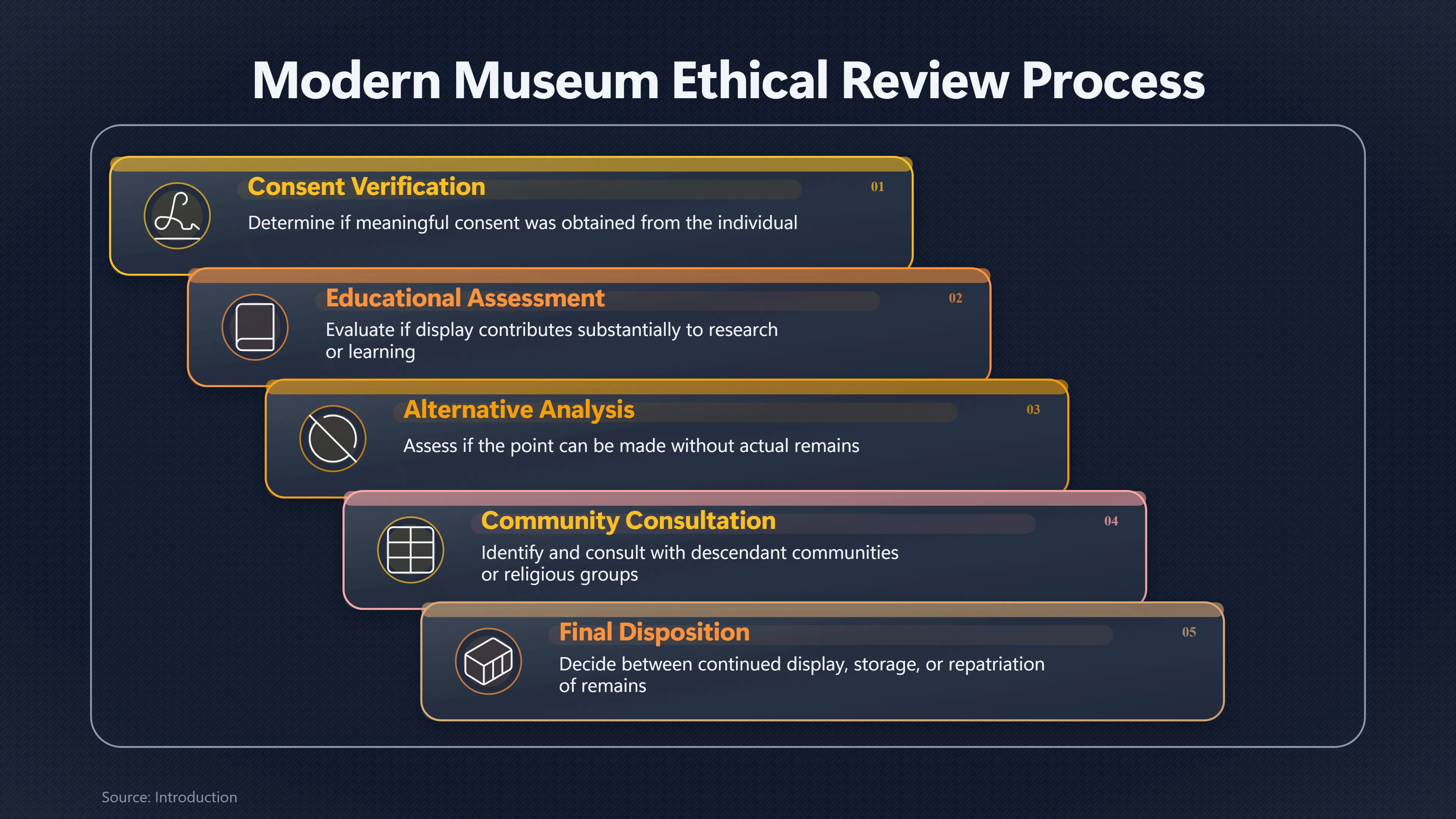
- Was meaningful consent obtained, or is this impossible to establish?
- Does the display contribute substantially to education or research?
- Could the same point be made without exhibiting actual remains?
- Are descendant communities, religious organisations or culturally connected groups affected?
- Should remains be returned, reburied or retained for continuing scientific value?
The UK’s Department for Culture, Media and Sport guidance provides a framework for these decisions, allowing designated national museums to consider claims for the return of certain human remains while emphasising legal compliance, ethical review and consultation.[GOV.UK]GOV.UKGuidance for the Care of Human Remains in Museums11, 2005…
In practice, there is rarely a universal answer. Some remains continue to play an important educational role. Others have been removed from display, placed into storage, or become the subject of repatriation discussions as public attitudes evolve.
How Regulation Changed Museum Practice
Legal regulation now reinforces ethical expectations.
The Human Tissue Authority (HTA), established under the Human Tissue Act 2004, licenses organisations that store and publicly display relevant categories of human tissue. The authority aims to ensure that tissue is used safely, ethically and with appropriate consent, providing public oversight where earlier collections often relied only on professional custom.[GOV.UK]GOV.UKAbout usHuman Tissue Authority - GOV.UK…
Museums holding regulated collections typically publish policies covering:
- acquisition and documentation;
- conservation and storage;
- access for researchers;
- photography and reproduction;
- public interpretation;
- repatriation procedures.
The Royal College of Surgeons of England, for example, maintains Human Tissue Authority licences alongside dedicated policies covering human remains and repatriation, signalling that ethical governance has become part of museum practice rather than an afterthought.[Royal College of Surgeons]rcseng.ac.ukRoyal College of Surgeons Museum policies — Royal College of SurgeonsRoyal College of Surgeons Museum policies — Royal College of Surgeons
Why These Museums Matter in Britain’s Curiosity Culture
Medical museums differ from many of Britain’s other unusual collections because their power lies less in mystery than in moral reflection.
A cabinet of magical charms or a collection of fabricated monsters invites visitors to ask whether extraordinary claims are true. Medical collections instead encourage questions about how scientific knowledge was produced, whose bodies made that knowledge possible, and whether the pursuit of education can justify displaying the dead.
This makes them an important bridge between Britain’s cabinet-of-curiosity tradition and its modern museum ethics. They preserve remarkable scientific collections while acknowledging that scientific achievement cannot be separated from the social, legal and moral conditions in which it developed.
For many visitors, the most memorable objects are therefore not simply preserved organs or anatomical preparations. They are reminders that every specimen once belonged to a person whose life, illness and death contributed to medicine, and whose dignity remains part of the museum’s responsibility today.
Amazon book picks
Further Reading
Books and field guides related to When Does Medical Display Become Exploitation?. Use these as the next step if you want deeper reading beyond the article.
The book of general ignorance
Rating: 4.3/5 from 6 Google Books ratings
First published 2007. Subjects: Nonfiction, Questions and answers, Humor (Nonfiction), Wonders And Curiosities, Reference.

The Island of the Colorblind
First published 1996. Subjects: Diseases, Medical anthropology, Chamorro (Micronesian people), Amyotrophic lateral sclerosis, Cycads.
The Immortal Life of Henrietta Lacks
Her name was Henrietta Lacks, but scientists know her as HeLa. She was a poor black tobacco farmer who worked the same land as her slave...
Medical Museums: Past, Present and Future
First published 2013. Subjects: Medical museums, Museums, Health and Wellbeing.
eBay marketplace picks
Marketplace Samples
Live-tested eBay searches with available results related to this page.
Selected fromscience museum print oneBay.co.uk.
Endnotes
1.
Source: museum.rcsed.ac.uk
Title: Human Remains Collections
Link:https://museum.rcsed.ac.uk/collections/human-remains
2.
Source: GOV.UK
Title: About us
Link:https://www.gov.uk/government/organisations/human-tissue-authority/about
Source snippet
Human Tissue Authority - GOV.UK...
3.
Source: museum.rcsed.ac.uk
Title: About Surgeons’ Hall Museum Edinburgh
Link:https://museum.rcsed.ac.uk/about-us
4.
Source: GOV.UK
Title: Guidance for the Care of Human Remains in Museums
Link:https://www.gov.uk/government/publications/guidance-for-the-care-of-human-remains-in-museums
Source snippet
11, 2005...
5.
Source: ed.ac.uk
Title: Image: (Left) Carbolic S
Link:https://www.ed.ac.uk/news/rare-objects-go-on-show-to-spotlight-300-years-of-medicine
Source snippet
Rare objects go on show to spotlight 300 years of medicine | News | The University of EdinburghApril 3, 2026 — RARE OBJECTS GO ON SHOW TO...
Published: April 3, 2026
6.
Source: hta.gov.uk
Title: Record retention FAQs | Human Tissue Authority
Link:https://www.hta.gov.uk/guidance-professionals/guidance-sector/public-display/record-retention-faqs
7.
Source: hta.gov.uk
Title: Code A: Section one
Link:https://www.hta.gov.uk/guidance-professionals/codes-practice-standards-and-legislation/codes-practice/code-guiding/code-section-one-guiding-principles
8.
Source: hta.gov.uk
Title: Code A: Section three
Link:https://www.hta.gov.uk/guidance-professionals/codes-practice-standards-and-legislation/codes-practice/code-guiding-principles-and-fundamental-principle-consent/code-section-three-consent-requirements
9.
Source: hta.gov.uk
Title: Code A: Annex B
Link:https://www.hta.gov.uk/guidance-professionals/codes-practice-standards-and-legislation/codes-practice/code-annex-b-consent
10.
Source: hta.gov.uk
Title: Code A: Annex C
Link:https://www.hta.gov.uk/guidance-professionals/codes-practice-standards-and-legislation/codes-practice/code-guiding/code-5
11.
Source: hta.gov.uk
Title: Code A: Section two
Link:https://www.hta.gov.uk/guidance-professionals/codes-practice-standards-and-legislation/codes-practice/code-guiding/code-section-two-fundamental-guiding-principle-consent
12.
Source: museum.rcsed.ac.uk
Link:https://museum.rcsed.ac.uk/collections
13.
Source: rcsed.ac.uk
Link:https://www.rcsed.ac.uk/visit/surgeons-hall-museum
14.
Source: museum.rcsed.ac.uk
Link:https://museum.rcsed.ac.uk/?areaproxdist=10&cat=&loc=Portobello&locplace=4281&locprox=1&prodtypes=acti%2Cattr%2Creta%2Ctour
15.
Source: museum.rcsed.ac.uk
Link:https://museum.rcsed.ac.uk/collections/collection-returns
16.
Source: museum.rcsed.ac.uk
Link:https://museum.rcsed.ac.uk/visit
17.
Source: hunterianmuseum.org
Link:https://hunterianmuseum.org/about/human-remains
18.
Source: museumsgalleriesscotland.org.uk
Title: Museums Galleries Scotland
Link:https://www.museumsgalleriesscotland.org.uk/advice-article/introduction-to-human-remains-in-museums/
Source snippet
Introduction to human remains in museums - Museums Galleries ScotlandMarch 26, 2024...
Published: March 26, 2024
19.
Source: hunterianmuseum.org
Link:https://hunterianmuseum.org/visit
20.
Source: rcseng.ac.uk
Title: Royal College of Surgeons Museum policies — Royal College of Surgeons
Link:https://www.rcseng.ac.uk/museums-and-archives/anatomy-and-pathology-museum/museum-policies/
21.
Source: hunterianmuseum.org
Title: Hunterian Museum | About
Link:https://hunterianmuseum.org/about
22.
Source: rcseng.ac.uk
Title: hunterian museum reopening 2023
Link:https://www.rcseng.ac.uk/news-and-events/media-centre/press-releases/hunterian-museum-reopening-2023/
23.
Source: rcseng.ac.uk
Link:https://www.rcseng.ac.uk/news-and-events/media-centre/press-releases/models-of-the-human-body-to-go-on-display-at-new-hunterian-museum-exhibition/
24.
Source: rcseng.ac.uk
Link:https://rcseng.ac.uk/museums-and-archives/anatomy-and-pathology-museum/
25.
Source: hunterianmuseum.org
Link:https://hunterianmuseum.org/visit/faqs
26.
Source: hunterianmuseum.org
Link:https://hunterianmuseum.org/
27.
Source: sciencemuseum.org.uk
Link:https://www.sciencemuseum.org.uk/human-remains
28.
Source: britishmuseum.org
Link:https://www.britishmuseum.org/our-work/departments/human-remains
29.
Source: artfund.org
Title: Surgeons’ Hall Museums
Link:https://www.artfund.org/explore/museums-and-galleries/surgeons-hall-museums
Additional References
30.
Source: wonderfulmuseums.com
Link:https://www.wonderfulmuseums.com/museum/surgeons-museum-scotland/
Source snippet
Wonderful MuseumsOctober 8, 2025 — SURGEONS MUSEUM SCOTLAND: UNEARTHING MEDICAL HISTORY’S GRIPPING TALES AND ENDURING LEGACY By Frank Joh...
Published: October 8, 2025
31.
Source: youtube.com
Title: Respecting the Dead: The Ethics of Human Skeletal Research and Curation
Link:https://www.youtube.com/watch?v=1vQIhGJiflM
Source snippet
This video provides direct commentary from bioethicist Dr. Arthur Caplan on the consent standards and ethical responsibilities surroundin...
32.
Source: youtube.com
Link:https://www.youtube.com/watch?v=sZQ4iLB-cv8
Source snippet
Should DEAD BODIES be on display? Should human remains be in museums? Egyptian mummies and bog men...
33.
Source: youtube.com
Link:https://www.youtube.com/watch?v=VEqvin_zMpQ
Source snippet
Research Ethics Consortia: Human Remains of Questionable Provenance within University Museums...
34.
Source: youtube.com
Title: Overlooked but on Display: Disability and Human Remains in Museums
Link:https://www.youtube.com/watch?v=3pZFuWjmm3k
Source snippet
Respecting the Dead: The Ethics of Human Skeletal Research and Curation...
35.
Source: ucl.ac.uk
Link:https://www.ucl.ac.uk/social-historical-sciences/archaeology/research/human-remains-policy
36.
Source: nhm.ac.uk
Link:https://www.nhm.ac.uk/about-us/governance/human-remains-in-the-collection.html
37.
Source: gla.ac.uk
Title: University of Glasgow
Link:https://www.gla.ac.uk/hunterian/about/policies/human-remains/