Within Strange Malawi
What Do Malawi's Gule Masks Really Mean?
Chamare presents Gule Wamkulu masks as parts of a living ritual system rather than anonymous curiosities or decorative tribal art.
On this page
- Inside the Chamare Museum
- Characters, Spirits and Social Messages
- What Museums Can and Cannot Reveal
Page outline Jump by section
Introduction
The Chamare Museum at the Kungoni Centre of Culture and Art is one of the most revealing places in Malawi to understand Gule Wamkulu masks. Rather than presenting them as exotic carvings or anonymous pieces of African art, the museum explains them as part of a living ceremonial system in which masks, music, dance and community authority work together. This makes Chamare unusual among ethnographic museums: its displays emphasise that the masks cannot be understood apart from the performances and social responsibilities that give them meaning. UNESCO recognises Gule Wamkulu as Intangible Cultural Heritage because it remains a living tradition among Chewa communities in Malawi, Zambia and Mozambique, not simply a historical artefact.[Intangible Cultural Heritage]ich.unesco.orgIntangible Cultural Heritage Gule WamkuluIntangible Cultural HeritageGule Wamkulu - UNESCO Intangible Cultural HeritageJanuary 1, 2008…
Inside the Chamare Museum
Located at Mua Mission in Dedza District, the Chamare Museum forms part of the wider Kungoni Centre, an institution that combines museum galleries, artistic workshops, cultural research and traditional performance. The museum’s architecture itself reflects cultural interpretation rather than conventional exhibition design. Three galleries represent the three cultural communities that meet around Mua—the Chewa, Ngoni and Yao—arranged around a central courtyard recalling the baobab tree beneath which the first White Fathers missionaries camped in 1902.[Kungoni]kungoni.orgOnline | Kungoni CentreKUNGONI Online | Kungoni Centre…
The museum’s most striking display is its extensive collection of Gule Wamkulu masks. Travel writers describe a dramatic “tree of the spirits” hung with hundreds of masks, while Kungoni’s own documentation notes that the institution has recorded well over 400 recognised masked characters through decades of field research. The collection is therefore not simply decorative but functions as an archive of an evolving performance tradition.[lonelyplanet.com]lonelyplanet.comLonely Planet Chamare Museum | Malawi, Africa | AttractionsLonely PlanetChamare Museum | Malawi, Africa | Attractions - Lonely Planet…
Much of this interpretation reflects the work of Father Claude Boucher Chisale, a Canadian-born missionary, anthropologist and artist who spent decades documenting Chewa traditions in collaboration with local custodians. Rather than treating Christianity and traditional culture as mutually exclusive, Kungoni developed an approach that records local knowledge while acknowledging its continuing religious and social importance.[Petit Futé]petitfute.co.ukPetit FutéCHAMARE MUSEUMKUNGONI CULTURE AND ART CENTRE - Museum - Mua Mission - Malawi…
Characters, Spirits and Social Messages
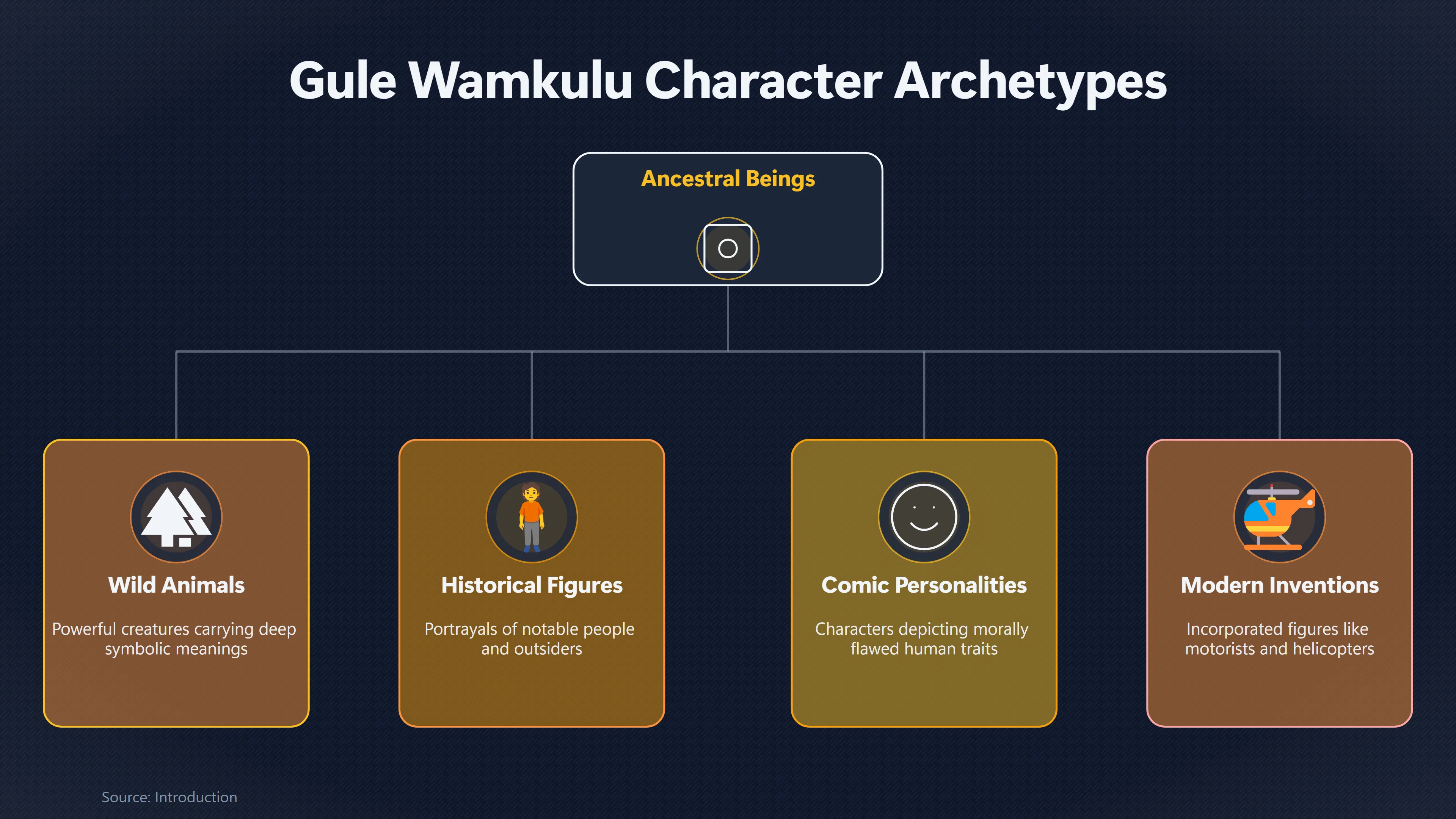
A common misunderstanding is that every Gule mask represents an ancestral spirit. In reality, the masked tradition encompasses an extraordinary range of characters drawn from both the supernatural and everyday life.
Museum interpretation explains that performers may embody:
- ancestral beings connected with the spirit world;
- powerful wild animals whose behaviour carries symbolic meaning;
- historical figures and outsiders;
- comic or morally flawed personalities;
- modern inventions and occupations incorporated into the tradition over time.
UNESCO notes that newer characters have included figures such as motorists and even helicopters, demonstrating that Gule Wamkulu is not frozen in the past but continually absorbs changing social realities. Each character conveys a recognisable personality whose behaviour comments on community values, responsibility, greed, vanity, courage or disorder rather than functioning as simple entertainment.[Intangible Cultural Heritage]ich.unesco.orgIntangible Cultural Heritage Gule WamkuluIntangible Cultural HeritageGule Wamkulu - UNESCO Intangible Cultural HeritageJanuary 1, 2008…
This moral dimension explains why the museum spends as much effort interpreting behaviour as explaining carving styles. A beautifully carved face is only one part of a complete character. Costume, music, movement, timing and interaction with spectators all contribute to its identity. Visitors therefore learn that a mask is less an isolated object than one element within a carefully structured public performance.
The diversity of characters also challenges stereotypes about African masks. Instead of representing a single religious category, Gule figures range from frightening spirits to comic tricksters, dangerous animals, authority figures and satirical portraits of human weaknesses. The masks become a visual language through which communities discuss acceptable behaviour, leadership and social order.[Intangible Cultural Heritage]ich.unesco.orgIntangible Cultural Heritage Gule WamkuluIntangible Cultural HeritageGule Wamkulu - UNESCO Intangible Cultural HeritageJanuary 1, 2008…
What Museums Can and Cannot Reveal
Chamare’s greatest achievement may be its willingness to acknowledge the limits of museum interpretation.
Gule Wamkulu is historically associated with the Nyau brotherhood, whose initiation practices include knowledge that is deliberately restricted. UNESCO likewise describes the dance as originating within an initiated male society whose ceremonies mark important transitions in community life, particularly initiation into adulthood, funerals and the installation or death of chiefs.[Intangible Cultural Heritage]ich.unesco.orgIntangible Cultural Heritage Gule WamkuluIntangible Cultural HeritageGule Wamkulu - UNESCO Intangible Cultural HeritageJanuary 1, 2008…
For that reason, the museum explains public meanings without claiming to disclose everything. Visitors can learn why particular characters appear, how performances relate to Chewa society and what broad lessons they communicate, but not every symbolic association or ritual practice is translated into exhibition labels.
This restraint is significant from a governance perspective. Rather than presenting sacred traditions as material for unrestricted consumption, the museum balances public education with respect for cultural ownership. Knowledge remains layered:
- some meanings are suitable for all visitors;
- some belong to local historical memory;
- some remain connected to initiation and community authority.
The result is a museum that interprets rather than exposes the tradition.
Why Performance Matters More Than the Object
Unlike many museum collections where an artefact has ceased to perform its original function, Gule masks continue to be used in ceremonies across parts of Malawi and neighbouring countries. UNESCO notes that performances still occur after initiation ceremonies as well as at funerals, weddings and chiefly events, although tourism and public festivals have increasingly created new performance settings that may alter traditional meanings.[Intangible Cultural Heritage]ich.unesco.orgIntangible Cultural Heritage Gule WamkuluIntangible Cultural HeritageGule Wamkulu - UNESCO Intangible Cultural HeritageJanuary 1, 2008…
Chamare therefore avoids encouraging visitors to think of the masks as relics from a vanished culture. Instead, the displays serve as preparation for understanding living performances that continue beyond the museum walls.
This approach also explains why the museum exhibits more than carved wooden faces. Full costumes, photographs, explanatory panels and contextual information help visitors understand that identity emerges through movement, sound and communal recognition rather than sculpture alone.
Why Chamare Matters in Malawi’s Curiosity Landscape
Within Malawi’s unusual museums and heritage collections, Chamare stands apart because it interprets mystery without sensationalism. Many museums display ritual objects as detached ethnographic specimens. Chamare instead presents Gule masks as active participants in a sophisticated cultural system that governs memory, morality and communal identity.
For travellers interested in unusual collections, the appeal lies not in discovering supposed secrets but in seeing how a museum can respectfully interpret a living ritual tradition whose deepest meanings remain rooted in the communities that continue to perform it. That balance between accessibility and cultural restraint makes Chamare one of the country’s most distinctive and intellectually rewarding museums.
Amazon book picks
Further Reading
Books and field guides related to What Do Malawi's Gule Masks Really Mean?. Use these as the next step if you want deeper reading beyond the article.
The Scramble For Africa
In 1880 the continent of Africa was largely unexplored by Europeans. Less than thirty years later, only Liberia and Ethiopia remained unc...


History of Art in Africa, A (reprint)
First published 2004. Subjects: The Arts: General Issues, Art & Art Instruction, Art, General, Art / General.
eBay marketplace picks
Marketplace Samples
Live-tested eBay searches with available results related to this page.
Selected fromAfrican art collectible oneBay.co.uk.
Endnotes
1.
Source: ich.unesco.org
Title: Intangible Cultural Heritage Gule Wamkulu
Link:https://ich.unesco.org/en/RL/gule-wamkulu-00142?RL=00142
Source snippet
Intangible Cultural HeritageGule Wamkulu - UNESCO Intangible Cultural HeritageJanuary 1, 2008...
Published: January 1, 2008
2.
Source: kungoni.org
Title: Online | Kungoni Centre
Link:https://www.kungoni.org/
Source snippet
KUNGONI Online | Kungoni Centre...
3.
Source: Wikipedia
Link:https://en.wikipedia.org/wiki/Nyau
4.
Source: ich.unesco.org
Title: safeguarding of the gulu wamkulu the great dance of the chewa people 00027
Link:https://ich.unesco.org/en/projects/safeguarding-of-the-gulu-wamkulu-the-great-dance-of-the-chewa-people-00027
Source snippet
of the Gulu Wamkulu, the Great Dance of the Chewa People - UNESCO Intangible Cultural HeritageSAFEGUARDING OF THE GULU WAMKULU, THE GREAT...
5.
Source: youtube.com
Title: Gule Wamkulu Ceremony Malawi
Link:https://www.youtube.com/watch?v=Lw8duw_W0OU
Source snippet
Kungoni Centre Chamare Museum Mua Mission Malawi Kungoni art gallery, Mua Mission, Malawi Francis Devasya...
6.
Source: lonelyplanet.com
Title: Lonely Planet Chamare Museum | Malawi, Africa | Attractions
Link:https://www.lonelyplanet.com/points-of-interest/chamare-museum/1295419
Source snippet
Lonely PlanetChamare Museum | Malawi, Africa | Attractions - Lonely Planet...
7.
Source: petitfute.co.uk
Title: Petit FutéCHAMARE MUSEUM
Link:https://www.petitfute.co.uk/v70808-mua-mission/c1173-visites-points-d-interet/c958-musee/1485276-centre-de-culture-et-d-art-de-kungoni.html
Source snippet
KUNGONI CULTURE AND ART CENTRE - Museum - Mua Mission - Malawi...
8.
Source: missionbell.org
Title: KUNGON I Online | Gule Wamkulu
Link:https://www.missionbell.org/
Additional References
9.
Source: emkp.org
Link:https://www.emkp.org/documenting-the-endangered-mask-making-craft-of-the-gule-wamkulu-cultural-dance-among-the-nyau-secret-societies-of-malawi/
Source snippet
Endangered Material Knowledge ProgrammeSeptember 3, 2024 — DOCUMENTING THE ENDANGERED MASK-MAKING CRAFT OF THE GULE WAMKULU CULTURAL DANC...
Published: September 3, 2024
10.
Source: kaweah.freedombox.rocks
Link:https://kaweah.freedombox.rocks/kiwix/content/wikipedia_en_all_maxi_2023-10/A/Nyau
Source snippet
Image A Gule Wamkulu mask depicting a wild animal. Nyau dances involve intricate footwork, flinging dust in the air. Dancers respond to s...
11.
Source: youtube.com
Link:https://www.youtube.com/watch?v=rPdne0kIzWE
Source snippet
Inside Malawi’s Hidden Gem: My 2011 UNDP-UNV Cultural Orientation at the Mua Cultural & Art Center...
12.
Source: 101lasttribes.com
Title: AFRIC A | 101 Last Tribes
Link:https://www.101lasttribes.com/tribes/chewa.html
Source snippet
AFRICA | 101 Last Tribes - Chewa peoplePASSAGE RITUALS (BIRTH, DEATH, PUBERTY, SEASONAL) The funerary ritual starts with utaya, the buria...
13.
Source: britishmuseum.org
Link:https://www.britishmuseum.org/collection/object/E_Af1993
Source snippet
masquerade-mask | British MuseumMASQUERADE-MASK Object Type masquerade-mask Museum number Af1993,09.23 Description Animal head-shaped mas...
14.
Source: africageographic.com
Link:https://africageographic.com/?p=9110
Source snippet
The gule wamkulu - meaning in the masksNovember 6, 2014 — Thursday, 6 November 2014 ShareTweetPinEmailShareShareLinkedIn WEIRD AND WONDER...
Published: November 6, 2014
15.
Source: britishmuseum.org
Link:https://www.britishmuseum.org/collection/object/E_Af1993
Source snippet
masquerade-mask | British MuseumMASQUERADE-MASK Object Type masquerade-mask Museum number Af1993,09.21 Description Human face-shaped mask...
16.
Source: youtube.com
Link:https://www.youtube.com/watch?v=Mqb9CBx6Mkk
Source snippet
The Gule Wamkulu...
17.
Source: youtube.com
Title: Nyau Dance of the Gule Wamkulu Secret Society in Malawi
Link:https://www.youtube.com/watch?v=O4EDUcpb9FU
Source snippet
Gule Wamkulu Ceremony Malawi...
18.
Source: youtube.com
Title: The Gule Wamkulu
Link:https://www.youtube.com/watch?v=H30wcV6-wbw
Source snippet
Nyau Dance of the Gule Wamkulu Secret Society in Malawi...