Within Iraq Curiosities
The Mysterious Bowls Made for Ancient Protection
Mesopotamian incantation bowls show how ordinary people used written formulas and symbols to seek protection from unseen dangers.
On this page
- How incantation bowls were used
- Demons, illness and protective writing
- What scholars can and cannot prove
Page outline Jump by section
Introduction
Incantation bowls are among the strangest surviving objects from ancient Iraq because they turn an ordinary household vessel into a piece of protective ritual technology. Made mainly in Mesopotamia during Late Antiquity, especially around the sixth to eighth centuries CE, these clay bowls carried written spells intended to guard people, homes and families from dangers that ancient communities associated with demons, illness, curses and misfortune. Their importance is not that they prove magic worked, but that they reveal how ordinary people in ancient Iraq understood fear, safety and the unseen world.[University of Exeter]exeter.ac.ukOpen source on exeter.ac.uk.
Today, these objects appear in archaeological collections rather than functioning as religious tools. Museums and universities study them as evidence for everyday beliefs in late antique Mesopotamia, especially because they preserve personal names, household worries, religious mixtures and writing practices that are rarely visible in more formal monuments. They are unusual historical objects: part archaeological artefact, part written ritual, and part record of private hopes for protection.[University of Exeter]exeter.ac.ukOpen source on exeter.ac.uk.
How incantation bowls were used
A household defence written in clay
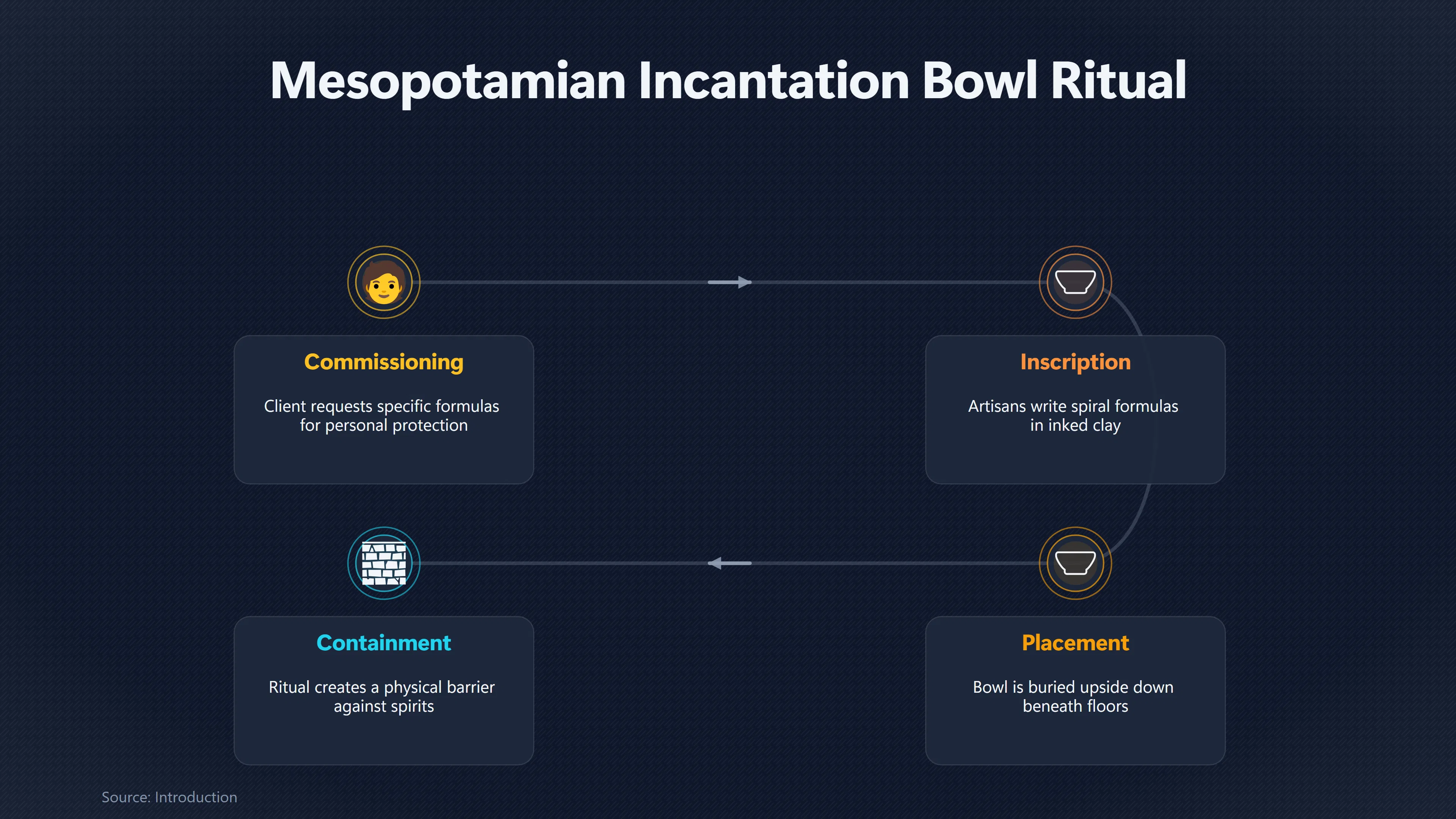
Incantation bowls, sometimes called magic bowls or demon bowls, were usually simple ceramic vessels rather than luxury objects. Their interiors were covered with inked inscriptions, often arranged in a spiral that moved from the outside towards the centre. Many were written in forms of Aramaic, including Jewish Babylonian Aramaic, Syriac and Mandaic, reflecting the diverse religious communities living in Mesopotamia under Sasanian rule and in the centuries around the Islamic conquest.[echoesofegypt.peabody.yale.edu]echoesofegypt.peabody.yale.eduIncantation Bowl | Echoes of Egypt | Yale Peabody MuseumIncantation Bowl | Echoes of Egypt | Yale Peabody Museum
The basic idea behind the ritual was practical protection. A person or family could commission a bowl containing a protective formula, often naming the client and the danger to be prevented. The finished object was then placed within a domestic setting, commonly buried upside down beneath a floor or near parts of a house. Scholars interpret this as an attempt to create a physical barrier against harmful supernatural forces.[Cambridge University Press & Assessment]cambridge.orgCambridge University Press & AssessmentTransferring performativity from speech to writing: illocutionary acts and incantation bowls | Bul…
The image of the bowl as a “trap” for demons comes from both the arrangement of the objects and the language of some texts. Some bowls contain drawings of bound or restrained supernatural beings, suggesting that the ritual aimed not simply to repel danger but to control and contain it. A bowl from Iraq now in the British Museum, for example, shows demon figures and contains unusual writing associated with protective practice.[British Museum]britishmuseum.orgBritish Museumincantation bowl | British MuseumBritish Museumincantation bowl | British Museum
Writing was treated as an active force
For the people who used these bowls, writing was not merely a record of a prayer. The written formula itself formed part of the ritual action. The spiral layout, repeated names, divine references and commands directed at harmful beings all helped create the intended protective effect.
This makes the bowls especially valuable to historians because they show writing being used outside official religious texts or royal inscriptions. They provide a glimpse of private concerns: sickness, family problems, fear of supernatural attack and the desire for personal security. Scholars studying the texts describe them as important evidence for the beliefs and daily lives of several communities in ancient Mesopotamia.[University of Exeter]exeter.ac.ukOpen source on exeter.ac.uk.
Demons, illness and protective writing
The dangers people wanted to prevent
Ancient Mesopotamian communities did not separate physical illness, bad luck and supernatural danger in the same way many modern societies do. A fever, a difficult birth, repeated misfortune or family conflict could be understood through a religious framework in which unseen forces played a role.
The surviving bowls reflect this broad concern. Some contain appeals for health and protection; others mention hostile spirits or attempt to reverse harm caused by an enemy. One British Museum example from southern Iraq includes a hostile “counter-charm” intended to harm an adversary, showing that these objects could be used not only defensively but also in conflicts between individuals.[British Museum]britishmuseum.orgBritish Museumincantation bowl | British MuseumBritish Museumincantation bowl | British Museum
The famous association with demons should also be understood carefully. Modern descriptions often focus on the dramatic idea of “demon traps”, but the historical reality is more complex. The bowls were part of a wider world of protective practices that included prayers, amulets and other ritual objects. Their purpose was not entertainment or horror; they were serious household objects created for people dealing with very real fears.[penn.museum]penn.museumExpedition Magazine | Secrets of Ancient MagicExpedition Magazine | Secrets of Ancient Magic
A meeting point of different traditions
One reason incantation bowls are so important is that they show cultural exchange in ancient Iraq. Their texts draw from several religious and linguistic traditions, including Jewish, Christian, Mandaean and other local practices. Rather than belonging to a single “magic system”, the bowls reveal a shared environment where different communities used similar ideas about protection, names, angels, spirits and written power.[Bar-Ilan University]cris.biu.ac.ilBar-Ilan University Aramaic Bowl Spells: Jewish Babylonian Aramaic Bowls, Vol. 1Bar-Ilan UniversityAramaic Bowl Spells: Jewish Babylonian Aramaic Bowls, Vol. 1 - Bar-Ilan University…
This mixture makes the bowls unusual historical witnesses. A single object can contain traces of language history, religious interaction and everyday domestic life. They sit between archaeology and folklore: they are real objects from the past, but they also preserve stories about how people imagined invisible threats and ways to overcome them.
What scholars can and cannot prove
Incantation bowls provide strong evidence that people in ancient Iraq used written protective rituals. Archaeologists can study their materials, locations, inscriptions and imagery. Collections around the world preserve thousands of examples, although many remain unpublished or still require further study.[University of Exeter]exeter.ac.ukOpen source on exeter.ac.uk.
What scholars cannot prove is whether the rituals achieved their intended supernatural purpose. Museums interpret these objects as evidence of belief and practice rather than evidence that demons, curses or magical forces existed. The historical question is not whether the bowls worked in a supernatural sense, but what they tell us about the people who made and used them.
There are also questions about ownership and provenance. Many incantation bowls entered museum collections through older excavations, purchases or private collections, and some have unclear histories before reaching researchers. The study of these objects therefore includes both their ancient use and modern debates about archaeological collecting. A notable example was the investigation of a large private collection of Mesopotamian Aramaic incantation bowls at University College London, where questions were raised about the legal history of the objects.[University College London]ucl.ac.ukUniversity College LondonUCL establishes committee of enquiry into provenance of incantation bowls | UCL News - UCL – University College…
For Iraq’s unusual heritage landscape, incantation bowls are among the clearest examples of how everyday objects can preserve ancient ideas about mystery and protection. They are not fantasy artefacts, but genuine archaeological remains showing how people living in Mesopotamia tried to manage uncertainty through words, symbols and ritual action.
Amazon book picks
Further Reading
Books and field guides related to The Mysterious Bowls Made for Ancient Protection. Use these as the next step if you want deeper reading beyond the article.
Magic and Magicians in the Greco-Roman World
First published 2001. Subjects: Magic, greek.
eBay marketplace picks
Marketplace Samples
Live-tested eBay searches with available results related to this page.
Selected fromancient art print oneBay.co.uk.
Endnotes
1.
Source: echoesofegypt.peabody.yale.edu
Title: Incantation Bowl | Echoes of Egypt | Yale Peabody Museum
Link:https://echoesofegypt.peabody.yale.edu/egyptosophy/incantation-bowl
2.
Source: cambridge.org
Link:https://www.cambridge.org/core/journals/bulletin-of-the-school-of-oriental-and-african-studies/article/transferring-performativity-from-speech-to-writing-illocutionary-acts-and-incantation-bowls/E748C39E28147479E774B5361C1309AC
Source snippet
Cambridge University Press & AssessmentTransferring performativity from speech to writing: illocutionary acts and incantation bowls | Bul...
3.
Source: penn.museum
Title: Expedition Magazine | Secrets of Ancient Magic
Link:https://www.penn.museum/sites/expedition/secrets-of-ancient-magic/
4.
Source: collections.penn.museum
Title: Museum Collections
Link:https://collections.penn.museum/collections/object/275285
Source snippet
Penn Museum Collections...
5.
Source: exeter.ac.uk
Link:https://www.exeter.ac.uk/research/projects/iais/pre-islamic_incantation_bowls/
6.
Source: britishmuseum.org
Title: British Museumincantation bowl | British Museum
Link:https://www.britishmuseum.org/collection/object/W
7.
Source: cris.biu.ac.il
Title: Bar-Ilan University Aramaic Bowl Spells: Jewish Babylonian Aramaic Bowls, Vol. 1
Link:https://cris.biu.ac.il/en/publications/aramaic-bowl-spells-jewish-babylonian-aramaic-bowls-vol-1/
Source snippet
Bar-Ilan UniversityAramaic Bowl Spells: Jewish Babylonian Aramaic Bowls, Vol. 1 - Bar-Ilan University...
8.
Source: britishmuseum.org
Title: British Museumincantation bowl | British Museum
Link:https://www.britishmuseum.org/collection/object/W
9.
Source: britishmuseum.org
Title: British Museumincantation bowl | British Museum
Link:https://www.britishmuseum.org/collection/object/W
10.
Source: ucl.ac.uk
Link:https://www.ucl.ac.uk/news/2005/may/ucl-establishes-committee-enquiry-provenance-incantation-bowls
Source snippet
University College LondonUCL establishes committee of enquiry into provenance of incantation bowls | UCL News - UCL – University College...
Additional References
11.
Source: almanac.upenn.edu
Link:https://almanac.upenn.edu/articles/curses-countercurses-incantations-and-more-penn-museums-new-exhibition-exploring-magic-in-the-an
12.
Source: youtube.com
Link:https://www.youtube.com/watch?v=PvfdmfvvsEM
13.
Source: youtube.com
Link:https://www.youtube.com/watch?v=gAmiEfhXIl8
14.
Source: youtube.com
Link:https://www.youtube.com/watch?v=wyI9m50ODB4
15.
Source: youtube.com
Link:https://www.youtube.com/watch?v=yC4jR7vkpkI
16.
Source: youtube.com
Link:https://www.youtube.com/watch?v=z8R7twsVCos