Within Marshall Islands
Is Bikini Atoll a Museum or Memorial?
Bikini Atoll is both a World Heritage site and a memorial landscape of bomb craters, displaced communities and radioactive shipwrecks.
On this page
- The nuclear test landscape
- The underwater ghost fleet
- Tourism, danger and displaced islanders
Page outline Jump by section
Introduction
Bikini Atoll is not a museum in the conventional sense, yet it functions as one of the world’s most extraordinary open-air memorial landscapes. Beneath the clear waters of its vast lagoon lies the so-called “Nuclear Ghost Fleet” – warships deliberately assembled as targets for the first post-war atomic bomb tests in 1946. Around them are bomb craters, abandoned military structures and an island landscape permanently shaped by the nuclear age. Together they form a place where history, archaeology, environmental change and human displacement are inseparable. UNESCO recognised this significance by inscribing the Bikini Atoll Nuclear Test Site as a World Heritage Site in 2010, not because it celebrates technology, but because it preserves tangible evidence of the beginning of the nuclear era and its lasting consequences.[UNESCO World Heritage Centre]whc.unesco.orgWorld Heritage Centre Bikini Atoll Nuclear Test SiteUNESCO World Heritage CentreBikini Atoll Nuclear Test Site - UNESCO World Heritage CentreJuly 31, 2010…
Unlike many unusual heritage attractions, Bikini’s appeal is deliberately complicated. The wrecks attract experienced technical divers from around the world, yet the atoll also remains a memorial to a community removed from its homeland and to environmental damage that has never been fully resolved.
Is Bikini Atoll a museum or memorial?
The best way to understand Bikini Atoll is as both.(#endnote-11 “Endnote 11”)[diveworldwide.com]diveworldwide.comSource details in endnotes.
It is a memorial because its most important story is not the ships themselves but the Marshallese people who were relocated before testing began and whose return has repeatedly been frustrated by radioactive contamination. Their displacement transformed Bikini from a living island community into a symbolic landscape of the Cold War. UNESCO specifically recognises the site’s importance as evidence of population displacement, environmental contamination and the global political consequences of nuclear weapons.[UNESCO World Heritage Centre]whc.unesco.orgWorld Heritage Centre Bikini Atoll Nuclear Test SiteUNESCO World Heritage CentreBikini Atoll Nuclear Test Site - UNESCO World Heritage CentreJuly 31, 2010…
At the same time, the atoll resembles a vast archaeological museum without walls. Instead of display cases, visitors encounter original landscapes left largely untouched after the tests. Rusting bunkers, concrete structures, enormous craters and preserved warships remain where history placed them. Rather than reconstructing events through replicas, the site presents the authentic remains of one of the twentieth century’s defining technological experiments. UNESCO even notes that the gradual decay of the military remains forms part of the site’s historical meaning rather than something that should necessarily be reversed.[UNESCO World Heritage Centre]whc.unesco.orgWorld Heritage Centre UNESCO World Heritage CentreUNESCO World Heritage CentreUNESCO World Heritage Centre - Decision - 34 COM 8B.20…
The nuclear test landscape
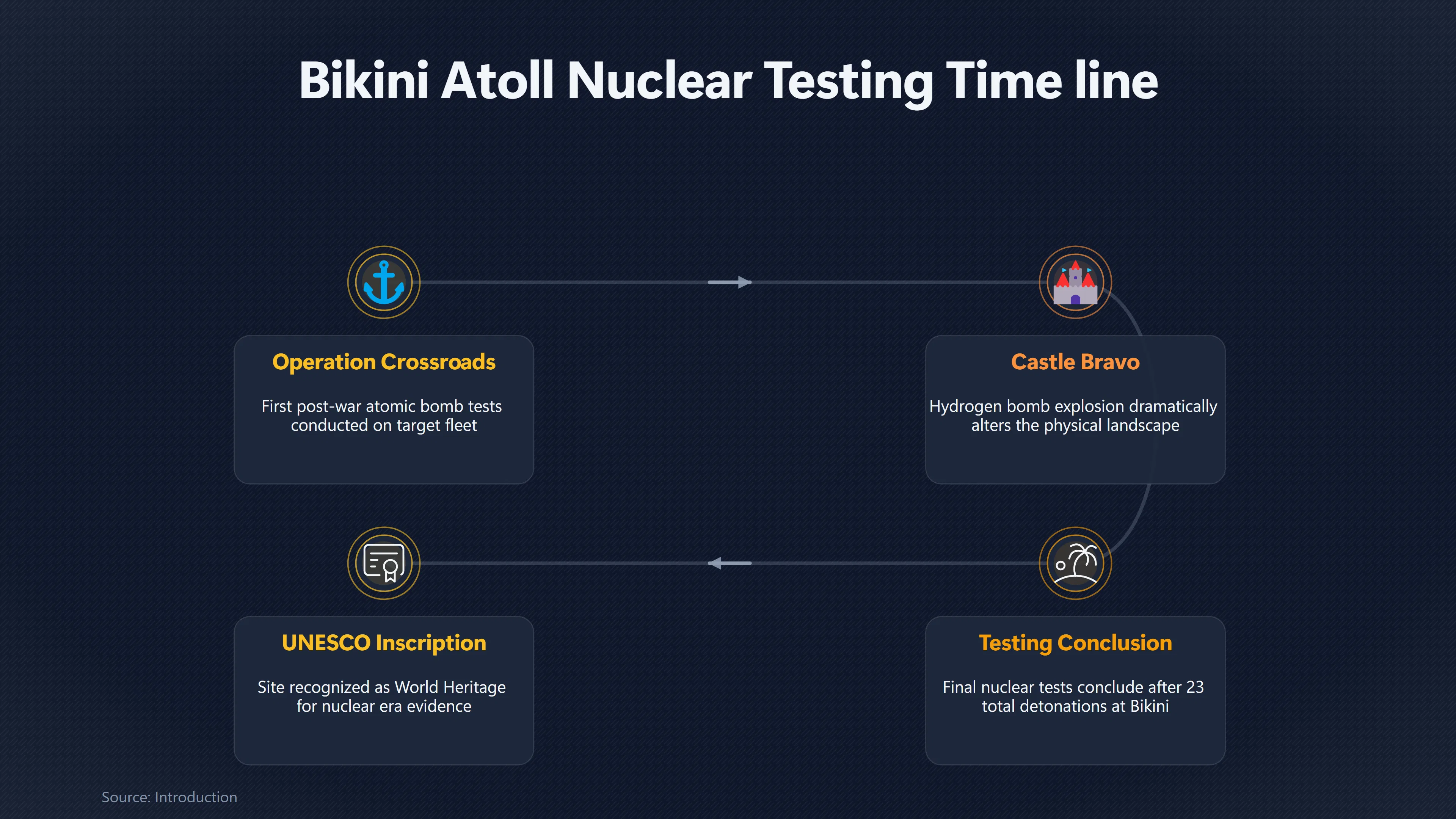
Between 1946 and 1958, the United States carried out 23 nuclear tests at Bikini Atoll itself. These included the 1946 Operation Crossroads experiments and later hydrogen bomb tests, most famously the 1954 Castle Bravo explosion, which dramatically altered the physical landscape. Across the wider Marshall Islands testing programme there were 67 nuclear detonations, with a combined explosive yield estimated at roughly 7,000 times that of the Hiroshima bomb.[UNESCO World Heritage Centre]whc.unesco.orgWorld Heritage Centre Bikini Atoll Nuclear Test SiteUNESCO World Heritage CentreBikini Atoll Nuclear Test Site - UNESCO World Heritage CentreJuly 31, 2010…
The landscape still preserves visible evidence of these events.
Among the most striking features are:
- the enormous Bravo crater, over 2 kilometres wide and around 80 metres deep;
- islands permanently reshaped or destroyed by nuclear explosions;
- abandoned military installations built to support testing;
- contaminated areas where long-term habitation remains problematic.
Unlike battlefields where rebuilding often obscures the past, Bikini’s limited redevelopment has left many of these features remarkably intact. The result is an unusual archaeological landscape where natural recovery and human destruction exist side by side. Coral reefs have recolonised damaged areas, while military remains continue to corrode beneath tropical waters.[UNESCO World Heritage Centre]whc.unesco.orgWorld Heritage Centre UNESCOWorld Heritage Convention World HeritageApril 18, 2026…
The underwater ghost fleet
The “Nuclear Ghost Fleet” is the feature that most clearly distinguishes Bikini Atoll from other historic sites.
For Operation Crossroads in 1946, the US Navy assembled a large target fleet of surplus American vessels together with captured German and Japanese warships to study how atomic weapons affected naval forces. The fleet included battleships, aircraft carriers, cruisers, destroyers and submarines positioned around Bikini Lagoon before two nuclear detonations, codenamed Able and Baker.[Nuclear Museum]ahf.nuclearmuseum.orgNuclear Museum Operation CrossroadsNuclear MuseumOperation Crossroads - Nuclear Museum…
Many of those vessels remain on the lagoon floor today.
Among the best-known wrecks are:
- USS Saratoga, one of the largest surviving aircraft carrier wrecks accessible to divers.
- USS Arkansas, a battleship overturned by the underwater Baker explosion.
- Japanese battleship Nagato, Admiral Isoroku Yamamoto’s former flagship and one of the most historically significant Axis vessels of the Second World War.
- Numerous destroyers, submarines and auxiliary ships resting in unusually clear tropical water.[Dive Worldwide]diveworldwide.comOpen source on diveworldwide.com.
The underwater setting creates a striking contrast. Coral, sharks and reef fish now inhabit vessels originally destroyed by nuclear weapons. Divers often describe the wrecks as remarkably well preserved because of the lagoon’s depth, isolation and relatively limited human disturbance.
Yet these are not ordinary recreational dive sites. Many wrecks lie well below standard recreational diving depths, requiring advanced technical training, specialised equipment and decompression procedures. UNESCO has also highlighted continuing concerns about unexploded ordnance, ageing fuel remaining within wrecks and other safety risks that require ongoing monitoring.[Dive Worldwide]diveworldwide.comOpen source on diveworldwide.com.
Tourism, danger and displaced islanders
Bikini Atoll occupies an unusual place in heritage tourism because access is both possible and ethically complicated.
Specialist liveaboard expeditions continue to bring experienced technical divers to the lagoon during limited seasons. Visitors may briefly land on parts of Bikini Island itself, but ordinary tourism remains highly restricted by remoteness, infrastructure limits and the specialised nature of the diving. The attraction is therefore less comparable to a conventional museum than to an expedition into a protected archaeological landscape.[Dive Worldwide]diveworldwide.comOpen source on diveworldwide.com.
The greatest caution, however, concerns what visitors do not always see.
Although many marine activities are considered safe under controlled conditions, radioactive contamination continues to affect decisions about permanent settlement and local food production. Coconut crabs and some locally grown foods have remained unsuitable for unrestricted consumption because of lingering radionuclides, even decades after testing. This means Bikini cannot simply be viewed as a fascinating wreck-diving destination divorced from its human history.[UNESCO World Heritage Centre]whc.unesco.orgWorld Heritage Centre Bikini Atoll Nuclear Test SiteUNESCO World Heritage CentreBikini Atoll Nuclear Test Site - UNESCO World Heritage CentreJuly 31, 2010…
For the displaced Bikini community, the atoll is not primarily a tourist attraction but an ancestral homeland whose future remains uncertain. Their story challenges the idea that heritage can ever be separated from living communities. The ghost fleet may attract international attention, but it exists within a landscape where the most enduring absence is the people who once called the islands home.
Why the ghost fleet matters in the Marshall Islands
Within the Marshall Islands’ unusual heritage landscape, Bikini Atoll stands apart because it preserves an entire historical environment rather than a single collection of objects.
Elsewhere, strange museums often display curiosities behind glass. Bikini instead preserves the setting itself: bomb craters, warships, abandoned infrastructure and an altered ecosystem spread across land and sea. It is simultaneously an underwater archaeological site, a Cold War memorial, a World Heritage landscape and a reminder that technological achievement can leave cultural and environmental wounds lasting for generations.
That combination makes Bikini Atoll’s Nuclear Ghost Fleet one of the world’s most unusual public-facing historical collections—not because it was designed as a museum, but because history itself transformed an inhabited atoll into an enduring record of the nuclear age.[UNESCO World Heritage Centre]whc.unesco.orgWorld Heritage Centre Bikini Atoll Nuclear Test SiteUNESCO World Heritage CentreBikini Atoll Nuclear Test Site - UNESCO World Heritage CentreJuly 31, 2010…
Amazon book picks
Further Reading
Books and field guides related to Is Bikini Atoll a Museum or Memorial?. Use these as the next step if you want deeper reading beyond the article.
We, the navigators
First published 1972. Subjects: Navigation, Micronesians, Polynesians, Micronésiens, Entdeckung.
Sea People
A blend of Jared Diamond’s Guns, Germs, and Steel and Simon Winchester’s Pacific, a thrilling intellectual detective story that looks dee...
Command and Control: Nuclear Weapons, the Damascus Accident,...
Presents a minute-by-minute account of an H-bomb accident that nearly caused a nuclear disaster, examining other near misses and America'...
The Making of the Atomic Bomb
Traces the development of the atomic bomb from Leo Szilard's concept through the drama of the race to build a workable device to the drop...
eBay marketplace picks
Marketplace Samples
Live-tested eBay searches with available results related to this page.
Selected frommilitary history poster oneBay.co.uk.

Endnotes
1.
Source: whc.unesco.org
Title: World Heritage Centre Bikini Atoll Nuclear Test Site
Link:https://whc.unesco.org/en/list/1339/
Source snippet
UNESCO World Heritage CentreBikini Atoll Nuclear Test Site - UNESCO World Heritage CentreJuly 31, 2010...
Published: July 31, 2010
2.
Source: whc.unesco.org
Title: World Heritage Centre UNESCO World Heritage Centre
Link:https://whc.unesco.org/en/decisions/3999
Source snippet
UNESCO World Heritage CentreUNESCO World Heritage Centre - Decision - 34 COM 8B.20...
3.
Source: whc.unesco.org
Title: World Heritage Centre UNESCO
Link:https://whc.unesco.org/document/103462
Source snippet
World Heritage Convention World HeritageApril 18, 2026...
Published: April 18, 2026
4.
Source: history.navy.mil
Title: mil Operation Crossroads
Link:https://www.history.navy.mil/browse-by-topic/wars-conflicts-and-operations/cold-war/crossroads.html
Source snippet
CrossroadsDecember 27, 2021 — Operation Crossroads 1 July 1946 Image: Operation Crossroads Operation Crossroads at 0900, 1 July 1946: Ske...
Published: December 27, 2021
6.
Source: whc.unesco.org
Link:https://whc.unesco.org/fr/list/1339/
Source snippet
d’essais nucléaires de l’atoll de Bikini - UNESCO World Heritage CentreJuly 31, 2010 — SITE D’ESSAIS NUCLÉAIRES DE L’ATOLL DE BIKINI BIKI...
Published: July 31, 2010
7.
Source: whc.unesco.org
Link:https://whc.unesco.org/en/compendium/285
Source snippet
World Heritage Centre - Compendiumc) Augment the comparative analysis; d) Define and put in place a buffer zone to protect the property f...
8.
Source: whc.unesco.org
Link:https://whc.unesco.org/en/list/1339/documents/
Source snippet
Atoll Nuclear Test Site - Documents - UNESCO World Heritage CentreBIKINI ATOLL NUCLEAR TEST SITE Nomination 1339 (inscribed) --- 2010 | N...
9.
Source: history.navy.mil
Link:https://www.history.navy.mil/content/history/nhhc/our-collections/art/exhibits/conflicts-and-operations/operation-crossroads-bikini-atoll.html
Source snippet
Crossroads: Bikini AtollOPERATION CROSSROADS: BIKINI ATOLL Tags Related Content Operation Crossroads: Bikini Atoll Operation Crossroads w...
10.
Source: ahf.nuclearmuseum.org
Title: Nuclear Museum Operation Crossroads
Link:https://ahf.nuclearmuseum.org/ahf/history/operation-crossroads/
Source snippet
Nuclear MuseumOperation Crossroads - Nuclear Museum...
11.
Source: diveworldwide.com
Link:https://www.diveworldwide.com/locations/bikini-atoll
12.
Source: Wikipedia
Title: Bikini Atoll
Link:https://en.wikipedia.org/wiki/Bikini_Atoll
Additional References
13.
Source: worldheritagesite.org
Link:https://www.worldheritagesite.org/list/bikini-atoll/
Source snippet
Bikini Atoll: Unesco World Heritage Site Travel GuideCONNECTIONS FOR BIKINI ATOLL Image: Photo in the Public Domain by 27for27 Photo in t...
14.
Source: youtube.com
Title: Diving Bikini Atoll Shipwrecks Operation Crossroads
Link:https://www.youtube.com/watch?v=2Bfdb4RezBQ
Source snippet
The Nuclear Fleet Giants of Bikini Atoll (USS Saratoga & IJN Nagato)...
15.
Source: youtube.com
Title: The Gigantic Ship Graveyard Of Operation Crossroads
Link:https://www.youtube.com/watch?v=gQkTurPO5O0
Source snippet
The US Nuclear Bomb Playground: Bikini Atoll...
16.
Source: youtube.com
Title: The US Nuclear Bomb Playground: Bikini Atoll
Link:https://www.youtube.com/watch?v=G_s-5AapFPA
Source snippet
Diving Bikini Atoll Shipwrecks Operation Crossroads...
17.
Source: youtube.com
Title: Bikini Atoll: The Atomic Ship Graveyard
Link:https://www.youtube.com/watch?v=6gEEW24puvA
Source snippet
The Gigantic Ship Graveyard Of Operation Crossroads...
18.
Source: youtube.com
Title: The Nuclear Fleet Giants of Bikini Atoll (USS Saratoga & IJN Nagato)
Link:https://www.youtube.com/watch?v=I-1OZp8KFds