Within Curious Mongolia
Why Mongolia's Fierce Masks Are Not Demons
Mongolia's fierce masks and preserved remains appear uncanny, but their meanings come from ritual use rather than secular horror.
On this page
- How Wrathful Figures Work in Buddhist Ritual
- The Monumental Masks of Choijin Lama Temple
- Preserved Remains, Visitor Claims and Evidence Limits
Page outline Jump by section
Introduction
Mongolia’s fierce Buddhist masks and reports of preserved clergy can look unsettling to modern visitors, but they are not intended as objects of horror. Instead, they belong to a ritual tradition in which terrifying faces symbolise the defeat of ignorance, fear and harmful forces rather than the celebration of evil. The country’s best-known public collection is preserved at the Choijin Lama Temple Museum in Ulaanbaatar, where elaborate ceremonial masks, ritual costumes and sacred objects survive alongside a much-discussed preserved cleric. Together they illustrate how Mongolia’s Buddhist heritage was transformed from a living religious tradition into a museum collection after the anti-religious campaigns of the late 1930s, while still retaining deep devotional significance.[washington.edu]depts.washington.eduUW Departments Choijin Lama Museum, UlaanbaatarUW Departments Choijin Lama Museum, Ulaanbaatar
Why Mongolia’s Fierce Masks Are Not Demons
To many first-time visitors, the oversized masks with bulging eyes, skull crowns, fangs and grimacing expressions resemble demons from folklore or horror films. Within Mongolian Buddhism, however, these figures represent wrathful protectors rather than evil beings.
Wrathful deities are depicted in frightening forms because their role is to overcome spiritual obstacles forcefully. Their terrifying appearance is understood as compassionate rather than malicious: anger is directed against ignorance, attachment and destructive behaviour, not against ordinary people. This symbolism is common across the Tibetan Buddhist traditions that profoundly influenced Mongolian religious life.[UW Departments]depts.washington.eduUW Departments Choijin Lama Museum, UlaanbaatarUW Departments Choijin Lama Museum, Ulaanbaatar
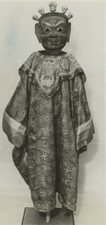
The masks were not everyday religious objects. They formed part of highly choreographed ritual dances performed by trained monks during major ceremonies. Each mask represented a specific protector, deity or symbolic character, with elaborate costumes completing the transformation from performer into sacred figure. The visual impact was intended to communicate religious ideas to large audiences while ritually purifying the surrounding community.[UW Departments]depts.washington.eduUW Departments Choijin Lama Museum, UlaanbaatarUW Departments Choijin Lama Museum, Ulaanbaatar
Rather than presenting supernatural monsters, the museum preserves objects that once functioned as active ritual instruments. Display cases therefore freeze what were originally moving performances involving music, chanting, costume and carefully prescribed ceremonial actions.
The Monumental Masks of Choijin Lama Temple
The Choijin Lama Temple Museum contains one of Mongolia’s most important surviving collections of ceremonial Tsam dance masks. Built between 1904 and 1908 for Choijin Lama Luvsanhaidav, brother of the Eighth Bogd Khaan, the temple escaped the widespread destruction that eliminated hundreds of monasteries during the religious purges of the 1930s. It subsequently became a museum rather than returning to full monastic use.[insightmongolia.com]insightmongolia.comChoijin Lama Temple MuseumInsight Mongolia…
The preserved masks are remarkable both for their size and craftsmanship. Many are constructed from papier-mâché, then richly decorated with paint, textiles, metalwork, coral or other ornamentation. Their exaggerated expressions were designed to be visible across crowded monastery courtyards during ritual performances rather than examined at close range behind museum glass.[UW Departments]depts.washington.eduUW Departments Choijin Lama Museum, UlaanbaatarUW Departments Choijin Lama Museum, Ulaanbaatar
Visitors can expect to see:
- Large wrathful guardian masks with fierce facial expressions.
- Complete ceremonial costumes used in Tsam performances.
- Ritual hats, musical instruments and liturgical objects associated with the dances.
- Sculptures and paintings showing the same protective deities represented by the masks.[UW Departments]depts.washington.eduUW Departments Choijin Lama Museum, UlaanbaatarUW Departments Choijin Lama Museum, Ulaanbaatar
Understanding this context changes the experience considerably. What initially appears macabre becomes a sophisticated religious performance tradition in which colour, movement, costume and symbolism were inseparable.

Preserved Remains, Visitor Claims and Evidence Limits
The museum’s most frequently discussed curiosity is not a mask but a preserved cleric associated with the main temple. Guidebooks and museum descriptions commonly note the presence of the embalmed remains of Baldanchoimbol, a senior lama and teacher connected with the Bogd Khaan’s court. Some descriptions state that the remains are displayed directly, while others explain that they are preserved within a statue or shrine inside the main temple.[gogo.mn]mongolia.gogo.mnto visit: Museums in UBJuly 16, 2016…
This distinction matters because visitor accounts sometimes exaggerate what can actually be seen. The museum is not organised as a display of human remains comparable to an anatomical museum or crypt. Instead, the preserved cleric forms part of a sacred historical setting in which religious significance outweighs curiosity value.
Published descriptions generally agree that preserved remains exist within the temple complex, but they differ in exactly how visible they are to visitors and how they are incorporated into the display. The available evidence does not support sensational claims about openly exhibited mummies or hidden supernatural relics. Rather, the preserved body survives as an exceptional religious object connected with Mongolia’s Buddhist hierarchy and the temple’s original function.[gogo.mn]mongolia.gogo.mnto visit: Museums in UBJuly 16, 2016…
The survival of these remains is historically significant for another reason. During the anti-religious campaigns of 1937–38, thousands of monks were killed, monasteries were destroyed and enormous numbers of religious objects disappeared. The Choijin Lama complex became one of the rare sites where important ritual collections and associated sacred objects escaped wholesale destruction, making both the masks and the preserved cleric witnesses to a disrupted religious past.[insightmongolia.com]insightmongolia.comChoijin Lama Temple MuseumInsight Mongolia…
Why These Collections Matter Within Mongolia’s Curiosity Culture
For travellers seeking unusual collections, the Choijin Lama Temple Museum offers something distinct from conventional ideas of the bizarre. The unsettling appearance of its wrathful masks derives from religious symbolism rather than occult spectacle, while the preserved cleric represents continuity of sacred tradition rather than a museum of death.
This combination makes the collection especially revealing within Mongolia’s landscape of unusual heritage. The objects have crossed several identities over the last century: they began as active ritual equipment, became protected museum artefacts during the socialist era, and today serve simultaneously as historical treasures, works of art and reminders of a religious culture that narrowly survived political repression. The sense of mystery comes not from supernatural claims but from encountering objects whose original ceremonial power is still recognisable even after they have entered the museum world.[washington.edu]depts.washington.eduUW Departments Choijin Lama Museum, UlaanbaatarUW Departments Choijin Lama Museum, Ulaanbaatar
Amazon book picks
Further Reading
Books and field guides related to Why Mongolia's Fierce Masks Are Not Demons. Use these as the next step if you want deeper reading beyond the article.
The Tibetan Book of the Dead
The best-known work of Nyingma literature, the oldest of the four major schools of Tibetan Buddhism, the "Bardo Thodol", or "The Tibetan...
Buddhism: A Very Short Introduction
This Very Short Introduction introduces the reader to the teachings of the Buddha and to the integration of Buddhism into daily life. Wha...
The Tibetan Book of Living and Dying
“A magnificent achievement. In its power to touch the heart, to awaken consciousness, [The Tibetan Book of Living and Dying] is an inesti...
The Art of Tibet
The catalogue of an exhibition ... shown in the Asia House Gallery in the spring of 1969 as an activity of The Asia Society ...
eBay marketplace picks
Marketplace Samples
Live-tested eBay searches with available results related to this page.
Selected fromMongolian temple art oneBay.co.uk.
Endnotes
1.
Source: insightmongolia.com
Title: Choijin Lama Temple Museum
Link:https://insightmongolia.com/guides/choijin-lama-temple-museum
Source snippet
Insight Mongolia...
2.
Source: mongoliantemples.org
Link:https://www.mongoliantemples.org/en/component/domm/1049?view=oldtempleen
3.
Source: mongolia.gogo.mn
Link:https://mongolia.gogo.mn/r/jkj06
Source snippet
to visit: Museums in UBJuly 16, 2016...
Published: July 16, 2016
4.
Source: mongolian.travel
Link:https://www.mongolian.travel/the-monastery-of-choijin-lama/
5.
Source: depts.washington.edu
Title: UW Departments Choijin Lama Museum, Ulaanbaatar
Link:https://depts.washington.edu/silkroad/museums/choijin/choijin.html
6.
Source: bumantourmongolia.com
Title: Choijin Lama Temple
Link:https://bumantourmongolia.com/2024/03/05/choijin-lama-temple/
7.
Source: visitulaanbaatar.net
Title: The Choijin Lama Temple Museum
Link:https://visitulaanbaatar.net/p/74
8.
Source: thingstodoinulaanbaatar.com
Title: choijin lama temple museum
Link:https://thingstodoinulaanbaatar.com/city/choijin-lama-temple-museum/
9.
Source: tripadvisor.com
Title: Choijin Lama Temple Museum
Link:https://www.tripadvisor.com/Attraction_Review-g293956-d459873-Reviews-or50-Choijin_Lama_Temple_Museum-Ulaanbaatar.html
Additional References
10.
Source: researchgate.net
Link:https://www.researchgate.net/publication/393301686_Depictions_and_Sacred_Texts_of_Sridevi_Preserved_in_the_Collections_of_Ulaanbaatar_Mongolia
Source snippet
The list of the museum does not contain votive plaques (tshatsha). 57 Both the size of the image itself and the size of the image with it...
11.
Source: wmf.org
Link:https://www.wmf.org/events/on-my-watch-choijin-lama-temple
Source snippet
August 5, 2025 — ON MY WATCH: CONSERVATION AND DIGITAL STORYTELLING AT MONGOLIA’S CHOIJIN LAMA TEMPLE Join us for a panel discussion on C...
Published: August 5, 2025
12.
Source: lonelyplanet.com
Title: Lonely Planet Choijin Lama Temple Museum | Ulaanbaatar, Mongolia | Attractions
Link:https://www.lonelyplanet.com/points-of-interest/choijin-lama-temple-museum/434802
Source snippet
Lonely PlanetChoijin Lama Temple Museum | Ulaanbaatar, Mongolia | Attractions - Lonely Planet...
13.
Source: youtube.com
Title: The Tsam Dance. Dashchoilin monastery. Ulaanbaatar
Link:https://www.youtube.com/watch?v=63Glcezdjfk
Source snippet
Choijin Lama Temple Museum Tsam mask Mongolia Choijinn Lama Temple Museum, UB, Mongolia 3 Factual Fiction...
14.
Source: youtube.com
Title: 200 Year Old Mummified Monk Not Dead, Just Meditating, Buddhism Expert Claims
Link:https://www.youtube.com/watch?v=UaZsr40cmyM
Source snippet
The Tsam Dance. Dashchoilin monastery. Ulaanbaatar...
15.
Source: youtube.com
Title: Choijin Lama Temple Museum on World Monuments Watch List
Link:https://www.youtube.com/watch?v=oxY9VUkgG7s
Source snippet
200 Year Old Mummified Monk Not Dead, Just Meditating, Buddhism Expert Claims...
16.
Source: discovermongolia.mn
Title: This was the h
Link:https://www.discovermongolia.mn/about-mongolia/destinations/northern-mongolia/choijin-lam-monastery
Source snippet
Choijin Lama monasteryJanuary 12, 2026 — Choijin Lama monastery Ulaanbaatar capital city Jan 12,2026 Image: cover The Choijin Lama Temple...
Published: January 12, 2026
17.
Source: youtube.com
Title: Tibetan Dancing Skeleton: Tsam in Tibet and Mongolia EXPLAINED
Link:https://www.youtube.com/watch?v=zMwaZ3GEsv4
Source snippet
Choijin Lama Temple Museum Virtual Visit...
18.
Source: legendtour.mn
Link:https://legendtour.mn/mongolia/regions/ub-choijin-lama-museum.shtml
19.
Source: earticle.net
Link:https://www.earticle.net/Article/A380669