Where Can You Find Oman's Strangest Museum Collections?
Oman does not have a famous museum of witchcraft, cryptids or medical horrors.
Page outline Jump by section
Introduction
For travellers interested in curiosities, the best approach is therefore not to search for one definitive “weird museum”. Oman’s most unusual material sits inside ethnographic, archaeological and natural-history institutions, where objects that might appear supernatural or eccentric are interpreted as parts of social life, trade, belief and survival. The strongest collections are generally well curated, but access varies sharply: some are major public museums, some are family foundations, and others require private arrangements or cannot normally be entered at all.
Where are Oman’s strangest museum objects?
The clearest public starting point is Muscat, where several institutions preserve objects that sit between conventional heritage and the cabinet of curiosity. Beyond the capital, Salalah’s frankincense museum connects archaeology with ritual scent and traditional medicine, while the Oman Across Ages Museum near Manah uses large-scale reconstructions and digital displays to turn deep history into an immersive spectacle.
The principal places for an offbeat museum itinerary are:
- The Natural History Museum in Muscat, chiefly for its enormous sperm-whale skeleton and other animal remains.
- Bait Al Zubair, a privately founded museum filled with weapons, jewellery, costumes, coins, stamps and domestic objects.
- Bait Adam, a small private collection known for postal history, coins, photographs and material associated with Oman’s rulers and overseas connections.
- The National Museum, where prehistoric metalwork, arms, ships, incense objects and open-storage displays reward close inspection.
- The Currency Museum, which reveals how many different monetary systems once overlapped in Oman.
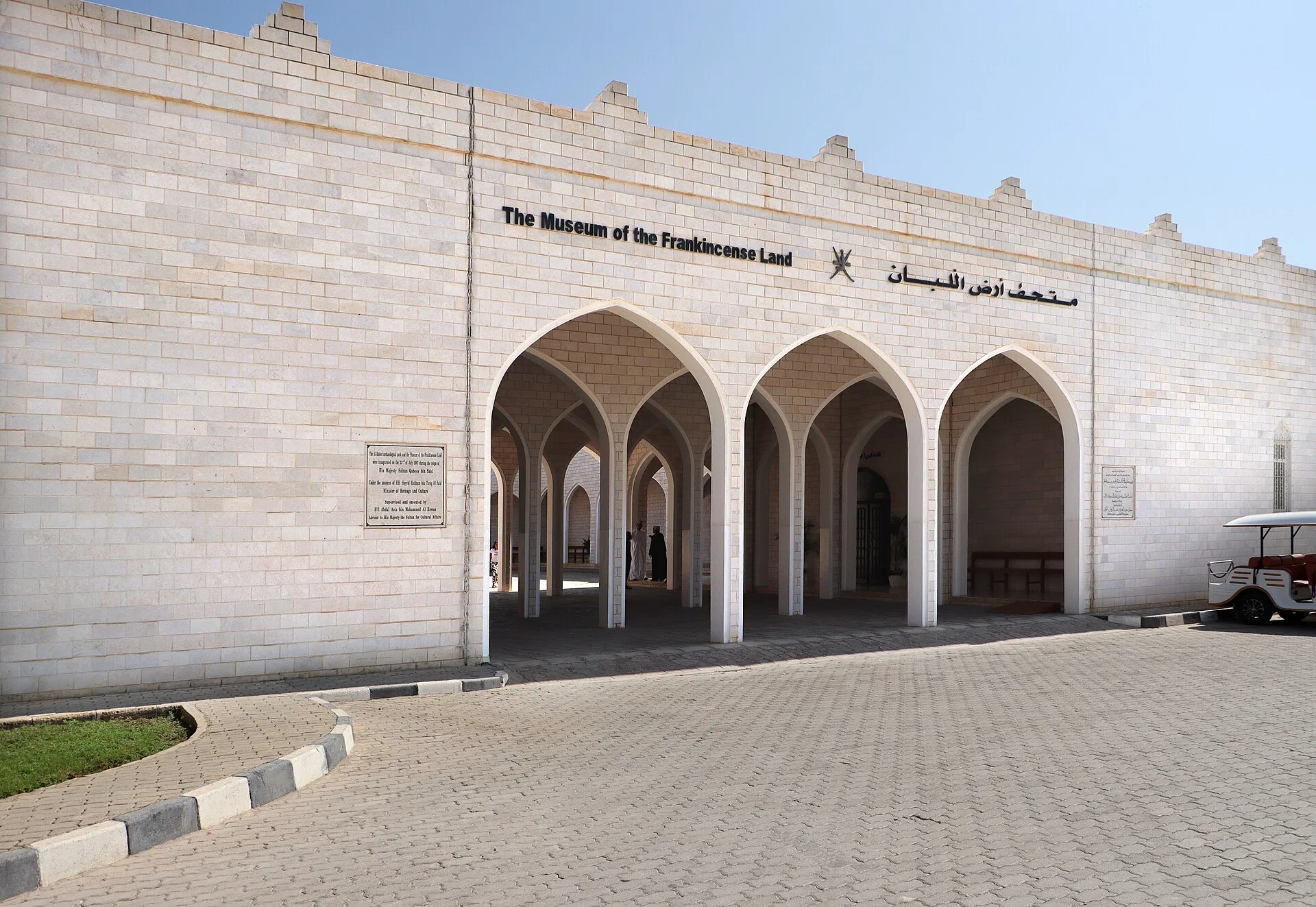
- The Museum of the Land of Frankincense in Salalah, where an aromatic substance is treated as archaeological evidence, medicine, sacred material and global commodity.
- Al Jalali Fort, a former prison converted into a restricted heritage museum rather than a normal visitor attraction.
Together, these places show that Oman’s curiosity culture is built less around shock or entertainment than around objects with layered uses. A dagger may be a weapon, ceremonial emblem and work of jewellery; a silver pendant may be decoration and supernatural protection; incense may be perfume, medicine, devotional substance and international cargo.
A whale skeleton and the natural oddities of Oman
The Natural History Museum contains Oman’s most immediately spectacular museum curiosity: the skeleton of a sperm whale approximately 14 metres long. It is displayed in a dedicated whale hall alongside further whale skeletons and skulls. The museum’s wider remit covers the development of life and the distinctive animals, plants, rocks and landscapes of Oman.[Ministry of Heritage and Tourism]mht.gov.omThere is also a whale hall in the Natural History Museum, which displays a 14-meter-long skeleton of a sperm whale, skeletons and skulls…
This is not a theatrical “monster museum”. The whale is presented as a scientific specimen rather than a sea-serpent relic, but its scale gives it the atmosphere of an old natural-history cabinet enlarged to architectural proportions. For visitors accustomed to Oman’s deserts and mountains, the skeleton is also a reminder that the country’s natural identity includes a long coastline and biologically rich seas.
Oman’s deserts have another unusually important connection with natural-history collections: they are exceptionally productive places for finding meteorites. Scientific expeditions have studied large numbers of specimens recovered from the country, including material from the Moon and Mars. One Martian meteorite found in Oman, Sayh al Uhaymir 008, entered the Natural History Museum in London’s research collection, while an Omani-Swiss programme analysed dozens of meteorites collected during systematic desert searches.[Natural History Museum]nhm.ac.ukBy the time the natural history section of the British Museum moved to South Kensington in 1883, the collection had grown to around 250 s…
The meteorite story requires care because scientifically important objects found in Oman are not necessarily displayed in an Omani museum. Nevertheless, they form a genuine part of the country’s curiosity landscape. Oman’s pale desert surfaces preserve dark extraterrestrial stones with unusual visibility, turning remote terrain into something resembling an open-air planetary archive.
Silver amulets, spirits and the limits of the word “magic”
Some of Oman’s most intriguing objects are pieces of traditional silver jewellery. Museum catalogues and specialist research record necklaces and pendants worn not only for appearance or status but also for protection, fertility and defence against harmful influences. One child’s necklace in the British Museum was believed to ward off evil, while another type was associated with enhancing a woman’s fertility.[British Museum]britishmuseum.orgRajab, 'Silver Jewellery of Oman' (Kuwait, 1997); Neil Richardson and Marcia Dorr, 'The Craft Heritage of Oman' (Dubai, 2003)…. For ch…
Certain pieces carried imagery interpreted as representing a spirit or devil-like figure. British Museum documentation notes that a stylised figure on the back of one pendant was described by some informants as a spirit and by others more specifically as a devil. Such objects could combine decorative, regional and talismanic functions rather than belonging to a separate, secret world of ritual magic.[British Museum]britishmuseum.orgAccording to Pauline Shelton, 'On the back of the samt there was almost always a small figure - on older examples, in a highly stylised f…
This distinction matters. Calling these objects “occult artefacts” would impose an external category that their makers and wearers might not have recognised. Protective jewellery belonged to everyday concerns: illness, childbirth, envy, misfortune and the perceived danger of the evil eye. In northern Oman, some amulets were deliberately worn over clothing, making protection visible as well as personal.[British Museum]britishmuseum.orgRajab, 'Silver Jewellery of Oman' (Kuwait, 1997); Neil Richardson and Marcia Dorr, 'The Craft Heritage of Oman' (Dubai, 2003)…. It is…
Visitors are most likely to encounter related material within broader displays of jewellery, dress and craftsmanship at Bait Al Zubair or the National Museum, rather than in a dedicated folklore or magic museum. The National Museum defines its collection around objects made in Oman or closely connected with Omani heritage, while Bait Al Zubair’s ethnographic holdings come principally from a long-established family collection.[National Museum Oman]nm.gov.omOpen source on nm.gov.om.
The interpretation is therefore cultural and historical. Museums may explain fabrication, regional style, trade and social identity more fully than supernatural belief. Readers specifically seeking folklore should examine labels carefully and avoid assuming that every silver container or pendant was magical; many served ordinary cosmetic, domestic or ceremonial purposes.
Private museums as modern cabinets of curiosity
Oman’s private house museums come closest to the traditional cabinet of curiosity: collections shaped by an individual or family rather than by a national survey of history. They often mix objects that larger institutions would separate into archaeology, decorative art, military history, postal history and ethnography.
Bait Al Zubair
Bait Al Zubair in Old Muscat displays artefacts collected by the Zubair family over several generations. Its holdings span traditional weapons, jewellery, clothing, domestic equipment, coins, stamps, manuscripts and works of art. The museum describes the collection as one of Oman’s finest in private ownership, with particular emphasis on inherited crafts and ways of life.[Baital Zubair]baitalzubair.comOpen source on baitalzubair.com.
For the curiosity-minded visitor, the appeal lies in accumulation and detail. Rows of decorated daggers, firearms, silver ornaments, incense burners and personal objects reveal how status and identity were encoded into things carried on the body or displayed in the home. The garden’s model village extends this approach by arranging buildings and objects into a condensed representation of traditional settlement life.[Wikipedia]WikipediaBait Al ZubairBait Al Zubair
Bait Al Zubair is public-facing and professionally organised, but its origin remains visible. It feels less like an anonymous state collection than a family archive that expanded into a museum. That makes it particularly useful for understanding how privately preserved heirlooms became part of Oman’s modern heritage industry.
Bait Adam
Bait Adam is more intimate and less straightforward to visit. Established in a private villa by collector Latif Al Balushi, it presents Omani history through coins, postal material, photographs, paintings, documents and objects associated with political and diplomatic life. Recent visitor information continues to describe it as a privately owned heritage museum where access is arranged rather than based on ordinary walk-in opening.[baitalghasham.com]baitalghasham.comBait Adam Museum | Experience Authentic Omani HospitalityBait Adam Museum | Experience Authentic Omani Hospitality
Its strongest curiosity credentials lie in postal and monetary history. Tour descriptions characterise the postal collection as unusually extensive and note displays concerning the Omani royal family and the country’s historical connections abroad.[Traveloka]traveloka.combait adam museum with lunch and guided tour 3983497448527bait adam museum with lunch and guided tour 3983497448527
Bait Adam is also an example of how credibility works differently in a private museum. The objects may be rare and historically valuable, but interpretation is closely associated with the collector’s own knowledge and storytelling. That personal contact is part of the attraction, although researchers requiring formal catalogue records or detailed provenance may find a national institution easier to assess.
Strange money and Oman’s vanished currencies
A museum about money may sound conventional, but Oman’s Currency Museum tells an unusually tangled story. Before a unified national currency, Oman used coins and notes from several political and commercial systems, reflecting its position between Arabia, East Africa, Persia, India and the wider Indian Ocean.
The Central Bank of Oman’s museum covers historic coinage, banknotes, minting and the development of the modern Omani currency. Its collections include locally produced coins, Islamic issues, Indian Gulf rupees and foreign silver currency.[Central Bank of Oman]cbo.gov.omCurrency Museum.aspxCurrency Museum.aspx
The Maria Theresa thaler is the most memorable example. This large European silver coin circulated widely far from the Habsburg territories whose ruler appeared on it, becoming accepted through weight, silver content and commercial familiarity. It remained part of Oman’s monetary world into the twentieth century, alongside currencies issued by India and local authorities.[Wikipedia]WikipediaCurrency Museum, MuscatCurrency Museum, Muscat
What makes the collection unusual is not visual eccentricity but the collapse of neat national categories. Coins carried portraits of foreign monarchs, arrived through maritime networks and continued circulating because communities trusted the metal even when the issuing government had little direct connection with Oman. The museum consequently functions as an archive of vanished economic habits: weighing, recognising and negotiating money in a world where several currencies might be acceptable at once.
Bait Adam and Bait Al Zubair also hold coins, stamps and documents, while the National Museum includes a dedicated currency gallery. A visitor interested in these objects can therefore compare three approaches: the Central Bank’s institutional history, the National Museum’s national narrative and the private collector’s fascination with rare individual pieces.[Eagle Trails Oman]eagletrailsoman.comEagle Trails Oman Private Museums and Heritage HousesEagle Trails Oman Private Museums and Heritage Houses
Frankincense as relic, medicine and commodity
The Museum of the Land of Frankincense, located beside the archaeological remains of Al Baleed in Salalah, is Oman’s most distinctive single-subject museum. It interprets frankincense not merely as perfume but as the centre of a historical system linking trees, ports, caravans, ships, religious practice and medicine.
The surrounding Land of Frankincense sites have UNESCO World Heritage status because they preserve evidence of the production and trade that made southern Arabia a major source of the resin. The museum is divided broadly between historical and maritime displays, connecting the substance with the development of ports and long-distance Omani seafaring.[Wikipedia]WikipediaMuseum of the Land of FrankincenseMuseum of the Land of Frankincense
Frankincense occupies an unusual borderland between practical and sacred object. It can be burned to perfume clothing and rooms, used in hospitality, traded as a luxury material and incorporated into religious or medicinal traditions. A lump of resin in a case may appear modest, but the museum’s central argument is that this small organic substance helped create settlements, trade routes and international reputations.
For strange-history readers, the museum is most valuable when it resists romantic claims. Stories connecting frankincense with ancient rulers and sacred gifts are culturally powerful, but archaeology is better at demonstrating production zones, ports, trade infrastructure and material exchange than proving every legendary journey. The museum’s setting within an archaeological park gives the subject more credibility than a purely commercial perfume attraction.
The experience is consequently part museum, part landscape interpretation. Visitors can examine excavated material and maritime history, then relate those displays to the climate and vegetation of Dhofar. It is one of the rare places where an apparently mystical substance is shown as both an object of belief and the product of a specific tree, environment and labour system.

Weapons, ships and open storage at the National Museum
The National Museum in Old Muscat is Oman’s flagship museum and the most reliable place to see unusual objects within a formal curatorial framework. Its galleries include arms and armour, maritime history, currency, prehistoric archaeology, frankincense, religious art and intangible heritage. The collection is restricted neither to royal treasures nor monumental archaeology; it also includes craft, clothing, domestic objects and evidence of ordinary life.[National Museum Oman]nm.gov.omOpen source on nm.gov.om.
Its arms displays are especially relevant to curiosity culture. Omani weapons were often practical tools, status symbols and pieces of decorative art at the same time. Research on historical firearms has drawn heavily on holdings in the National Museum and Bait Al Zubair, demonstrating that these collections are not merely tourist arrangements but significant sources for studying weapons used in Oman over several centuries.[Archaeopress]archaeopress.comOpen source on archaeopress.com.
The museum also uses replicas and large reconstructions to make maritime history tangible. Early reporting described life-sized ship replicas among a collection of thousands of objects, many of which had not previously been publicly displayed.[Art Newspaper]theartnewspaper.comArt Newspaper A museum of many firsts in Muscat spans two million yearsArt Newspaper A museum of many firsts in Muscat spans two million years
Its open-storage or collections gallery is particularly suited to visitors who enjoy densely arranged material. Open storage places more objects within view than a conventional, highly selective display, allowing patterns and variations to emerge across groups of weapons, vessels, ornaments or tools. This is the National Museum at its most cabinet-like, although the surrounding institution remains carefully designed and state-curated rather than eccentric or improvised.[Wikipedia]WikipediaNational Museum (OmanNational Museum (Oman
A prison museum that most people cannot visit
Al Jalali Fort presents the most frustrating case in Oman’s unusual museum landscape. Built and rebuilt as a strategic fortress overlooking Old Muscat, it later served as a place of confinement and was used as Oman’s principal prison during much of the twentieth century. After restoration in the 1980s, it was converted into a museum containing weapons, maps, rugs, pottery, jewellery and other heritage objects.[Wikipedia]WikipediaAl Jalali FortAl Jalali Fort
It therefore appears to offer exactly the combination sought by many strange-museum travellers: military architecture, prison history, difficult access routes, cannons and collections displayed inside a former place of detention. In practice, however, it is not a normal public prison museum. Access is generally restricted to official guests, dignitaries or exceptional permit holders. Visitors should treat the fort as a closed or highly restricted collection rather than an attraction they can reliably enter.[Tripadvisor]tripadvisor.comAl Jalali FortAl Jalali Fort
This restricted status is itself revealing. Not every heritage collection exists principally for tourism. Al Jalali functions partly as a ceremonial and diplomatic setting, meaning its museum displays serve state representation as much as public education. Its prison story is also not developed for visitors in the detailed manner found in dedicated penal museums elsewhere.
The exterior can still be viewed from Old Muscat, where the fort’s position opposite Al Mirani and above the harbour makes its former defensive and custodial power easy to understand. Claims online that it is an ordinary ticketed museum should be treated cautiously.
How credible and visitor-friendly are the collections?
Oman’s unusual collections range from rigorously institutional to highly personal. None should automatically be dismissed, but visitors should understand what kind of authority each one represents.
National and scientific museums offer the strongest formal curation. The National Museum maintains conservation facilities and collection policies, while the Natural History Museum interprets biological and geological specimens within a scientific framework. The Oman Across Ages Museum, opened as a major national attraction, combines approximately 1,300 historical objects with extensive screens, replicas and multimedia. Its strength is immersive explanation rather than an atmosphere of mysterious discovery.[Museum With No Frontiers]museumwnf.orgOpen source on museumwnf.org.
Private family museums provide denser, more individual experiences. Bait Al Zubair is established, visitor-facing and organised around a major family collection. Bait Adam is closer to a hosted private encounter and should be arranged in advance. Personal narration may reveal stories absent from formal labels, but provenance and interpretation can depend more heavily on the collector.
Commercial or tourism-led interpretation is most visible where heritage, craft sales, hospitality and guided experiences overlap. This does not make the objects false, but it can influence what is emphasised. Romantic stories about incense, royal objects or ancient customs should be distinguished from claims supported by archaeological context, catalogues or documented ownership.
Folkloric objects require the greatest sensitivity. Protective jewellery and spirit imagery should be presented as evidence of beliefs recorded among particular communities and periods, not as proof that supernatural forces exist or that all Omanis shared the same practices. Museum labels, collector testimony and later scholarship may also use different language for the same object.
What makes Oman’s curiosity culture distinctive?
Oman’s strange collections matter because they challenge the idea that unusual museums must be sensational. The country’s most compelling curiosities are generally embedded in respectable categories—silverwork, navigation, currency, zoology or archaeology—yet become stranger as their full histories emerge.
A whale skeleton opens onto the hidden scale of marine life. A necklace becomes a defence against envy or harmful spirits. A European coin turns into trusted Arabian currency. Resin from a desert tree links household fragrance with temples, medicine and oceanic commerce. A picturesque fortress reveals a past as a prison and a present as a museum closed to almost everyone.
This is a landscape of layered objects rather than staged mysteries. Visitors who read labels closely, compare state and private collections, and separate folklore from verified provenance will find Oman richer in curiosities than its museum names initially suggest. Its unusual heritage is not concentrated in a single chamber of horrors; it is distributed across homes, forts, scientific specimens, jewellery cases, archaeological parks and collections whose ordinary appearance conceals a far more complicated life.
Amazon book picks
Further Reading
Books and field guides related to Where Can You Find Oman's Strangest Museum Collections?. Use these as the next step if you want deeper reading beyond the article.
Silver Jewellery of Oman
First published 1997. Subjects: Silver jewelry, Jewelry, Silverwork, Tareq Rajab Museum (Kuwait).
Oman: Politics and Society in the Qaboos State
When Sultan Qaboos overthrew his father as ruler of the Persian Gulf state of Oman in 1970, with the help of British advisers, few expect...
eBay marketplace picks
Marketplace Samples
Live-tested eBay searches with available results related to this page.
Selected fromOman art print oneBay.co.uk.
Endnotes
1.
Source: Wikipedia
Title: Bait Al Zubair
Link:https://en.wikipedia.org/wiki/Bait_Al_Zubair
2.
Source: baitalghasham.com
Title: Bait Adam Museum | Experience Authentic Omani Hospitality
Link:https://baitalghasham.com/en/blog/bait-adam-museum/
3.
Source: traveloka.com
Title: bait adam museum with lunch and guided tour 3983497448527
Link:https://www.traveloka.com/en-sg/activities/sultanate-of-oman/product/bait-adam-museum-with-lunch-and-guided-tour-3983497448527
4.
Source: Wikipedia
Title: Currency Museum, Muscat
Link:https://en.wikipedia.org/wiki/Currency_Museum%2C_Muscat
5.
Source: Wikipedia
Title: National Museum (Oman)
Link:https://en.wikipedia.org/wiki/National_Museum_%28Oman%29
6.
Source: Wikipedia
Title: Museum of the Land of Frankincense
Link:https://en.wikipedia.org/wiki/Museum_of_the_Land_of_Frankincense
7.
Source: archaeopress.com
Link:https://www.archaeopress.com/Archaeopress/Products/9781803270326
8.
Source: Wikipedia
Title: Al Jalali Fort
Link:https://en.wikipedia.org/wiki/Al_Jalali_Fort
9.
Source: tripadvisor.com
Title: Al Jalali Fort
Link:https://www.tripadvisor.com/Attraction_Review-g294007-d321348-Reviews-Al_Jalali_Fort-Muscat_Governorate.html
10.
Source: tripadvisor.com
Title: Very interesting museum
Link:https://www.tripadvisor.com/ShowUserReviews-g1940497-d3572445-r345338240-Bait_Al_Zubair-Muscat_Muscat_Governorate.html
11.
Source: tripadvisor.com
Title: The Currency Museum of Oman
Link:https://www.tripadvisor.com/Attraction_Review-g298418-d10085134-Reviews-The_Currency_Museum_of_Oman-Ruwi_Muscat_Muscat_Governorate.html
12.
Source: baitalghasham.com
Link:https://baitalghasham.com/en/
13.
Source: baitalghasham.com
Link:https://baitalghasham.com/en/blog/omani-museums/
14.
Source: mht.gov.om
Link:https://mht.gov.om/en/media-center/news/under-the-theme-of-museums-sustainability-and-well-being-the-sultanate-of-oman-celebrates-the-international-museum-day/
Source snippet
There is also a whale hall in the Natural History Museum, which displays a 14-meter-long skeleton of a sperm whale, skeletons and skulls...
15.
Source: nhm.ac.uk
Link:https://www.nhm.ac.uk/our-science/services/collections/mineralogy/meteorites.html
Source snippet
By the time the natural history section of the British Museum moved to South Kensington in 1883, the collection had grown to around 250 s...
16.
Source: britishmuseum.org
Link:https://www.britishmuseum.org/collection/object/W
Source snippet
Rajab, 'Silver Jewellery of Oman' (Kuwait, 1997); Neil Richardson and Marcia Dorr, 'The Craft Heritage of Oman' (Dubai, 2003).... For ch...
17.
Source: britishmuseum.org
Link:https://www.britishmuseum.org/collection/object/W
Source snippet
Rajab, 'Silver Jewellery of Oman' (Kuwait, 1997); Neil Richardson and Marcia Dorr, 'The Craft Heritage of Oman' (Dubai, 2003).... It is...
18.
Source: britishmuseum.org
Link:https://www.britishmuseum.org/collection/object/W
Source snippet
According to Pauline Shelton, 'On the back of the samt there was almost always a small figure - on older examples, in a highly stylised f...
19.
Source: britishmuseum.org
Link:https://www.britishmuseum.org/collection/object/W
Source snippet
Rajab, 'Silver Jewellery of Oman' (Kuwait, 1997); Neil Richardson and Marcia Dorr, 'The Craft Heritage of Oman' (Dubai, 2003).... It is...
20.
Source: nm.gov.om
Link:https://www.nm.gov.om/en/collection
21.
Source: baitalzubair.com
Link:https://www.baitalzubair.com/Museum/Museum
22.
Source: facebook.com
Link:https://www.facebook.com/ExperienceOman/posts/bait-alzubair-museum-in-muscat-started-as-a-familys-private-home-and-grew-into-o/1093707346135216/
23.
Source: tripadvisor.co.uk
Title: Tripadvisor BAIT ADAM MUSEUM
Link:https://www.tripadvisor.co.uk/Attraction_Review-g1940497-d8854429-Reviews-Bait_Adam_Museum-Muscat_Muscat_Governorate.html
24.
Source: cbo.gov.om
Title: Currency Museum.aspx
Link:https://cbo.gov.om/Pages/CurrencyMuseum.aspx
25.
Source: eagletrailsoman.com
Title: Eagle Trails Oman [Private Museums]({{ ‘private-museums/’ | relative_url }}) and Heritage Houses
Link:https://eagletrailsoman.com/sunny-valley/
26.
Source: theartnewspaper.com
Title: Art Newspaper A museum of many firsts in Muscat spans two million years
Link:https://www.theartnewspaper.com/2016/02/16/a-museum-of-many-firsts-in-muscat-spans-two-million-years-of-omani-history
27.
Source: museumwnf.org
Link:https://www.museumwnf.org/partner.php?id=Mus21%3Bon&theme=EPM&tye=museum
28.
Source: archive.fm.gov.om
Link:https://archive.fm.gov.om/en/5605/
29.
Source: omannews.gov.om
Title: Oman News Agency
Link:https://omannews.gov.om/topics/en/83/show/126921/ftp
30.
Source: omannews.gov.om
Title: وكالة الأنباء العمانية (العمانية)
Link:https://omannews.gov.om/topics/ar/6/show/462304/index.php
31.
Source: omannews.gov.om
Title: Oman News Agency
Link:https://omannews.gov.om/topics/en/79/show/123645
32.
Source: omannews.gov.om
Title: Oman News Agency
Link:https://omannews.gov.om/topics/en/128/show/123643/dark
33.
Source: omannews.gov.om
Title: Oman News Agency
Link:https://omannews.gov.om/topics/en/132/show/123301
34.
Source: omannews.gov.om
Title: Oman News Agency
Link:https://omannews.gov.om/topics/en/140/show/123246
35.
Source: mht.gov.om
Link:https://mht.gov.om/en/media-center/news/mht-opens-exhibition-for-museums-and-private-heritage-houses-at-oman-across-ages-museum/
36.
Source: omannews.gov.om
Title: وكالة الأنباء العمانية (العمانية)
Link:https://omannews.gov.om/topics/ar/119/show/434229
37.
Source: omannews.gov.om
Title: Oman News Agency
Link:https://omannews.gov.om/topics/en/83/show/117076
38.
Source: omannews.gov.om
Title: Oman News Agency
Link:https://omannews.gov.om/topics/en/79/show/112153
39.
Source: omannews.gov.om
Title: وكالة الأنباء العمانية (العمانية)
Link:https://omannews.gov.om/topics/ar/122/show/408170
40.
Source: omannews.gov.om
Title: Oman News Agency
Link:https://omannews.gov.om/topics/en/102/show/4690
41.
Source: omannews.gov.om
Title: Oman News Agency
Link:https://omannews.gov.om/topics/en/81/show/4605
42.
Source: omannews.gov.om
Title: وكالة الأنباء العمانية (العمانية)
Link:https://omannews.gov.om/topics/ar/112/show/387893
43.
Source: mht.gov.om
Title: نامُعُ ةنطلس نعُ مليف نامُعُ ةنطلسل يحايسلا ليلدلا
Link:https://mht.gov.om/media/5s5jhsla/50th-jos-_-abstracts-book-_-english-4.pdf
44.
Source: archiam.co.uk
Link:https://www.archiam.co.uk/national-museum-oman/
45.
Source: nhm.ac.uk
Link:https://www.nhm.ac.uk/discover/collections.html
46.
Source: nhm.ac.uk
Link:https://www.nhm.ac.uk/our-science/services/collections/mineralogy.html
47.
Source: nhm.ac.uk
Title: caroline smith
Link:https://www.nhm.ac.uk/our-science/people/caroline-smith.html
48.
Source: fm.gov.om
Link:https://www.fm.gov.om/en/exhibitions/omanis-everywhere/abdullah-alghafri/
49.
Source: lonelyplanet.com
Link:https://www.lonelyplanet.com/points-of-interest/bait-al-zubair/451849
50.
Source: flyingcarpettours.com
Title: al jalali fort
Link:https://www.flyingcarpettours.com/Attractions/oman-attractions/muscat-attarction/al-jalali-fort
51.
Source: nm.gov.om
Title: Sitemap The National Museum
Link:https://www.nm.gov.om/en/sitemap
52.
Source: nm.gov.om
Title: islam gallery
Link:https://www.nm.gov.om/en/islam-gallery?action=first
53.
Source: nm.gov.om
Link:https://www.nm.gov.om/ra/collection/gift/crafts-industries
54.
Source: nm.gov.om
Link:https://www.nm.gov.om/en/collection/gift/crafts-industries
55.
Source: britishmuseum.org
Link:https://www.britishmuseum.org/collection/search?object=amulet
56.
Source: britishmuseum.org
Link:https://www.britishmuseum.org/collection/object/W
57.
Source: tripadvisor.co.uk
Title: BAI T AL ZUBAIR
Link:https://www.tripadvisor.co.uk/Attraction_Review-g1940497-d3572445-Reviews-Bait_Al_Zubair-Muscat_Muscat_Governorate.html
58.
Source: 365adventures.me
Link:https://365adventures.me/bait-al-zubair-museum/
Additional References
59.
Source: arxiv.org
Link:https://arxiv.org/abs/1602.00915
Source snippet
A gamma-ray spectroscopy survey of Omani meteoritesThe gamma-ray activities of 33 meteorite samples (30 ordinary chondrites, 1 Mars...
60.
Source: youtube.com
Link:https://www.youtube.com/watch?v=OYD-qP3hGoA
Source snippet
The Museum of The Frankincense Land In Salalah, Oman...
61.
Source: youtube.com
Title: The National Museum tour
Link:https://www.youtube.com/watch?v=8r0OVBjD7Cs
Source snippet
Land of Frankincense Museum Salalah Oman Begin a Tour of the Museum of the Frankincense Land (Salalah) SideTripofaLifeTime...
62.
Source: youtube.com
Title: Muscat, Oman
Link:https://www.youtube.com/watch?v=lJVERdt5yTs
Source snippet
Inside Oman’s National Museum: a journey through 7,000 artefacts and the nation’s heritage...
63.
Source: researchgate.net
Link:https://www.researchgate.net/publication/341725306_Cetacean_Skeletons_at_the_Whale_Hall_in_the_Natural_History_Museum_in_Muscat_Sultanate_of_Oman_alhyakl_alzmyt_llqyats_alhytan_fy_qat_alhytan_fy_mthf_altarykh_altbyy_fy_msqt_sltnt_uman
64.
Source: experienceoman.om
Link:https://experienceoman.om/media/sjnpdmet/oman-101-things-to-do.pdf
65.
Source: instagram.com
Link:https://www.instagram.com/p/Dafb0xajcvd/
66.
Source: wallacecollection.org
Link:https://www.wallacecollection.org/explore/collection/arms-and-armour/
67.
Source: pomegranate-travel.com
Link:https://pomegranate-travel.com/experiences/bait-adam-museum/
68.
Source: musement.com
Link:https://www.musement.com/us/muscat/bait-adam-museum-with-lunch-and-guided-tour-275947/