Within Strange Indonesia
Why Bali's Monsters End Up in Museums
Bali's towering ogoh-ogoh begin as temporary ritual sculptures, but museums now preserve them as art, heritage and cultural spectacle.
On this page
- What ogoh ogoh represent before Nyepi
- How temporary parade figures become permanent exhibits
- Mengwi and SAKA as contrasting museum experiences
Page outline Jump by section
Introduction
Bali’s giant ogoh-ogoh monsters are designed to disappear. Built by neighbourhood groups for the eve of Nyepi, the Balinese Day of Silence, these towering figures traditionally represent destructive forces, chaos and imbalance before being ritually destroyed or left to decay. Yet in recent years a growing number have escaped that temporary fate. Museums now preserve selected examples as works of community art, records of changing craftsmanship and gateways into understanding one of Bali’s most visually spectacular traditions.[sakamuseum.org]sakamuseum.orgCollection | SAKA MuseumCollection | SAKA Museum

This shift from street parade to permanent display is unusual because it changes the role of the sculptures. An object created for a single night’s ritual performance becomes a museum exhibit expected to educate visitors throughout the year. Understanding that transformation helps explain why Bali’s monster figures are not simply tourist attractions but expressions of living religious practice, local identity and contemporary artistic innovation.
What ogoh-ogoh represent before Nyepi
Ogoh-ogoh are immense figures made primarily from bamboo frameworks covered with lightweight materials such as papier-mâché, foam, wood and paint. Most portray terrifying beings: demons, mythical creatures, monstrous animals or characters drawn from Hindu epics. Their frightening appearance is deliberate rather than decorative. They symbolise bhuta kala—destructive or chaotic forces that must be recognised and ritually restored to balance before the New Year begins.[sakamuseum.org]sakamuseum.orgCollection | SAKA MuseumCollection | SAKA Museum
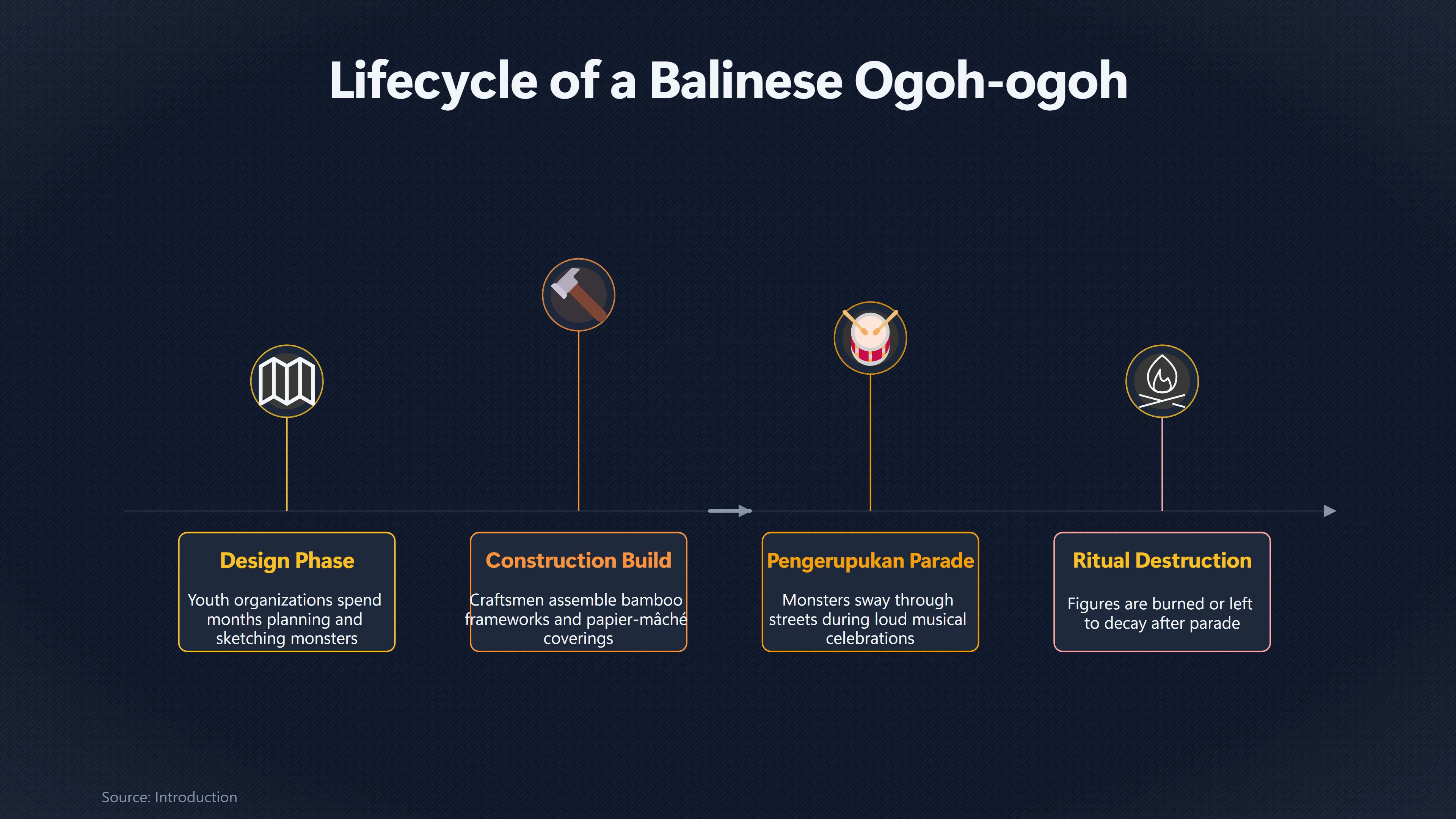
The figures come alive during the Pengerupukan celebrations on the evening before Nyepi. Local youth organisations, known as sekaa teruna, spend weeks or even months designing and constructing them. The finished monsters are carried through village streets on bamboo platforms while crowds create noise with drums, shouting and music. The swaying motion of the carriers gave rise to the name “ogoh-ogoh”, referring to a rocking or shaking movement.[sakamuseum.org]sakamuseum.orgCollection | SAKA MuseumCollection | SAKA Museum
Although outsiders often interpret the parade as a carnival, Balinese communities generally understand it as a ritual of controlled disorder. The monsters temporarily embody dangerous forces so they can be confronted symbolically before the island enters twenty-four hours of silence during Nyepi.
How temporary parade figures become permanent exhibits
The museum story begins with a paradox: ogoh-ogoh were never intended to last.[bali.com]bali.comOgoh Ogoh Museum MengwiBali.com
Traditionally many figures were burned after the procession, reinforcing the idea that negative forces had been neutralised. Others gradually deteriorated because they were built from inexpensive materials designed for a single event. Even today, many communities continue to favour impermanence over preservation because the ritual, not the object itself, carries the greatest religious importance.[sakamuseum.org]sakamuseum.orgCollection | SAKA MuseumCollection | SAKA Museum
Museums preserve only a small proportion of these creations. The selection process usually favours figures that demonstrate exceptional artistic quality, innovative engineering or particular cultural significance. Conservation also requires practical changes. Lightweight parade sculptures must be stabilised, protected from humidity, insects and sunlight, and sometimes reinforced internally because materials intended to survive only a few days deteriorate rapidly in museum conditions.
Displaying ogoh-ogoh indoors also changes how visitors encounter them. Instead of watching moving sculptures surrounded by music, smoke and crowds, visitors can study carving, painting, facial expressions and construction techniques at close range. Museums therefore shift attention from ritual performance towards craftsmanship, design and cultural interpretation.
Mengwi and SAKA as contrasting museum experiences
Mengwi: preserving community creations
The Ogoh-Ogoh Museum in Mengwi was established specifically to prevent remarkable parade figures from disappearing after Nyepi. Located near the historic Taman Ayun Temple complex, it houses more than twenty examples collected from different parts of Bali, particularly Badung Regency. The museum was founded by artist I Ketut Nuada, who began acquiring outstanding ogoh-ogoh that might otherwise have been discarded or destroyed.[Bali.com]bali.comOgoh Ogoh Museum MengwiOgoh Ogoh Museum Mengwi
Its approach resembles a heritage collection. Visitors compare differences in regional styles, facial expressions, costumes and construction methods while learning about the symbolism behind individual monsters. Because the sculptures originated in different villages and years, the museum also documents how artistic tastes have evolved, including increasing use of mechanical movement, dramatic lighting and contemporary themes.

SAKA Museum: ritual placed in a wider cultural story
SAKA Museum, at Jimbaran, takes a different approach. Rather than functioning solely as an ogoh-ogoh collection, it places the sculptures within the broader context of Nyepi, Balinese calendars, sacred manuscripts, music and religious practice. Its exhibition Walking Among Giants includes specially commissioned monumental ogoh-ogoh alongside films explaining their creation and ritual significance.[sakamuseum.org]sakamuseum.orgCollection | SAKA MuseumCollection | SAKA Museum
The museum deliberately recreates some of the scale and theatrical impact that visitors would normally experience outdoors. Audio-visual presentations, documentaries and educational programmes explain how communities collaborate to build the figures, allowing visitors to understand that the monsters are only one element within a much larger cycle of purification and renewal.[sakamuseum.org]sakamuseum.orgCollection | SAKA MuseumCollection | SAKA Museum
The contrast between the two institutions is revealing:
- Mengwi focuses on preserving surviving community-made sculptures that once participated in real parades.
- SAKA uses museum-quality exhibitions to interpret the entire Nyepi tradition, with ogoh-ogoh acting as dramatic entry points into Balinese culture.
- Both preserve material that was historically temporary, but one emphasises collecting existing works while the other develops an immersive cultural narrative.
Why museums preserve something designed to disappear
Preserving ogoh-ogoh does not simply save impressive sculptures. It documents an art form that constantly changes.
Since the 1980s the figures have become increasingly ambitious, incorporating complex engineering, moving parts, smoke effects, lighting systems and sophisticated painting techniques. Annual competitions have encouraged experimentation, making each generation of ogoh-ogoh a record of contemporary Balinese creativity rather than a fixed traditional style.[sakamuseum.org]sakamuseum.orgCollection | SAKA MuseumCollection | SAKA Museum
Museums therefore preserve evidence of changing artistic practice as much as religious symbolism. A preserved ogoh-ogoh records how one community interpreted mythology, craftsmanship and public spectacle at a particular moment in time.
At the same time, curators must avoid suggesting that the museum version replaces the living tradition. A static display cannot reproduce the excitement of hundreds of people carrying a swaying giant through crowded streets on the eve of Nyepi. Most museums address this by incorporating photographs, films and oral explanations alongside the sculptures, reminding visitors that the parade—not the preserved object—remains the centre of the tradition.[sakamuseum.org]sakamuseum.orgCollection | SAKA MuseumCollection | SAKA Museum
Why these museum collections matter
Ogoh-ogoh museums occupy an unusual place within Indonesia’s landscape of curious collections. They preserve monsters, yet they are not horror museums. They display spectacular giant effigies, yet their purpose is educational rather than sensational. Most importantly, they capture a cultural tradition built around impermanence.
For visitors interested in Indonesia’s stranger heritage, these museums reveal how a temporary ritual object can acquire a second life as cultural history. The monsters remain visually striking, but their deeper significance lies in demonstrating how Balinese communities continually negotiate the relationship between ritual practice, artistic innovation and cultural preservation.
Amazon book picks
Further Reading
Books and field guides related to Why Bali's Monsters End Up in Museums. Use these as the next step if you want deeper reading beyond the article.
Death and the Regeneration of Life
It is a classical anthropological paradox that symbols of rebirth and fertility are frequently found in funerary rituals throughout the w...
Balinese Art
Balinese Art is the first comprehensive survey of Balinese painting from its origins in the traditional Balinese village to its present p...
The Anthropology of Art
An authoritative introduction to art forms in the non-Western world addresses the problem of cross-cultural aesthetic appreciation in soc...
Bali: Sekala and Niskala: Essays on Religion, Ritual, and Art
First published 1985. Subjects: Civilization, Bali island (indonesia), social life and customs, Bali island (indonesia), religion, Art, b...
eBay marketplace picks
Marketplace Samples
Live-tested eBay searches with available results related to this page.
Selected fromBali art print oneBay.co.uk.


Endnotes
1.
Source: sakamuseum.org
Title: Collection | SAKA Museum
Link:https://www.sakamuseum.org/en/collection
2.
Source: indonesia.travel
Title: Visit Indonesia SAKA Museum Bali: Cultural Legacy and Creative Experience
Link:https://www.indonesia.travel/uk/en/destination/bali-nusa-tenggara/bali/saka-museum-bali/
3.
Source: bali.com
Title: Ogoh Ogoh Museum Mengwi
Link:https://bali.com/places/ogoh-ogoh-museum-mengwi/
4.
Source: indonesia.travel
Title: Visit Indonesia Museum Ogoh-Ogoh: Menyaksikan Seni dan Tradisi Bali
Link:https://www.indonesia.travel/fr/en/destination/bali-nusa-tenggara/bali/museum-ogoh-ogoh
5.
Source: time.com
Link:https://time.com/6992403/saka-museum/
Source snippet
El museo, que lleva el nombre del antiguo calendario solar hindú, presenta una colección con poesía indonesia, documentales sobre Nyepi...
6.
Source: sakamuseum.org
Link:https://www.sakamuseum.org/en
7.
Source: sakamuseum.org
Title: Collection | SAKA Museum KOLEKSI UNGGULAN: Ogoh
Link:https://www.sakamuseum.org/id/collection
8.
Source: sakamuseum.org
Link:https://www.sakamuseum.org/id/articles/saka-museum-marks-the-saka-new-year-with-public-programs
9.
Source: sakamuseum.org
Link:https://www.sakamuseum.org/en/faq
10.
Source: sakamuseum.org
Title: SAK A: Art & Culture Museum in Bali by AYANAImage: Ngewacak Rare
Link:https://www.sakamuseum.org/id
11.
Source: sakamuseum.org
Link:https://www.sakamuseum.org/en/exhibitions/kasanga
12.
Source: indonesia.travel
Link:https://www.indonesia.travel/de/de/destination/bali-nusa-tenggara/bali/museum-ogoh-ogoh/
13.
Source: indonesia.travel
Link:https://www.indonesia.travel/au-en/explore-indonesia/bali-nusa-tenggara/bali/museum-ogoh-ogoh
14.
Source: indonesia.travel
Link:https://www.indonesia.travel/in/en/explore-indonesia/bali-nusa-tenggara/bali/museum-ogoh-ogoh/
15.
Source: atlasobscura.com
Title: Ogoh-Ogoh Museum in Mengwi
Link:https://www.atlasobscura.com/places/ogohogoh-museum
16.
Source: tripadvisor.com
Title: Ogoh-Ogoh Museum
Link:https://www.tripadvisor.com/Attraction_Review-g1025508-d10354274-Reviews-Ogoh_Ogoh_Museum-Mengwi_Bali.html
Additional References
17.
Source: baliprov.go.id
Link:https://www.baliprov.go.id/web/serahkan-hadiah-ogoh-ogoh-gubernur-koster-wagub-minta-stt-kembangkan-kreativitas-dan-kuatkan-jati-diri-bali/
Source snippet
Pemerintah Provinsi BaliMay 9, 2026 — SERAHKAN HADIAH OGOH-OGOH, GUBERNUR KOSTER-WAGUB MINTA STT KEMBANGKAN KREATIVITAS DAN KUATKAN JATI...
Published: May 9, 2026
18.
Source: prokompim.badungkab.go.id
Link:https://prokompim.badungkab.go.id/berita/parade-ogoh-ogoh-paud-se-kecamatan-mengwi.html
Source snippet
Ogoh-Ogoh PAUD Se-Kecamatan Mengwi | Prokompim | Kabupaten BadungMarch 10, 2026 — PARADE OGOH-OGOH PAUD SE-KECAMATAN MENGWI Image: Parade...
Published: March 10, 2026
19.
Source: corner.inc
Title: The Ogoh Ogoh Bali Museum
Link:https://www.corner.inc/place/pUty7H1YeJzF
Source snippet
No.1 Taman Ayun., Desa Mengwi, Mengwi, Kabupaten Badung | CornerJanuary 2, 2026 — Image: The Ogoh Ogoh Bali Museum THE OGOH OGOH BALI MUS...
Published: January 2, 2026
20.
Source: atlasobscura.com
Title: by Roxanne Hoorn May
Link:https://www.atlasobscura.com/articles/bali-new-year-monster-parade-ogoh-ogoh
Source snippet
Meet the Creatures and Creators Behind Bali’s Parade for Banishing Evil SpiritsMay 1, 2024 — MEET THE CREATURES AND CREATORS BEHIND BALI’...
Published: May 1, 2024
21.
Source: youtube.com
Title: The Demon Festival Of Bali
Link:https://www.youtube.com/watch?v=yU1nbWQGd-M
Source snippet
"Ogoh-ogoh" Bali Nyepi museum OGOH-OGOH TERTINGGI BALI ADA DI MUSEUM INI...
22.
Source: youtube.com
Title: Sculpting the Spirit: The Sacred Purpose of Ogoh Ogoh
Link:https://www.youtube.com/watch?v=cXT5HHNOmsg
Source snippet
The Demon Festival Of Bali - Inside Hindu OGOH OGOH Celebrations...
23.
Source: youtube.com
Title: BALI’S AWARD WINNING SAKA MUSEUM
Link:https://www.youtube.com/watch?v=n24s94nu5N4
Source snippet
Sculpting the Spirit: The Sacred Purpose of Ogoh Ogoh...
24.
Source: youtube.com
Title: The Ritual That Shuts Down Bali
Link:https://www.youtube.com/watch?v=KR7DtTPQUwk
Source snippet
BALI NEW YEAR - NYEPI & The Amazing OGOH OGOH EXHIBIT...
25.
Source: youtube.com
Title: BALI NEW YEAR
Link:https://www.youtube.com/watch?v=yrL-ym1m-Uo
Source snippet
BALI'S AWARD WINNING SAKA MUSEUM...
26.
Source: tripadvisor.co.uk
Title: OGO H-OGOH MUSEUM
Link:https://www.tripadvisor.co.uk/Attraction_Review-g1025508-d10354274-Reviews-Ogoh_Ogoh_Museum-Mengwi_Bali.html