Within Strange Chile
Why the Atacama Keeps Stones From Space
San Pedro's meteorite collection shows how the Atacama Desert preserves ancient material from space and turns private collecting into public science.
On this page
- How meteorites are found and identified
- What the San Pedro museum displays
- Why the desert preserves such ancient falls
Page outline Jump by section
Introduction
The Atacama Desert is one of the world’s great natural archives of meteorites. Rather than preserving ancient books or fossils, it preserves rocks that fell from space, sometimes remaining exposed on the surface for hundreds of thousands of years. Around San Pedro de Atacama, this remarkable concentration of extraterrestrial material has inspired a small but distinctive visitor attraction: a meteorite museum built around a private collection that introduces the public to planetary science through objects recovered from the surrounding desert.
What makes the Atacama unusual is not that more meteorites fall there than elsewhere. Instead, the desert’s hyper-arid climate, exceptionally stable landscapes and sparse vegetation mean that meteorites are easier to spot and survive far longer than in wetter environments. The result is a landscape that acts as a natural space archive, preserving evidence of impacts that have vanished from most other parts of the world. Scientific expeditions and carefully documented collections have transformed these finds from curiosities into valuable records of the Solar System’s history.[ScienceDirect]sciencedirect.comThe Atacama Desert: A preferential arid region for the recovery of meteorites—Find location features and strewnfield distrib…
Why the Atacama Keeps Stones From Space
Most meteorites that land on Earth disappear surprisingly quickly. Rainwater, plants, acidic soils and human activity gradually break them down or bury them. The Atacama Desert offers almost the opposite conditions.
Its importance comes from a combination of factors:
- Extreme dryness greatly slows chemical weathering.
- Little vegetation leaves dark meteorites visible against pale desert surfaces.
- Stable ground surfaces can remain undisturbed for immense periods, allowing meteorites to accumulate rather than being buried or washed away.
- Low population density means many areas experience relatively little disturbance.
Researchers have identified dozens of meteorite dense collection areas across the Atacama, with thousands of officially classified meteorites recovered over the past two decades. Comparisons with other hot deserts show that Atacama meteorites are often less weathered than expected and, in many respects, resemble the preservation quality seen in Antarctic collections despite being found in a hot environment.[Wiley Online Library]onlinelibrary.wiley.comWiley Online LibraryDense collection areas and terrestrial alteration of meteorites in the Atacama Desert - Pinto - 2024 - Meteoritics &…
Even so, preservation is not perfect. Iron-rich minerals slowly oxidise, creating terrestrial weathering products such as magnetite and maghemite. Scientists therefore assess each meteorite’s weathering grade before deciding how suitable it is for studies of its original extraterrestrial properties.[ScienceDirect]sciencedirect.comMagnetic study of meteorites recovered in the Atacama desert (Chile): Implications for meteorite paleomagnetism and the stab…
How Meteorites Are Found and Identified
Finding meteorites in the Atacama is far more demanding than simply picking up unusual-looking rocks.
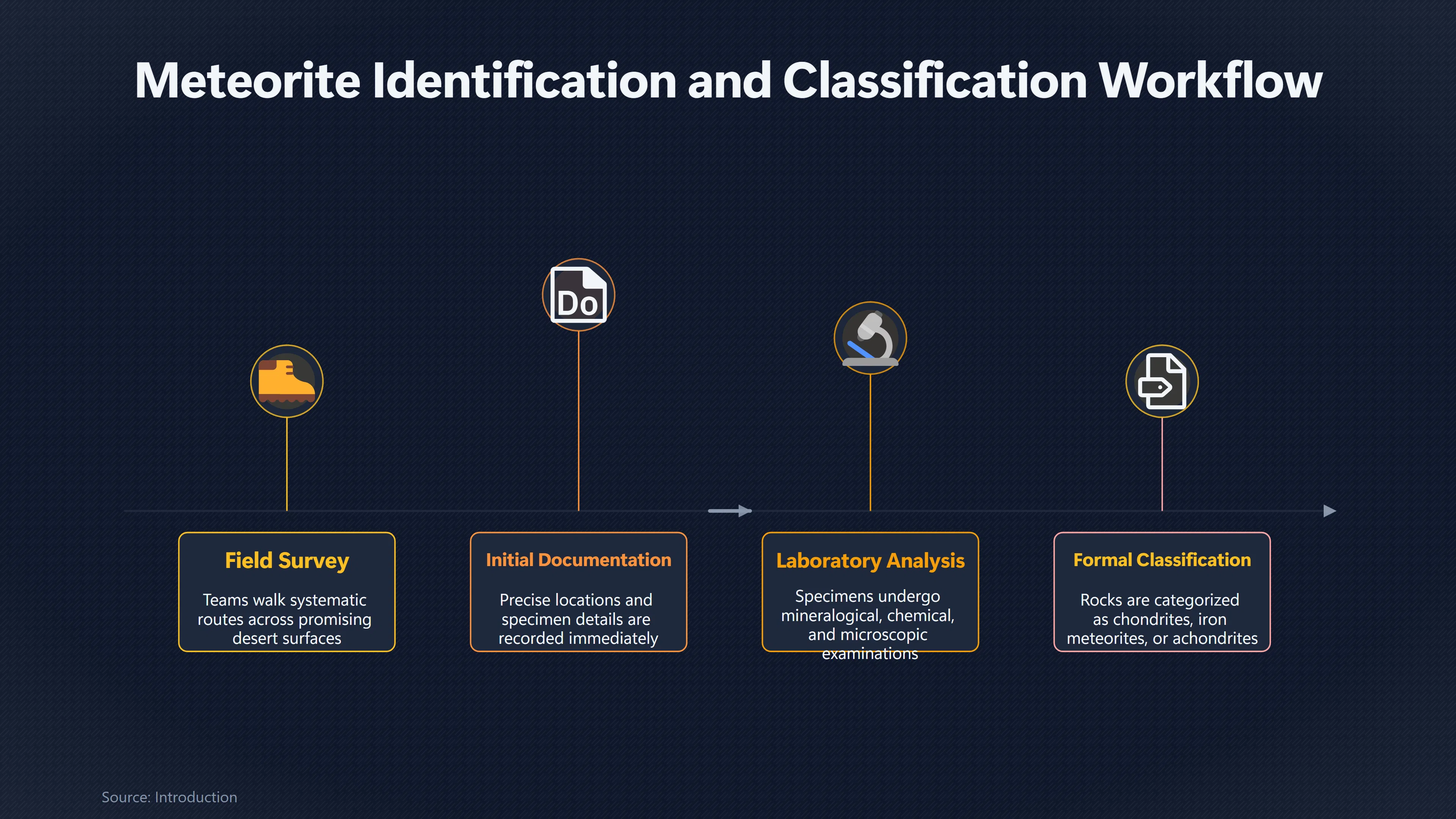
Search teams typically walk systematic routes across promising surfaces, recording precise locations and documenting each specimen before collection. Fresh-looking fusion crust, high density, metallic minerals and magnetic properties can all provide clues, but appearance alone is not enough. Many terrestrial rocks resemble meteorites, while genuine meteorites vary greatly depending on their composition and age.
Scientific value depends on proper documentation. Once recovered, specimens are examined using mineralogical, chemical and microscopic analyses before being formally classified. This process allows researchers to distinguish ordinary chondrites from rarer iron meteorites, achondrites and other types, while also identifying whether apparently separate fragments actually belong to the same fall.[ScienceDirect]sciencedirect.comThe Atacama Desert: A preferential arid region for the recovery of meteorites—Find location features and strewnfield distrib…
Because meteorites preserve information about asteroid formation and the early Solar System, careful provenance is often as important as the specimen itself. A spectacular-looking rock without a documented find location contributes far less to science than a smaller specimen recovered under controlled conditions.

What the San Pedro Museum Displays
San Pedro de Atacama’s Meteorite Museum presents this scientific story through an accessible private collection assembled from meteorites recovered in northern Chile. Rather than functioning as a large national museum, it offers visitors an introduction to how meteorites differ in appearance, composition and origin.
Displays typically include:
- ordinary stony meteorites, the most common type reaching Earth;
- iron meteorites showing metallic interiors;
- polished cross-sections revealing crystalline structures;
- explanations of meteorite formation, atmospheric entry and impact;
- information about why the Atacama has become one of the world’s richest meteorite recovery regions.
The collection bridges private collecting and public education. While the museum originated through individual enthusiasm rather than a university or national institution, its displays introduce visitors to genuine scientific classification and the reasons researchers continue to study the Atacama so intensively. It therefore occupies an unusual place within Chile’s landscape of curiosity collections: part specialist museum, part gateway to planetary science.
Why Scientists Value the Desert Archive
The Atacama preserves more than attractive specimens. It preserves time.
Some meteorites have remained on the desert surface for extraordinary lengths of time, allowing researchers to reconstruct long-term meteorite flux—the rate at which meteorites have reached Earth over hundreds of thousands or even millions of years. Cosmogenic isotope studies have shown that certain Atacama collections possess average terrestrial ages approaching one million years, making them among the oldest known meteorite accumulations in any hot desert.[Wiley Online Library]onlinelibrary.wiley.comWiley Online LibraryTerrestrial ages of meteorites from the Atacama Desert (Chile) and insights into the past meteorite flux to Earth - S…
The stability of the landscape also allows scientists to investigate how meteorites weather over time. Studies of their magnetic minerals have demonstrated that lightly weathered specimens often retain much of their original extraterrestrial magnetic record, while more heavily weathered examples gradually acquire magnetic signatures produced after landing on Earth. These findings help researchers decide which meteorites remain suitable for studying the magnetic history of their parent asteroids.[ScienceDirect]sciencedirect.comMagnetic study of meteorites recovered in the Atacama desert (Chile): Implications for meteorite paleomagnetism and the stab…
A Scientific Curiosity in Chile’s Unusual Heritage
Within Chile’s wider landscape of unusual collections, the Atacama meteorite displays stand apart because their fascination comes from natural preservation rather than mystery or folklore. Visitors encounter genuine fragments of asteroids and early Solar System material in a setting where the surrounding landscape continues to yield new discoveries.
The museum’s appeal lies not in sensational claims but in the unlikely combination of private collecting, extreme desert geography and planetary science. The Atacama demonstrates that one of the world’s driest environments has become an accidental archive of space history, preserving objects that elsewhere would have disappeared long ago. In that sense, the desert itself is the largest exhibit: a vast open-air repository where stones from space can survive long enough to become both scientific evidence and one of Chile’s most distinctive curiosity collections.
Amazon book picks
Further Reading
Books and field guides related to Why the Atacama Keeps Stones From Space. Use these as the next step if you want deeper reading beyond the article.
Rocks from Space: Meteorites and Meteorite Hunters
Appendices A-C: Meteorite verification laboratories, Commercial meteorite dealers, Selected list of suspected impact craters worldwide.
The Cambridge Encyclopedia of Meteorites
Beautifully illustrated with over 140 full colour images, The Cambridge Encyclopedia of Meteorites provides a thorough guide to these fas...
A Brief History of Time
Rating: 4.0/5 from 7 Google Books ratings
#1 NEW YORK TIMES BESTSELLER A landmark volume in science writing by one of the great minds of our time, Stephen Hawking’s book explores...
eBay marketplace picks
Marketplace Samples
Live-tested eBay searches with available results related to this page.
Selected frommeteorite display oneBay.co.uk.

Endnotes
1.
Source: sciencedirect.com
Link:https://www.sciencedirect.com/science/article/pii/S0140196307000791
Source snippet
The Atacama Desert: A preferential arid region for the recovery of meteorites—Find location features and strewnfield distrib...
2.
Source: onlinelibrary.wiley.com
Link:https://onlinelibrary.wiley.com/doi/abs/10.1111/maps.14125
Source snippet
Wiley Online LibraryDense collection areas and terrestrial alteration of meteorites in the Atacama Desert - Pinto - 2024 - Meteoritics &...
3.
Source: sciencedirect.com
Link:https://www.sciencedirect.com/science/article/pii/S003192011200074X
Source snippet
Magnetic study of meteorites recovered in the Atacama desert (Chile): Implications for meteorite paleomagnetism and the stab...
4.
Source: onlinelibrary.wiley.com
Link:https://onlinelibrary.wiley.com/doi/10.1111/maps.70125
Source snippet
Wiley Online LibraryTerrestrial ages of meteorites from the Atacama Desert (Chile) and insights into the past meteorite flux to Earth - S...
5.
Source: sciencedirect.com
Link:https://www.sciencedirect.com/science/article/abs/pii/S003192011200074X
Source snippet
Magnetic study of meteorites recovered in the Atacama desert (Chile): Implications for meteorite paleomagnetism and the stab...
6.
Source: onlinelibrary.wiley.com
Link:https://onlinelibrary.wiley.com/doi/full/10.1111/maps.70125
7.
Source: sciencedirect.com
Link:https://www.sciencedirect.com/science/article/pii/S0009254120305957
8.
Source: onlinelibrary.wiley.com
Link:https://onlinelibrary.wiley.com/doi/full/10.1111/maps.12607
9.
Source: doi.org
Title: The Meteoritical Bulletin, No
Link:https://doi.org/10.1111/maps.70157
Source snippet
114 - Gattacceca - 2026 - Meteoritics & Planetary Science - Wiley Online LibraryApril 20, 2026 — ABSTRACT Meteoritical Bulletin 114 conta...
Published: April 20, 2026
10.
Source: doi.org
Link:https://doi.org/10.1111/MAPS.12894
11.
Source: nhm.ac.uk
Link:https://www.nhm.ac.uk/our-science/services/collections/mineralogy/meteorites.html
12.
Source: monumentos.gob.cl
Link:https://www.monumentos.gob.cl/patrimonio-mundial/tentativa/san-pedro-de-atacama
Additional References
13.
Source: meteoritical.org
Link:https://meteoritical.org/news/research-grant-final-report-influence-evaporites-terrestrial-alteration-co-carbonaceous-chondrites-atacama-desert-evidence-oxyge
Source snippet
sert: Evidence from oxygen isotope analysis":: Meteoritical SocietyJune 18, 2026 — RESEARCH GRANT FINAL REPORT: "THE INFLUENCE OF EVAPOR...
Published: June 18, 2026
14.
Source: mdpi.com
Title: Mössbauer Study of Weathering Products in Meteorites from the Atacama Desert
Link:https://www.mdpi.com/2312-7481/11/12/107
Source snippet
Mössbauer Study of Weathering Products in Meteorites from the Atacama Desert...
15.
Source: youtube.com
Title: Hunting Down The Most Valuable Meteorite [4K]
Link:https://www.youtube.com/watch?v=faEoXiTjqek
Source snippet
Meteorite Museum in San Pedro de Atacama[https://www.youtube.com/watch?v=s-NSWKAYAuQ](https://www.youtube.com/watch?v=s-NSWKAYAuQ) Atlas Obscura...
16.
Source: arxiv.org
Title: arXiv The meteorite flux of the last 2 Myr recorded in the Atacama desert
Link:https://arxiv.org/abs/1904.12644
17.
Source: museodelmeteorito.cl
Link:https://www.museodelmeteorito.cl/index.php
18.
Source: nhm.ac.uk
Link:https://www.nhm.ac.uk/discover/imilac-meteorite-gem-as-old-solar-system.html
19.
Source: meteoritical.org
Link:https://meteoritical.org/publications/meteoritical-bulletin
20.
Source: repositorio.uchile.cl
Link:https://repositorio.uchile.cl/handle/2250/125228
21.
Source: wifi.nhm.ac.uk
Link:https://wifi.nhm.ac.uk/our-science/services/collections/mineralogy/meteorites.html
22.
Source: meteoritical.org
Title: Community Grant Report: “Meteorites: Human heritage”:: Meteoritical Society
Link:https://meteoritical.org/news/community-grant-report-meteorites-human-heritage