Within Strange Hungary
Why Budapest Museums Keep Difficult Objects
Budapest's specialist museums reveal how institutions preserved the tools of healing, mourning and criminal investigation.
On this page
- Medical instruments and early pharmacy
- Funeral culture and public remembrance
- Police evidence and forensic display
Page outline Jump by section
Introduction
Budapest’s most unusual institutional collections are striking not because they chase the macabre, but because they preserve the physical evidence of professions that dealt daily with illness, death and crime. Medical museums display surgical instruments, pharmacy equipment and anatomical teaching models once used in real practice. Funeral collections and cemetery exhibitions explain how Hungarians have commemorated the dead rather than treating death as spectacle. Police collections preserve forensic equipment, criminal evidence and investigative technology to document the history of law enforcement. Together these institutions show how objects associated with suffering become historical evidence, helping visitors understand changing ideas about healthcare, remembrance and justice.
Medical instruments and early pharmacy
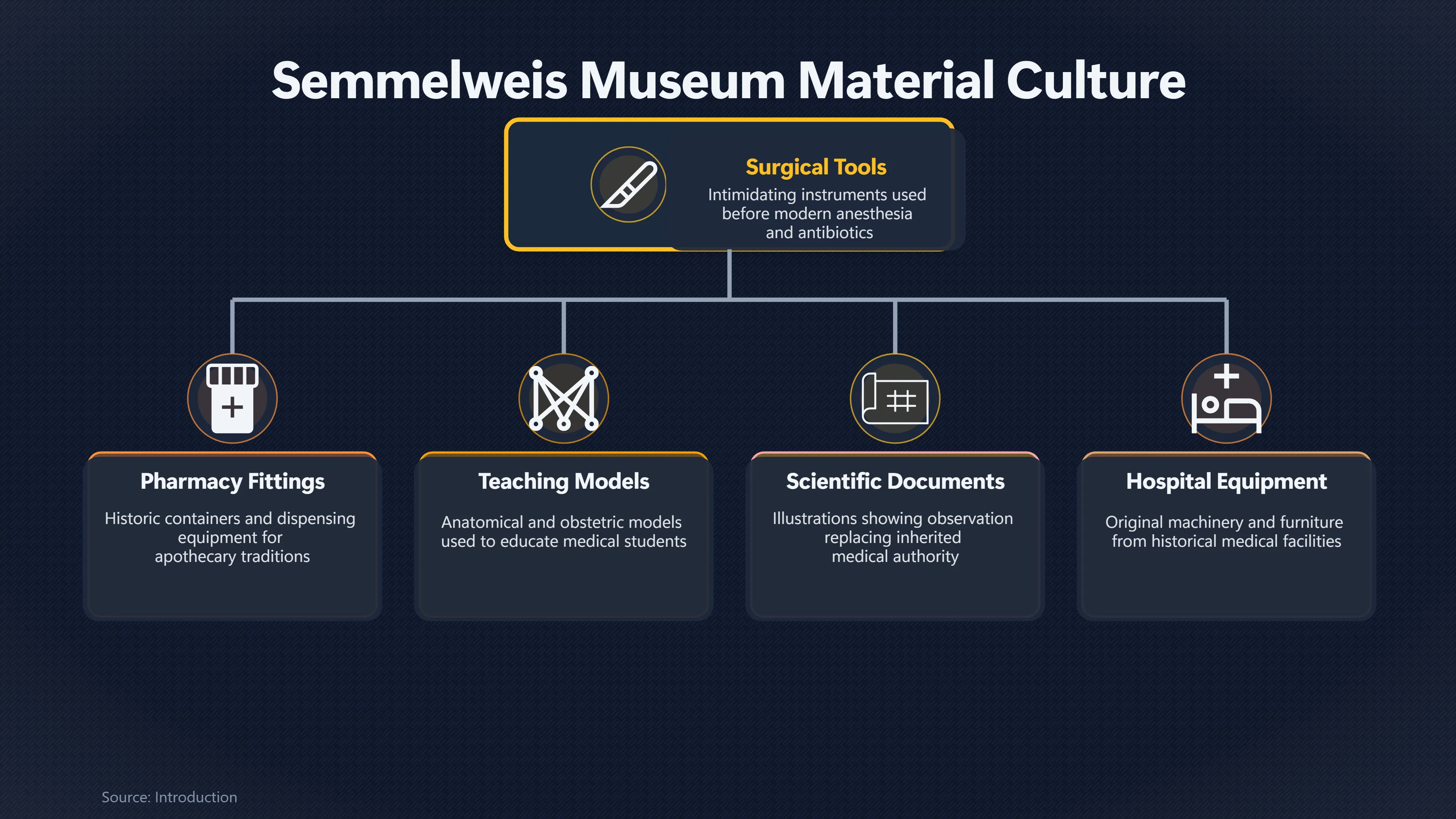
The strongest example is the Semmelweis Museum of Medical History, Library and Archives, housed in the birthplace of Ignaz Semmelweis, the nineteenth-century physician whose insistence on hand disinfection transformed maternity care. Rather than celebrating a single individual, the museum traces the wider development of European and Hungarian medicine through original instruments, scientific books, pharmacy fittings, anatomical models and hospital equipment. Its collections span the period before modern germ theory, when surgery and obstetrics often relied on practices that now appear alarming but represented the best available knowledge of their time.[Magyar Nemzeti Múzeum]mnm.huOpen source on mnm.hu.
One reason the museum stands out within Hungary’s curiosity culture is its emphasis on material culture rather than medical heroics. Visitors encounter:
- Early surgical instruments whose intimidating appearance reflects operations before effective anaesthesia and antibiotics.
- Historic pharmacy interiors, containers and dispensing equipment illustrating the transition from apothecary traditions to regulated pharmaceutical practice.
- Obstetric and anatomical teaching models used to educate generations of doctors and midwives.
- Scientific illustrations and documents showing how observation gradually replaced inherited medical authority.[Museum.hu]museum.huSemmelweis Museum, Library and Archives of the History of MedicineSemmelweis Museum, Library and Archives of the History of Medicine - Museum.hu…
These displays deliberately place unsettling objects within their historical context. A nineteenth-century amputation saw or obstetric forceps are presented as evidence of changing medical knowledge rather than as curiosities divorced from the patients whose lives depended on them.
Budapest also contains more specialised medical collections. The Anatomy Museum of Semmelweis University preserves anatomical preparations, congenital anomaly specimens and historic teaching collections assembled over more than a century. Although primarily intended for education and periodically closed to the general public, it demonstrates how universities historically collected human material for medical training rather than public entertainment. The institution has made clear that many specimens date back to the nineteenth century, reflecting changing approaches to anatomy teaching and preservation.[Semmelweis Egyetem]semmelweis.huEgyetem Anatómiai Múzeum – Anatómiai, Szövet- és Fejlődéstani IntézetSemmelweis EgyetemAnatómiai Múzeum – Anatómiai, Szövet- és Fejlődéstani Intézet…
Military medicine provides another perspective at the Hospital in the Rock Nuclear Bunker Museum beneath Buda Castle. Its exhibitions include original military medical equipment from the Second World War through the Cold War, illustrating how surgeons worked under siege conditions and later prepared for the possibility of nuclear conflict. Here the emphasis is less on medical discovery than on emergency treatment in extreme circumstances.[hospitalintherock.eu]hospitalintherock.euHospital in the Rock Nuclear Bunker Museum…
Funeral culture and public remembrance
Budapest has relatively few museums devoted solely to death, but it preserves funeral culture through cemeteries, memorial collections and exhibitions that interpret mourning as social history rather than gothic spectacle.
The city’s most significant site is the Fiumei Road Cemetery, one of Europe’s great national cemeteries. Although primarily an active memorial landscape rather than a museum, it functions as an open-air collection of funerary art, monumental sculpture, mausoleums and commemorative architecture spanning the nineteenth and twentieth centuries. Its elaborate tombs reveal changing attitudes towards public remembrance, national identity and family prestige.
Unlike commercial “dark tourism” attractions, the cemetery encourages visitors to read monuments as historical documents. Symbolic carvings, inscriptions and architectural styles demonstrate how different generations represented grief, patriotism and social status. The experience is contemplative rather than sensational, making it an important counterpart to Hungary’s more overtly unusual collections.
Budapest’s medical collections reinforce this approach to death. The Semmelweis Museum explores mortality through the history of disease, childbirth and public health, while avoiding displays designed merely to shock. Death appears as part of medical history, illustrating why innovations such as antiseptic practice dramatically reduced maternal mortality.[Magyar Nemzeti Múzeum]mnm.huOpen source on mnm.hu.
This measured treatment distinguishes Budapest from cities where death museums emphasise execution devices or theatrical horror. Hungarian institutions generally frame difficult objects through research, remembrance and professional history.

Police evidence and forensic display
The Police History Museum offers a similarly restrained approach to criminal investigation. Its permanent collections trace the evolution of Hungarian policing from the nineteenth century to the present through uniforms, official documents, communications equipment and investigative technology. More unusual is its exhibition devoted to criminal investigation, where forensic tools, reconstructed crime scenes, photographs and evidential objects explain how detectives gathered and interpreted physical evidence.[Museum.hu]museum.huPolice History MuseumPolice History Museum - Museum.hu…
Rather than glorifying famous crimes, the museum focuses on professional methods. Visitors can follow the development of:
- Fingerprint identification and other forensic techniques.
- Crime-scene recording and photography.
- Laboratory equipment used by forensic specialists.
- Investigative procedures and police documentation.
- Historical uniforms and equipment showing institutional change across different political eras.[Museum.hu]museum.huPolice History MuseumPolice History Museum - Museum.hu…
Many of the displayed objects would have been ordinary working tools rather than museum pieces when first used. Their significance lies in showing how criminal investigation became increasingly scientific during the twentieth century.
The museum also illustrates an important distinction within Budapest’s unusual collections. Some artefacts are genuine pieces of criminal evidence, but they are displayed to explain investigative practice instead of recreating notorious crimes for entertainment. This institutional perspective keeps the emphasis on forensic history rather than sensational storytelling.
Why these collections matter
Viewed together, Budapest’s medical, funeral and police collections reveal a consistent philosophy about preserving difficult objects. Instruments that once caused pain, funeral monuments created in grief and forensic evidence gathered after crimes all become historical sources once their original practical purpose has ended.
This approach gives Budapest’s collections a distinctive character within Hungary’s landscape of unusual museums. Instead of presenting morbidity as spectacle, they demonstrate how professional institutions preserve challenging material to explain scientific progress, changing social values and the practical realities of healthcare, remembrance and criminal investigation.
For visitors interested in unusual collections, the appeal lies not in horror or mystery but in seeing how ordinary professional objects—scalpels, medicine bottles, mourning monuments, fingerprint kits and police evidence—acquire new meaning when interpreted as part of the country’s cultural and institutional history.
Amazon book picks
Further Reading
Books and field guides related to Why Budapest Museums Keep Difficult Objects. Use these as the next step if you want deeper reading beyond the article.
The Body: A Guide for Occupants
NATIONAL BESTSELLER NEW YORK TIMES BESTSELLER INTERNATIONAL BESTSELLER A NEW YORK TIMES EDITORS' CHOICE NAMED ONE OF THE BEST BOOKS OF 20...
The Ghost Map
A historical chronicle of Victorian London's worst cholera outbreak traces the day-by-day efforts of Dr. John Snow, who put his own life...
The Butchering Art
DAILY MAIL, GUARDIAN AND OBSERVER BOOKS OF THE YEAR 2017 Winner of the 2018 PEN/E.O. Wilson Prize for Literary Science Writing Shortliste...
The Poisoner's Handbook
In early-twentieth-century New York, poisons offered an easy path to the perfect crime. Science had no place in the Tammany Hall-controll...
eBay marketplace picks
Marketplace Samples
Live-tested eBay searches with available results related to this page.
Selected fromscience collectible oneBay.co.uk.

Endnotes
1.
Source: museum.hu
Title: Semmelweis Museum, Library and Archives of the History of Medicine
Link:https://www.museum.hu/museum/66/Semmelweis_Museum_Library_and_Archives_of_the_History_of_Medicine
Source snippet
Semmelweis Museum, Library and Archives of the History of Medicine - Museum.hu...
2.
Source: semmelweis.hu
Title: Egyetem Anatómiai Múzeum – Anatómiai, Szövet- és Fejlődéstani Intézet
Link:https://semmelweis.hu/anatomia/anatomiai-muzeum/
Source snippet
Semmelweis EgyetemAnatómiai Múzeum – Anatómiai, Szövet- és Fejlődéstani Intézet...
3.
Source: hospitalintherock.eu
Link:https://hospitalintherock.eu/en/exhibitions
Source snippet
Hospital in the Rock Nuclear Bunker Museum...
4.
Source: museum.hu
Title: Police History Museum
Link:https://www.museum.hu/museum/182/Police_History_Museum
Source snippet
Police History Museum - Museum.hu...
5.
Source: medicine.museum
Title: Semmelweis Medical History Museum in Budapest, Hungary
Link:https://medicine.museum/museum/4-collin-medical-instruments-paris-france
Source snippet
Museum of MedicineSemmelweis Medical History Museum in Budapest, Hungary Image: Semmelweis Medical History Museum in Budapest Semmelweis...
6.
Source: medicine.museum
Title: Semmelweis Medical History Museum in Budapest, Hungary
Link:https://medicine.museum/museum/4-Stander-Female-Pelvis-Phantom
Source snippet
Museum of MedicineSemmelweis Medical History Museum in Budapest, Hungary Image: Semmelweis Medical History Museum in Budapest Semmelweis...
7.
Source: museum.hu
Title: Police History Museum
Link:https://www.museum.hu/museum/182/Police_History_Museum/exhibition
8.
Source: youtube.com
Title: 5 FREE museums in BUDAPEST: local’s ultimate budget-friendly guide to Hungary
Link:https://www.youtube.com/watch?v=eYiutMsvyAk
Source snippet
Hospital in the Rock - Sziklakórház...
9.
Source: youtube.com
Title: Hospital in the Rock
Link:https://www.youtube.com/watch?v=kkVMsgIR59s
Source snippet
This video provides an overview of the Semmelweis Medical Museum, located in Ignaz Semmelweis's birthplace, illustrating the history of m...
10.
Source: mnm.hu
Link:https://mnm.hu/en/affiliated-museums/mnm-semmelweis-medical-history-museum-library-and-archives
11.
Source: Wikipedia
Title: Semmelweis Museum of Medical History
Link:https://en.wikipedia.org/wiki/Semmelweis_Museum_of_Medical_History
Additional References
12.
Source: artsandculture.google.com
Link:https://artsandculture.google.com/partner/semmelweis-museum
Source snippet
Google Arts & CultureHNM Semmelweis Museum, Library and Archive of the History of Medicine, Budapest, Hungary — Google Arts & Culture...
13.
Source: youtube.com
Title: Semmelweis Orvostörténeti Múzeum
Link:https://www.youtube.com/watch?v=7M93rmf4mT8
Source snippet
5 FREE museums in BUDAPEST: local's ultimate budget-friendly guide to Hungary...
14.
Source: hmddirectory.nlm.nih.gov
Link:https://hmddirectory.nlm.nih.gov/hmddir/print_collection/274
Source snippet
of History of Medicine CollectionsJune 11, 2014 — DIRECTORY OF HISTORY OF MEDICINE COLLECTIONS Name: Semmelweis Museum, Library and Archi...
Published: June 11, 2014
15.
Source: youtube.com
Title: Ignaz Semmelweis – The Persecuted Medical Pioneer
Link:https://www.youtube.com/watch?v=BxA-a4_SPME
Source snippet
Semmelweis Orvostörténeti Múzeum - Budapest / Kirándulástervező...
16.
Source: en.nori.gov.hu
Link:https://en.nori.gov.hu/heritage/fiumei-road-cemetery
17.
Source: youtube.com
Title: Semmelweis Medical Museum, Budapest, Hungary
Link:https://www.youtube.com/watch?v=UPdE2W1dMO4
Source snippet
Ignaz Semmelweis – The Persecuted Medical Pioneer...
18.
Source: fiumeiutisirkert.nori.gov.hu
Title: 34 2 parcella
Link:https://fiumeiutisirkert.nori.gov.hu/szoborpark/34-2-parcella