Where Serbia Keeps Its Strangest Objects
Serbia does not have a single, neatly branded “museum of the strange”. Its curiosity culture is scattered across memorial sites, archaeological displays, private collections, scientific archives and places where folklore has attached itself to a surviving building or object.
Page outline Jump by section
Introduction
What makes these places valuable is the range of ways in which strangeness is handled. Some are carefully researched public institutions; others are devotional memorials, private passion projects, commercial attractions or tourist interpretations of folklore. Serbia’s unusual collections are therefore less a trail of novelty museums than a map of how the country preserves death, invention, political ritual, village belief and archaeological mystery.
The tower made from human remains
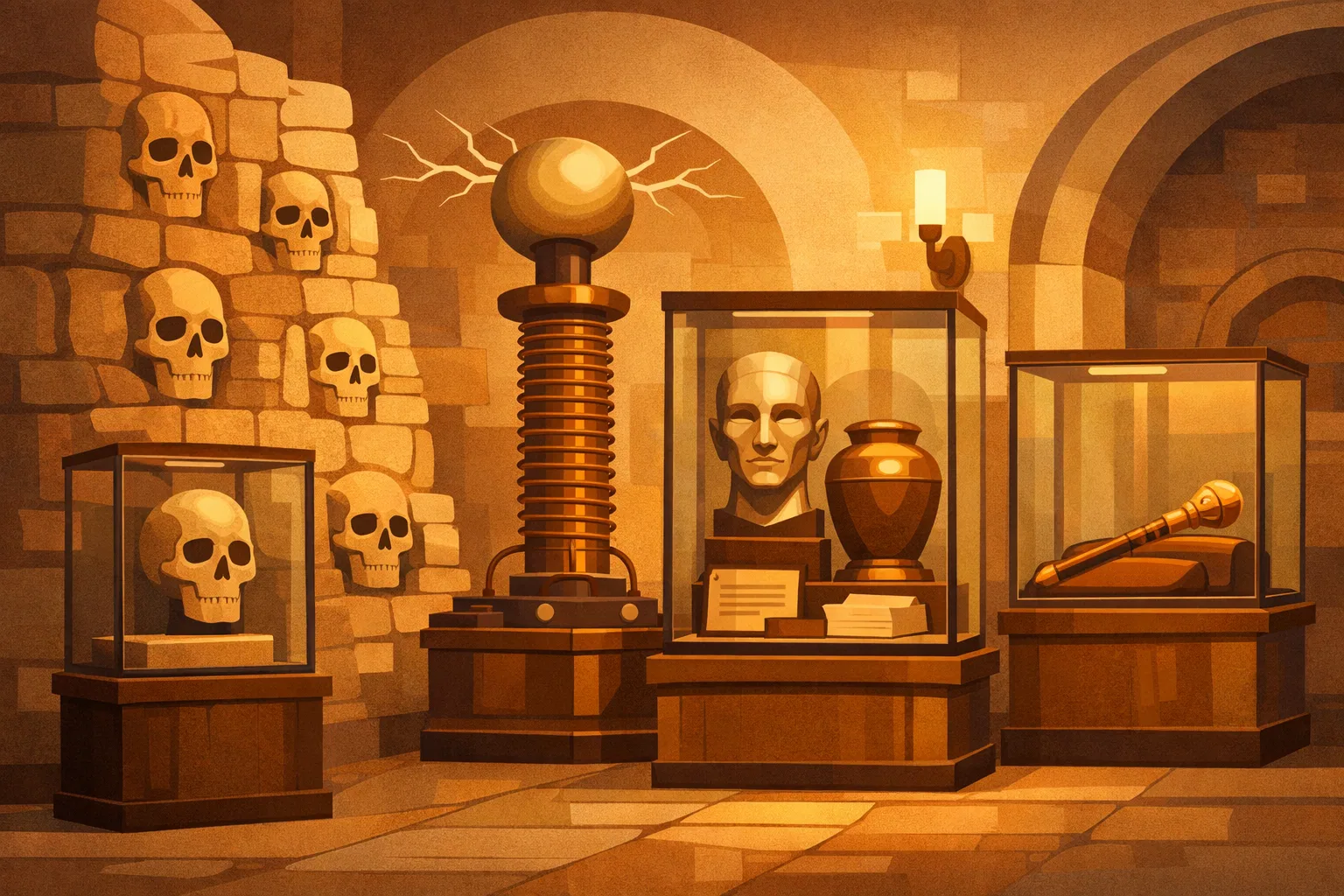
The Skull Tower in Niš is Serbia’s starkest encounter with human remains in a public heritage setting. It was constructed after the Battle of Čegar in 1809, during the First Serbian Uprising against Ottoman rule. The Ottoman commander ordered the severed heads of Serbian rebels to be built into a tower intended as a warning. The structure later became a Serbian memorial to resistance and sacrifice rather than the instrument of intimidation its builders intended.[National Museum Niš]narodnimuzejnis.rsToday the Museum has over 40,000 objects in its collections from the fields of archaeology, numismatics, epigraphy, history, history of a…
The surviving monument is protected inside a chapel and administered by the National Museum in Niš. Visitors see skulls still embedded in the masonry, together with a separately displayed skull traditionally identified as that of rebel commander Stevan Sinđelić. The experience is closer to an ossuary, battlefield memorial and national shrine than to a conventional museum gallery. Its power comes from the fact that the remains are not replicas or theatrical props: the building itself is the principal exhibit.
The tower’s interpretation has changed dramatically over time. A structure designed to display imperial punishment became a symbol of national liberation. The French writer Alphonse de Lamartine, who saw it in the nineteenth century, described the skulls as remains deserving respect rather than objects of terror. That reversal is central to understanding the site: the same material object can carry radically different meanings depending on who controls its story.[National Museum Niš]narodnimuzejnis.rse-mail: info@narodnimuzejnis.rsNational Museum NišSkull Tower Monument – National Museum NišIn 1833 the French poet and academician Alphonse de Lamartine (1790-1869) pu…
The Skull Tower is credible as a documented historic monument, although individual identifications and some frequently repeated numbers should be treated cautiously. The broad history is well established; popular retellings often simplify the battle, the construction process and the gradual disappearance of many skulls.
Tesla’s laboratory, archive and funerary relics
The Nikola Tesla Museum in Belgrade combines three types of institution that are normally kept apart: a science museum, a personal archive and a mausoleum. Visitors encounter working demonstrations of Tesla’s electrical inventions, personal possessions and documentary material, but also his spherical funerary urn. The museum additionally preserves casts of Tesla’s death mask and a posthumous impression of his right hand.[tesla-museum.org]tesla-museum.orgNikola Tesla MuseumThe museological work of the Nikola Tesla Museum may be seen as beginning in 1957, when the urn received by the Museum…
These memorial objects give the museum an atmosphere quite unlike that of an ordinary technology display. Tesla has become a scientific hero, pop-cultural icon and frequent subject of exaggerated stories about lost inventions, secret weapons and suppressed discoveries. The museum’s greatest value is that it preserves the documentary record against which such claims can be tested.
Its archive contains manuscripts, correspondence, calculations, technical drawings, photographs and patent documentation catalogued under more than 160,000 reference numbers. UNESCO placed the archive on its Memory of the World Register in 2003, describing it as an indispensable resource for studying the history of global electrification.[unesco.org]unesco.orgNikola Tesla's ArchiveSimply speaking, the collection documents the most important era of the history of development of the modern world, which, thanks to the…
Visitors should nevertheless distinguish between the museum’s holdings and what can be seen during a normal visit. The archive is vastly larger than the public exhibition, and many documents are research material rather than objects permanently displayed. The demonstrations are designed to make electrical principles memorable, while the archive and memorial collection establish institutional credibility.
Tesla’s urn also illustrates a recurring Serbian pattern: prominent individuals are remembered through collections that merge scholarship with near-devotional attention. The museum does not present Tesla as an occult figure, but the combination of electrical spectacle, preserved bodily traces and an inventor surrounded by modern mythology inevitably places it near the border between science history and secular pilgrimage.
Prehistoric faces at Lepenski Vir
At Lepenski Vir on the Danube, the unusual objects are monumental stone sculptures created by a prehistoric community of fishers and settled hunter-gatherers. Their heavy brows, broad mouths and ambiguous human-animal features have encouraged descriptions such as “fish people”, idols or river deities. Those labels are modern interpretations, not translations of any surviving ancient explanation.
The visitor centre protects part of the excavated settlement and displays artefacts associated with occupation during the Mesolithic and Neolithic periods. These include stone sculptures and altars, tools, jewellery, pottery and reconstructions relating to burial practices. The site also preserves the remains of distinctive trapezoidal buildings arranged around hearths.[serbia.travel]old.serbia.travelTravel Lepenski Vir MuseumTravel Lepenski Vir Museum
Lepenski Vir was discovered during rescue archaeology connected with the construction of the Iron Gate hydroelectric system in the 1960s and 1970s. The archaeological site and museum are therefore products of both deep prehistory and modern engineering: excavation, relocation and protective construction were necessary because the Danube landscape was being transformed.[narodnimuzej.rs]narodnimuzej.rsOpen source on narodnimuzej.rs.
The sculptures are strange because their meaning remains unresolved, not because they are anomalous or evidence of a forgotten non-human civilisation. Archaeologists can study their material, position and relationship to buildings and burials, but cannot recover the stories told about them. Claims that the settlement functioned as an astronomical observatory have also been debated. One published analysis found that some landscape and sunrise alignments may be suggestive while rejecting a commonly asserted summer-solstice alignment with the mountain opposite the site.[arXiv]arxiv.orgarXiv Was Lepenski Vir an ancient Sun or Pleiades observatory?arXiv Was Lepenski Vir an ancient Sun or Pleiades observatory?
For visitors interested in mystery objects, Lepenski Vir is one of Serbia’s strongest destinations precisely because responsible interpretation leaves room for uncertainty. The figures are authentic, well excavated and professionally curated, yet their expressions and symbolic purpose remain open to argument.
Tito’s gifts and the machinery of political devotion
The Museum of Yugoslavia in Belgrade contains one of the country’s largest collections of objects whose apparent eccentricity conceals a serious political function. Josip Broz Tito received gifts from foreign leaders, institutions, military units, factories, schools and private citizens. The resulting holdings include applied art, archaeological objects, ethnographic material, minerals, weapons, records, photographs, amateur crafts and ceremonial relay batons.[muzej-jugoslavije.org]muzej-jugoslavije.orgOpen source on muzej-jugoslavije.org.
Individually, many objects can seem bizarre: personalised jewellery boxes, embroidered portraits, elaborate albums, commemorative minerals, bust-shaped savings boxes and handmade tributes produced with enormous labour. Viewed together, however, they document diplomacy, mass participation and the construction of presidential authority. A gift from a foreign statesman communicated international alignment; a homemade portrait sent by a citizen communicated loyalty, affection or a desire to participate in official culture.[muzej-jugoslavije.org]muzej-jugoslavije.orgOpen source on muzej-jugoslavije.org.
The relay-baton collection is especially distinctive. Batons were carried through communities and presented during public celebrations associated with Tito’s birthday and the Day of Youth. The museum’s holdings include thousands of these designed objects, ranging from polished official pieces to inventive local constructions. They are remnants of a political ritual that combined sport, youth mobilisation, spectacle and personality cult.[muzej-jugoslavije.org]muzej-jugoslavije.orgOpen source on muzej-jugoslavije.org.
Tito is buried in the House of Flowers within the museum complex. That makes the site simultaneously a historical museum, former presidential environment, state-gift repository and burial place.[muzej-jugoslavije.org]muzej-jugoslavije.orgOpen source on muzej-jugoslavije.org.
Interpretation matters here because visitors approach Yugoslavia from sharply different positions: nostalgia, family memory, anti-communism, curiosity about the Non-Aligned Movement or interest in design and propaganda. Museum researchers have experimented with participatory and playful methods precisely because the objects carry contested memories and can be read differently by different communities.[arXiv]arxiv.orgOpen source on arxiv.org.
Aircraft wreckage as a war trophy
Belgrade’s Museum of Aviation stands beside the city’s main airport in a futuristic glass building that is itself part of the attraction. Its collection covers civil, royal Yugoslav, socialist Yugoslav and Serbian aviation, including locally produced aircraft and machines acquired from both Eastern and Western sources.
Its strangest and most politically charged exhibits are fragments of American aircraft shot down during the NATO campaign against Yugoslavia in 1999, including an F-117 stealth aircraft. The loss became internationally famous because the aircraft had been promoted as exceptionally difficult to detect. Displaying its remains turns damaged technology into a war trophy, technical specimen and instrument of national memory.[Wikipedia]WikipediaAeronautical Museum (BelgradeAeronautical Museum (Belgrade
The museum is not simply an exhibition about a single conflict. Its broader holdings include aircraft, engines, radar equipment, missiles, photographs and technical documentation. The 1999 wreckage is unusual because it changes the emotional register of the collection: beside restored machines intended to demonstrate aviation progress sit fragments whose significance depends on destruction and military defeat.
Related exhibits can also be encountered at Belgrade’s Military Museum, whose collections range from historic armour and uniforms to artillery and modern conflict material. The outdoor displays around Belgrade Fortress make heavy weapons unusually visible within a public park and heritage complex.[muzej.mod.gov.rs]muzej.mod.gov.rsOpen source on mod.gov.rs.
Both institutions require critical reading. Military museums select which victories, losses and technologies to foreground, and interpretation of the 1990s remains politically sensitive. The wreckage is authentic, but the meaning attached to it is shaped by national narratives, institutional language and the visitor’s own understanding of the conflict.
Small museums built around one obsession
Serbia’s most appealing curiosity collections are not necessarily its largest. Several institutions grew from individual collecting habits, local traditions or categories normally treated as too ordinary for museum display.
The Jeremija Museum of Bread in Pećinci was founded by painter Slobodan Jeremić and is presented by Serbia’s national tourism organisation as the country’s only museum devoted specifically to bread. Its importance lies not merely in old loaves or baking tools, but in connecting agriculture, domestic work, religious customs and the symbolic place of bread in village life. It is an artist-shaped, specialist collection rather than a large state museum.[serbia.travel]serbia.travelТуристичка организација Србије“Jeremija” Museum of BreadТуристичка организација Србије“Jeremija” Museum of Bread
The Museum of Naïve and Marginal Art in Jagodina preserves work by self-taught, outsider and other non-academic artists. Its collection exceeds 3,000 works dating from the twentieth century to the present, and the institution organises events devoted to self-taught visionaries. It is unusual not because the art is presented as a freak show, but because creative practices once excluded from formal art history are treated as material worthy of professional collecting, research and conservation.[mnmu.rs]mnmu.rsOpen source on mnmu.rs.
This institutional approach is important. “Outsider” or “marginal” art has often been marketed through biographies involving mental illness, poverty or social isolation. The Jagodina museum’s stated purpose is to interpret the work as art rather than as medical evidence or personal curiosity. That makes it one of Serbia’s most relevant collections for readers interested in visionary imagery and unconventional makers.
Serbia’s tourism authorities have also promoted newer private attractions, including a perfume museum. Such small collections can be engaging, but they are generally more vulnerable than national institutions to changes in access, ownership and opening arrangements. Current visiting information should be confirmed directly before travelling.[Туристичка организација Србије]serbia.travelТуристичка организација СрбијеThe Wondrous Treasury of SerbiaТуристичка организација СрбијеThe Wondrous Treasury of Serbia

Vampire folklore without a vampire museum
Serbia has a major place in European vampire history, but its strongest vampire-related attraction is not a formal museum. Near the village of Zarožje, a watermill is associated with the legend of Sava Savanović, a vampire said to have attacked millers who worked there at night. The tale became widely known through Milovan Glišić’s nineteenth-century story After Ninety Years.[Туристичка организација Србије]serbia.travelOpen source on serbia.travel.
The location works as a folklore site: a physical structure gives visitors somewhere to attach a story that circulated through oral tradition and literature. Tourism accounts describe a restored mill and guided visits in which the legend forms part of a wider rural walk.[explore-serbia.rs]explore-serbia.rsOpen source on explore-serbia.rs.
Visitors should not confuse the existence of a mill with evidence that a supernatural being inhabited it. The value of the place lies in demonstrating how landscape, labour and fear interact in folklore. Watermills were isolated, noisy and dangerous places where people worked after dark beside fast-moving water and heavy machinery. They were ideal settings for stories about unexplained death and predatory spirits.
The Sava Savanović story also shows how folklore is commercialised without necessarily being contained in glass cases. A building, literary narrative, village identity and guided-tour economy can together function like a dispersed museum. Compared with the professionally excavated mysteries of Lepenski Vir, this is a different kind of uncertainty: the material place is real, while the vampire belongs to storytelling and belief.
Dark collections that should not be treated as novelties
The Memorial Complex “12 February” in Niš occupies the surviving Crveni Krst concentration camp established under German occupation in 1941. Prisoners included Serbs, Jews, Roma, resistance members and political detainees. The preserved complex contains cells, guard structures, documents, photographs, letters and personal belongings.[National Museum Niš]narodnimuzejnis.rsOpen source on narodnimuzejnis.rs.
Although it fits the broad category of prison and dark-history museums, it should not be approached as macabre entertainment. Its authenticity comes from the preserved architecture and records of imprisonment, execution and deportation. The National Museum in Niš reports that tens of thousands passed through the camp and that many prisoners were killed at nearby Bubanj or transported elsewhere for forced labour and imprisonment.[National Museum Niš]narodnimuzejnis.rsOpen source on narodnimuzejnis.rs.
The site’s relationship with the Skull Tower is instructive. Both preserve evidence of mass violence, but they arose in different political settings and perform different memorial functions. The tower displays human remains transformed into a national symbol; the camp preserves spaces and documentary traces through which individual persecution can be reconstructed.
Serbia’s strange-history landscape is strongest when such differences remain clear. Human remains, prison cells and war wreckage may all attract visitors seeking unsettling experiences, but they demand more care than illusion museums or private collections. Their purpose is commemoration and historical interpretation, not simply shock.
How to judge Serbia’s unusual attractions
The country’s curiosity sites range from internationally recognised archives to folklore landmarks with minimal formal interpretation. A useful way to assess them is to ask what kind of evidence is actually present.
Professionally curated institutions include the Nikola Tesla Museum, the Museum of Yugoslavia, the Museum of Naïve and Marginal Art, Lepenski Vir and the National Museum sites in Niš. Their collections are catalogued and interpreted by specialist staff, although exhibitions still reflect curatorial choices and national debates.
Historic structures and memorials include the Skull Tower and the Crveni Krst camp. Here the building or surviving fabric is the main artefact. Authenticity is high, but visitors should distinguish documented history from later patriotic, political or tourist embellishment.
Private specialist museums such as the bread collection can offer unusually personal displays and close contact with local knowledge. They may have limited staffing, irregular access or interpretation shaped heavily by the founder.
Folklore locations such as the Sava Savanović mill preserve a relationship between story and landscape rather than proof of supernatural events. Their credibility should be judged as evidence of cultural belief and literary tradition, not of vampires.
Commercial interactive attractions may provide enjoyable optical effects or themed entertainment, but they usually have a different purpose from collecting museums. Their exhibits are designed primarily for participation and photography rather than original-object research.
Practical arrangements can change, particularly at small or privately run sites. Visitors should check official pages for opening days, language provision, guided-tour requirements and temporary closures. Serbia’s most rewarding strange collections are often those where the odd object is only the starting point: a skull wall becomes a struggle over memory, a stone face becomes an archaeological problem, a relay baton reveals political ritual, and an inventor’s urn turns a science museum into a place of pilgrimage.
Amazon book picks
Further Reading
Books and field guides related to Where Serbia Keeps Its Strangest Objects. Use these as the next step if you want deeper reading beyond the article.
The Balkans: Nationalism, War, and the Great Powers,
From the bestselling author of McMafia and DarkMarket comes this unique and lively history of Balkan geopolitics since the early nineteen...
Tesla: Inventor of the Electrical Age
“The gold standard for Tesla biography.”—Science “Superb.”—Nature The definitive account of Tesla's life and work Nikola Tesla was a majo...

The Penguin Book of Vampire Stories
/Alan Ryan, editor Collected here are 32 stories featuring the frightening creature--the vampire. Just in time for Halloween, this charac...
eBay marketplace picks
Marketplace Samples
Live-tested eBay searches with available results related to this page.
Selected fromSerbia collectible oneBay.co.uk.
Current eBay listing
Old Collectible Postcard From Serbia Croatia Slovenia Kingdom 1920’s
Current eBay listing
Starbucks Serbia Belgrade Skyline Mug Ceramic Collectible, Used
Endnotes
1.
Source: tesla-museum.org
Link:https://tesla-museum.org/en/museum/history/
Source snippet
Nikola Tesla MuseumThe museological work of the Nikola Tesla Museum may be seen as beginning in 1957, when the urn received by the Museum...
2.
Source: tesla-museum.org
Title: The Museum has four casts of the Tesla death mask
Link:https://tesla-museum.org/en/legacy/collections/memorial-items/
Source snippet
Memorial Items – Nikola Tesla MuseumAmong the collection of memorial items are Tesla’s death mask, a posthumous impression of Tesla’s rig...
3.
Source: tesla-museum.org
Link:https://tesla-museum.org/en/extraordinary-world/museum/
Source snippet
Nikola Tesla MuseumIn 1957, an urn with Nikola Tesla’s remains was brought to the museum...
4.
Source: unesco.org
Title: Nikola Tesla’s Archive
Link:https://www.unesco.org/en/memory-world/nikola-teslas-archive
Source snippet
Simply speaking, the collection documents the most important era of the history of development of the modern world, which, thanks to the...
5.
Source: tesla-museum.org
Title: heritage protection
Link:https://tesla-museum.org/en/museum/heritage-protection/
Source snippet
Nikola Tesla MuseumIn 2003, in recognition of the universal significance of Nikola Tesla and his inventions, UNESCO added Tesla’s archive...
6.
Source: tesla-museum.org
Link:https://tesla-museum.org/en/legacy/archive/
7.
Source: old.serbia.travel
Title: Travel Lepenski Vir Museum
Link:https://www.old.serbia.travel/en/see-serbia/culture/museums-and-galleries/lepenski-vir-museum
8.
Source: serbia.travel
Title: Туристичка организација СрбијеLepenski Vir Museum
Link:https://www.serbia.travel/en/lepenski-vir-museum/
9.
Source: narodnimuzej.rs
Title: Музеј Лепенски Вир | Народни музеј
Link:https://www.narodnimuzej.rs/about-museum/locations-of-the-national-museum/muzej-lepenski-vir/?lang=en
10.
Source: narodnimuzej.rs
Link:https://www.narodnimuzej.rs/prehistory/lepenski-vir-collection/?lang=en
11.
Source: arxiv.org
Title: arXiv Was Lepenski Vir an ancient Sun or Pleiades observatory?
Link:https://arxiv.org/abs/1501.01108
12.
Source: muzej-jugoslavije.org
Link:https://muzej-jugoslavije.org/en/fond/
13.
Source: muzej-jugoslavije.org
Link:https://muzej-jugoslavije.org/en/predistorija-osnova-za-razumevanje-muzeja-jugoslavije/
14.
Source: muzej-jugoslavije.org
Link:https://muzej-jugoslavije.org/en/art/goblen-josipa-broza-tita/
15.
Source: muzej-jugoslavije.org
Link:https://muzej-jugoslavije.org/en/mineral-treasures-of-yugoslavia-samples-from-the-collection-of-gifts-of-josip-broz-tito/
16.
Source: muzej-jugoslavije.org
Link:https://muzej-jugoslavije.org/en/art/kutija-za-nakit-u-obliku-skrinje/
17.
Source: muzej-jugoslavije.org
Link:https://muzej-jugoslavije.org/en/art/stedna-kasica-bista-josipa-broza-tita/
18.
Source: muzej-jugoslavije.org
Link:https://muzej-jugoslavije.org/en/art/stafeta-mladosti/
19.
Source: muzej-jugoslavije.org
Link:https://muzej-jugoslavije.org/en/art/plava-knjiga/
20.
Source: muzej-jugoslavije.org
Link:https://www.muzej-jugoslavije.org/wp-content/uploads/2017/06/2008-%C5%A0tafete.pdf
21.
Source: muzej-jugoslavije.org
Link:https://muzej-jugoslavije.org/en/posetite-nas/?building=2&room=0
22.
Source: arxiv.org
Link:https://arxiv.org/abs/2101.12533
23.
Source: Wikipedia
Title: Aeronautical Museum (Belgrade)
Link:https://en.wikipedia.org/wiki/Aeronautical_Museum_%28Belgrade%29
24.
Source: Wikipedia
Title: Military Museum, Belgrade
Link:https://en.wikipedia.org/wiki/Military_Museum%2C_Belgrade
25.
Source: muzej.mod.gov.rs
Link:https://www.muzej.mod.gov.rs/eng
26.
Source: serbia.travel
Title: Туристичка организација Србије“Jeremija” Museum of Bread
Link:https://www.serbia.travel/es/jeremija-museum-of-bread/
27.
Source: old.serbia.travel
Title: Travel Museums and galleries
Link:https://www.old.serbia.travel/en/see-serbia/culture/museums-and-galleries
28.
Source: old.serbia.travel
Link:https://www.old.serbia.travel/files/The%2520Cultural%2520Treasures%2520of%2520Serbia.pdf
Source snippet
FREE ISSUE | |The bread museum in Pećinci was founded by painter Slobodan... e-mail: office@serbia.travel...
29.
Source: mnmu.rs
Link:https://mnmu.rs/en/
30.
Source: serbia.travel
Title: Туристичка организација СрбијеMuseum of Naïve and Marginal Art
Link:https://www.serbia.travel/en/museum-of-naive-and-marginal-art/
31.
Source: serbia.travel
Title: Туристичка организација СрбијеМузеј наивне и маргиналне уметности
Link:https://www.serbia.travel/%D0%BC%D1%83%D0%B7%D0%B5%D1%98-%D0%BD%D0%B0%D0%B8%D0%B2%D0%BD%D0%B5-%D0%B8-%D0%BC%D0%B0%D1%80%D0%B3%D0%B8%D0%BD%D0%B0%D0%BB%D0%BD%D0%B5-%D1%83%D0%BC%D0%B5%D1%82%D0%BD%D0%BE%D1%81%D1%82%D0%B8/
32.
Source: serbia.travel
Title: Туристичка организација СрбијеThe Wondrous Treasury of Serbia
Link:https://www.serbia.travel/en/stories-items/the-wondrous-treasury-of-serbia/
33.
Source: serbia.travel
Link:https://www.serbia.travel/en/stories-items/povlen-mountain-of-silence-secrets-and-shadows/
34.
Source: explore-serbia.rs
Link:https://explore-serbia.rs/en/tours-2/sava-savanovic-mill/
35.
Source: serbian.travel
Title: Niš City Guide: Fortress, Skull Tower & Nightlife
Link:https://serbian.travel/nis
36.
Source: srbija.gov.rs
Title: ernment designates three cultural properties of exceptional importance
Link:https://www.srbija.gov.rs/vest/en/264079/government-designates-three-cultural-properties-of-exceptional-importance.php
37.
Source: tesla-museum.org
Link:https://tesla-museum.org/en/exhibitions/exhibition-at-the-cicevac/
38.
Source: tesla-museum.org
Link:https://tesla-museum.org/en/exhibitions/exhibition-in-valjevo-nikola-tesla-the-man-from-the-future/
39.
Source: serbia.travel
Title: Old Village Open-Air Museum
Link:https://www.serbia.travel/en/old-village-open-air-museum/
40.
Source: serbia.travel
Title: Museum of Vojvodina
Link:https://www.serbia.travel/en/museum-of-vojvodina/
41.
Source: serbia.travel
Title: “Jeremija” Ekmek Müzesi
Link:https://www.serbia.travel/tr/jeremija-ekmek-muzesi/
42.
Source: serbia.travel
Title: Muzej Lepenski Vir
Link:https://www.serbia.travel/sr-lat/muzej-lepenski-vir/
43.
Source: serbia.travel
Title: Muzej naivne i marginalne umetnosti
Link:https://www.serbia.travel/sr-lat/muzej-naivne-i-marginalne-umetnosti/
44.
Source: serbia.travel
Title: Museum of Yugoslavia
Link:https://www.serbia.travel/en/museum-of-yugoslavia/
45.
Source: serbia.travel
Title: National Museum in Kikinda
Link:https://www.serbia.travel/en/national-museum-in-kikinda/
46.
Source: serbia.travel
Title: Lepenski Vir
Link:https://www.serbia.travel/en/lepenski-vir/
47.
Source: serbia.travel
Title: Lepenski Vir Müzesi
Link:https://www.serbia.travel/tr/lepenski-vir-muzesi/
48.
Source: mnmu.rs
Link:https://mnmu.rs/en/prateci-projekti/animuza/
49.
Source: muzej-jugoslavije.org
Title: Museum of Yugoslavia
Link:https://muzej-jugoslavije.org/en/exhibition/figure-secanja/
50.
Source: muzej-jugoslavije.org
Title: Museum of Yugoslavia
Link:https://muzej-jugoslavije.org/en/exhibition/carski-darovi/
51.
Source: mod.gov.rs
Link:https://www.mod.gov.rs/eng/5277/obelezena-godisnjica-bitke-na-cegru-5277
52.
Source: srbija.gov.rs
Title: Monograph “Naïve and Marginal Arts in Serbia” presented
Link:https://www.srbija.gov.rs/vest/en/33141/monograph-nave-and-marginal-arts-in-serbia-presented.php
53.
Source: Wikipedia
Link:https://en.wikipedia.org/wiki/Serbia
54.
Source: Wikipedia
Title: Crveni Krst concentration camp
Link:https://en.wikipedia.org/wiki/Crveni_Krst_concentration_camp
55.
Source: old.serbia.travel
Title: travel Archaeological Sites
Link:https://www.old.serbia.travel/en/see-serbia/culture/archaeological-sites
56.
Source: serbia.travel
Title: Туристичка организација Србије
Link:https://www.serbia.travel/en/culture/museums-and-galleries/
57.
Source: serbia.travel
Title: When in Niš
Link:https://www.serbia.travel/en/stories-items/when-in-nis/
58.
Source: serbia.travel
Title: Čudesna riznica Srbije
Link:https://www.serbia.travel/sr-lat/stories-items/cudesna-riznica-srbije/
59.
Source: old.serbia.travel
Title: travel Museum of Vojvodina
Link:https://www.old.serbia.travel/en/see-serbia/culture/museums-and-galleries/museum-of-vojvodina
60.
Source: serbia.travel
Title: Naif ve Marjinal Sanat Müzesi
Link:https://www.serbia.travel/tr/naif-ve-marjinal-sanat-muzesi/
61.
Source: serbia.travel
Title: Музеј Војводине
Link:https://www.serbia.travel/%D0%BC%D1%83%D0%B7%D0%B5%D1%98-%D0%B2%D0%BE%D1%98%D0%B2%D0%BE%D0%B4%D0%B8%D0%BD%D0%B5/
62.
Source: serbia.travel
Title: Музей наивного и маргинального искусства
Link:https://www.serbia.travel/ru/%D0%BC%D1%83%D0%B7%D0%B5%D0%B9-%D0%BD%D0%B0%D0%B8%D0%B2%D0%BD%D0%BE%D0%B3%D0%BE-%D0%B8-%D0%BC%D0%B0%D1%80%D0%B3%D0%B8%D0%BD%D0%B0%D0%BB%D1%8C%D0%BD%D0%BE%D0%B3%D0%BE-%D0%B8%D1%81%D0%BA%D1%83%D1%81/
63.
Source: old.serbia.travel
Title: travel Aviation Museum
Link:https://www.old.serbia.travel/en/see-serbia/culture/museums-and-galleries/aviation-museum
64.
Source: serbia.travel
Title: Музей хлеба Еремия
Link:https://www.serbia.travel/ru/%D0%BC%D1%83%D0%B7%D0%B5%D0%B9-%D1%85%D0%BB%D0%B5%D0%B1%D0%B0-%D0%B5%D1%80%D0%B5%D0%BC%D0%B8%D1%8F/
65.
Source: serbia.travel
Title: Museo del pane di Jeremija
Link:https://www.serbia.travel/it/museo-del-pane-di-jeremija/
66.
Source: serbia.travel
Title: Le Musée du pain “Jeremija”
Link:https://www.serbia.travel/fr/le-musee-du-pain-jeremija/
67.
Source: serbia.travel
Title: Туристичка организација Србије
Link:https://www.serbia.travel/es/cultura/museos-y-galerias/
68.
Source: serbia.travel
Link:https://www.serbia.travel/zh-hans/%E8%80%B6%E9%9B%B7%E7%B1%B3%E4%BA%9A%E9%9D%A2%E5%8C%85%E5%8D%9A%E7%89%A9%E9%A6%86/
69.
Source: serbia.travel
Title: Туристичка организација Србије
Link:https://www.serbia.travel/es/que-tipo-de-viajero-eres/page/17/
70.
Source: serbia.travel
Title: Das Brotmuseum Jeremija
Link:https://www.serbia.travel/de/das-brotmuseum-jeremija/
71.
Source: old.serbia.travel
Title: travel Central Serbia
Link:https://www.old.serbia.travel/en/explore-serbia/holidays-for-family/central-serbia
72.
Source: serbia.travel
Title: Туристичка организација Србије
Link:https://www.serbia.travel/en/b2b/local-tourism-organisations/page/2/
73.
Source: old.serbia.travel
Title: travel Tourist organizations
Link:https://www.old.serbia.travel/en/useful-info/tourist-organizations
74.
Source: serbia.travel
Title: Туристичка организација Србије
Link:https://www.serbia.travel/zh-hans/%E6%96%87%E5%8C%96/%E5%8D%9A%E7%89%A9%E9%A6%86%E5%92%8C%E7%94%BB%E5%BB%8A/
75.
Source: tesla-museum.org
Link:https://tesla-museum.org/en/home/
76.
Source: tesla-museum.org
Link:https://tesla-museum.org/en/legacy/
77.
Source: tesla-museum.org
Title: exhibit 058
Link:https://tesla-museum.org/en/qr-en/exhibit-058/
78.
Source: tesla-museum.org
Link:https://tesla-museum.org/en/legacy/archive/photo-material/
79.
Source: tesla-museum.org
Link:https://tesla-museum.org/en/legacy/press-clippings/
80.
Source: museums.eu
Title: Nikola Tesla Museum It possesses several exceptionally valuable collections
Link:https://museums.eu/museum/details/242
81.
Source: lepenski-vir.rs
Link:https://www.lepenski-vir.rs/
82.
Source: muzej-jugoslavije.org
Link:https://muzej-jugoslavije.org/en/art/delovi-mesecevog-tla/
83.
Source: muzej-jugoslavije.org
Link:https://muzej-jugoslavije.org/en/o-nama/
84.
Source: muzej-jugoslavije.org
Link:https://muzej-jugoslavije.org/en/art/spomen-marka-sa-likom-tita/
85.
Source: muzej-jugoslavije.org
Link:https://muzej-jugoslavije.org/en/art/corinthian-helmet/
86.
Source: muzej-jugoslavije.org
Link:https://muzej-jugoslavije.org/en/art/ukrasen-album-gramofonskih-ploca/
87.
Source: GOV.UK
Link:https://www.gov.uk/foreign-travel-advice/serbia
88.
Source: mnmu.rs
Title: O нама
Link:https://mnmu.rs/en/o-nama/
89.
Source: mnmu.rs
Title: Дан музеја
Link:https://mnmu.rs/en/dan-muzeja/
90.
Source: jagodina.museum
Link:https://jagodina.museum/en/collections/art-department/zbirka-slikarstva/
91.
Source: jagodina.museum
Link:https://jagodina.museum/en/collections/
92.
Source: jagodina.museum
Link:https://jagodina.museum/en/
93.
Source: unesco.org
Title: Archivo de Nikola Tesla
Link:https://www.unesco.org/es/memory-world/nikola-teslas-archive
94.
Source: unesco.org
Link:https://www.unesco.org/en/countries/rs/lists-and-nominations?sort=sort_datasets_filters_asc
95.
Source: unesco.org
Title: Archives de Nikola Tesla
Link:https://www.unesco.org/fr/memory-world/nikola-teslas-archive
96.
Source: unesco.org
Title: Memory of the World
Link:https://www.unesco.org/en/memory-world/list?f%5B0%5D=countries%3Ad29703c7-891d-5150-b58f-cff44a8fefab
97.
Source: unesco.org
Title: Memory of the World
Link:https://www.unesco.org/en/memory-world/list?fq%5Bsm_unsc_field_ref_countries_label%5D%5B0%5D=Serbia
98.
Source: unesco.org
Title: Memory of the World
Link:https://www.unesco.org/en/memory-world/list?f%5B0%5D=countries%3Aec217221-8c32-59ec-85d2-4aa9cae25b52
99.
Source: unesco.org
Title: Memory of the World
Link:https://www.unesco.org/en/memory-world/grid?date_from=&date_to=&fq%5Bsm_unsc_field_ref_countries_label%5D%5B%5D=Serbia&op=Search&query=
100.
Source: unesco.org
Title: Memory of the World
Link:https://www.unesco.org/en/memory-world/list?hub=370&sort=sort_country_desc
101.
Source: unesco.org
Title: Memory of the World
Link:https://www.unesco.org/en/memory-world/list?f%5B0%5D=countries%3Ad083ba3c-1574-5126-b6bf-300a5d3ba578&sort=sort_country_asc
102.
Source: unesco.org
Title: Memory of the World
Link:https://www.unesco.org/en/memory-world/list?fq%5Bsm_unsc_hierarchical_field_ref_datasets_filters_label%5D%5BCollection+Type%5D%5B0%5D=Collection+Type+%7C-%3E+Books&hub=66369
103.
Source: unesco.org
Title: Memory of the World
Link:https://www.unesco.org/en/memory-world/list?fq%5Bsm_unsc_hierarchical_field_ref_datasets_filters_label%5D%5BCollection+Type%5D%5B0%5D=Collection+Type+%7C-%3E+Books&hub=1081&sort=sort_date_desc
104.
Source: muzejvazduhoplovstva.mod.gov.rs
Link:https://www.muzejvazduhoplovstva.mod.gov.rs/eng/230/o-nama-230
105.
Source: muzejvazduhoplovstva.mod.gov.rs
Link:https://www.muzejvazduhoplovstva.mod.gov.rs/eng
106.
Source: youtube.com
Title: The scariest monument in world
Link:https://www.youtube.com/watch?v=bxJin7gvRpI
Source snippet
Tesla Museum...
107.
Source: youtube.com
Title: Tesla Museum
Link:https://www.youtube.com/watch?v=TpVFeyV72_c
Source snippet
Exploring Lepenski Vir: Europe's Oldest Urban Site - Ancient Neolithic Village & Its Mysteries...
108.
Source: narodnimuzejnis.rs
Link:https://narodnimuzejnis.rs/en/o-muzeju/istorijat-muzeja/
Source snippet
Today the Museum has over 40,000 objects in its collections from the fields of archaeology, numismatics, epigraphy, history, history of a...
109.
Source: narodnimuzejnis.rs
Title: e-mail: info@narodnimuzejnis.rs
Link:https://narodnimuzejnis.rs/en/o-muzeju/objekti/cele-kula/
Source snippet
National Museum NišSkull Tower Monument – National Museum NišIn 1833 the French poet and academician Alphonse de Lamartine (1790-1869) pu...
110.
Source: narodnimuzejnis.rs
Link:https://narodnimuzejnis.rs/en/o-muzeju/objekti/memorijalni-kompleks-12-februar/
111.
Source: srpskikod.org
Title: The Skull Tower | Srpski Kod
Link:https://www.srpskikod.org/en/first-level/uprising/the-skull-tower
112.
Source: robert-schuman.eu
Link:https://www.robert-schuman.eu/en/our-information-files/serbia
113.
Source: responsibletravel.com
Link:https://www.responsibletravel.com/holidays/serbia/travel-guide
114.
Source: bhfieldschool.org
Link:https://www.bhfieldschool.org/countries/serbia
115.
Source: narodnimuzejnis.rs
Link:https://narodnimuzejnis.rs/en/za-posetioce/radno-vreme/
116.
Source: narodnimuzejnis.rs
Link:https://narodnimuzejnis.rs/en/za-posetioce/ulaznice/
117.
Source: narodnimuzejnis.rs
Link:https://narodnimuzejnis.rs/en/category/%D0%BE%D0%B1%D1%98%D0%B5%D0%BA%D1%82%D0%B8/
118.
Source: narodnimuzejnis.rs
Link:https://narodnimuzejnis.rs/RS/o-muzeju/objekti/cele-kula/
119.
Source: visitacity.com
Link:https://www.visitacity.com/en/belgrade/attractions/military-museum
120.
Source: atthemuseum.org
Title: Museum of Yugoslavia
Link:https://atthemuseum.org/museums/museum-of-yugoslavia
121.
Source: tob.rs
Link:https://www.tob.rs/en/what-to-see/museums-and-arts/the-museum-of-yugoslavia
122.
Source: beligrad.com
Link:https://www.beligrad.com/museum.htm
Additional References
123.
Source: youtube.com
Title: Exploring Lepenski Vir: Europe’s Oldest Urban Site
Link:https://www.youtube.com/watch?v=BeBpVcc-pmo
Source snippet
Visiting Tito's Grave & Private Blue Train (Plavi Voz)...
124.
Source: youtube.com
Title: Visiting Tito’s Grave & Private Blue Train (Plavi Voz)
Link:https://www.youtube.com/watch?v=q_Ay36CM2Xs
Source snippet
Superstitious Serbs in small village living in fear of a vampire said to be stalking the area...
125.
Source: rcseng.ac.uk
Link:https://www.rcseng.ac.uk/museums-and-archives/anatomy-and-pathology-museum/
126.
Source: facebook.com
Link:https://www.facebook.com/groups/archeologyandcivilizations/posts/9757150511045052/
127.
Source: belgradecard.rs
Link:https://belgradecard.rs/attraction/aviation-museum/
128.
Source: tripadvisor.com
Link:https://www.tripadvisor.com/Attraction_Review-g294472-d3355709-Reviews-Belgrad_Military_Museum-Belgrade.html
129.
Source: facebook.com
Link:https://www.facebook.com/groups/2238420386383150/posts/5090762554482238/
130.
Source: beg.aero
Link:https://beg.aero/eng/services/enrich-your-stay
131.
Source: commons.wikimedia.org
Link:https://commons.wikimedia.org/wiki/File%3ADisplay_of_many_of_the_gifts_given_to_Tito_who_kept_the_6Yugoslav_countries_federated%281943-1991%29-_Museum_of_Yugoslav_History%2813810216923%29.jpg
132.
Source: academia.edu
Link:https://www.academia.edu/Documents/in/History_of_Medical_Museums/MostDownloaded