Within Curious Angola
Why Angola's Slavery Museum Feels So Immediate
At Morro da Cruz, shackles, ship models and a baptismal setting gain force from the historic chapel and the Atlantic coast outside.
On this page
- The chapel, estate and Atlantic setting
- Shackles, ship models and forced renaming
- What the site can prove and what provenance still matters
Page outline Jump by section
Introduction
Angola’s National Museum of Slavery is unusual because its most powerful exhibit is not a single object but the relationship between artefacts, architecture and landscape. South of Luanda at Morro da Cruz, visitors stand inside a seventeenth-century chapel where enslaved Africans were baptised before forced Atlantic crossings, then step outside to look towards the same coastline from which slave ships departed. Shackles, iron restraints, ship models and baptismal furnishings gain much of their emotional force because they remain in a place directly connected with the history they interpret, rather than being displayed in an abstract gallery.[welcometoangola.co.ao]welcometoangola.co.aoWelcome to Angola Visitar o Museu Nacional da Escravatura: LuandaWelcome to AngolaVisitar o Museu Nacional da Escravatura: Luanda - Welcome To Angola…
Unlike museums that rely on dramatic reconstruction, this site combines surviving historic buildings with collections intended to document the mechanics of the transatlantic slave trade. It therefore occupies an important place within Angola’s landscape of unusual museums: not because the objects are inherently rare, but because their setting allows visitors to connect material evidence with one of the Atlantic world’s most consequential historical routes.[Welcome to Angola]welcometoangola.co.aoWelcome to Angola Visitar o Museu Nacional da Escravatura: LuandaWelcome to AngolaVisitar o Museu Nacional da Escravatura: Luanda - Welcome To Angola…
The chapel, estate and Atlantic setting
The museum occupies the former estate associated with Álvaro de Carvalho Matoso, one of the largest slave traders operating on the Angolan coast during the first half of the eighteenth century. Its centrepiece is the Casa Grande Chapel, dating from the seventeenth century, where enslaved people were baptised before embarkation for the Americas. The museum itself was established to preserve and explain this history, turning a place once linked to forced departure into a site of public remembrance.[visiteluanda.com]visiteluanda.comNational Slavery MuseumPlaces of Interest…
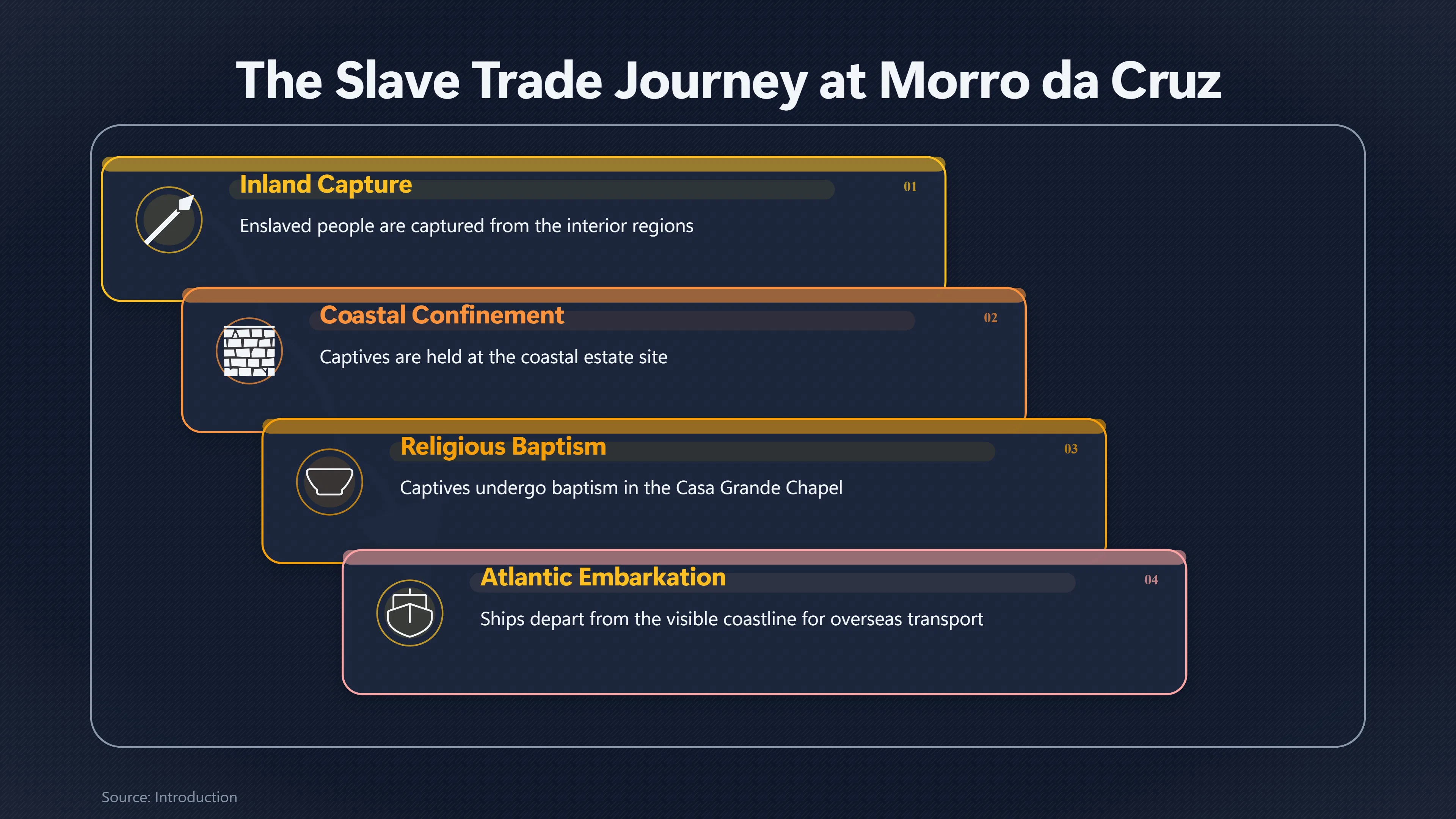
The location matters as much as the building. From Morro da Cruz the Atlantic is immediately visible, making the coastline part of the interpretation rather than merely the scenery. Visitors can understand that the route from inland capture to coastal confinement ended here, before continuing across the ocean. The view compresses geography into lived experience: the sea is no longer an abstract destination but the final horizon many captives saw before transportation.[Welcome to Angola]welcometoangola.co.aoWelcome to Angola Visitar o Museu Nacional da Escravatura: LuandaWelcome to AngolaVisitar o Museu Nacional da Escravatura: Luanda - Welcome To Angola…
This combination of surviving architecture and landscape distinguishes the museum from many slavery exhibitions elsewhere. Rather than reconstructing events through immersive technology, it relies on the authenticity of place. The chapel, estate and shoreline function together as historical evidence that cannot easily be relocated or replicated.[visiteluanda.com]visiteluanda.comNational Slavery MuseumPlaces of Interest…
Shackles, ship models and forced renaming
Inside the museum, displays include iron shackles, restraints, weights, weapons, ship models and baptismal objects connected with the Atlantic slave trade. Individually, these artefacts are familiar categories within slavery museums around the world. At Morro da Cruz, however, they are interpreted within the sequence of events that occurred on the estate itself.[gettyimages.ae]gettyimages.aeGetty ImagesOctober 20, 2021…
The baptismal setting is especially significant. Historical interpretation at the museum explains that captives were baptised before embarkation, a process tied to colonial ideas of religious conversion and incorporation into the Portuguese imperial system. Baptism frequently accompanied the assignment of Christian names, replacing or obscuring existing identities before transportation overseas. The museum therefore presents baptismal objects not simply as religious artefacts but as material witnesses to cultural transformation carried out under coercive conditions.[visiteluanda.com]visiteluanda.comNational Slavery MuseumPlaces of Interest…
Nearby, ship models help visitors understand that the Atlantic crossing was not an abstract historical process but a carefully organised commercial system. Combined with shackles and restraints, the models connect inland capture, confinement on the coast and overseas transportation into one continuous narrative rather than isolated episodes.[gettyimages.ae]gettyimages.aeGetty ImagesOctober 20, 2021…
The displays deliberately avoid treating these objects as curiosities. Their purpose is evidential: they illustrate how physical restraint, administrative control and religious ritual worked together within the wider machinery of the transatlantic slave trade.[Welcome to Angola]welcometoangola.co.aoWelcome to Angola Visitar o Museu Nacional da Escravatura: LuandaWelcome to AngolaVisitar o Museu Nacional da Escravatura: Luanda - Welcome To Angola…

What the site can prove and what provenance still matters
One reason the museum carries particular authority is that several key elements of the story are anchored to surviving physical locations. The chapel remains where baptisms occurred, and the estate itself is historically associated with slave trading activity. Those facts give the museum a stronger geographical connection than exhibitions built entirely from relocated collections.[visiteluanda.com]visiteluanda.comNational Slavery MuseumPlaces of Interest…
The individual objects, however, deserve the same scrutiny applied to any historical collection. Museums dealing with slavery often contain items acquired from different locations and periods, and not every restraint or weapon can necessarily be tied to a single documented individual or voyage. Good interpretation therefore depends on explaining provenance where it is known and distinguishing authenticated local artefacts from representative objects used to illustrate broader historical practices. This distinction matters because visitors often assume every displayed item originated on the estate itself when museum collections are usually assembled through multiple acquisition histories.[Welcome to Angola]welcometoangola.co.aoWelcome to Angola Visitar o Museu Nacional da Escravatura: LuandaWelcome to AngolaVisitar o Museu Nacional da Escravatura: Luanda - Welcome To Angola…
The museum’s strength lies less in proving every object’s exact biography than in preserving a documented historical setting where architecture, landscape and collections reinforce one another. The combination creates a rare form of evidence in which place itself becomes one of the most important exhibits.
Why the coastal setting remains so powerful
Many memorial museums depend primarily on text panels and artefacts. At Morro da Cruz, memory is also carried by the environment. The Atlantic coastline outside the chapel continually reminds visitors that millions of people left West Central Africa by sea, with Angola supplying one of the largest numbers of enslaved Africans transported to the Americas, particularly Brazil. The physical proximity between chapel and ocean turns distant historical statistics into an immediate spatial experience.[Reuters]reuters.compresident has visited the country. During his visit, Biden aims to acknowledge the shared history between the U.S. and Angola in the tran…
That immediacy has continued to shape the site’s public role. International commemorations have used the museum precisely because it links surviving buildings, historical objects and the Atlantic world in a single location. Recent restoration support has likewise focused on preserving the historic fabric of the chapel as well as the museum collections, recognising that the site’s significance depends on both.[Reuters]reuters.compresident has visited the country. During his visit, Biden aims to acknowledge the shared history between the U.S. and Angola in the tran…
Amazon book picks
Further Reading
Books and field guides related to Why Angola's Slavery Museum Feels So Immediate. Use these as the next step if you want deeper reading beyond the article.
Central Africans, Atlantic Creoles, and the Foundation of the...
This book establishes Central Africa as the origin of most Africans brought to English and Dutch American colonies in North America, the...
The Atlantic Slave Trade
First published 1999. Subjects: Europe, Slave-trade, Slave trade, Africa, America.

Transformations in Slavery: A History of Slavery in Africa
First published 1983. Subjects: Africa, History, Slave trade, Slave-trade, Slavery.
The Slave Trade: The Story of the Atlantic Slave Trade, 1440-...
First published 1997. Subjects: Slavenhandel, Slave-trade, Slave trade, Commerce, Esclaves.
eBay marketplace picks
Marketplace Samples
Live-tested eBay searches with available results related to this page.
Selected fromslave ship model oneBay.co.uk.


Endnotes
1.
Source: visiteluanda.com
Title: National Slavery Museum
Link:https://www.visiteluanda.com/en/locais-interesse/museu-nacional-escravatura.html
Source snippet
Places of Interest...
2.
Source: reuters.com
Link:https://www.reuters.com/world/africa/biden-mark-us-angolas-shared-slave-trade-history-2024-12-03/
Source snippet
president has visited the country. During his visit, Biden aims to acknowledge the shared history between the U.S. and Angola in the tran...
3.
Source: mincult.gov.ao
Link:https://mincult.gov.ao/home
4.
Source: gettyimages.ae
Link:https://www.gettyimages.ae/detail/news-photo/an-outside-view-of-the-national-museum-of-slavery-in-luanda-news-photo/1235998621
Source snippet
Getty ImagesOctober 20, 2021...
Published: October 20, 2021
5.
Source: gettyimages.dk
Link:https://www.gettyimages.dk/detail/news-photo/weapons-presented-at-the-national-museum-of-slavery-are-news-photo/1235998779
Source snippet
Getty Images...
6.
Source: gettyimages.pt
Link:https://www.gettyimages.pt/detail/fotografia-de-not%C3%ADcias/an-inside-view-from-the-national-museum-of-fotografia-de-not%C3%ADcias/1235999125
Source snippet
Getty Images...
7.
Source: gettyimages.dk
Link:https://www.gettyimages.dk/detail/news-photo/an-outside-view-from-the-national-museum-of-slavery-in-news-photo/1235998658
8.
Source: gettyimages.pt
Link:https://www.gettyimages.pt/detail/fotografia-de-not%C3%ADcias/an-iron-handcuff-with-chain-presented-at-the-fotografia-de-not%C3%ADcias/1235998853
9.
Source: gettyimages.pt
Link:https://www.gettyimages.pt/detail/fotografia-de-not%C3%ADcias/an-iron-handcuff-with-chain-presented-at-the-fotografia-de-not%C3%ADcias/1235998967
11.
Source: monumentos.gov.pt
Link:https://www.monumentos.gov.pt/Site/APP_PagesUser/SIPA.aspx?id=34169
12.
Source: mincultur.gov.ao
Title: Ministério da Cultura e Turismo
Link:https://mincultur.gov.ao/documentos/legislacao/
13.
Source: welcometoangola.co.ao
Title: Welcome to Angola Visitar o Museu Nacional da Escravatura: Luanda
Link:https://welcometoangola.co.ao/en/directorio/museu-nacional-da-escravatura/
Source snippet
Welcome to AngolaVisitar o Museu Nacional da Escravatura: Luanda - Welcome To Angola...
14.
Source: museum-explorer.com
Title: National Museum of Slavery
Link:https://museum-explorer.com/national-museum-of-slavery/
15.
Source: welcometoangola.co.ao
Title: Visitar o Museu Nacional da Escravatura: Luanda
Link:https://welcometoangola.co.ao/directorio/museu-nacional-da-escravatura/
Additional References
16.
Source: theguardian.com
Link:https://www.theguardian.com/world/2024/dec/03/us-history-of-enslavement-in-spotlight-joe-biden-angola
Source snippet
He mentioned that the US has not fully lived up to the idea that all men and women are created equal, a concept embedded in the Declarati...
17.
Source: youtube.com
Title: National Highlight Part 3: Slavery Museum portrays the experiences of slaves
Link:https://www.youtube.com/watch?v=XfRkvVleWms
Source snippet
U.S. President Biden visits slavery museum in Angola...
18.
Source: youtube.com
Title: Watch Biden’s speech at Angola’s National Museum of Slavery
Link:https://www.youtube.com/watch?v=5N87opPO448
Source snippet
Biden in Angola: Meeting & Remarks at National Museum of Slavery | Live...
19.
Source: youtube.com
Title: Biden speaks on ‘shared history’ of slavery during Angola visit
Link:https://www.youtube.com/watch?v=FJD-cnz2jyo
Source snippet
Watch Biden's speech at Angola's National Museum of Slavery...
20.
Source: youtube.com
Title: U.S. President Biden visits slavery museum in Angola
Link:https://www.youtube.com/watch?v=Kzt_4JZVk3s
Source snippet
Biden speaks on 'shared history' of slavery during Angola visit...
21.
Source: elpais.com
Link:https://elpais.com/cultura/2024-11-18/datos-grilletes-y-pilas-bautismales-para-no-olvidar-la-esclavitud.html
22.
Source: gettyimages.com.br
Link:https://www.gettyimages.com.br/detail/foto-jornal%C3%ADstica/iron-handcuffs-with-chain-presented-at-the-national-foto-jornal%C3%ADstica/1235998470
23.
Source: casafrica.es
Link:https://www.casafrica.es/es/redes/museo-nacional-de-la-esclavitud-museu-nacional-da-escravatura
24.
Source: momaa.org
Link:https://momaa.org/directory/national-museum-of-slavery/
25.
Source: unesco.org
Link:https://www.unesco.org/en/query-list/t/transatlantic-slave-trade