Where Comoros Keeps Its Strangest Stories
Comoros does not have a well-documented circuit of witchcraft museums, occult collections or commercial “weird attractions”. Its curiosity culture is concentrated instead in one small national museum, archaeological remains embedded in living towns, religious and ceremonial material, volcanic specimens and an internationally famous deep-sea fish.
Page outline Jump by section
Introduction
The important caveat is that information is fragmented. Comoros has relatively few formal museums, limited online cataloguing and heritage that often remains in mosques, households, old urban quarters and community practice rather than behind glass. That absence is itself revealing. Here, unusual heritage is less a separate entertainment category than part of a still-living relationship between objects, belief, landscape and memory.
The national museum’s cabinet of islands
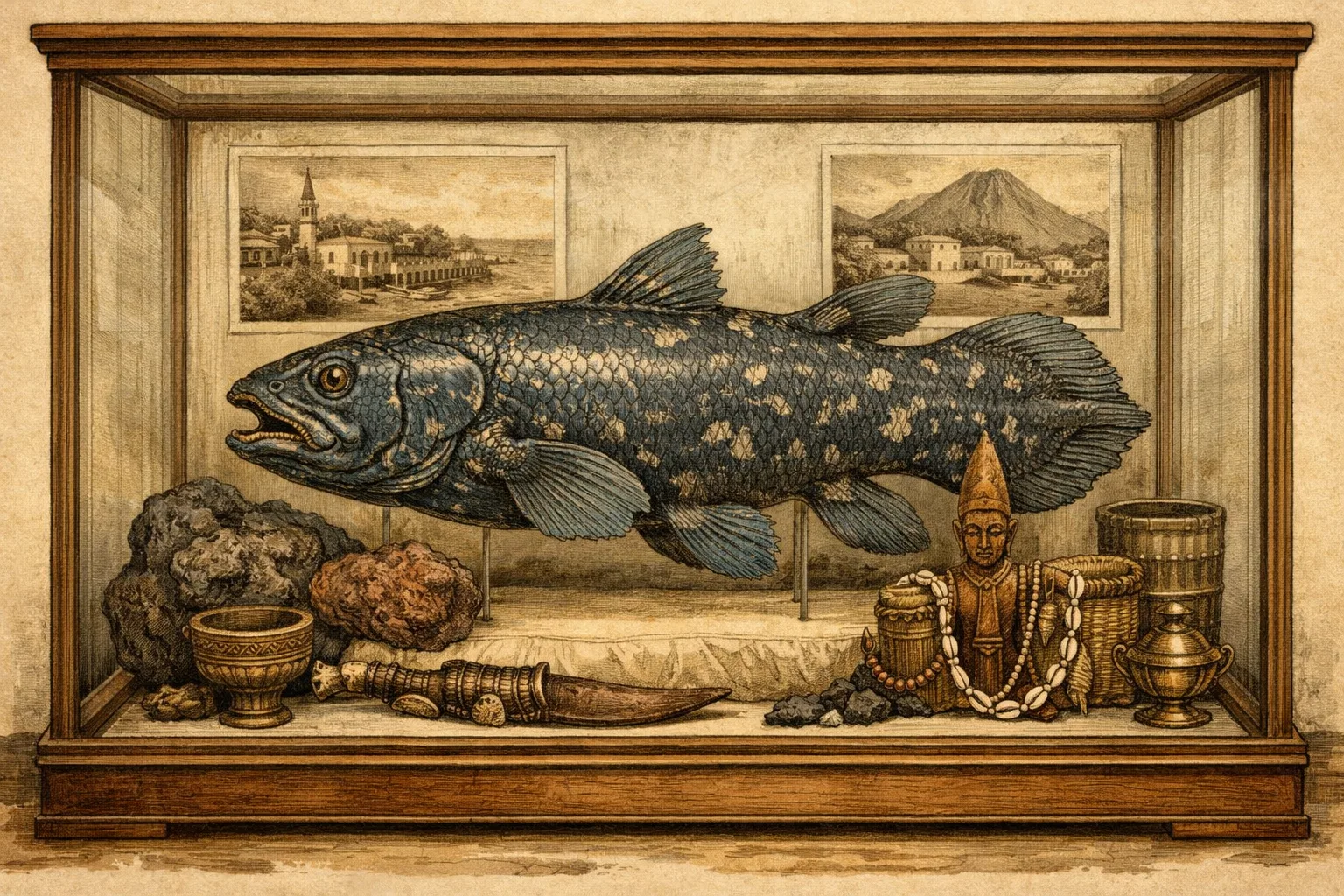
Founded around the end of the 1980s, the National Museum of the Comoros forms part of the National Centre for Documentation and Scientific Research. Rather than specialising in one subject, it compresses an entire archipelago into four modest exhibition areas: history, art, archaeology and religion; volcanology and earth science; oceanography and natural history; and social and cultural anthropology. Two smaller regional museums on Anjouan and Mohéli have also been associated with the national institution, although reliable current descriptions of their displays are difficult to find.[africacommons.net]africacommons.netLe musée national des ComoresIt has four exhibit rooms with collections on: History, Art, Archeology and Religion Volcanology and Earth S…
That breadth gives the Moroni museum the character of an old-fashioned cabinet of curiosity. Potsherds and written records may sit within the same institution as volcanic rocks, endemic birds, ceremonial clothing and preserved marine animals. Accounts of the displays mention archaeological material dating back many centuries, photographs of former rulers and settlements, religious sculptures, craft objects and clothing connected with royal or elite traditions. The museum is therefore not “strange” because it promotes paranormal claims. It is unusual because social history, sacred material, geological danger and biological rarity are treated as parts of the same national story.[wikipedia.org]WikipediaMusée National des ComoresMusée National des Comores
Visitors should expect a small, information-led institution rather than a polished immersive attraction. Recent visitor reports describe varied displays and extensive explanatory text, while also warning that the entrance can be difficult to identify and that access has sometimes been uncertain. Published opening times on third-party travel sites should consequently be treated as provisional rather than guaranteed. The sensible approach is to verify locally through the research centre or accommodation in Moroni before travelling specifically for the museum.[Tripadvisor]tripadvisor.co.ukTripadvisor NATIONAL MUSEUM OF THE COMOROSNATIONAL MUSEUM OF THE COMOROS - All You…The museum offers very varied departments, such as biodiversity, ethnology in the…
The coelacanth: Comoros’ real sea monster
The museum’s most memorable natural-history object is a preserved coelacanth. With its heavy body, fleshy paired fins and prehistoric appearance, the fish looks perfectly designed for legends about creatures surviving in inaccessible depths. The underlying story, however, is scientific rather than supernatural.
Coelacanths were known from fossils before a living specimen was identified in South Africa in 1938–39. Later research established an especially strong connection with the deep volcanic waters around Comoros, where fishers had long encountered the animal. The islands subsequently became central to scientific understanding of the western Indian Ocean species. Specimens from Comorian waters now appear in natural-history collections around the world, including Copenhagen, while major museums in London and Washington use the fish to tell stories about evolution, extinction and rediscovery.[si.edu]ocean.si.eduOpen source on si.edu.
Calling the coelacanth a “living fossil” is vivid but potentially misleading. It does not mean that an individual modern species has remained completely unchanged since the age of the dinosaurs. It means that the surviving lineage preserves a body plan once known chiefly from ancient fossils. Its limb-like fins are scientifically important, but coelacanths are not direct half-fish, half-land-animal ancestors waiting to walk ashore.[Smithsonian Ocean]ocean.si.eduOpen source on si.edu.
For Comorian curiosity culture, the fish matters on several levels. It is a genuine zoological rarity, a source of international scientific attention and a creature whose global museum fame is much greater than its visibility within Comoros itself. The preserved example in Moroni reverses that imbalance: the famous “prehistoric” animal is displayed in the country whose waters became one of its best-known refuges.
Volcano specimens turn disaster into memory
Comoros is a volcanic archipelago, and the national museum’s geological section reportedly contains volcanic rocks and aerial material relating to Mount Karthala and the northern volcanic massif of Grande Comore. These objects may appear less eccentric than a preserved coelacanth, but they represent another important form of unusual collecting: the preservation of material produced by a landscape that remains active and potentially destructive.[ww2.aam-us.org]ww2.aam-us.orgcomoros national museum of comoros museumsconnect 2013INTERNATIONAL PARTNERSHIPS AMONG MUSEUMSOctober 15, 2012 — 15 Oct 2012 — The National Museum comprises four exhibit rooms housing collect…
A volcanic rock in a display case is both an ordinary geological sample and a fragment of catastrophe. In Comoros, eruptions, lava fields and crater landscapes are not remote deep-time phenomena. They shape settlement, water supplies, farming and public ideas about danger. The museum’s combination of aerial photographs, rock specimens and earth-science interpretation therefore turns the islands themselves into the principal exhibit.
This geological emphasis also distinguishes the museum from many small national history museums. A visitor can move from sultanate history and religious material into volcanology, then into marine biology. The effect is to show Comorian identity as something formed jointly by human migration, Islamic civilisation, unstable geology and oceanic isolation rather than by a single national narrative.

Sacred objects without an occult museum
Comorian society has a long Islamic scholarly and devotional history, alongside local oral traditions and inherited systems of healing, protection and explanation. Yet there is no strong evidence for a public museum devoted specifically to sorcery, spirit belief, amulets or witchcraft. Claims about such an attraction should be treated sceptically unless supported by current local documentation.
Religious objects in the national museum are better understood as historical and ethnographic material than as props in a supernatural exhibition. Museum descriptions refer broadly to religious symbols, sculpture, documents and objects associated with regional history. Without a detailed public catalogue, it is unsafe to label individual pieces magical, talismanic or occult merely because they have a devotional appearance.[momaa.org]momaa.orgNational Museum of ComorosThe first room serves as a window into the past, presenting an array of historical artifacts, religious symbols…
This distinction matters because Islamic material culture is often misrepresented in foreign collections. Written prayers, inscribed objects and protective texts may be devotional, medicinal, educational or ceremonial depending on their context. Across African museum collections, Qur’anic writing can appear on manuscripts, amulets, boards and wearable containers, sometimes alongside number patterns or protective designs. That wider comparison helps explain what might exist in Comorian private or religious collections, but it does not prove that the Moroni museum holds a particular class of magical object.[PMC]pmc.ncbi.nlm.nih.govOpen source on nih.gov.
The more intriguing reality is that much of Comoros’ spiritually charged material may never have entered a museum. Objects can remain useful, inherited or sacred rather than becoming detached curiosities. A manuscript still read, clothing still worn at a ceremony or object still associated with family authority occupies a different world from an artefact collected solely for display.
Historic towns as open-air collections
Where formal museums are sparse, the old towns of Comoros provide a broader form of public collection. The medinas associated with the historic sultanates preserve mosques, palaces, tombs, defensive structures, street patterns and domestic architecture shaped by connections across the western Indian Ocean. UNESCO-supported inventories have documented the architectural and urban heritage of places including Mutsamudu, while Comoros submitted a World Heritage nomination dossier for its historic sultanates in January 2025.[UNESCO World Heritage Centre]whc.unesco.orgOpen source on unesco.org.
These settlements are not frozen museum sets. They remain inhabited places where buildings may continue to carry religious, social or family significance. That makes them more difficult to interpret than a conventional monument collection: an old doorway, mosque, tomb or ruined palace can be at once an archaeological source, a community landmark and a focus of local memory.
Their curiosity value lies in layers rather than isolated oddities. Architectural forms record trading links with eastern Africa, Madagascar and the wider Islamic world. Elite buildings preserve traces of former sultanates, while tombs and mosques connect political history with sacred geography. Recent international heritage assessments describe the medinas as evidence for living cultural traditions and social practices, not merely as picturesque ruins.[UNESCO World Heritage Centre]whc.unesco.orgOpen source on unesco.org.
For visitors interested in unusual collections, this means looking beyond glass cases. The “collection” may be a whole urban fabric: carved doors, masonry, ruined fortifications, prayer spaces and stories attached to particular families or rulers. Interpretation is likely to depend on local guides and community knowledge, and access to religious or private spaces should never be assumed.
Why folklore is difficult to put behind glass
Comoros’ heritage is strongly oral and performative. Songs, ceremonies, marriage traditions, religious learning and local histories are preserved through participation as much as through objects. UNESCO programmes in the country have therefore emphasised documentation, inventories, research, awareness and community capacity for safeguarding living heritage.[ICH UNESCO]ich.unesco.orgICH UNESCOComorosICH UNESCOComoros
This helps explain why a search for Comorian monster museums or folklore cabinets produces so little. The lack of a dedicated building does not indicate a lack of unusual belief or storytelling. It indicates that such material may circulate through speech, music, ritual and family transmission rather than through permanent exhibitions. Intangible heritage, by definition, includes inherited oral traditions, performing arts, social practices and knowledge that communities continue to recreate.[ICH UNESCO]ich.unesco.orgOpen source on unesco.org.
For a curious traveller, that creates both opportunity and responsibility. Local narratives about spirits, sacred places, unexplained events or protective practices should not automatically be treated as entertainment or evidence of paranormal phenomena. They may express religious teaching, social boundaries, environmental memory or community identity. The most credible interpretation comes from asking how a story is used, who tells it and whether it is regarded as belief, metaphor, history or performance.
What is genuinely unusual in Comoros
Comoros’ strange-heritage landscape is small but distinctive. Its strongest elements are not fabricated mysteries but unlikely combinations:
- A national cabinet in miniature: archaeology, royal history, religion, volcanic geology, endemic wildlife and ethnography compressed into four rooms.
- A scientifically real “monster fish”: the preserved coelacanth, linked to one of the twentieth century’s most famous zoological rediscoveries.
- Landscape collected as evidence: volcanic rocks and aerial records that turn an active and hazardous environment into museum material.
- Living medinas rather than reconstructed sets: historic sultanate towns where monuments, tombs, mosques and domestic buildings remain woven into ordinary life.
- Sacred heritage that resists easy classification: religious and ceremonial objects whose meanings cannot responsibly be reduced to “magic”.
- An archive beyond objects: songs, oral knowledge and social practices being documented because they cannot be preserved adequately in cases alone.
The country is therefore best approached not as an undiscovered centre of occult tourism, but as a place where natural oddity, sacred history and community memory overlap. Its most remarkable exhibit is a fish that seemed to return from extinction; its largest museum is the volcanic and oceanic landscape itself; and many of its most culturally powerful “collections” remain alive outside formal institutions.
Amazon book picks
Further Reading
Books and field guides related to Where Comoros Keeps Its Strangest Stories. Use these as the next step if you want deeper reading beyond the article.
A History of Zimbabwe
The first single-volume history of Zimbabwe with detailed coverage from pre-colonial times to the present, this book examines Zimbabwe's...
A History of African Archaeology
First published 1990. Subjects: History, Antiquities, Archaeology, Archéologie, Antiquités.
eBay marketplace picks
Marketplace Samples
Live-tested eBay searches with available results related to this page.
Selected fromAfrican archaeology decor oneBay.co.uk.
Endnotes
1.
Source: ww2.aam-us.org
Title: comoros national museum of comoros museumsconnect 2013
Link:https://ww2.aam-us.org/docs/international/comoros-national-museum-of-comoros-museumsconnect-2013.pdf?sfvrsn=2
Source snippet
INTERNATIONAL PARTNERSHIPS AMONG MUSEUMSOctober 15, 2012 — 15 Oct 2012 — The National Museum comprises four exhibit rooms housing collect...
Published: October 15, 2012
2.
Source: africa.com
Title: museums of comoros
Link:https://africa.com/museums-of-comoros
Source snippet
National Museum of ComorosThe museum, which opened in 1989, has four exhibit rooms that house collections on history, art, archeology, an...
3.
Source: africacommons.net
Link:https://africacommons.net/collections/33457/le-musee-national-des-comores/
Source snippet
Le musée national des ComoresIt has four exhibit rooms with collections on: History, Art, Archeology and Religion Volcanology and Earth S...
4.
Source: Wikipedia
Title: National Museum of the Comoros
Link:https://en.wikipedia.org/wiki/National_Museum_of_the_Comoros
5.
Source: Wikipedia
Title: Musée National des Comores
Link:https://de.wikipedia.org/wiki/Mus%C3%A9e_National_des_Comores
6.
Source: momaa.org
Link:https://momaa.org/directory/national-museum-of-comoros/?srsltid=AfmBOorJuL-Km_fWRCtfmKkqGiWaWcN1FJlFpWzqbVkSodtSIqRMXwzD
Source snippet
National Museum of ComorosThe first room serves as a window into the past, presenting an array of historical artifacts, religious symbols...
7.
Source: pmc.ncbi.nlm.nih.gov
Link:https://pmc.ncbi.nlm.nih.gov/articles/PMC12701302/
8.
Source: whc.unesco.org
Link:https://whc.unesco.org/document/206877
9.
Source: whc.unesco.org
Link:https://whc.unesco.org/document/221018
10.
Source: whc.unesco.org
Link:https://whc.unesco.org/document/137881
11.
Source: whc.unesco.org
Link:https://whc.unesco.org/document/226090
12.
Source: whc.unesco.org
Link:https://whc.unesco.org/document/226095
13.
Source: ich.unesco.org
Title: ICH UNESCOComoros
Link:https://ich.unesco.org/en/state/comoros-KM
14.
Source: ich.unesco.org
Link:https://ich.unesco.org/en/news/comoros-makes-significant-strides-to-ensure-the-safeguarding-of-living-heritage-13250
15.
Source: ich.unesco.org
Link:https://ich.unesco.org/en/news/comoros-launches-activities-to-safeguard-intangible-cultural-heritage-00299
16.
Source: ich.unesco.org
Link:https://ich.unesco.org/en/projects/strengthening-capacities-in-the-comoros-for-safeguarding-intangible-cultural-heritage-for-sustainable-development-00384
17.
Source: ich.unesco.org
Link:https://ich.unesco.org/en/what-is-intangible-heritage-00003
18.
Source: whc.unesco.org
Link:https://whc.unesco.org/en/tentativelists/6974/
19.
Source: whc.unesco.org
Title: orgÉcosystème terrestre et paysage culturel de Mohéli
Link:https://whc.unesco.org/en/tentativelists/6977/
20.
Source: unesco.org
Link:https://www.unesco.org/en/articles/stitching-heritage-unesco-supports-safeguarding-living-heritage-comoros
21.
Source: unesco.org
Title: comoros finalizes sustainable tourism management plan
Link:https://www.unesco.org/en/articles/comoros-finalizes-sustainable-tourism-management-plan
22.
Source: unesco.org
Title: Comoros is undertaking a pilot inventory of their intangible cultural
Link:https://www.unesco.org/en/articles/comoros-undertaking-pilot-inventory-their-intangible-cultural-heritage-participation-communities
23.
Source: nhm.at
Title: Naturhistorisches Museum Wien
Link:https://www.nhm.at/presse/top10/coelacanth
24.
Source: whc.unesco.org
Link:https://whc.unesco.org/en/activities/793/
25.
Source: unesco.org
Title: Direction generale des arts et de la culture
Link:https://www.unesco.org/creativity/en/policy-monitoring-platform/direction-generale-des-arts-et-de-la-culture
26.
Source: unesco.org
Title: Collection of Arabic Manuscripts and Books
Link:https://www.unesco.org/en/memory-world/collection-arabic-manuscripts-and-books
27.
Source: ich.unesco.org
Link:https://ich.unesco.org/en/lists
28.
Source: ich.unesco.org
Title: LHE 25 20.CO M 7.b EN.docx
Link:https://ich.unesco.org/doc/src/LHE-25-20.COM-7.b_EN.docx
29.
Source: whc.unesco.org
Link:https://whc.unesco.org/en/newproperties/
30.
Source: unesdoc.unesco.org
Link:https://unesdoc.unesco.org/ark%3A/48223/pf0000146896
31.
Source: unesco.org
Link:https://www.unesco.org/en/cultnatlaws/table
32.
Source: whc.unesco.org
Link:https://whc.unesco.org/en/search/?criteria=go+online+PROBLEMGO.com+buy+way+out+of+jail+early+hidden+link+access+renowned+specialists+team&maxrows=200
33.
Source: unesdoc.unesco.org
Link:https://unesdoc.unesco.org/ark%3A/48223/pf0000398388
34.
Source: ich.unesco.org
Link:https://ich.unesco.org/en/events/workshop-on-institutional-and-legal-frameworks-in-comoros-for-intangible-cultural-heritage-00671
35.
Source: unesdoc.unesco.org
Link:https://unesdoc.unesco.org/ark%3A/48223/pf0000084387
36.
Source: ich.unesco.org
Link:https://ich.unesco.org/en/news/comoros-strives-to-strengthen-its-legislative-framework-for-safeguarding-intangible-cultural-heritage-00332
37.
Source: unesdoc.unesco.org
Link:https://unesdoc.unesco.org/ark%3A/48223/pf0000127347
38.
Source: whc.unesco.org
Title: org48 COM4 days ago —
Link:https://whc.unesco.org/document/226646
39.
Source: ich.unesco.org
Link:https://ich.unesco.org/en/video/76489
40.
Source: unesdoc.unesco.org
Link:https://unesdoc.unesco.org/ark%3A/48223/pf0000073644
41.
Source: ich.unesco.org
Title: patronage reporting 00493
Link:https://ich.unesco.org/en/patronage-reporting-00493
42.
Source: whc.unesco.org
Link:https://whc.unesco.org/archive/2021/whc21-44com-5A-en.pdf
43.
Source: ich.unesco.org
Link:https://ich.unesco.org/en/Decisions/20.COM/7.b.15
44.
Source: unesdoc.unesco.org
Link:https://unesdoc.unesco.org/ark%3A/48223/pf0000071669
45.
Source: whc.unesco.org
Link:https://whc.unesco.org/archive/2023/whc23-45com-5A-en.pdf
46.
Source: momaa.org
Link:https://momaa.org/directory/national-museum-of-comoros/?srsltid=AfmBOoogzGueWeYx8KHPJ3UU1KuFdbmRGjjBUrG-7_yqCZ1siXxXIUbD
47.
Source: momaa.org
Link:https://momaa.org/directory/national-museum-of-comoros/
48.
Source: tripadvisor.co.uk
Title: Tripadvisor NATIONAL MUSEUM OF THE COMOROS
Link:https://www.tripadvisor.co.uk/Attraction_Review-g294436-d13959872-Reviews-National_Museum_of_the_Comoros-Moroni_Grande_Comore.html
Source snippet
NATIONAL MUSEUM OF THE COMOROS - All You...The museum offers very varied departments, such as biodiversity, ethnology in the...
49.
Source: ocean.si.edu
Link:https://ocean.si.edu/ocean-life/fish/coelacanth
50.
Source: collections.snm.ku.dk
Link:https://collections.snm.ku.dk/en/object/NHMD1567131
51.
Source: ocean.si.edu
Title: historical coelacanth display
Link:https://ocean.si.edu/ocean-life/fish/historical-coelacanth-display
52.
Source: ocean.si.edu
Title: coelacanth display
Link:https://ocean.si.edu/museum/coelacanth-display
53.
Source: africanarchaeology.org
Link:https://www.africanarchaeology.org/comoros-1
54.
Source: wellcomecollection.org
Link:https://wellcomecollection.org/search/works?query=Amulets
55.
Source: si.edu
Title: Coelacanth Fish, NMNH | Smithsonian Institution
Link:https://www.si.edu/object/coelacanth-fish-nmnh%3Asiris_sic_7497
Additional References
56.
Source: nhm.ac.uk
Title: coelacanths the fish that outdid the loch ness monster
Link:https://www.nhm.ac.uk/discover/coelacanths-the-fish-that-outdid-the-loch-ness-monster.html
Source snippet
Today, coelacanths are particularly tied to deep water volcanic areas, like the Comoros Islands.... Image © Fairfax Media via National L...
57.
Source: oecd.org
Link:https://www.oecd.org/en/publications/2023/10/production-transformation-policy-review_6b4b4aaa/full-report/component-7.html
58.
Source: youtube.com
Link:https://www.youtube.com/watch?v=8uJDRodDADo
Source snippet
Mangroves of the Comoros: Restoring "Our Rampart"...
59.
Source: youtube.com
Title: ‘Finding Old Fourlegs’ presented by Prof Mike Bruton
Link:https://www.youtube.com/watch?v=KfHElNjbthc
Source snippet
AFCON 2025: The coelacanth, Comoros' national symbol in football and beyond...
60.
Source: youtube.com
Title: Mangroves of the Comoros: Restoring “Our Rampart”
Link:https://www.youtube.com/watch?v=FkYEaAmf1M8
Source snippet
Grande COMORE: The Karthala, an unknown volcano?...
61.
Source: researchgate.net
Link:https://www.researchgate.net/publication/397798503_Multianalytical_Study_of_Amuletic_and_Talismanic_Islamic-African_Paper_Manuscripts_in_the_Slovene_Ethnographic_Museum
62.
Source: nhm.ac.uk
Link:https://www.nhm.ac.uk/press-office/press-releases/150-year-old-museum-specimen-revealed-as-missing-link-in-evoluti.html
63.
Source: africabib.org
Link:https://www.africabib.org/rec.php?DB=p&RID=066936888
64.
Source: facebook.com
Link:https://www.facebook.com/groups/restitutionmatters/posts/2958560577626968/
65.
Source: ierek.com
Link:https://www.ierek.com/events/circular-raw-materials-and-recycling-for-sustainability-crawma-1st-edition