Within Djibouti Curiosities
Why Are African Giants Carved at Abourma?
Abourma preserves thousands of engravings whose elephants, giraffes and cattle reveal a greener prehistoric Djibouti.
On this page
- What the engravings show
- How scholars interpret the images
- What visiting the remote site involves
Page outline Jump by section
Introduction
Abourma is not a conventional museum, yet it is one of Djibouti’s most remarkable open-air collections. Spread across the basalt slopes of the Makarrassou Massif in the Tadjourah region, the site preserves thousands of prehistoric engravings carved over many centuries. Among its most striking images are elephants, giraffes, rhinoceroses, hippopotamuses and other large animals that no longer inhabit Djibouti. Together, these carvings form an extraordinary visual archive of a landscape that was once greener, wetter and far richer in wildlife than the country is today.[UNESCO World Heritage Centre]whc.unesco.orgWorld Heritage Centre Les Gravures Rupestre d’AbourmaUNESCO World Heritage CentreLes Gravures Rupestre d’Abourma - UNESCO World Heritage CentreJanuary 5, 2015…
For anyone interested in unusual heritage, Abourma stands out because it preserves evidence rather than legend. The engravings offer a rare glimpse into vanished ecosystems and the lives of prehistoric pastoral communities, making the site one of the strongest candidates for Djibouti’s first UNESCO World Heritage inscription.[UNESCO World Heritage Centre]whc.unesco.orgUNESCO World Heritage CentreDjibouti advances in the preparation of its first nomination dossier to the World Heritage List - UNESCO Worl…
Why Are African Giants Carved at Abourma?
The most surprising aspect of Abourma is the contrast between the carvings and the modern landscape. Today’s northern Djibouti is largely arid, rocky and volcanic, yet the engraved panels depict animals associated with rivers, woodlands and savannahs.
The best-known figures include:
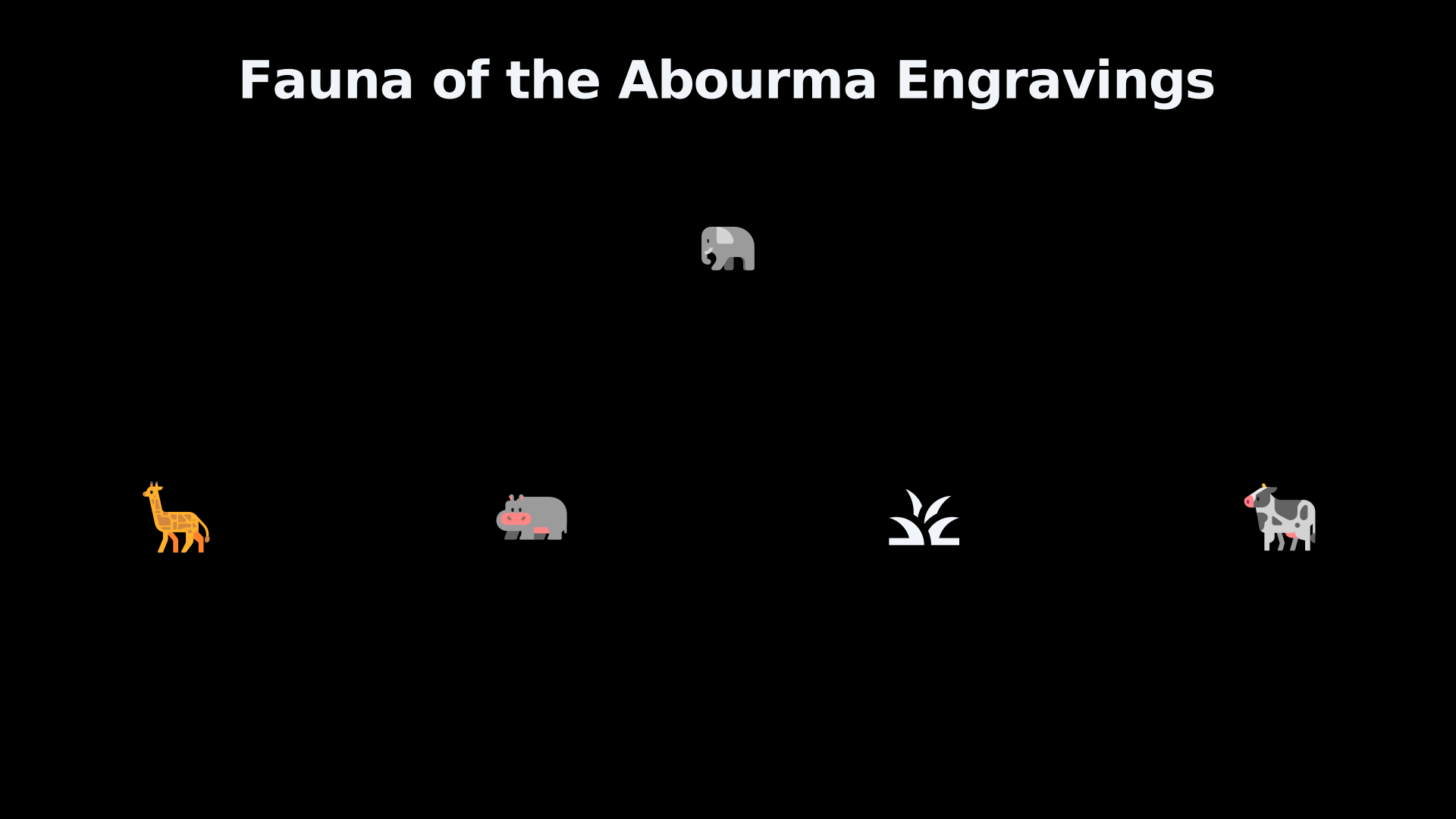
- Elephants with prominent tusks.
- Giraffes shown with elongated necks and distinctive proportions.
- Rhinoceroses and hippopotamuses.
- Antelope and other wild game.
- Cattle, goats and other domesticated livestock.
- Human hunters, warriors and herders.[UNESCO World Heritage Centre]whc.unesco.orgWorld Heritage Centre Les Gravures Rupestre d’AbourmaUNESCO World Heritage CentreLes Gravures Rupestre d’Abourma - UNESCO World Heritage CentreJanuary 5, 2015…
Rather than representing mythical creatures, these animals are widely interpreted as records of species that once inhabited the wider Horn of Africa during wetter climatic phases of the Holocene. As rainfall declined over thousands of years, habitats shifted and large mammals gradually disappeared from what is now Djibouti. The engravings therefore preserve a memory of ecological change as well as human activity.[UNESCO World Heritage Centre]whc.unesco.orgWorld Heritage Centre Les Gravures Rupestre d’AbourmaUNESCO World Heritage CentreLes Gravures Rupestre d’Abourma - UNESCO World Heritage CentreJanuary 5, 2015…
The sheer scale of the site also makes it exceptional. UNESCO’s Tentative List describes nearly three kilometres of engraved rock surfaces containing thousands of figures and scenes spread across basalt outcrops, making it the largest known rock art complex in Djibouti and one of the most extensive in eastern Africa.[UNESCO World Heritage Centre]whc.unesco.orgWorld Heritage Centre Les Gravures Rupestre d’AbourmaUNESCO World Heritage CentreLes Gravures Rupestre d’Abourma - UNESCO World Heritage CentreJanuary 5, 2015…
What the Engravings Show
Although the famous elephants and giraffes attract most attention, Abourma is far more than a prehistoric animal gallery.
Researchers have identified scenes that include hunting parties, combat between groups of archers, herding, and people interacting with domestic animals. One particularly unusual composition shows people forming a circle around a cow, suggesting that livestock held social or ceremonial importance beyond simple food production.[ScienceDirect]sciencedirect.comScienceDirect Les Hommes d’Abourma (République de DjiboutiLes Hommes d’Abourma (République de Djibouti) - ScienceDirect…
The variety of subjects matters because it transforms the site from a collection of isolated pictures into a narrative landscape. Instead of depicting animals alone, many panels illustrate relationships between people, wildlife and domesticated herds. These scenes hint at changing economies as communities combined hunting with increasingly organised pastoral life.[UNESCO World Heritage Centre]whc.unesco.orgWorld Heritage Centre Les Gravures Rupestre d’AbourmaUNESCO World Heritage CentreLes Gravures Rupestre d’Abourma - UNESCO World Heritage CentreJanuary 5, 2015…
Different engraving styles and levels of weathering also suggest that the site accumulated over long periods rather than being created during a single episode. Archaeologists therefore view Abourma as the product of many generations, recording changing traditions across several millennia rather than a single prehistoric culture.[UNESCO World Heritage Centre]whc.unesco.orgWorld Heritage Centre Les Gravures Rupestre d’AbourmaUNESCO World Heritage CentreLes Gravures Rupestre d’Abourma - UNESCO World Heritage CentreJanuary 5, 2015…
How Scholars Interpret the Images
The animal carvings are generally treated as archaeological evidence rather than symbolic fantasy. Because many depicted species are well known from African environments, scholars see them as reflecting real fauna present when the engravings were made.
This interpretation fits wider environmental evidence showing that parts of the Sahara and Horn of Africa experienced much wetter conditions during the African Humid Period, before increasing aridity transformed the landscape. Abourma’s engravings complement that broader picture by providing direct visual testimony from people who lived through those changing environments.[UNESCO World Heritage Centre]whc.unesco.orgWorld Heritage Centre Les Gravures Rupestre d’AbourmaUNESCO World Heritage CentreLes Gravures Rupestre d’Abourma - UNESCO World Heritage CentreJanuary 5, 2015…
Researchers are more cautious when interpreting social meaning. Hunting scenes, battle scenes and cattle imagery clearly indicate important activities, but the motivations behind individual compositions cannot always be reconstructed with certainty. Some images may record everyday life, while others could commemorate significant events or express beliefs that are no longer recoverable from the archaeological record. The engravings therefore reveal much about prehistoric behaviour while leaving important questions open.[ScienceDirect]sciencedirect.comScienceDirect Les Hommes d’Abourma (République de DjiboutiLes Hommes d’Abourma (République de Djibouti) - ScienceDirect…
The site’s importance today extends beyond archaeology. UNESCO experts have repeatedly identified Abourma as the country’s strongest candidate for World Heritage nomination because of its scale, preservation and ability to illustrate vanished pastoral societies. Recent international work has focused not only on documenting the engravings but also on developing management plans and long-term conservation.[unesco.org]whc.unesco.orgUNESCO World Heritage CentreDjibouti advances in the preparation of its first nomination dossier to the World Heritage List - UNESCO Worl…
What Visiting the Remote Site Involves
Abourma remains a remote archaeological landscape rather than a fully developed tourist attraction.
Visitors should expect an outdoor heritage site with natural rock surfaces instead of galleries, interpretation centres or extensive visitor facilities. Access generally involves travelling into the Tadjourah region and crossing rugged volcanic terrain, where local knowledge and appropriate transport are valuable. The isolation is part of the site’s appeal but also means that practical services are limited.[UNESCO]unesco.orgDjibouti considers nominating Abourma Rock Art site to the UNESCODjibouti considers nominating Abourma Rock Art site to the UNESCO…
Because the engravings are carved directly into exposed basalt, respectful behaviour is especially important. The panels are vulnerable to natural weathering as well as accidental or deliberate damage. UNESCO assessments have noted that while most carvings remain in good condition, some have already been affected by geomorphological processes and climate-related deterioration, reinforcing the need for careful conservation.[UNESCO]unesco.orgDjibouti considers nominating Abourma Rock Art site to the UNESCODjibouti considers nominating Abourma Rock Art site to the UNESCO…
Why Abourma Matters in Djibouti’s Curiosity Landscape
For a country with relatively few conventional museums devoted to unusual history, Abourma functions as an immense open-air archive of lost worlds. Its carved elephants, giraffes and rhinoceroses challenge modern assumptions about Djibouti’s environment, revealing that today’s desert landscapes once supported dramatically different ecosystems.
The site is unusual not because it presents mysterious or supernatural claims, but because it preserves an authentic prehistoric record that seems almost unbelievable when compared with the modern surroundings. That combination of striking imagery, environmental history and archaeological evidence makes Abourma one of the most distinctive heritage attractions in Djibouti and a fitting centrepiece of the country’s emerging cultural conservation efforts. In 2025 UNESCO identified it as Djibouti’s leading World Heritage candidate, and in early 2026 the country formally advanced its nomination while also granting the site national cultural protection.[unesco.org]whc.unesco.orgUNESCO World Heritage CentreDjibouti advances in the preparation of its first nomination dossier to the World Heritage List - UNESCO Worl…
Amazon book picks
Further Reading
Books and field guides related to Why Are African Giants Carved at Abourma?. Use these as the next step if you want deeper reading beyond the article.
The Archaeology of Rock-Art
Pictures, painted and carved in caves and on open rock surfaces, are amongst our loveliest relics from prehistory. This pioneering set of...
The Oxford Handbook of the Archaeology and Anthropology of Ro...
Rock art is one of the most visible and geographically widespread of cultural expressions, and it spans much of the period of our species...
The Mind in the Cave: Consciousness and the Origins of Art
The art created in the caves of western Europe in the Ice Age provokes awe and wonder. What do these symbols on the walls of Lascaux and...
The First Signs: Unlocking the Mysteries of the World's Oldes...
“If you love mysteries, you’ll love this book. Genevieve von Petzinger acts as guide and sleuth in this fascinating, accessible, and fast...
eBay marketplace picks
Marketplace Samples
Live-tested eBay searches with available results related to this page.
Selected fromAfrican rock art print oneBay.co.uk.

Endnotes
1.
Source: whc.unesco.org
Title: World Heritage Centre Les Gravures Rupestre d’Abourma
Link:https://whc.unesco.org/en/tentativelists/5957/
Source snippet
UNESCO World Heritage CentreLes Gravures Rupestre d’Abourma - UNESCO World Heritage CentreJanuary 5, 2015...
Published: January 5, 2015
2.
Source: unesco.org
Title: Djibouti considers nominating Abourma Rock Art site to the UNESCO
Link:https://www.unesco.org/en/articles/djibouti-considers-nominating-abourma-rock-art-site-unesco-world-heritage-list
Source snippet
Djibouti considers nominating Abourma Rock Art site to the UNESCO...
3.
Source: whc.unesco.org
Link:https://whc.unesco.org/en/news/2815
Source snippet
UNESCO World Heritage CentreDjibouti advances in the preparation of its first nomination dossier to the World Heritage List - UNESCO Worl...
4.
Source: sciencedirect.com
Title: ScienceDirect Les Hommes d’Abourma (République de Djibouti)
Link:https://www.sciencedirect.com/science/article/pii/S0003552109000818
Source snippet
Les Hommes d’Abourma (République de Djibouti) - ScienceDirect...
5.
Source: unesco.org
Title: Djibouti receives support for preparation of a first World Heritage
Link:https://www.unesco.org/en/articles/djibouti-receives-support-preparation-first-world-heritage-nomination-file
Source snippet
Djibouti receives support for preparation of a first World Heritage...
6.
Source: whc.unesco.org
Link:https://whc.unesco.org/en/news/2515
7.
Source: unesco.org
Title: djibouti reviews its potential world heritage sites
Link:https://www.unesco.org/en/articles/djibouti-reviews-its-potential-world-heritage-sites
8.
Source: sciencedirect.com
Link:https://www.sciencedirect.com/science/article/abs/pii/S1040618215010289
9.
Source: whc.unesco.org
Link:https://whc.unesco.org/en/statesparties/dj/
10.
Source: djibouti.un.org
Link:https://djibouti.un.org/fr/309312-djibouti-franchit-une-%C3%A9tape-historique-validation-nationale-et-d%C3%A9p%C3%B4t-du-tout-premier-dossier
11.
Source: geognos.com
Link:https://www.geognos.com/en/place/djibouti
Additional References
12.
Source: thescribsandnibs.com
Title: Visiting Abourma Rock Art Site in Djibouti: What to expect
Link:https://thescribsandnibs.com/africa/djibouti/abourma-rock-art-site/
Source snippet
The Scribs and NibsMay 13, 2026 — VISITING ABOURMA ROCK ART SITE IN DJIBOUTI: WHAT TO EXPECT May 13, 2026May 13, 2026 Djibouti is home to...
Published: May 13, 2026
13.
Source: takeyourbackpack.com
Title: visit abourma rock art site
Link:https://www.takeyourbackpack.com/backpacking-in-djibouti/visit-abourma-rock-art-site/
Source snippet
Abourma Rock Art Site National Park Guide (Djibouti, 2026)May 10, 2026 — DJIBOUTI🇩🇯 | NATIONAL PARKSABOURMA ROCK ART SITE PREHISTORIC CAR...
Published: May 10, 2026
14.
Source: youtube.com
Title: Stories on stones: The hidden rock engravings of Abourma in Djibouti | AFP
Link:https://www.youtube.com/watch?v=7cWp3t-g3T8
Source snippet
Stories on stones: The hidden rock engravings of Abourma in Djibouti...
15.
Source: journalofficiel.dj
Link:https://www.journalofficiel.dj/texte-juridique/decret-n2026-022-pr-mjc-portant-classement-du-site-dart-rupestre-dabourma-au-patrimoine-culturel-national/
Source snippet
eJO - Journal Officiel de DjiboutiDécret n° 2026-022/PR/MJC portant classement du site d’art rupestre d’Abourma au patrimoine culturel na...
16.
Source: travel2djibouti.com
Link:https://www.travel2djibouti.com/abourma-djiboutis-rock-art-gem/
17.
Source: worldheritagesite.org
Link:https://worldheritagesite.org/tentative/les-gravures-rupestre-dabourma/
18.
Source: worldheritagesite.org
Link:https://www.worldheritagesite.org/tentative/id/5957
19.
Source: researchportalplus.anu.edu.au
Link:https://researchportalplus.anu.edu.au/en/publications/rethinking-the-age-and-unity-of-large-naturalistic-animal-forms-i/
20.
Source: doi.org
Link:https://doi.org/10.3390/quat7040048
21.
Source: africanews.com
Link:https://www.africanews.com/2021/08/06/stories-on-stones-the-hidden-rock-engravings-of-abourma-in-djibouti//