Within Strange Malawi
What Survives Inside the Lake Malawi Museum?
Mangochi's museum preserves boats, weapons, slave-trade carvings and obsolete technology in an atmospheric but ageing local collection.
On this page
- Boats, Navigation and Lake Trade
- Slave Caravans, Weapons and Local Memory
- The Appeal and Risks of Ageing Displays
Page outline Jump by section
Introduction
The Lake Malawi Museum in Mangochi is one of Malawi’s most distinctive regional museums because it combines ethnography, lake transport, archaeology and colonial history in a single, compact collection. Rather than presenting polished, interactive galleries, it offers something closer to a time capsule: traditional fishing craft stand alongside colonial gunboat relics, carved scenes from the East African slave trade, hunting weapons, musical instruments and displays documenting the Yao people and the communities that have depended on Lake Malawi for centuries. The result is both fascinating and uneven. For many visitors, the museum’s greatest attraction is precisely that it preserves older styles of exhibition that have disappeared elsewhere, even as those same ageing displays reveal the practical challenges of maintaining museums with limited resources.[Visit Malawi]visitmalawi.mwVisit Malawi Museums and Monuments – Visit MalawiVisit Malawi Museums and Monuments – Visit Malawi
What Survives Inside the Lake Malawi Museum?
Founded by the Society of Malawi in 1971 before passing into government museum management during the 1970s, the museum occupies the former Gymkhana Club in Mangochi. Its permanent theme, “The People of the Lake and Their Environment”, reflects a deliberately broad approach that links natural history, archaeology, local culture and transport rather than treating them as separate subjects. Today it remains one of the country’s few specialist museums dedicated to a particular landscape and way of life.[Visit Malawi]visitmalawi.mwVisit Malawi Museums and Monuments – Visit MalawiVisit Malawi Museums and Monuments – Visit Malawi
Unlike larger national museums, the Lake Malawi Museum concentrates on how people lived around the lake itself. Visitors move between displays of domestic life, archaeological finds, navigation, fishing traditions, missionary activity and colonial administration. The mixture can feel eclectic, but it reflects the reality that Lake Malawi was simultaneously a transport corridor, trading route, military frontier and cultural meeting place.[Visit Malawi]visitmalawi.mwVisit Malawi Museums and Monuments – Visit MalawiVisit Malawi Museums and Monuments – Visit Malawi
Boats, Navigation and Lake Trade
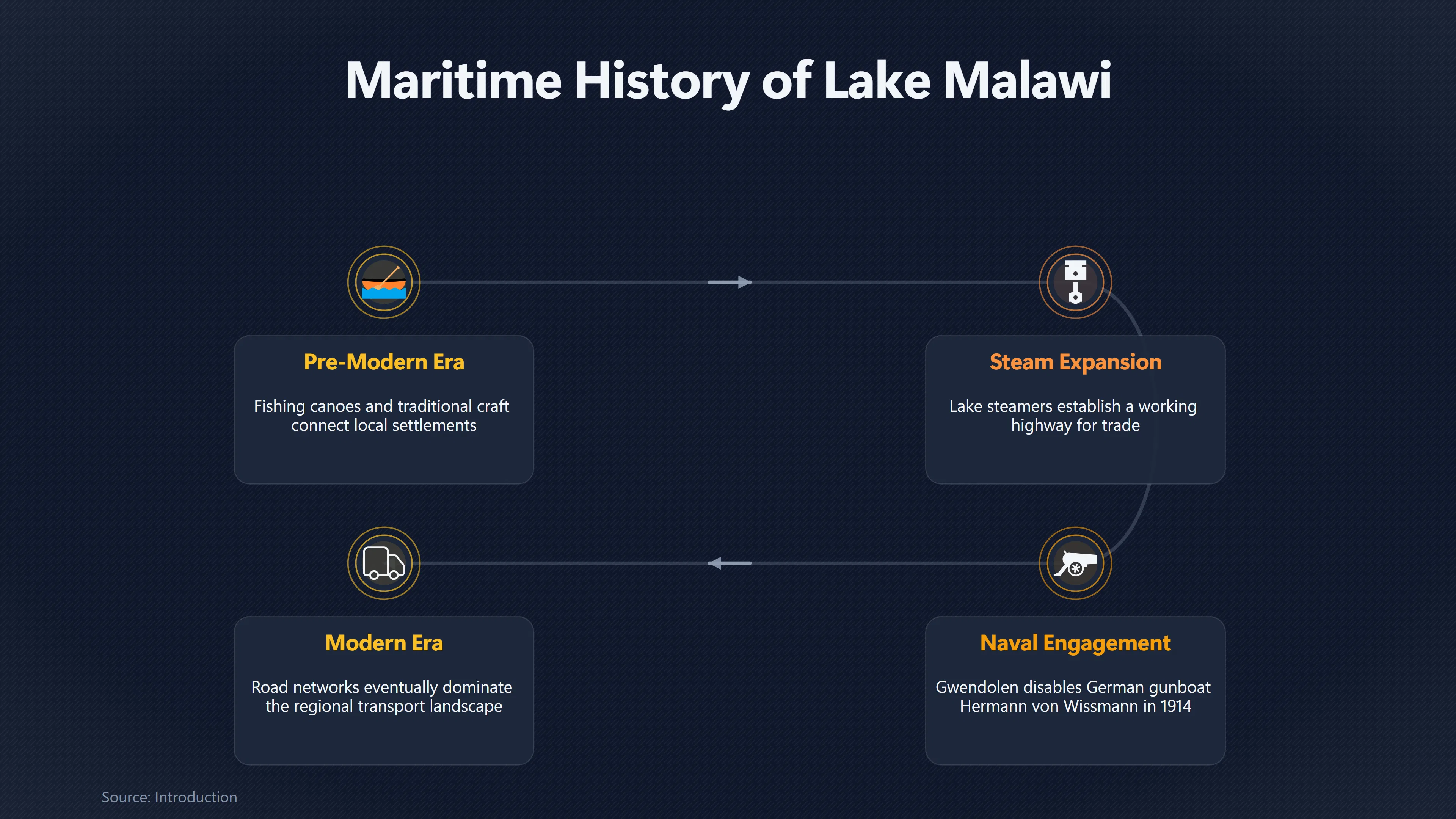
The museum’s most memorable exhibits are its historic boats and maritime displays. Scale models and preserved equipment document the vessels that once connected settlements around Lake Malawi long before modern roads became dominant. Rather than focusing only on fishing canoes, the collection illustrates the wider transport network that linked missionaries, traders, colonial officials and local communities.[Wikipedia]WikipediaLake Malawi MuseumLake Malawi Museum
The centrepiece is a large representation of the British gunboat Gwendolen (also written Guendolen in some historical sources). Original navigation equipment accompanies the display, helping visitors understand how steam-powered vessels operated on an inland African lake. The vessel became historically significant in August 1914 when it disabled the German gunboat Hermann von Wissmann during the opening days of the First World War, an engagement often described as Britain’s first naval success of that conflict.[Visit Malawi]visitmalawi.mwVisit Malawi Museums and Monuments – Visit MalawiVisit Malawi Museums and Monuments – Visit Malawi
Beyond the famous gunboat, the museum preserves models and records of numerous lake steamers and service vessels that illustrate the evolution of transport across the lake during the late nineteenth and early twentieth centuries. Collectively they demonstrate that Lake Malawi functioned as a working highway rather than a barrier, connecting distant settlements and enabling trade, administration and missionary activity.[Wikipedia]WikipediaLake Malawi MuseumLake Malawi Museum

Slave Caravans, Weapons and Local Memory
The museum’s historical galleries become especially distinctive when they address the nineteenth-century slave trade. Rather than relying solely on written panels, they include carved scenes depicting slave caravans and displays explaining the role of Mangochi and the southern lakeshore within wider East African trading networks. These exhibits place the visitor in a region where commerce, warfare and forced migration were deeply intertwined.[Wikipedia]WikipediaLake Malawi MuseumLake Malawi Museum
Weapons displayed alongside these carvings include traditional hunting and fighting implements used by communities around the lake. Instead of presenting them simply as military artefacts, the museum places them within everyday life, showing how tools for hunting, defence and status formed part of broader social history. Musical instruments, household objects and archaeological material nearby reinforce that these weapons belonged to living communities rather than isolated battles.[Wikipedia]WikipediaLake Malawi MuseumLake Malawi Museum
The Yao people feature prominently throughout the galleries. Their history cannot be separated from the lake’s commercial networks, including both legitimate trade and the slave routes that crossed the region during the nineteenth century. Recent heritage initiatives seeking international recognition for the Fort Mangochi and Makanjira Historical Corridor, as well as Malawi’s proposed Slave Heritage Route, demonstrate that these themes remain central to how the country interprets its past rather than being treated as closed historical episodes.[UNESCO World Heritage Centre]whc.unesco.orgWorld Heritage Centre Fort Mangochi and Makanjira Historical CorridorUNESCO World Heritage CentreFort Mangochi and Makanjira Historical Corridor - UNESCO World Heritage CentreOctober 6, 2025…
The Appeal and Risks of Ageing Displays
One reason the Lake Malawi Museum stands out is that many displays retain a distinctly twentieth-century museum style. Cases are densely packed, interpretation is relatively text-heavy and several exhibits have changed little for decades. Visitors looking for multimedia experiences or immersive digital installations may find the museum modest by contemporary standards.[Wikipedia]WikipediaLake Malawi MuseumLake Malawi Museum
Yet those older displays also have an unexpected value. They preserve an earlier philosophy of museum interpretation in which diverse artefacts were brought together to tell a broad historical narrative rather than being separated into narrowly themed galleries. Boats, stone tools, weapons, missionary objects and natural history specimens sit side by side, reflecting how Malawi’s museums historically developed through mixed collections assembled by the Society of Malawi and later expanded by the national museum service.[Taylor & Francis Online]tandfonline.comOpen source on tandfonline.com.
There are practical drawbacks. Documentation is not always as detailed as visitors might expect, exhibition design shows signs of limited investment, and some interpretive approaches reflect the period in which they were first installed rather than current museum practice. Scholars examining Malawi’s museum sector have noted broader challenges involving funding, documentation, collecting and exhibition renewal across the national system.[Taylor & Francis Online]tandfonline.comOpen source on tandfonline.com.

Why It Matters in Malawi’s Curiosity Landscape
For readers interested in unusual museums rather than conventional art galleries, the Lake Malawi Museum is memorable because of its atmosphere. It is not strange through sensational claims or mysterious relics, but because it preserves an unusually eclectic combination of objects that reveal the lake’s many identities: battlefield, transport corridor, fishing ground, missionary route and cultural homeland.
Its ageing galleries also remind visitors that museums are historical artefacts in their own right. The display cases, labels and methods of interpretation tell a story about how Malawi chose to preserve and present its heritage over the past half-century. In that sense, the museum is both a collection of historical objects and an exhibit about the changing practice of collecting itself, making it one of the country’s most distinctive stops for travellers interested in offbeat cultural history.[Taylor & Francis Online]tandfonline.comOpen source on tandfonline.com.
Amazon book picks
Further Reading
Books and field guides related to What Survives Inside the Lake Malawi Museum?. Use these as the next step if you want deeper reading beyond the article.
The Scramble For Africa
In 1880 the continent of Africa was largely unexplored by Europeans. Less than thirty years later, only Liberia and Ethiopia remained unc...

The Story of Africa
"Basil Davidson's Africa is an exciting and compelling history of the peoples who make up Africa today: where they came from, how they de...
eBay marketplace picks
Marketplace Samples
Live-tested eBay searches with available results related to this page.
Selected fromboat model oneBay.co.uk.

Endnotes
1.
Source: Wikipedia
Title: Lake Malawi Museum
Link:https://en.wikipedia.org/wiki/Lake_Malawi_Museum
2.
Source: whc.unesco.org
Link:https://whc.unesco.org/en/tentativelists/6904/
Source snippet
David Livingstone Trail - UNESCO World Heritage CentreOctober 6, 2025 — MALAWI SLAVE HERITAGE ROUTE AND DR. DAVID LIVINGSTONE TRAIL Malaw...
Published: October 6, 2025
3.
Source: whc.unesco.org
Title: World Heritage Centre Fort Mangochi and Makanjira Historical Corridor
Link:https://whc.unesco.org/en/tentativelists/6907/
Source snippet
UNESCO World Heritage CentreFort Mangochi and Makanjira Historical Corridor - UNESCO World Heritage CentreOctober 6, 2025...
Published: October 6, 2025
4.
Source: visitmalawi.mw
Title: Visit Malawi Museums and Monuments – Visit Malawi
Link:https://visitmalawi.mw/museums-and-monuments/
5.
Source: tandfonline.com
Link:https://www.tandfonline.com/doi/abs/10.1080/23311983.2022.2160577
6.
Source: malawitourism.com
Link:https://www.malawitourism.com/regions/south-malawi/mangochi/
7.
Source: visitmalawi.mw
Link:https://visitmalawi.mw/mangochi/
Additional References
8.
Source: researchgate.net
Link:https://www.researchgate.net/publication/366887033_Curating_the_nation_Collections_ethnographic_representations_and_heritage_production_at_Museum_of_Malawi
Source snippet
January 1, 2023 — CURATING THE NATION: COLLECTIONS, ETHNOGRAPHIC REPRESENTATIONS AND HERITAGE PRODUCTION AT MUSEUM OF MALAWI Cogent Arts...
Published: January 1, 2023
9.
Source: malawiplus.com
Title: Lake Malawi Museum in Mangochi, Malawi|Malawi Travel and Business Guide
Link:https://malawiplus.com/lake-malawi-museum/
Source snippet
June 19, 2022 — LAKE MALAWI MUSEUM IN MANGOCHI, MALAWI malawiplus 19/06/2022 Image LAKE MALAWI MUSEUM ABOUT LAKE MALAWI MUSEUM Name | Lak...
Published: June 19, 2022
10.
Source: beijingmwembassy.gov.mw
Title: Embassy of Malawi in Beijing National Packs & Museums
Link:https://beijingmwembassy.gov.mw/index.php/en/tourism/national-parks-museums
Source snippet
Embassy of Malawi in BeijingNational Packs & Museums - EMBASSY OF THE REPUBLIC OF MALAWI TO THE PEOPLE'S REPUBLIC OF CHINA...
11.
Source: youtube.com
Title: Discover the Museum of Malawi: A Journey Through Nature, Culture, and History
Link:https://www.youtube.com/watch?v=PfLEiAOR6Hk
Source snippet
MV ILALA: The Timeless Ship Of Lake Malawi...
12.
Source: youtube.com
Title: I Found a 125-Year-Old Ship in Malawi! The Gwendolyn
Link:https://www.youtube.com/watch?v=EIcFO4lOVzY
Source snippet
Lake Malawi And The Unlikely First World War Naval Battle...
13.
Source: malawian.com
Link:https://www.malawian.com/tourism/destinations/mangochi-southern-lakeshore/
14.
Source: youtube.com
Title: Chauncy Maples | Lake Malawi
Link:https://www.youtube.com/watch?v=Wy7wzzPtY5E
Source snippet
Discover the Museum of Malawi: A Journey Through Nature, Culture, and History...
15.
Source: malawitourism.com
Title: Malawi Tourism Museums & Historical Sites | Culture | Malawi Tourism
Link:https://www.malawitourism.com/experiences/culture/museums-historical-sites/
16.
Source: youtube.com
Title: “Lake Malawi And The Unlikely First World War Naval Battle”
Link:https://www.youtube.com/watch?v=lilkQV40p7M
Source snippet
Chauncy Maples | Lake Malawi...
17.
Source: booking.com
Title: 14 Verified Hotel Reviews of Captains Villa
Link:https://www.booking.com/reviews/mw/hotel/villa-tafika-lodge-where-lake-malawi-and-shire-meet.en-gb.html