Within Strange Malta
Why Malta Displays Crocodiles Beside Catacombs
Malta's strangest displays place a Nile crocodile, Christian burial chambers and ornate reliquaries within the same devotional landscape.
On this page
- The mummified crocodile at St Agatha's Museum
- Bones, catacombs and early Christian burial
- Reliquaries as devotion rather than macabre display
Page outline Jump by section
Introduction
Malta’s strangest religious displays are not found in a single cabinet of curiosities but in a series of places where archaeology, natural history and Catholic devotion overlap. Within a short distance of one another, visitors can see a mummified Nile crocodile hanging inside a church museum, descend into vast early Christian catacombs once filled with human burials, and encounter reliquaries that preserve fragments of saints’ remains as objects of prayer rather than spectacle. Together these sites reveal how Malta’s religious culture has long absorbed objects from very different worlds, treating exotic animals, ancient cemeteries and sacred human remains as parts of a shared devotional landscape rather than separate museum categories.[stagathamalta.com]stagathamalta.comSt. Agatha, Malta…

Why a crocodile appears beside Christian archaeology
Perhaps the most unexpected object in Malta’s religious collections is the mummified crocodile displayed at St Agatha’s Museum in Rabat. Visitors entering the museum pass archaeological finds, fossils, minerals and religious art before encountering the preserved reptile, an object that seems entirely out of place until viewed in the wider history of Mediterranean devotion.[stagathamalta.com]stagathamalta.comSt. Agatha, Malta…
The mummified crocodile at St Agatha’s Museum
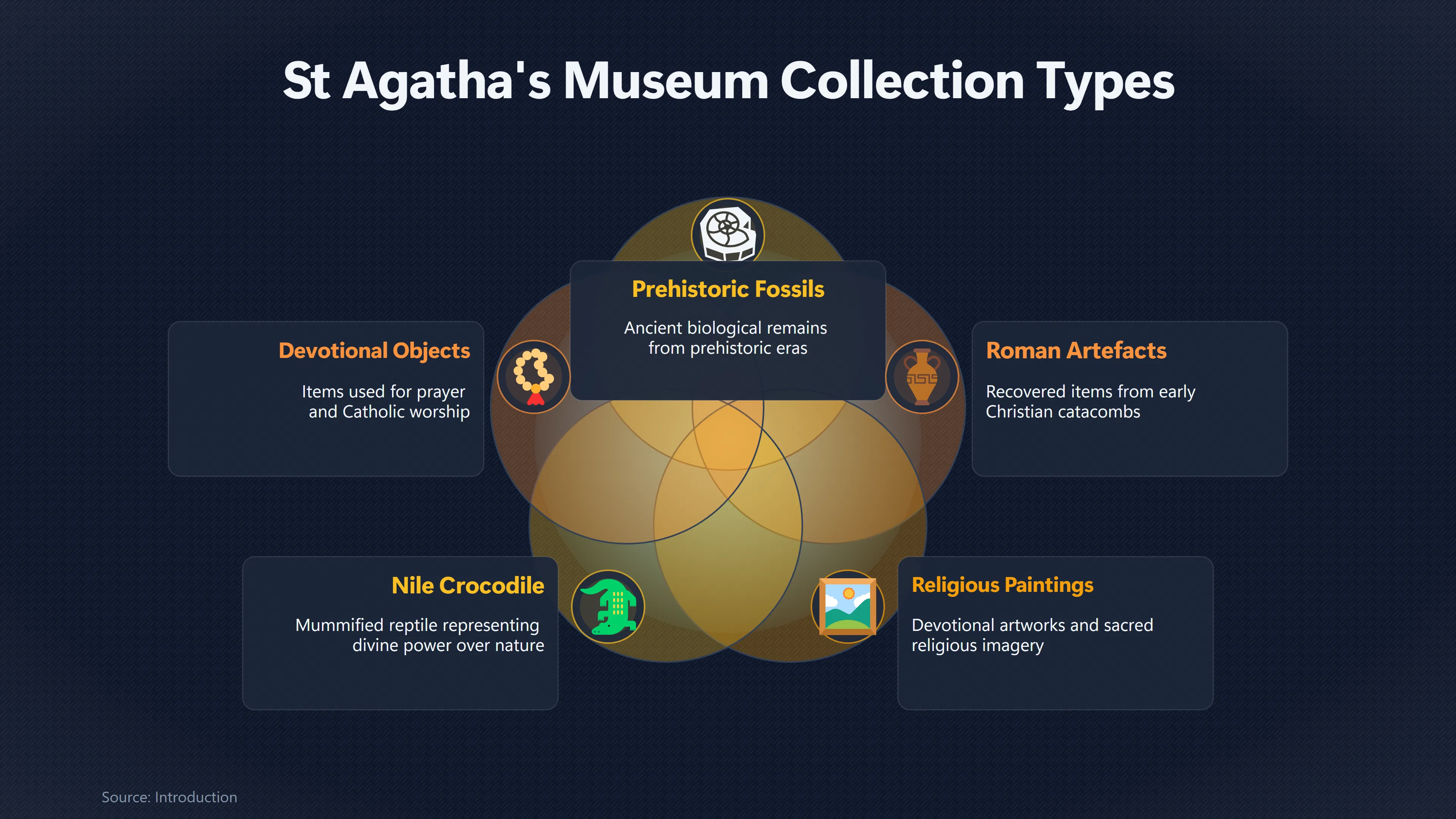
The museum itself is attached to St Agatha’s Crypt and Catacombs, a site associated with the early Christian cult of Saint Agatha. Its collections deliberately mix prehistoric fossils, Roman artefacts recovered from the catacombs, religious paintings, devotional objects and the famous crocodile. The museum identifies it simply as a mummified crocodile from the Nile.[stagathamalta.com]stagathamalta.comSt. Agatha, Malta…
Although no definitive documentation explains exactly when or why the crocodile entered the collection, its presence fits a wider early modern Catholic tradition. Exotic animals brought from Egypt or the eastern Mediterranean were sometimes displayed in churches as gifts from travellers, reminders of biblical lands, or symbols of divine power over dangerous creatures. Crocodiles also appeared in churches elsewhere around the Mediterranean, particularly in Italy, where they were occasionally suspended from ceilings as votive offerings or interpreted as representations of evil overcome by faith. Malta’s example survives because the museum preserves the eclectic collecting habits of earlier centuries rather than presenting a narrowly archaeological display.
The result is strikingly different from a natural history museum. The crocodile is not interpreted primarily as zoological evidence but as part of a broader collection linking pilgrimage, antiquarian curiosity and Christian heritage.
Why Malta’s catacombs feel different from many others
The underground cemeteries around Rabat are among the largest surviving groups of early Christian catacombs in the Mediterranean. Their importance lies less in dramatic displays of skeletons than in what the architecture reveals about how communities buried and remembered their dead between the Roman and early Byzantine periods.[UNESCO World Heritage Centre]whc.unesco.orgWorld Heritage Centre Maltese Catacomb ComplexesUNESCO World Heritage CentreMaltese Catacomb Complexes - UNESCO World Heritage Centre…
Unlike later European ossuaries where bones were deliberately arranged for display, Malta’s catacombs were primarily communal burial complexes carved into soft limestone. Most visible human remains were removed during earlier centuries of excavation, reuse or archaeological investigation. What visitors encounter today are the tombs themselves: rock-cut chambers, burial niches, decorated graves and ceremonial spaces that communicate the social life surrounding death rather than presenting skeletons as exhibits.[Heritage Malta]heritagemalta.mtHeritage Malta St Paul's CatacombsHeritage MaltaSt Paul's Catacombs - Heritage Malta…
Several features make these catacombs distinctive:
- Large interconnected underground networks developed from earlier Punic and Roman burial traditions.
- Family tombs sit alongside evidence for broader communal cemeteries.
- Stone dining platforms, known as triclinia, were used for commemorative meals honouring the dead.
- Archaeological evidence shows Christian, Jewish and polytheist burial traditions coexisting within the wider cemetery landscape during Late Antiquity.[heritagemalta.mt]heritagemalta.mtHeritage Malta St Paul's CatacombsHeritage MaltaSt Paul's Catacombs - Heritage Malta…
Rather than presenting a single religious narrative, the catacombs illustrate Malta as a crossroads where different communities shared burial space while maintaining distinct traditions. This coexistence has become one of the strongest arguments for recognising the catacomb complexes as internationally significant heritage.[unesco.org]whc.unesco.orgWorld Heritage Centre Maltese Catacomb ComplexesUNESCO World Heritage CentreMaltese Catacomb Complexes - UNESCO World Heritage Centre…
St Agatha’s and St Paul’s catacombs
Although often mentioned together, the two principal visitor sites offer different experiences.
St Paul’s Catacombs form the largest accessible complex, with extensive passages, burial chambers and ceremonial areas that illustrate centuries of changing funerary practice. Heritage Malta emphasises the site’s long development from Punic through Roman and Byzantine periods and notes that its association with St Paul is traditional rather than archaeologically demonstrated.[Heritage Malta]heritagemalta.mtHeritage Malta St Paul's CatacombsHeritage MaltaSt Paul's Catacombs - Heritage Malta…
St Agatha’s Catacombs, by contrast, are closely connected with the neighbouring church and museum. Here the archaeological remains are interpreted alongside devotional traditions surrounding Saint Agatha, making it easier to see how religious memory and archaeological evidence became intertwined over many centuries.
Sacred human remains are objects of devotion, not macabre attractions
To modern visitors, reliquaries containing fragments of human remains can appear unsettling. Within Malta’s Catholic tradition, however, they were never intended as displays of mortality comparable to bone chapels or anatomical museums.
Relics are preserved because saints were believed to remain spiritually connected to the faithful after death. Bones, teeth or tiny bodily fragments were enclosed within elaborate reliquaries crafted from precious metals, crystal or carved wood, allowing believers to honour the saint without directly viewing the remains themselves.
In Malta, this tradition reflects centuries under the Knights of St John and the islands’ enduring Catholic identity. Churches accumulated relics through gifts, exchanges and connections with Rome and the wider Mediterranean. The emphasis was devotional rather than sensational: the artistic container often became as important as the relic it protected.
This distinction matters because visitors accustomed to European ossuaries may expect dramatic displays of skeletons. Malta generally presents sacred remains in a very different way. The reliquary is treated as a liturgical object used in worship, processions and feast days rather than as a curiosity or work of macabre art.

A distinctive blend of archaeology, faith and curiosity
What makes Malta unusual is not any single object but the way very different categories coexist within the same religious landscape.
A visitor can move from Roman burial chambers to a museum displaying an Egyptian crocodile, then continue to churches housing centuries-old reliquaries, all within a compact historic district. None of these collections were originally assembled to create a “weird museum”. Instead, they reflect successive layers of collecting shaped by pilgrimage, scholarship, colonial connections, antiquarian interests and living Catholic devotion.
For that reason, Malta’s sacred oddities reward careful interpretation. The crocodile is best understood as an inherited curiosity embedded in a religious collection. The catacombs are archaeological cemeteries whose atmosphere comes from their original function rather than exposed bones. The reliquaries preserve human remains, but they do so within a devotional framework where reverence consistently outweighs spectacle.
Seen together, these places reveal a version of Malta’s curiosity culture that is both unusual and deeply rooted in history: a landscape where natural wonders, ancient burial spaces and sacred relics have long been preserved side by side without losing their original religious meaning.
Amazon book picks
Further Reading
Books and field guides related to Why Malta Displays Crocodiles Beside Catacombs. Use these as the next step if you want deeper reading beyond the article.
The Knights of Malta
First published 1994. Subjects: Grand Sovereign Dynastic Hospitaller Order of Saint John, History, Knights of Malta, Catholicism, Religio...
The Archaeology of Death and Burial
The archaeology of death and burial is central to our attempts to understand vanished societies. Through the remains of funerary rituals...
Malta: An Archaeological Guide
First published 2005. Subjects: Antiquities, Excavations (Archaeology), Phoenicians, Carthaginians, Romans.
eBay marketplace picks
Marketplace Samples
Live-tested eBay searches with available results related to this page.
Selected fromreligious decor oneBay.co.uk.
Endnotes
1.
Source: stagathamalta.com
Link:https://stagathamalta.com/museum.html
Source snippet
St. Agatha, Malta...
2.
Source: whc.unesco.org
Title: World Heritage Centre Maltese Catacomb Complexes
Link:https://whc.unesco.org/en/tentativelists/1113
Source snippet
UNESCO World Heritage CentreMaltese Catacomb Complexes - UNESCO World Heritage Centre...
3.
Source: stagathamalta.com
Link:https://stagathamalta.com/catacombs.html
4.
Source: stagathamalta.com
Link:https://stagathamalta.com/crypt.html
5.
Source: stagathamalta.com
Link:https://stagathamalta.com/church.html
6.
Source: heritagemalta.mt
Title: Heritage Malta St Paul’s Catacombs
Link:https://heritagemalta.mt/explore/st-pauls-catacombs/
Source snippet
Heritage MaltaSt Paul's Catacombs - Heritage Malta...
7.
Source: culture.ec.europa.eu
Title: Culture and Creativity St. Paul’s Catacombs (Malta)
Link:https://culture.ec.europa.eu/fr/cultural-heritage/initiatives-and-success-stories/european-heritage-label/european-heritage-label-sites/saint-pauls-catacombs
Source snippet
Paul's Catacombs (Malta) - Culture and CreativityApril 14, 2026 — ST. PAUL'S CATACOMBS (MALTA) Enlarge Image: "" © Heritage Malta, Steve...
Published: April 14, 2026
8.
Source: heritagemalta.mt
Link:https://heritagemalta.mt/news/st-pauls-catacombs-awarded-european-heritage-label-in-landmark-recognition-for-malta/
Source snippet
St Paul’s Catacombs Awarded European Heritage Label In Landmark Recognition For Malta - Heritage MaltaFebruary 27, 2026 — ST PAUL’S CATAC...
Published: February 27, 2026
9.
Source: heritagemalta.mt
Title: A Window Into Roman Malta: St Paul’s Catacombs Skeleton To Come To Life
Link:https://heritagemalta.mt/news/a-window-into-roman-malta-st-pauls-catacombs-skeleton-to-come-to-life/
Source snippet
Heritage MaltaJuly 15, 2026 — A WINDOW INTO ROMAN MALTA: ST PAUL’S CATACOMBS SKELETON TO COME TO LIFE Stqarrija bil-Malti Agħfas Hawn / P...
Published: July 15, 2026
10.
Source: timesofmalta.com
Title: St Agatha’s Catacombs
Link:https://timesofmalta.com/article/st-agathas-catacombs.23293
11.
Source: heritagemalta.mt
Title: Abbatija tad-Dejr Catacombs
Link:https://heritagemalta.mt/explore/abbatija-tad-dejr/
12.
Source: heritagemalta.mt
Title: Salini Catacombs
Link:https://heritagemalta.mt/explore/katakombi-tas-salina/
13.
Source: heritagemalta.mt
Title: The Piglet Cremation
Link:https://heritagemalta.mt/news/the-piglet-cremation/
14.
Source: heritagemalta.mt
Title: St Augustine’s Catacombs
Link:https://heritagemalta.mt/explore/st-augustine-catacombs/
Additional References
15.
Source: ancient-history-sites.com
Title: Saint Agatha Catacombs: Early Christian Burial Site and Museum in Malta
Link:https://www.ancient-history-sites.com/sites/saint-agatha-catacombs/
Source snippet
Ancient History SitesAugust 7, 2025 — SAINT AGATHA CATACOMBS: EARLY CHRISTIAN BURIAL SITE AND MUSEUM IN MALTA VISITOR INFORMATION Google...
Published: August 7, 2025
16.
Source: youtube.com
Title: St Paul’s Catacombs, Rabat, Malta
Link:https://www.youtube.com/watch?v=_jy2h-3zy_M
Source snippet
St Agatha Catacombs Rabat Malta St Agatha Complex in Rabat, Malta | S6 EP: 21, part 2 | The Local Traveller with Clare Agius | Malta The...
17.
Source: youtube.com
Title: St Paul’s Catacombs, Rabat, Malta
Link:https://www.youtube.com/watch?v=3gsnGCWu4V4
Source snippet
What are catacombs?...
18.
Source: rmo.nl
Link:https://www.rmo.nl/en/news-press/news/egyptian-giant-crocodile-mummy-is-full-of-surprises/
19.
Source: um.edu.mt
Link:https://www.um.edu.mt/library/oar/handle/123456789/8207
20.
Source: stagnesmuseum.org.uk
Link:https://www.stagnesmuseum.org.uk/
21.
Source: britishmuseum.org
Link:https://www.britishmuseum.org/collection/object/Y_EA37347
22.
Source: umkalthoum.gov.eg
Link:https://www.umkalthoum.gov.eg/
23.
Source: youtube.com
Title: St Paul’s Catacombs (English Version)
Link:https://www.youtube.com/watch?v=vyMx2kJFhZw
Source snippet
St Paul's Catacombs, Rabat, Malta - Historic timeline...
24.
Source: lostguardian.com
Title: St. Paul’s Catacombs, Malta’s subterranean heritage
Link:https://www.lostguardian.com/visit-malta/st-pauls-catacombs-maltas-subterranean-heritage/