Where Does Malawi Keep Its Strangest Stories?
Malawi does not appear to have a dedicated museum of witchcraft, cryptids, UFOs or medical oddities. Its strange-collection landscape is subtler and, in some ways, more culturally revealing.
Page outline Jump by section
Introduction
The strongest destinations are the Chamare Museum at Kungoni, where masks and ritual objects help explain the Chewa, Ngoni and Yao peoples; Karonga’s museum, built around fossils of dinosaurs and early humans; and the Lake Malawi Museum, with its ageing mixture of boats, weapons, musical instruments and historical curiosities. Beyond museum walls, living traditions such as the Gule Wamkulu masked dance, the Vimbuza healing dance and the Khulubvi rain-shrine landscape form a parallel heritage system in which unusual objects cannot be separated neatly from belief, performance and community authority.[kungoni.org]kungoni.orgKungoni Centre: KUNGONI OnlineGule Wamkulu, the Great Dance of the Chewa people of Malawi: When Animals Sing and Spirits Dance. ov…

Where Malawi’s strangest collections are found
Malawi’s museums tend to be historical, ethnographic or archaeological rather than deliberately sensational. A visitor should therefore not expect theatrical galleries filled with “cursed” objects or lurid claims about magic. The country’s curiosity culture is more likely to emerge through a carved mask whose meaning is only partly disclosed, an enormous reconstructed dinosaur, a spirit-healing tradition documented as cultural heritage, or an old industrial engine preserved in the open air.
The national tourism authority lists museums and monuments that combine conventional displays with open-air artefacts, traditional buildings, an iron-smelting furnace, engines and relics dating from the colonial period. This mixture is typical: natural history, ethnography, missionary history and obsolete technology are often collected in the same institution rather than divided into specialised museums.[Visit Malawi]visitmalawi.mwCulture Museum Centre Karonga (CMCK) Museum is modelled on the public-private partnership between the Government of Malawi through the De…
Documentation can be uneven. Websites are sometimes basic, opening information may be difficult to confirm, and exhibits may change without detailed online catalogues. Some museums are state-run, while others are mission-founded, community-led or supported through partnerships between government departments, foundations and overseas donors. Travellers interested in a particular collection should verify access locally rather than assuming that every listed site keeps regular metropolitan museum hours.
Chamare Museum: masks, spirits and guarded knowledge
The Chamare Museum, part of the Kungoni Centre of Culture and Art at Mua in Dedza District, is the clearest starting point for readers interested in Malawi’s ritual and folkloric material. Kungoni describes itself as a cultural centre combining a museum, research, artistic training, carving and performance. Its displays interpret Chewa, Ngoni and Yao culture, while the wider centre supports carvers and presents traditional music and dance.[Kungoni]kungoni.orgKungoni Centre: KUNGONI OnlineGule Wamkulu, the Great Dance of the Chewa people of Malawi: When Animals Sing and Spirits Dance. ov…
What makes Chamare unusual is its treatment of Gule Wamkulu, the masked tradition associated with the Nyau brotherhood. The masks do not function simply as decorative folk art. They belong to a performance system involving initiation, funerals, community ceremonies, moral instruction and representations of spirits, animals, ancestors and social outsiders. UNESCO describes Gule Wamkulu as a ritual dance practised among Chewa communities in Malawi, Mozambique and Zambia, performed by members of a traditionally secret society of initiated men.[Intangible Cultural Heritage]ich.unesco.orgIntangible Cultural Heritage Gule WamkuluNyau members still are responsible for the initiation of young men into adulthood, and for the performance of the Gule Wamkulu at the end…
The tradition’s cast of characters can be startling. Masks and large constructed figures may represent wild animals, spirits of the dead, slave traders or modern machines and technologies. Their performances can be comic, frightening, satirical or morally instructive. The result is not a static “monster collection” in the Western cryptid-museum sense, but a changing social theatre in which the strange figure has a recognised role and message.[YouTube]youtube.comYou Tube The Gule WamkuluYou Tube The Gule Wamkulu
Kungoni has documented more than 200 Gule characters, making it an unusually substantial interpretive resource. Yet visitors should resist treating the museum as a complete unveiling of secret knowledge. Some meanings are restricted, locally contested or dependent on initiation and performance context. A museum label can explain a mask’s public identity without exhausting what that identity means to its custodians.[Kungoni]kungoni.orgKungoni Centre: KUNGONI OnlineGule Wamkulu, the Great Dance of the Chewa people of Malawi: When Animals Sing and Spirits Dance. ov…
This tension has become important far beyond Malawi. A recent collaborative museum project involving Malawian heritage specialists and European institutions aims to improve the interpretation of Gule Wamkulu masks held overseas. Its premise is that masks removed from living traditions are easily mislabelled as anonymous “tribal art”, stripped of ritual authority or described through outdated colonial categories.[themuseumslab.org]themuseumslab.orgOpen source on themuseumslab.org.
Chamare is therefore both a visitor attraction and a corrective. It places striking objects within the societies that made and used them, although its position within a Catholic mission-founded cultural centre also makes it part of a longer and sometimes uneasy relationship between Christian institutions and indigenous belief.
Karonga: dinosaurs, ancient humans and deep time
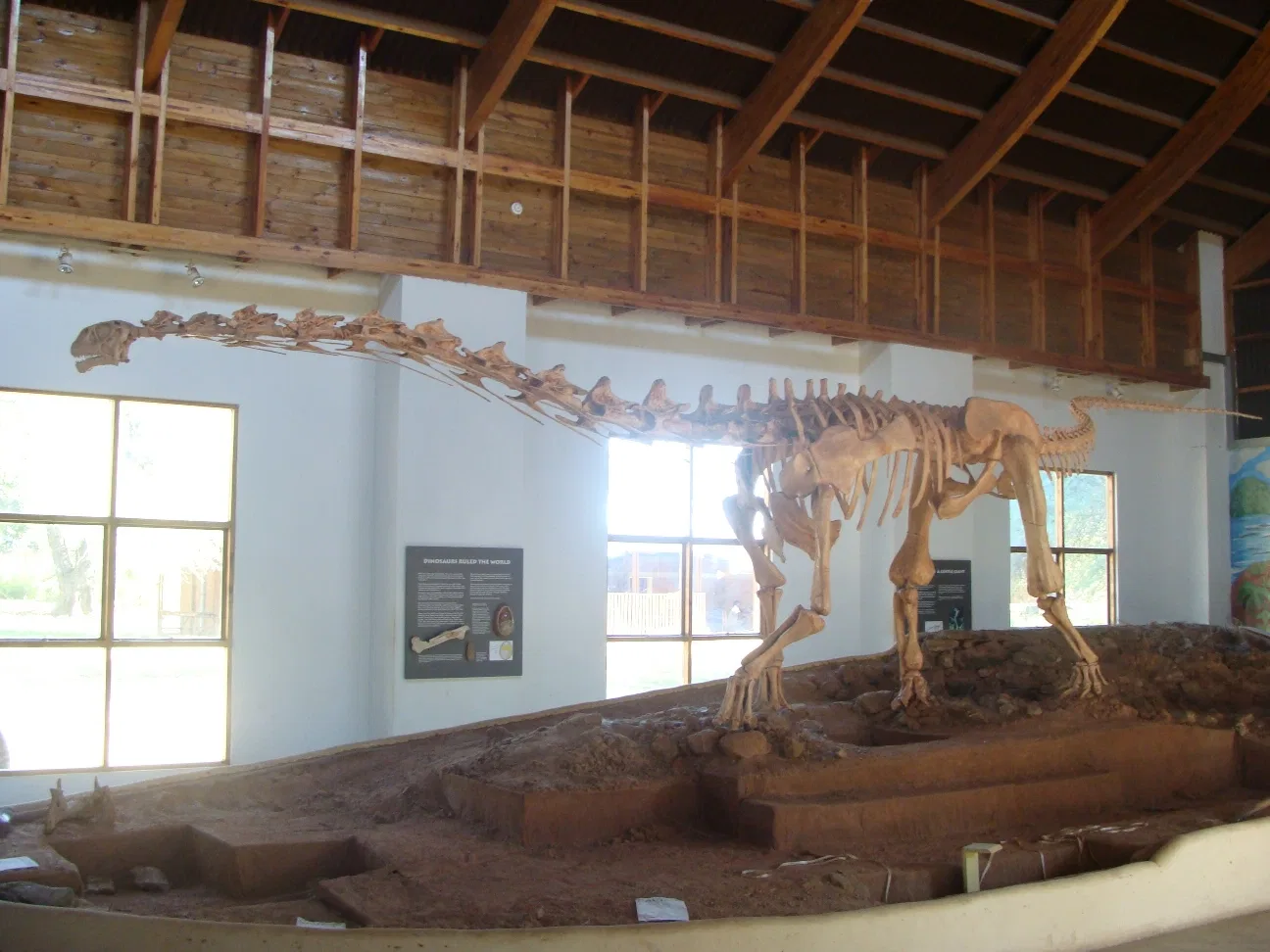
The Cultural and Museum Centre Karonga offers Malawi’s most dramatic natural-history display. Its central attraction is the fossil material associated with Malawisaurus, a Cretaceous long-necked dinosaur discovered in northern Malawi. The wider Karonga fossil landscape has yielded remains of dinosaurs, crocodilians, fish, turtles, flying reptiles and early humans, giving the area international geological and archaeological importance.[UNESCO World Heritage Centre]whc.unesco.orgUNESCO World Heritage CentreKaronga Fossilised Geoheritage LandscapeThese include some of Africa's most important dinosaur discoveries su…
The museum’s scope is often summarised as a journey “from dinosaurs to democracy”. Displays move through prehistoric environments, human evolution, archaeology, the slave trade, colonial rule, independence and local cultural traditions. This sweep can feel like a cabinet of deep time: fossil bones, reconstructions and archaeological objects are used to compress hundreds of millions of years into one regional story.[Atlas Obscura]atlasobscura.comAtlas Obscura Karonga MuseumAtlas Obscura Karonga Museum
For an offbeat traveller, the fascination lies partly in the unexpected location. Malawi rarely appears on popular lists of dinosaur destinations, yet the Karonga region contains some of Africa’s significant vertebrate fossil sites. The proposed Karonga Fossilised Geoheritage Landscape, added to Malawi’s UNESCO World Heritage tentative list, specifically highlights the completeness and scientific value of its fossil assemblages.[UNESCO World Heritage Centre]whc.unesco.orgUNESCO World Heritage CentreKaronga Fossilised Geoheritage LandscapeThese include some of Africa's most important dinosaur discoveries su…
Karonga is also one of the country’s more academically grounded unusual attractions. Its collections are connected with field research and government antiquities work, rather than assembled as a commercial roadside spectacle. That does not eliminate uncertainty: fossil reconstructions inevitably combine recovered material with scientific interpretation, and popular accounts sometimes give differing ages for individual specimens. The most reliable reading is that the museum presents genuine regional fossils within an evolving scientific account, not that every displayed skeleton consists entirely of bones from one complete animal.
The centre’s building and exhibition design were developed specifically around the fossil story, and community leaders were involved in assembling cultural collections. This makes Karonga more than a dinosaur hall. It is an attempt to join palaeontology, archaeology and local memory in a single regional institution.[Wikipedia]WikipediaCultural & Museum Centre KarongaCultural & Museum Centre Karonga
Lake Malawi Museum: boats, slave caravans and fading technology
The Lake Malawi Museum in Mangochi is less polished but potentially more atmospheric. It contains material relating to the communities around the lake, especially Yao history, alongside Stone Age artefacts, pottery, musical instruments, games, hunting weapons, boat models and objects connected with missionary and colonial navigation.[Wikipedia]WikipediaLake Malawi MuseumLake Malawi Museum
Its strangest appeal comes from accumulation. Models and remnants of historic lake vessels appear beside navigation equipment, domestic objects, weaponry and carved representations of slave caravans. The lake emerges not merely as scenery but as a corridor of migration, conflict, missionary activity, commerce and forced movement. Image records of the museum show displays devoted to early steamers and boats as well as artefacts illustrating the regional slave trade.[Wikimedia Commons]commons.wikimedia.orgCategory:Lake Malawi MuseumCategory:Lake Malawi Museum
The museum has reportedly occupied the former Gymkhana Club building since the early 1970s, and descriptions suggest that portions of the display may be old-fashioned or infrequently renewed. That can be a weakness—labels and interpretations may not meet current curatorial expectations—but it also gives the place the feeling of an inherited local cabinet rather than a highly designed tourist experience.[Wikipedia]WikipediaLake Malawi MuseumLake Malawi Museum
Visitors should approach the slave-trade material carefully. Carved tableaux can be powerful visual aids, but they are interpretations, not direct documentary evidence. Their value depends on supporting dates, names and explanations of how Yao political history, Indian Ocean commerce and nineteenth-century violence intersected around the lake. Without that context, a dramatic caravan carving risks simplifying a complicated regional history.
Chichiri Museum and the problem of the ethnographic showcase
Chichiri Museum in Blantyre is Malawi’s principal general museum and contains archaeology, ethnography, natural history, colonial material and open-air exhibits. The national tourism authority notes traditional structures, an iron-smelting furnace, old engines and other industrial relics among its displays. For curiosity-minded visitors, the appeal is the unexpected proximity of domestic life, ritual culture, machinery and national history.[Visit Malawi]visitmalawi.mwCulture Museum Centre Karonga (CMCK) Museum is modelled on the public-private partnership between the Government of Malawi through the De…
Chichiri also raises an important question: who controls the story told by collected objects? Historian Mwayi Lusaka argues that the Museum of Malawi grew from colonial collecting and inherited modes of displaying ethnic communities that could present Malawian life as static, archaic or divided into neatly bounded “tribes”. He does not claim that present-day curators deliberately reproduce colonial prejudice, but he identifies an unresolved struggle to reinterpret inherited collections for a post-colonial public.[ResearchGate]researchgate.netOpen source on researchgate.net.
This matters especially for ritual objects. A mask, charm, divination object or ceremonial implement can be made to look uncanny when isolated in a case. Yet its apparent strangeness may be produced partly by the museum itself: removed from performance, stripped of ownership history and labelled in the language of an earlier collector.
Chichiri is consequently useful not because it offers a straightforward “museum of strange Malawi”, but because it demonstrates how strangeness is curated. Its old engines and furnaces are technical relics; its ethnographic objects are evidence of social systems; and its displays are also evidence of how governments and museums have tried to define the nation.

Healing traditions that do not fit inside a case
Some of Malawi’s most unusual heritage is not primarily object-based. The Vimbuza healing dance, practised among Tumbuka communities in northern Malawi, combines drumming, song, spirit possession, diagnosis and communal performance. UNESCO describes it as part of a wider healing tradition in which patients, often women, may stay with a healer before taking part in a ritual where music and movement allow them to “dance” their affliction.[Intangible Cultural Heritage]ich.unesco.orgIntangible Cultural Heritage Vimbuza healing danceIntangible Cultural Heritage Vimbuza healing dance
Vimbuza is easy for outsiders to misclassify. It is neither simply entertainment nor a museum-style reconstruction of an abandoned custom. It is a living therapeutic and spiritual system that has existed alongside biomedical treatment, Christianity and changing ideas about mental health. Missionaries and colonial authorities attempted to suppress it, while later heritage programmes sought to document and safeguard it.[Intangible Cultural Heritage]ich.unesco.orgIntangible Cultural Heritage Vimbuza healing danceIntangible Cultural Heritage Vimbuza healing dance
A heritage centre such as Kandewe in Rumphi District has reportedly presented Phoka beliefs, religious practices, hunting, fishing and local dances, including Vimbuza. Small community museums of this kind can offer locally rooted interpretation, but information about current opening arrangements is limited and should be verified before travel.[Wikipedia]WikipediaKandewe Heritage CentreKandewe Heritage Centre
The key distinction is between viewing an explanatory display and attending a real healing ceremony. The latter is not automatically a tourist performance. Visitors should not assume that spiritual distress, trance or treatment is available for casual observation merely because the tradition has UNESCO recognition.
Khulubvi: a sacred landscape rather than a museum
The Khulubvi shrine and its associated rain shrines in the Lower Shire Valley broaden the idea of a curiosity collection even further. There is no conventional gallery of magical relics. Instead, sacred forests, ritual pools, ceremonial structures and multiple linked shrines preserve the geography of the Mbona belief system. Malawi placed this cultural landscape on UNESCO’s World Heritage tentative list in 2025.[UNESCO World Heritage Centre]whc.unesco.orgIt encompasses the core Khulubvi shrine, associated sacred forests, ritual pools, ceremonial structures, and a network of satellite shrin…
Mbona is associated with rain, fertility, political authority and the well-being of communities in southern Malawi. Objects, buildings and natural features within the shrine network matter because of their relationships to ritual practice. Taking one item out of that system and displaying it as an isolated “occult artefact” would substantially change its meaning.
Khulubvi is unusual precisely because it remains active. It is devotional and community-governed rather than a historical attraction designed solely for tourists. Access, photography and behaviour may therefore be subject to local authority and religious restrictions. The correct model is closer to visiting a living pilgrimage landscape than entering a folklore museum.
What Malawi does not appear to have
No well-documented, permanent Malawian institution currently presents itself as a specialist museum of witchcraft, ghosts, cryptids, UFOs, crime or medical abnormalities. Online claims that imply the existence of such an attraction should be treated cautiously unless supported by an identifiable institution, physical address and current visitor information.
This absence does not mean that beliefs in witchcraft, spirits or supernatural causation are absent from Malawian life. It means that they are not generally packaged into a single commercial curiosity museum. Relevant material is dispersed among ethnographic collections, living ceremonies, mission archives, sacred sites and objects now held outside the country.
Overseas museums, for example, hold Malawian ritual and medical objects collected during the colonial period. The British Museum’s database includes amulets, religious equipment and divination-related material attributed to Malawi. Such collections can help identify object types, but they also raise questions about how the objects were acquired, whether their original names and uses were recorded accurately, and why more detailed catalogues may exist abroad than in the communities from which the objects came.[British Museum]britishmuseum.orgOpen source on britishmuseum.org.
How to visit responsibly
Malawi’s unusual heritage rewards curiosity, but it requires more cultural care than a conventional novelty museum.
- Distinguish exhibits from ceremonies. A mask in Chamare Museum is a visitor-facing object. An initiation, funeral or healing rite may be private, restricted or inappropriate to photograph.
- Ask before photographing sacred material. Permission from a ticket desk does not necessarily override community rules concerning particular masks, shrines or performers.
- Treat supernatural claims as beliefs, not museum-certified facts. A display may document how a community understands spirits or healing without claiming scientific proof.
- Look for provenance. The most useful labels explain who made an object, where it was used, how it entered the collection and whether local custodians contributed to its interpretation.
- Verify practical details. Smaller museums and heritage centres may have irregular hours, limited staffing or changing access conditions.
- Avoid demanding secret explanations. Restricted knowledge is not an incomplete tourist service. In traditions such as Gule Wamkulu, limits on disclosure are part of the institution being interpreted.
Why Malawi’s curiosity culture matters
Malawi’s unusual collections show that a country does not need a self-conscious “museum of the weird” to possess a rich strange-history landscape. Its most memorable objects belong to systems that cross the usual museum categories: masks that are also social characters, dances that are also treatments, fossils that anchor regional identity, boat relics that recall missionary ambition and forced migration, and shrines whose landscape is itself the collection.
The central curatorial challenge is context. Removed from their communities, Malawian masks and ritual objects can be reduced to exotic decorations. Displayed only through inherited colonial categories, they can make living societies seem frozen in the past. Interpreted with community knowledge, however, they reveal humour, fear, ethics, healing, resistance and historical change.
For the visitor, the country’s strongest offbeat route runs from the ritual masks and cultural archive of Kungoni to Karonga’s deep-time fossils, then through the mixed ethnographic and mechanical collections of Chichiri and Mangochi. Beyond those institutions lie living heritage systems—Vimbuza, Gule Wamkulu and Khulubvi—that remind travellers that some of the world’s most compelling “collections” cannot be understood by looking through glass.
Amazon book picks
Further Reading
Books and field guides related to Where Does Malawi Keep Its Strangest Stories?. Use these as the next step if you want deeper reading beyond the article.
The Scramble For Africa
In 1880 the continent of Africa was largely unexplored by Europeans. Less than thirty years later, only Liberia and Ethiopia remained unc...
The Fate of Africa
Traces the history of Africa in the fifty years since the independence era began, describing how the withdrawal of Europe's colonial powe...
African History: A Very Short Introduction
Includes bibliographical references and index.
eBay marketplace picks
Marketplace Samples
Live-tested eBay searches with available results related to this page.
Selected fromAfrican art print oneBay.co.uk.
Endnotes
1.
Source: kungoni.org
Link:https://www.kungoni.org/
Source snippet
Kungoni Centre: KUNGONI OnlineGule Wamkulu, the Great Dance of the Chewa people of Malawi: When Animals Sing and Spirits Dance. ov...
2.
Source: whc.unesco.org
Link:https://whc.unesco.org/en/tentativelists/6905/
Source snippet
UNESCO World Heritage CentreKaronga Fossilised Geoheritage LandscapeThese include some of Africa's most important dinosaur discoveries su...
3.
Source: whc.unesco.org
Link:https://whc.unesco.org/en/tentativelists/6908/
Source snippet
It encompasses the core Khulubvi shrine, associated sacred forests, ritual pools, ceremonial structures, and a network of satellite shrin...
4.
Source: ich.unesco.org
Title: Intangible Cultural Heritage Gule Wamkulu
Link:https://ich.unesco.org/en/RL/gule-wamkulu-00142?RL=00142
Source snippet
Nyau members still are responsible for the initiation of young men into adulthood, and for the performance of the Gule Wamkulu at the end...
5.
Source: unesco.org
Title: the People Chewa: Gule Wamkulu/ Chew Nyan | Intangible Heritage
Link:https://www.unesco.org/archives/multimedia/document-634
6.
Source: youtube.com
Title: You Tube The Gule Wamkulu
Link:https://www.youtube.com/watch?v=H30wcV6-wbw
7.
Source: themuseumslab.org
Link:https://themuseumslab.org/en/Gule-Wamkulu-Masks
8.
Source: Wikipedia
Title: Cultural & Museum Centre Karonga
Link:https://en.wikipedia.org/wiki/Cultural_%26_Museum_Centre_Karonga
9.
Source: Wikipedia
Title: Lake Malawi Museum
Link:https://en.wikipedia.org/wiki/Lake_Malawi_Museum
10.
Source: commons.wikimedia.org
Title: Category:Lake Malawi Museum
Link:https://commons.wikimedia.org/wiki/Category%3ALake_Malawi_Museum
11.
Source: researchgate.net
Link:https://www.researchgate.net/publication/366887033_Curating_the_nation_Collections_ethnographic_representations_and_heritage_production_at_Museum_of_Malawi
12.
Source: ich.unesco.org
Title: Intangible Cultural Heritage Vimbuza healing dance
Link:https://ich.unesco.org/en/RL/vimbuza-healing-dance-00158
13.
Source: youtube.com
Title: You Tube The Vimbuza Healing Dance
Link:https://www.youtube.com/watch?v=XInX8QdfOeU
14.
Source: ich.unesco.org
Link:https://ich.unesco.org/en/projects/action-plan-for-the-safeguarding-of-the-vimbuza-healing-dance-00043
15.
Source: Wikipedia
Title: Kandewe Heritage Centre
Link:https://en.wikipedia.org/wiki/Kandewe_Heritage_Centre
16.
Source: researchgate.net
Title: 233430310 Colonial museums in a postcolonial Europe
Link:https://www.researchgate.net/publication/233430310_Colonial_museums_in_a_postcolonial_Europe
17.
Source: ich.unesco.org
Title: 26206 EN
Link:https://ich.unesco.org/doc/src/26206-EN.pdf
18.
Source: ich.unesco.org
Link:https://ich.unesco.org/en/lists
19.
Source: ich.unesco.org
Title: 39148 EN.doc
Link:https://ich.unesco.org/doc/src/39148-EN.doc
20.
Source: unesdoc.unesco.org
Link:https://unesdoc.unesco.org/ark%3A/48223/pf0000383673
21.
Source: ich.unesco.org
Title: 00010 EN
Link:https://ich.unesco.org/doc/src/00010-EN.pdf
22.
Source: unesdoc.unesco.org
Link:https://unesdoc.unesco.org/ark%3A/48223/pf0000391939.locale%3Den
23.
Source: ich.unesco.org
Title: 20435 EN
Link:https://ich.unesco.org/doc/src/20435-EN.pdf?v=1370338359
24.
Source: unesdoc.unesco.org
Link:https://unesdoc.unesco.org/ark%3A/48223/pf0000217032
25.
Source: unesdoc.unesco.org
Link:https://unesdoc.unesco.org/ark%3A/48223/pf0000217212
26.
Source: unesdoc.unesco.org
Link:https://unesdoc.unesco.org/ark%3A/48223/pf0000378881
27.
Source: ich.unesco.org
Link:https://ich.unesco.org/en/video/41688
28.
Source: ich.unesco.org
Title: safeguarding of the gulu wamkulu the great dance of the chewa people 00027
Link:https://ich.unesco.org/en/projects/safeguarding-of-the-gulu-wamkulu-the-great-dance-of-the-chewa-people-00027
29.
Source: ich.unesco.org
Title: el vimbuza danza de la curacion 00158
Link:https://ich.unesco.org/es/RL/el-vimbuza-danza-de-la-curacion-00158?RL=00158
30.
Source: unesco.org
Title: Intangible Cultural Heritage
Link:https://www.unesco.org/en/intangible-cultural-heritage/list?f%5B0%5D=countries%3A10d20f41-9d26-5d5a-bba7-2c9e73b685de&sort=sort_country_desc
31.
Source: ich.unesco.org
Title: le vimbuza danse de guerison 00158
Link:https://ich.unesco.org/fr/RL/le-vimbuza-danse-de-guerison-00158
32.
Source: ich.unesco.org
Title: le gule wamkulu 00142
Link:https://ich.unesco.org/fr/RL/le-gule-wamkulu-00142
33.
Source: whc.unesco.org
Link:https://whc.unesco.org/en/statesparties/mw
34.
Source: Wikipedia
Link:https://en.wikipedia.org/wiki/Lesotho
35.
Source: Wikipedia
Title: Museum of Witchcraft and Magic
Link:https://en.wikipedia.org/wiki/Museum_of_Witchcraft_and_Magic
36.
Source: Wikipedia
Link:https://en.wikipedia.org/wiki/Malawi
37.
Source: Wikipedia
Link:https://en.wikipedia.org/wiki/Official
38.
Source: Wikipedia
Title: List of museums in London
Link:https://en.wikipedia.org/wiki/List_of_museums_in_London
39.
Source: youtube.com
Title: OFFICIA L
Link:https://www.youtube.com/watch?v=xXWuZylav2M
40.
Source: youtube.com
Link:https://www.youtube.com/watch?v=8NGuZS6MVmw&vl=en
41.
Source: youtube.com
Link:https://www.youtube.com/watch?v=60Mu3eITgY4
42.
Source: youtube.com
Link:https://www.youtube.com/watch?v=CBbFFv53QwI
43.
Source: africa.com
Title: museums of eswatini
Link:https://africa.com/museums-of-eswatini
44.
Source: africa.com
Link:https://africa.com/museums-of-malawi
45.
Source: unesco.pl
Link:https://www.unesco.pl/kultura/dziedzictwo-kulturowe/dziedzictwo-niematerialne/listy-dziedzictwa-niematerialnego/afryka/malawi/
46.
Source: tourist.com
Link:https://tourist.com/museums-culture/Eswatini/
47.
Source: researchgate.net
Link:https://www.researchgate.net/figure/The-Cultural-and-Museum-Center-Karonga-in-a-shape-of-dinosaur-and-a-sculpted-dinosaur-in_fig1_372949161
48.
Source: researchgate.net
Link:https://www.researchgate.net/publication/384000256_The_potential_of_museums_and_cultural_heritage_centres_in_facilitating_the_Sino-_Malawi_diplomacy
49.
Source: researchgate.net
Link:https://www.researchgate.net/publication/352838040_Culture_History_and_Politics_in_Malawi_The_Production_of
50.
Source: youtube.com
Title: Nyau Dance of the Gule Wamkulu Secret Society in Malawi
Link:https://www.youtube.com/watch?v=O4EDUcpb9FU
Source snippet
The Vimbuza Healing Dance...
51.
Source: youtube.com
Title: Kungoni Centre of Culture and Catholic mission in Mua
Link:https://www.youtube.com/watch?v=rPdne0kIzWE
Source snippet
From dinosaurs to democracy...
52.
Source: youtube.com
Title: From dinosaurs to democracy
Link:https://www.youtube.com/watch?v=Wfn6_4w_sK0
Source snippet
Kungoni Centre Chamare Museum Malawi Gule Wamkulu Tours-TV.com: Kungoni Centre of Culture and Catholic mission in Mua ToursTV Com...
53.
Source: visitmalawi.mw
Link:https://visitmalawi.mw/museums-and-monuments/
Source snippet
Culture Museum Centre Karonga (CMCK) Museum is modelled on the public-private partnership between the Government of Malawi through the De...
54.
Source: atlasobscura.com
Title: Atlas Obscura Karonga Museum
Link:https://www.atlasobscura.com/places/karonga-museum
55.
Source: britishmuseum.org
Link:https://www.britishmuseum.org/collection/search?keyword=witch
56.
Source: museum-explorer.com
Title: Chichiri Museum
Link:https://museum-explorer.com/chichiri-museum/
57.
Source: wepa.unima.org
Link:https://wepa.unima.org/en/malawi/
58.
Source: collection-online.moa.ubc.ca
Link:https://collection-online.moa.ubc.ca/search/item?place_made=67850&row=7&tab=more
59.
Source: britishmuseum.org
Title: British Museum
Link:https://www.britishmuseum.org/
60.
Source: atlasobscura.com
Link:https://www.atlasobscura.com/things-to-do/south-africa/museums
61.
Source: thecommonwealth.org
Link:https://thecommonwealth.org/our-member-countries/malawi
62.
Source: GOV.UK
Link:https://www.gov.uk/foreign-travel-advice/malawi
63.
Source: aljazeera.com
Link:https://www.aljazeera.com/where/malawi/
64.
Source: visitmalawi.mw
Link:https://visitmalawi.mw/
65.
Source: visitmalawi.mw
Link:https://visitmalawi.mw/department-of-culture/
Additional References
66.
Source: mafrome.org
Title: Missionaries of Africa Kungoni Centre of Culture & Art
Link:https://mafrome.org/kungoni-centre-of-culture-art/
Source snippet
Missionaries of AfricaKungoni Centre of Culture & Art - Missionaries of AfricaTo meet its goal, Kungoni offers a variety of services and...
67.
Source: worldoflearning-dev.taylorfrancis.com
Title: World of Learning Lake Malawi Museum
Link:https://worldoflearning-dev.taylorfrancis.com/institutions/Lake-Malawi-Museum/mw/mw-mw.201804101454.0001
Source snippet
World of LearningLake Malawi Museum - The Europa World of LearningMangochi Lake Malawi Museum … incl. artefacts and exhibits of Yao peopl...
68.
Source: pasiri.org
Link:https://www.pasiri.org/general
69.
Source: facebook.com
Link:https://www.facebook.com/CMCK.Malawi/posts/its-another-weekendwhats-on-your-plan-this-weekend-visit-the-museum-and-enjoy-a-/1455800013260399/
70.
Source: facebook.com
Link:https://www.facebook.com/CMCK.Malawi/posts/-discover-dinosaurs-in-karonga-this-festive-season-this-christmas-week-make-unfo/992967482876990/
71.
Source: momaa.org
Link:https://momaa.org/directory/cultural-museum-centre-karonga/?srsltid=AfmBOoplgrtBL2wbHhKLDoQbwF22ezPHQWaSbVjuU39yHFNq0vRhceqn
72.
Source: colab.ws
Link:https://colab.ws/articles/10.1080%2F23311983.2022.2160577
73.
Source: emkp.org
Link:https://www.emkp.org/documenting-the-endangered-mask-making-craft-of-the-gule-wamkulu-cultural-dance-among-the-nyau-secret-societies-of-malawi/
74.
Source: entc.org.sz
Link:https://entc.org.sz/eswatini-national-museum/
75.
Source: oddtrips.com
Link:https://oddtrips.com/destinations/africa/eswatini/