Within Curious Lesotho
Inside Lesotho's Main Cabinet of Curiosity
Morija brings dinosaur remains, missionary records and Basotho history together in Lesotho's richest cabinet of curiosity.
On this page
- From missionary collections to national memory
- Fossils, footprints and geological displays
- How credible and visitor friendly is Morija?
Page outline Jump by section
Introduction
Morija Museum and Archives is the closest thing Lesotho has to a cabinet of curiosities. Rather than specialising in a single theme, it brings together dinosaur fossils, geological specimens, archaeological finds, ethnographic collections, missionary papers, rare books, maps, photographs and works of art under one roof. The result is an institution where natural history and human history are deliberately presented as part of the same story: the evolution of the landscape, the deep past revealed by fossils, and the documentary record of the Basotho nation.[Museum]morijamuseum.orgMuseum Collection | Morija MuseumMuseum Collection | Morija Museum
For visitors interested in unusual museums, Morija is significant not because it pursues spectacle, but because it preserves the richest concentration of scientifically and historically important collections in Lesotho. Its displays connect the country’s famous dinosaur trackways and fossil beds with archives that document nineteenth-century missionaries, Basotho leaders and changing cultural traditions. That combination makes it one of southern Africa’s more distinctive small museums.
From missionary collections to national memory
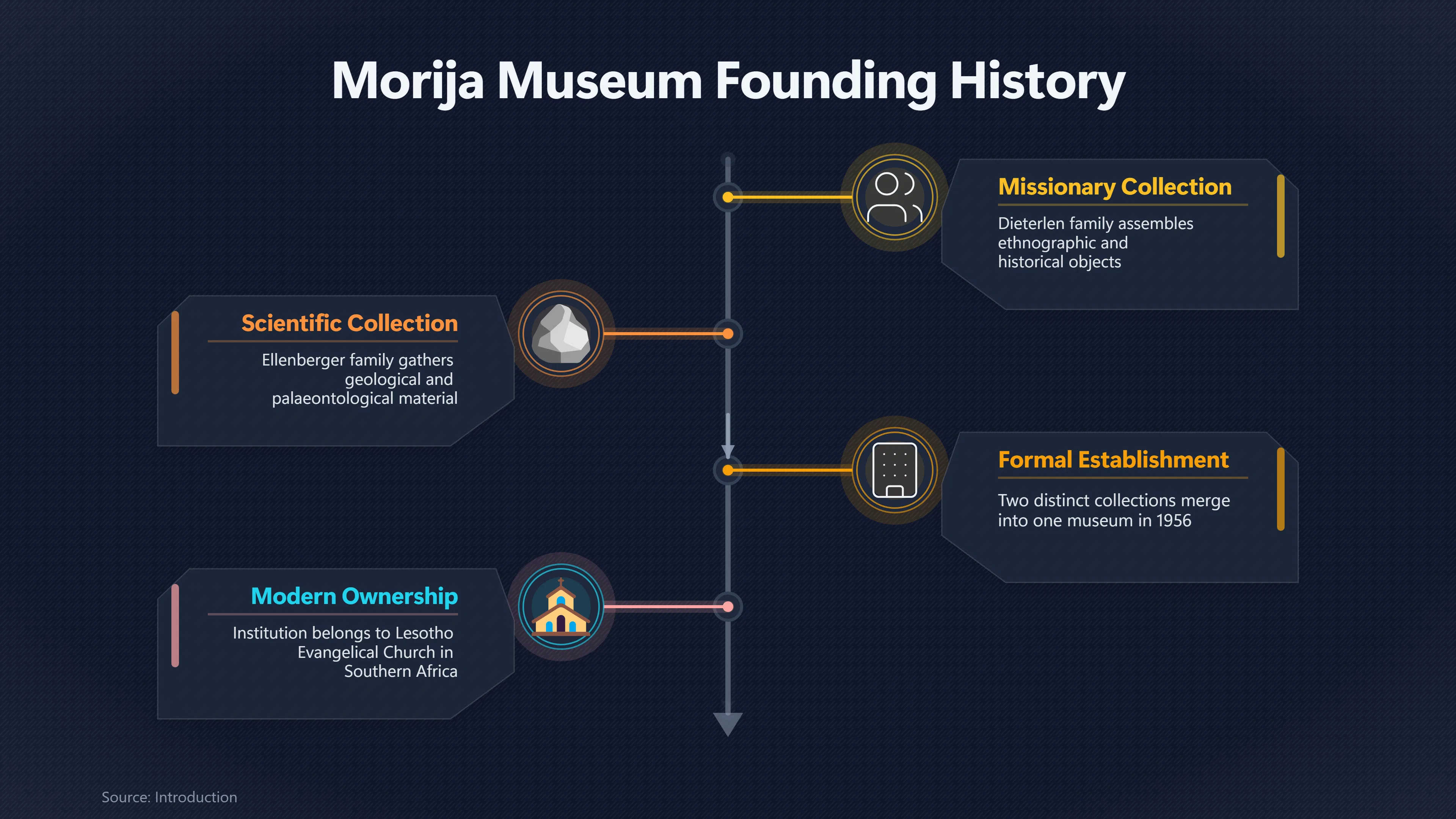
Morija Museum was formally established in 1956 by combining two very different collections. One consisted of ethnographic and historical objects assembled largely by members of the Dieterlen missionary family. The other brought together geological and palaeontological material collected by the Ellenberger family, whose scientific work helped draw international attention to Lesotho’s fossil heritage. These two collections remain the foundation of the museum today.[Museum]morijamuseum.orgOpen source on morijamuseum.org.
That origin explains why the museum feels different from many national museums. It was not created as a state showcase but developed from decades of collecting by missionaries, educators and researchers working in Morija, one of Lesotho’s oldest educational and cultural centres. Today it belongs to the Lesotho Evangelical Church in Southern Africa while operating as a non-profit heritage institution devoted to research, education and conservation.[Museum]morijamuseum.orgMuseum Board & Partners | Morija Museum And Archives | MorijaMuseum Board & Partners | Morija Museum And Archives | Morija
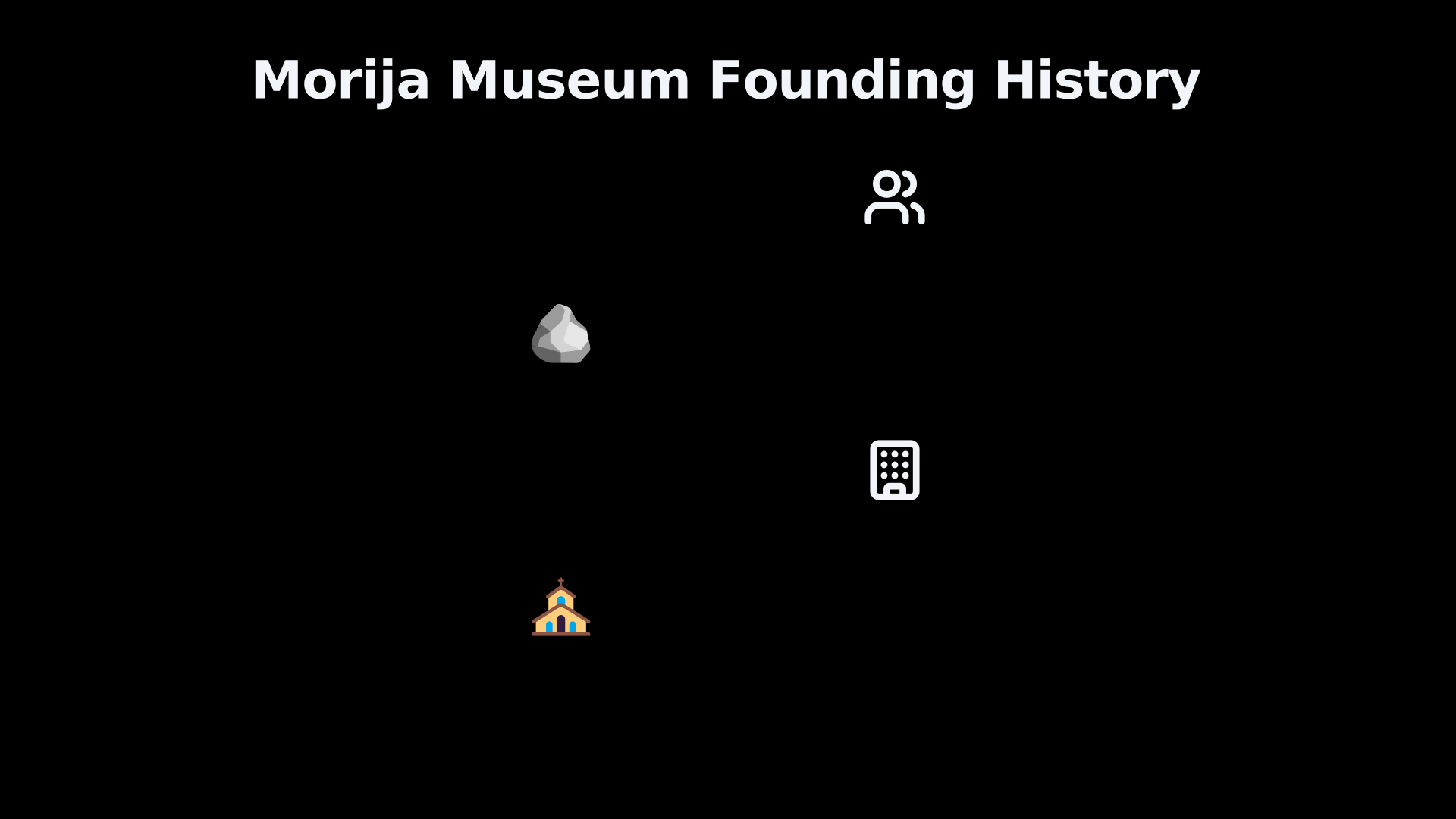
The archives are arguably as remarkable as the museum galleries themselves. They preserve tens of thousands of documents dating from the early nineteenth century onwards, including:
- missionary correspondence and church records;
- rare books and newspapers;
- colonial government publications;
- maps and photographs;
- genealogies and oral-history records;
- music collections, including early Sesotho hymnals;
- academic theses and specialist research on Lesotho.
The archives are especially valuable because early missionaries recorded not only church affairs but also local customs, oral traditions, genealogies and language. Modern researchers therefore use the collections to study religion, politics, linguistics, folklore, education and the formation of the Basotho nation.[Museum]morijamuseum.orgMuseum Archival Collection | Morija MuseumMuseum Archival Collection | Morija Museum
An important feature of the institution is its ongoing digitisation programme. Partnerships with organisations including the British Library, Yale Divinity School Library and FamilySearch have digitised significant portions of the archival holdings, helping protect fragile manuscripts while making them more accessible for future research.[Museum]morijamuseum.orgMuseum Archival Collection | Morija MuseumMuseum Archival Collection | Morija Museum
Fossils, footprints and geological displays
For many visitors, the museum’s most unusual exhibits are its palaeontological collections. Lesotho is internationally known for rocks of the Karoo Supergroup, which preserve abundant traces of life from the late Triassic and early Jurassic periods. Instead of treating these discoveries as isolated scientific specimens, Morija places them within the broader story of the country’s landscape and geological history.[Museum]morijamuseum.orgMuseum Collection | Morija MuseumMuseum Collection | Morija Museum
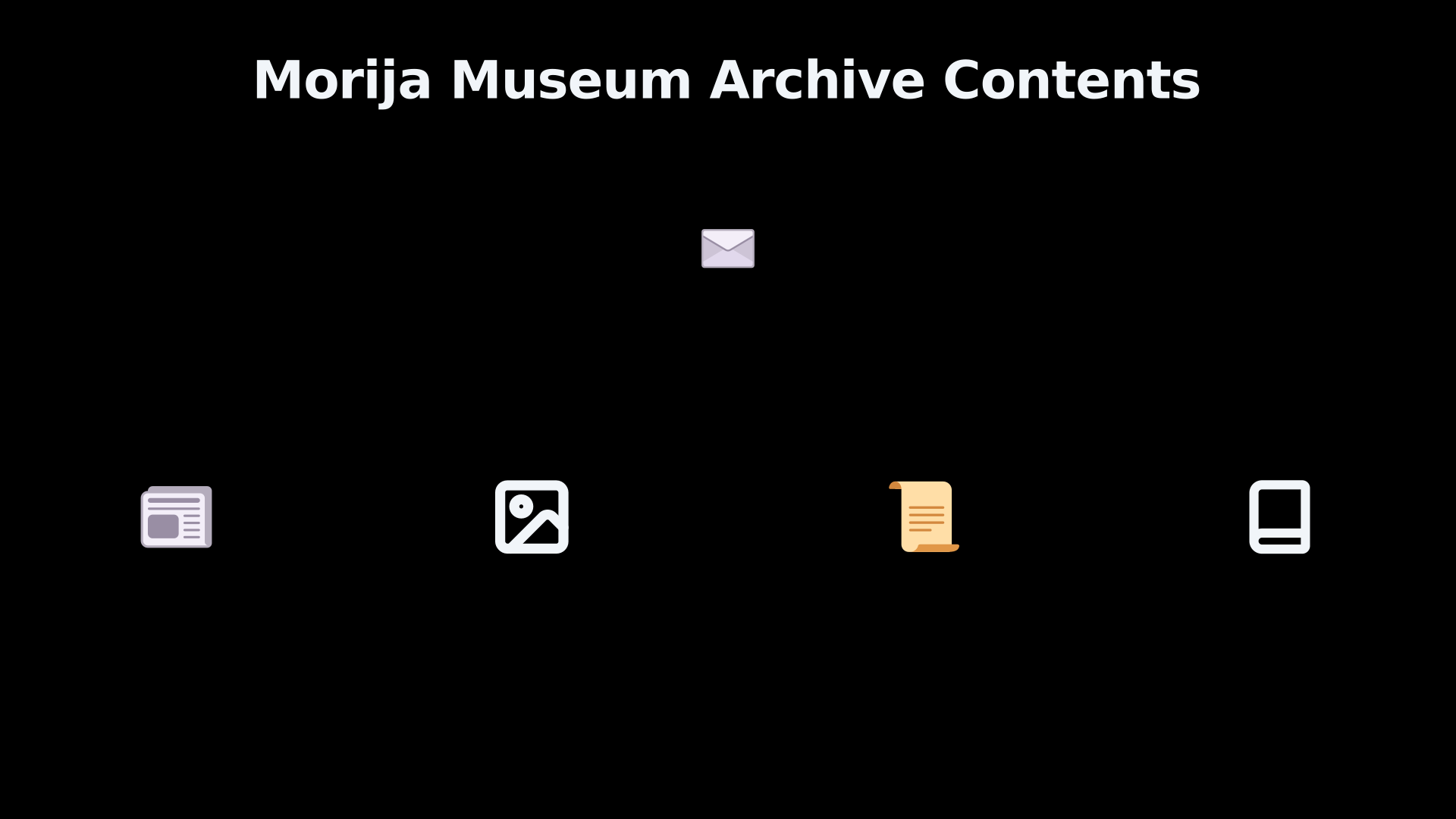
The displays include:
- fossilised plants;
- dinosaur bones recovered from Lesotho;
- dinosaur footprints collected or documented from sites around the country;
- geological specimens such as meteorites, quartz and petrified wood.
The museum begins its geological displays with broad themes including the formation of the universe, continental drift and the geological development of southern Africa before moving into Lesotho’s own fossil record. This gives visitors a coherent explanation of why dinosaur footprints occur so widely across the country rather than presenting isolated curiosities.[Museum]morijamuseum.orgMuseum Collection | Morija MuseumMuseum Collection | Morija Museum
These indoor collections also serve as an introduction to Lesotho’s wider fossil landscape. Many of the country’s famous dinosaur tracksites remain in situ on sandstone surfaces, riverbeds or rock shelters. Morija helps visitors understand what they are seeing before travelling to those outdoor locations, making the museum an important interpretive centre as well as a repository of specimens.[Museum]morijamuseum.orgMuseum Collection | Morija MuseumMuseum Collection | Morija Museum
More than fossils: an eclectic collection
Although fossils are often the headline attraction, Morija’s wider collections reinforce its reputation as Lesotho’s principal curiosity museum.
Alongside geological material are archaeological collections containing prehistoric stone tools, ceramics and artefacts from early farming communities. Ethnographic galleries display Basotho household objects, clothing, weapons and everyday material culture, while natural history exhibits include mammals, birds and reptiles associated with the country’s environment. The museum also holds artworks by important Basotho artists, including sculptures by Samuel Makoanyane, one of Lesotho’s best-known twentieth-century sculptors.[Museum]morijamuseum.orgMuseum Collection | Morija MuseumMuseum Collection | Morija Museum
The overall effect is unusual because visitors move through millions of years of history in a relatively compact building, from meteorites and dinosaur fossils to archaeological artefacts and documentary records of the nineteenth and twentieth centuries.
Preserving objects that no longer survive intact
One of Morija’s more intriguing recent initiatives illustrates how a museum can preserve heritage even when the original objects are deteriorating.
The museum now displays large facsimiles of historic rock-art copies produced during the Frobenius Institute expedition to Lesotho in 1928. Among them is a full-scale reproduction of the famous Ha Baroana rock-art panel, more than ten metres long. Although these reproductions are modern displays rather than original prehistoric paintings, they have become historically important because many of the original rock paintings have faded or deteriorated dramatically during the past century.[frobenius-institut.de]frobenius-institut.deLesotho: Rock art exhibition opens at the Morija Museum…
In this sense the exhibition preserves two layers of history at once: prehistoric rock art and the early twentieth-century efforts to document it before irreversible damage occurred.
How credible and visitor-friendly is Morija?
Morija Museum is best understood as a research museum rather than an entertainment attraction. Its collections are curated by heritage professionals, and the institution actively undertakes research, heritage consultancy, publication projects and educational programmes. Staff use the archives and collections not only for exhibitions but also for scholarly work, heritage management and community projects throughout Lesotho.[Museum]morijamuseum.orgMuseum Research & Publications | Morija MuseumMuseum Research & Publications | Morija Museum
Visitors should therefore expect a modest museum in physical scale rather than an immersive multimedia experience. Much of its importance lies in the provenance of its collections and their concentration in one place. The museum continues to modernise its displays through digital interpretation, multimedia resources and plans for expanded exhibition and research facilities, while remaining fundamentally a working cultural institution rather than a commercial curiosity attraction.[Museum]morijamuseum.orgMuseum Collection | Morija MuseumMuseum Collection | Morija Museum
Within Lesotho’s landscape of unusual heritage, Morija stands apart because it links scientific evidence, documentary history and cultural memory in a single institution. Dinosaur bones, fossil footprints, missionary manuscripts, rare newspapers and Basotho artefacts are not presented as unrelated collections but as different chapters in the same story of how the country and its people have been understood, recorded and remembered over millions of years.
Amazon book picks
Further Reading
Books and field guides related to Inside Lesotho's Main Cabinet of Curiosity. Use these as the next step if you want deeper reading beyond the article.
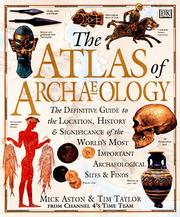
The Atlas of Archaeology
First published 1998. Subjects: Ancient Civilization, Antigüedades, Antiquities, Archaeology, Arqueología.
African Perspectives on Colonialism
This history deals with the twenty-year period between 1880 and 1900, when virtually all of Africa was seized and occupied by the Imperia...
The Oxford Handbook of African Archaeology
Africa has the longest and arguably the most diverse archaeological record of any of the continents. It is where the human lineage first...
eBay marketplace picks
Marketplace Samples
Live-tested eBay searches with available results related to this page.
Selected fromafrican art print oneBay.co.uk.


Endnotes
1.
Source: frobenius-institut.de
Link:https://www.frobenius-institut.de/en/aktuelles/frankfurt-lesotho-felsbildausstellung-im-morija-museum-eroeffnet-2
Source snippet
Lesotho: Rock art exhibition opens at the Morija Museum...
2.
Source: frobenius-institut.de
Link:https://www.frobenius-institut.de/aktuelles/frankfurt-lesotho-felsbildausstellung-im-morija-museum-eroeffnet
Source snippet
t Vor fast 100 Jahren reisten drei Frankfurter Malerinnen, Agnes Schulz, Maria Weyersberg und Elisabeth Mannsfeld nach Lesotho...
3.
Source: morijamuseum.org
Title: Museum Collection | Morija Museum
Link:https://www.morijamuseum.org/collection
4.
Source: morijamuseum.org
Link:https://www.morijamuseum.org/museum-history
5.
Source: morijamuseum.org
Title: Museum Strategic Plan | Morija Museum And Archives | Morija
Link:https://www.morijamuseum.org/stragicplan
Source snippet
Strategic Plan | Morija Museum And Archives | Morija* * * * # History & Strategic Plan Morija Museum & Archives is an integral outgrowth...
6.
Source: morijamuseum.org
Title: Museum Board & Partners | Morija Museum And Archives | Morija
Link:https://www.morijamuseum.org/organisation
7.
Source: morijamuseum.org
Title: Museum Archival Collection | Morija Museum
Link:https://www.morijamuseum.org/archivalcollection
8.
Source: morijamuseum.org
Title: Museum Research & Publications | Morija Museum
Link:https://www.morijamuseum.org/reasearch-publications
9.
Source: morijamuseum.org
Title: Museum Expansion Project | Morija Museum
Link:https://www.morijamuseum.org/expansion
Source snippet
Expansion Project | Morija Museum* * * * ## Phase II Expansion Project Given the great strides made in programme development over the pas...
10.
Source: morijamuseum.org
Title: Contact | Museum MORIJAMUSEUM * * * * # Get in touch OPENING HOURS: Mon
Link:https://www.morijamuseum.org/contact-9
Source snippet
Contact | MuseumMORIJAMUSEUM * * * * # Get in touch OPENING HOURS: Mon - Fri 8:00 am – 5:00 pm Saturday 9:00 am – 5:00 pm Sunday 12 noon...
11.
Source: museummors.dk
Title: The exhibitions at Dueholm Monastery can be found in fou
Link:https://museummors.dk/en/
Source snippet
Home | Museum MorsTHE PAST - THE FOSSILS - THE STORIES Image: 337496085 5954218961338936 6496290903246507625 N DUEHOLM MONASTERY The Nati...
Additional References
12.
Source: nrm.se
Title: About our collections | Naturhistoriska riksmuseet
Link:https://www.nrm.se/engelska/in-english/collections/palaeontological-collections—fossils/about-our-collections/about-our-collections
Source snippet
February 26, 2026 — ABOUT OUR COLLECTIONS The museum's palaeontological collections today house almost 2 million fossils with many unique...
Published: February 26, 2026
13.
Source: youtube.com
Title: Morija Museum & Archives
Link:https://www.youtube.com/watch?v=QJNcpCDEgo4
Source snippet
Unlocking Lesotho’s Past | Inside the Morija Museum & Archives...
14.
Source: youtube.com
Title: Unlocking Lesotho’s Past | Inside the Morija Museum & Archives
Link:https://www.youtube.com/watch?v=YiOJTuMoW50
Source snippet
Morija Arts and Cultural Festival...
15.
Source: youtube.com
Title: Discover Lesotho
Link:https://www.youtube.com/watch?v=uBKOtF-Qp-8
Source snippet
Morija Museum & Archives...
16.
Source: youtube.com
Title: MORIJA MUSEUM & ARCHIVES
Link:https://www.youtube.com/watch?v=NQITsDtTSgM
Source snippet
Discover Lesotho - Morija...