Where Burkina Faso Keeps Its Sacred Mysteries
Burkina Faso does not have a large, clearly signposted circuit of “weird museums” in the commercial sense.
Page outline Jump by section
Introduction
The outstanding destination is the privately founded Museum of Manéga, where masks, funerary objects and sacred sound are interpreted as parts of a living system of memory. The National Museum in Ouagadougou provides the broader institutional setting, while regional museums in Gaoua and Bobo-Dioulasso preserve objects whose meanings can involve death, initiation, social authority and relations with the unseen world. Beyond museum walls, places such as Bazoulé’s sacred crocodile pond show how Burkina Faso’s curiosity culture often remains embedded in pilgrimage, oral history and community practice rather than being converted into spectacle. Documentation is uneven, however, and opening conditions can be difficult to verify remotely.
Manéga: Burkina Faso’s great cabinet of sacred memory
About 50 kilometres north-west of Ouagadougou, the Museum of Manéga is the country’s clearest answer to a museum of mysteries, ritual objects and unusual belief. It is a private institution established by Titinga Frédéric Pacéré, a lawyer, writer, poet, traditional authority and cultural preservationist who died in November 2024. The Burkinabè government described him as a “Living Human Treasure” whose work was devoted to protecting and promoting the country’s culture.[SIG]sig.gov.bfSIGDécès de Maître Titinga Frédéric PACÉRÉ (Communiqué du GouvernementTrésor Humain Vivant, il a consacré sa vie à la préservation et à la valorisation de l’art et de la culture du Burkina Faso, avec un rega…
The institution is also known as the Museum of Bendrology. Pacéré coined “bendrology” from the name of a sacred Mossi drum associated with the communication of dynastic history, public values and encoded messages. The idea is important because the collection is not organised simply around beautiful objects. It treats drums, masks, speech, rhythm, funeral practice and oral history as interconnected ways of storing knowledge.[Wikipedia]WikipediaLe terme "Bendrologie" est un néologisme créé à partir du mot "bendré", un instrument de musique sacré utilisé chez les Mossi pour rappel…
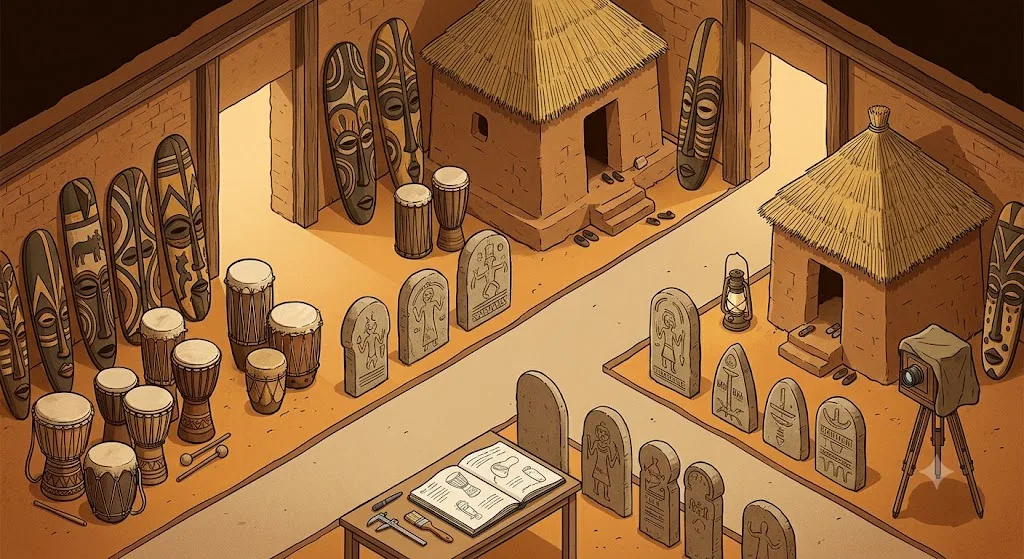
Visitors encounter masks associated with several communities, ritual musical instruments, amulets, protective objects, ceramics, grave markers and reconstructed forms of traditional housing. Reports on the museum describe hundreds of masks, including examples said to have been used in funerary ceremonies rather than manufactured merely as decoration. The site also includes reconstructed sacred environments intended to explain concepts of death, ancestry and spiritual authority.[Afrik]afrik.comBendrologie: les masques ont la paroleUn musée fort de 500 masques sacrés ayant tous participé à des rituels devant des morts, dont le site explique la symbolique, l’utilisati…
The most uncanny part of Manéga is its treatment of mortality. The museum has a funerary pavilion and spaces commonly translated as the “House of the Dead” or “Pavilion of Death”. Published descriptions say that visitors may be expected to observe unusual entry customs, including removing their shoes and, in one account, entering backwards. These actions should not be treated as theatrical gimmicks: within the museum’s interpretation, they acknowledge rules governing the boundary between ordinary life and the domain of ancestors.[Wikipedia]WikipediaLe terme "Bendrologie" est un néologisme créé à partir du mot "bendré", un instrument de musique sacré utilisé chez les Mossi pour rappel…
Another striking group consists of carved funerary stones or grave markers, often called Yakouga in descriptions of the collection. Claims about their extreme age vary and are not always supported by accessible archaeological documentation, so visitors should be cautious about accepting sweeping statements that they represent some of Africa’s oldest cultural objects. Their importance is clearer as evidence of regional ways of memorialising the dead and giving durable form to social identity.[Afrik]afrik.comBendrologie: les masques ont la paroleUn musée fort de 500 masques sacrés ayant tous participé à des rituels devant des morts, dont le site explique la symbolique, l’utilisati…
Manéga is unusual because it sits between several museum types. It is a personal collection, a cultural archive, an educational reconstruction, a memorial landscape and a defence against the loss of heritage through the international art market. Pacéré explicitly presented the museum as a way to keep important objects and knowledge in Africa rather than allowing them all to disappear into foreign collections.[RFI]www1.rfi.frarticle 11609.aspPrivilège accordé à RFI: notre guide n'est autre que le fondateur de Manéga, l'avocat Titinga Frédéric Pacéré, ancien bâtonnier, écrivain…
That personal authorship is also a reason to visit critically. Manéga reflects Pacéré’s intellectual framework and his effort to translate complex traditions for outsiders. It should not be assumed that every community represented would explain its objects in exactly the same way, or that a museum display can reproduce the authority of an object still used in ceremony. Its strength lies in making those tensions visible: a sacred mask in a case is simultaneously protected, displaced from performance and reinterpreted for a public audience.

Why the masks are more than frightening faces
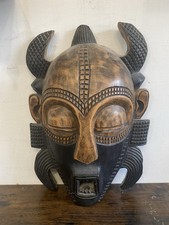
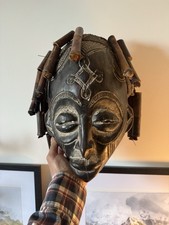
Burkina Faso is internationally associated with masks, especially tall plank forms, animal-headed figures and boldly patterned wooden faces. Their unfamiliar proportions can make them look monstrous or surreal to foreign viewers, but treating them simply as “tribal curiosities” misses their primary functions.
Among several communities in Burkina Faso, masks have historically appeared in funerals, initiations, agricultural rites and ceremonies concerned with social order. They may represent animals, ancestors or powers associated with the natural world. In some traditions, a mask is not complete when separated from its fibre costume, performer, music, audience and prescribed movement. The museum object is therefore only one surviving part of a larger event.[Wikipedia]WikipediaArt of Burkina FasoArt of Burkina Faso
This distinction matters at Manéga and the National Museum. A plank mask hanging motionless on a wall may once have moved rapidly above a dancer, transforming geometric patterns into a shifting visual language. A face that appears grotesque in isolation may have served as a protective presence at a funeral or helped regulate the relationship between the living and the dead.
It also complicates questions of authenticity. A mask may be:
- an older object used in ceremony;
- a replacement made for continuing local use;
- a commissioned example made for a museum;
- a work produced for collectors;
- or a decorative piece borrowing the appearance of a ritual form.
Age alone does not settle the question. A recently made mask can be culturally authentic if created and used within an established practice, while an apparently old example may have weak provenance or may have been altered to appeal to buyers. Museum labels are most useful when they explain who made an object, who used it, how it was acquired and whether its ceremonial history is documented.
The National Museum: unusual objects in a wider national story
The National Museum of Burkina Faso in Ouagadougou is the country’s principal public collecting institution. Founded in 1962, it holds roughly 14,000 objects, more than 12,000 of which the museum says have been inventoried. Its remit is broader than strange history, covering archaeology, ethnography, crafts, social life and national heritage.[Musée National du Burkina Faso]museenational.gov.bfMusée National du Burkina Faso HistoireMusée National du Burkina Faso Histoire
For an offbeat visitor, its value lies in context. Here, masks, ritual objects, tools, metalwork and musical instruments can be understood alongside ordinary domestic and economic life. That prevents sacred or visually dramatic objects from being reduced to isolated oddities. The museum’s exhibitions and cultural programming also show that these traditions are not frozen remnants of a vanished past; in May 2026, for example, it hosted an international festival devoted to traditional instruments and dances.[Musée National du Burkina Faso]museenational.bfMusée National du Burkina Faso#Collections Musée NationalMusée National du Burkina Faso#Collections Musée National
The collection is particularly useful for understanding the overlap between sound and authority. In many museum traditions, drums and horns are displayed as musical technology. In Burkina Faso, some instruments have also carried political, historical or ritual messages. Their importance may lie not merely in the sound they produce but in who is permitted to play them, when they may be heard and what their rhythms communicate.
The National Museum is more conventionally curated than Manéga and is an official state institution with scientific, cultural and technical responsibilities.[Musée National du Burkina Faso]museenational.gov.bfMusée National du Burkina Faso AccueilMusée National du Burkina Faso Accueil Its unusual material is therefore framed within a national heritage narrative rather than a single collector’s interpretation. The trade-off is that visitors seeking an immersive encounter with funeral symbolism and sacred spaces may find Manéga more distinctive.
Regional collections that preserve difficult histories
Burkina Faso’s regional museums are smaller and less consistently documented online, but several contain material relevant to unusual belief, ritual and the preservation of vulnerable traditions.
The museum in Bobo-Dioulasso holds a permanent collection of objects associated with communities in western Burkina Faso, including masks, jewellery, pottery, ceremonial or military clothing and historic photographs. Its importance is less about a single spectacular curiosity than the survival of a compact regional archive in which masks can be viewed beside the clothing, materials and local histories that gave them meaning.[Africa.com]africa.comMuseums of AfricaMuseums of Africa
In Gaoua, the museum commonly known as the Poni Museum or Museum of the Civilisations of the South-West was founded through the work of Madeleine Père, a French nun and ethnologist who spent decades documenting communities of the region. Its collections relate especially to the lives and material culture of peoples including the Lobi.[Wikipedia]WikipediaMusée des civilisations des peuples du Sud-OuestMusée des civilisations des peuples du Sud-Ouest
For readers interested in unusual religious collections, the south-west is significant because household shrines, protective figures, divination, funerary practice and relationships with ancestors have often been central to descriptions of Lobi material culture. Yet this is also where careful interpretation is most necessary. Older ethnographic collections were frequently shaped by outsiders who selected, classified and translated objects through colonial or missionary assumptions. A figure labelled simply as a “fetish”, for example, may actually belong to a precise network of obligations, protection, family authority and ritual use.
These museums matter because they keep such objects near the landscapes and communities from which they came. Their displays may be modest, but proximity can offer something that a major foreign art museum cannot: the possibility of understanding a ritual object as part of architecture, farming, kinship and local memory rather than as an anonymous masterpiece.
Sacred crocodiles: a living attraction rather than a museum
The sacred crocodile pond at Bazoulé, around 30 kilometres from Ouagadougou, is not a museum, but it belongs firmly within Burkina Faso’s landscape of unusual public heritage. The crocodiles are regarded locally as protectors, and oral accounts connect them with the discovery of water during a severe drought. The site has become a guided visitor attraction where belief, animal encounter and tourism overlap.[ChicFaso]chicfaso.comOpen source on chicfaso.com.
What makes Bazoulé relevant is that the “collection” is alive. The crocodiles are not specimens preserved behind glass; they form part of a continuing relationship between a community, a water source and a body of legend. Visitors may hear stories about the animals’ sacred status and see local guides manage close encounters.
The experience should nevertheless be approached with more caution than promotional photographs sometimes suggest. Feeding or posing near large reptiles is an animal-welfare and personal-safety issue, even where guides have extensive local experience. The most meaningful interpretation is not that the crocodiles are magically harmless, but that the pond expresses a long-standing cultural accommodation between people, dangerous animals, environmental need and protective belief.
Bazoulé also illustrates a broader point: in Burkina Faso, some of the most distinctive “exhibits” cannot be detached from place. Sacred ponds, ceremonial masks and funerary practices lose much of their significance when treated only as collectible objects.
How credible are the collections?
The strongest collections in Burkina Faso are credible as records of cultural practice, but individual claims require different levels of caution.
The National Museum has the clearest institutional status, formal inventory and public mandate. Manéga has exceptional cultural value and was created by a major Burkinabè intellectual, but its interpretation is closely associated with its founder’s theories and preservation project. Regional collections often contain invaluable objects yet may have limited published catalogues, conservation information or online visitor details.
Four questions help when assessing an unusual display:
Was the object used, commissioned or bought? A documented ceremonial history is different from a stylistic attribution made after purchase.
Who supplied the interpretation? Community specialists, makers and ritual custodians may understand an object differently from an early ethnographer, dealer or tourist guide.
Is belief being reported or endorsed? A museum can accurately state that an object is regarded as protective without claiming scientific proof of supernatural power.
Does the label explain provenance? This is especially important for sacred objects that may have left communities through sale, pressure, colonial collecting or the art trade.
These concerns extend beyond Burkina Faso. In 2017, during a speech in Ouagadougou, the French president promised to create conditions for returning African cultural heritage. France passed a broader restitution law in May 2026, increasing the possibility that objects shown to have been wrongfully removed during the colonial period may eventually return to countries of origin.[Uni Museum Tübingen]unimuseum.uni-tuebingen.deOpen source on uni-tuebingen.de.
For Burkina Faso, restitution is not only about recovering impressive sculptures. It raises the harder question of what should happen when a sacred, funerary or community-owned object comes back. A national museum, regional institution, traditional authority and originating family may all have legitimate but different claims over how it should be stored, displayed or ritually treated.
Visiting in practice
Current travel conditions are the greatest obstacle to exploring Burkina Faso’s unusual collections. As of July 2026, the UK Foreign, Commonwealth and Development Office advises against all travel to Burkina Faso because of serious security risks. Museum opening hours, road access and regional travel may also change with little notice.[GOV.UK]GOV.UKBurkina Faso travel adviceBurkina Faso travel advice
Anyone already in the country for essential reasons should verify access directly through an institution or trusted local contact rather than relying on old travel blogs. This is particularly important for Manéga and smaller regional museums, whose websites or directory listings may not reflect current staffing, conservation work or security restrictions.
Visitors should also expect rules around photography, access and behaviour to differ from those of an ordinary art museum. Some masks and sacred spaces may not be appropriate to photograph. A guide may ask visitors to remove shoes, follow a particular route or avoid touching objects that appear accessible. Such instructions are part of the cultural meaning of the collection, not simply museum etiquette.
Why Burkina Faso matters to strange-museum culture
Burkina Faso’s distinctive contribution to unusual museum culture is not a gallery of invented monsters, sensational crime relics or commercial paranormal exhibits. It is a network of collections concerned with a more fundamental mystery: how societies preserve relationships with ancestors, spirits, death, memory and invisible authority.
Manéga is the essential example because it gathers masks, drums, funerary markers, ritual spaces and oral knowledge into one highly personal museum. The National Museum supplies firmer institutional context, while regional collections show how much meaning is lost when masks and protective objects are separated from community history. Bazoulé’s crocodiles demonstrate that some forms of heritage remain living, dangerous and place-bound.
The result is a strange-history landscape in which the most unusual object is rarely strange to the people who made or used it. Its oddness appears when it crosses boundaries: from ceremony to display, village to capital, sacred custody to private collection, oral memory to written label, or Burkina Faso to a museum overseas. Understanding those transitions is what turns a room of remarkable objects into a deeper account of how cultural memory survives.

Amazon book picks
Further Reading
Books and field guides related to Where Burkina Faso Keeps Its Sacred Mysteries. Use these as the next step if you want deeper reading beyond the article.
The Museum Experience Revisited
The first book to take a "visitor's eye view" of the museum visit when it was first published in 1992, The Museum Experience revolutioniz...
The Oxford Encyclopedia of African Thought
From St. Augustine and early Ethiopian philosophers to the anti-colonialist movements of Pan-Africanism and Negritude, this encyclopedia...
eBay marketplace picks
Marketplace Samples
Live-tested eBay searches with available results related to this page.
Selected fromAfrican mask decor oneBay.co.uk.
Endnotes
1.
Source: sig.gov.bf
Title: SIGDécès de Maître Titinga Frédéric PACÉRÉ (Communiqué du Gouvernement)
Link:https://www.sig.gov.bf/details?cHash=5b8a0b4fef8ad3615dec1ad7f4b3dcf1&tx_news_pi1%5Baction%5D=detail&tx_news_pi1%5Bcontroller%5D=News&tx_news_pi1%5Bnews%5D=1957
Source snippet
Trésor Humain Vivant, il a consacré sa vie à la préservation et à la valorisation de l’art et de la culture du Burkina Faso, avec un rega...
2.
Source: www1.rfi.fr
Title: article 11609.asp
Link:https://www1.rfi.fr/actufr/articles/023/article_11609.asp
Source snippet
Privilège accordé à RFI: notre guide n'est autre que le fondateur de Manéga, l'avocat Titinga Frédéric Pacéré, ancien bâtonnier, écrivain...
3.
Source: Wikipedia
Link:https://fr.wikipedia.org/wiki/Mus%C3%A9e_de_Man%C3%A9ga
Source snippet
Le terme "Bendrologie" est un néologisme créé à partir du mot "bendré", un instrument de musique sacré utilisé chez les Mossi pour rappel...
4.
Source: afrik.com
Title: Bendrologie: les masques ont la parole
Link:https://www.afrik.com/bendrologie-les-masques-ont-la-parole
Source snippet
Un musée fort de 500 masques sacrés ayant tous participé à des rituels devant des morts, dont le site explique la symbolique, l’utilisati...
5.
Source: Wikipedia
Link:https://es.wikipedia.org/wiki/Museo_de_Man%C3%A9ga
6.
Source: Wikipedia
Title: Art of Burkina Faso
Link:https://en.wikipedia.org/wiki/Art_of_Burkina_Faso
7.
Source: museenational.gov.bf
Title: Musée National du Burkina Faso Histoire
Link:https://www.museenational.gov.bf/le-musee/a-propos
8.
Source: museenational.gov.bf
Title: Musée National du Burkina Faso Actualités
Link:https://www.museenational.gov.bf/au-quotidien/actualites
9.
Source: museenational.gov.bf
Title: Musée National du Burkina Faso Accueil
Link:https://www.museenational.gov.bf/accueil
10.
Source: africa.com
Title: Museums of Africa
Link:https://africa.com/museums-of-burkina-faso
11.
Source: Wikipedia
Title: Musée des civilisations des peuples du Sud-Ouest
Link:https://fr.wikipedia.org/wiki/Mus%C3%A9e_des_civilisations_des_peuples_du_Sud-Ouest
12.
Source: chicfaso.com
Link:https://www.chicfaso.com/en/blog/week-end-touristique-depuis-ouagadougou
13.
Source: GOV.UK
Title: Burkina Faso travel advice
Link:https://www.gov.uk/foreign-travel-advice/burkina-faso
14.
Source: travel.state.gov
Title: burkina faso
Link:https://travel.state.gov/en/international-travel/travel-advisories/burkina-faso.html
15.
Source: Wikipedia
Title: Report on the restitution of African cultural heritage
Link:https://en.wikipedia.org/wiki/Report_on_the_restitution_of_African_cultural_heritage
16.
Source: archive.org
Link:https://archive.org/details/landofflyingmask0000whee
17.
Source: chicfaso.com
Link:https://www.chicfaso.com/en/post/musee-national-du-burkina-faso
18.
Source: chicfaso.com
Link:https://www.chicfaso.com/fr/post/musee-de-[manega
19.
Source: museenational.gov.bf
Link:https://www.museenational.gov.bf/au-quotidien/evenements-du-musee
20.
Source: museenational.gov.bf
Link:https://www.museenational.gov.bf/visiter-le-musee
21.
Source: museenational.gov.bf
Link:https://www.museenational.gov.bf/le-musee/a-propos?cHash=c16197a1874481864adf92add6e1f60e&tx_fpnewsletter_pi1%5Baction%5D=create&tx_fpnewsletter_pi1%5Bcontroller%5D=Log
22.
Source: GOV.UK
Link:https://www.gov.uk/foreign-travel-advice
23.
Source: museenational.bf
Title: Musée National du Burkina Faso#Collections Musée National
Link:https://museenational.bf/collectionsmuseenational/
24.
Source: unimuseum.uni-tuebingen.de
Link:https://www.unimuseum.uni-tuebingen.de/fileadmin/content/05_Forschung_Lehre/Provenienz/sarr_savoy_en.pdf
25.
Source: museenational.bf
Title: Musée National du Burkina Faso
Link:https://museenational.bf/
26.
Source: museenational.bf
Title: les masques au delà du visible
Link:https://museenational.bf/exposition/les-masques-au-dela-du-visible/
27.
Source: museenational.bf
Title: Collections Archive
Link:https://museenational.bf/collection/
28.
Source: museenational.bf
Title: A propos
Link:https://museenational.bf/a-propos/
29.
Source: ireland.ie
Link:https://www.ireland.ie/en/dfa/overseas-travel/advice/burkina-faso/
30.
Source: musee-foaa.com
Title: Burkina Faso
Link:https://www.musee-foaa.com/burkina-faso/
Additional References
31.
Source: lemonde.fr
Link:https://www.lemonde.fr/afrique/article/2020/07/26/au-burkina-faso-le-musee-de-manega-protege-le-langage-des-tams-tams-et-des-masques-de-l-oubli_6047328_3212.html
Source snippet
Collection du Musée privé de Manega par le chef coutumier Frédéric Titinga Pacéré Masques à lames des Younyonsé portés à l’occasion des r...
32.
Source: lemonde.fr
Link:https://www.lemonde.fr/en/culture/article/2026/05/08/france-passes-law-on-the-restitution-of-cultural-artifacts-looted-during-colonial-rule_6753247_30.html
Source snippet
Notably, the law removes geographic and temporal limitations, although it primarily targets artifacts seized between 1815 and 1972. To qu...
33.
Source: infosculturedufaso.net
Link:https://www.infosculturedufaso.net/tourisme-a-la-decouverte-du-musee-de-la-bendrologie-de-manega/
Source snippet
Ce site reste l’un des sites les plus agréables et incontournables à visiter au Burkina Faso car on y a aussi reconstruit des exemples d’...
34.
Source: test.nypl.org
Title: The New York Public Library Le pavillon de la mort / Titinga Frédéric Pacéré
Link:https://test.nypl.org/research/research-catalog/bib/hb990060120000203941
Source snippet
Item Details | Research Catalog | NYPL## Le pavillon de la mort / Titinga Frédéric Pacéré.... Manéga: Musée de la Bendrologie: Ed...
35.
Source: youtube.com
Link:https://www.youtube.com/watch?v=tCNaoZfrcJc
Source snippet
Faces of Africa: Guardians of the Sacred Crocodiles...
36.
Source: youtube.com
Title: Sacred Crocs, Thriving Tourism | Burkina Faso Village Lives Alongside Reptiles
Link:https://www.youtube.com/watch?v=21MZ6xATBWg
Source snippet
Burkina faso, Le musée de Manéga, garant du patrimoine culturel...
37.
Source: youtube.com
Title: Faces of Africa: Guardians of the Sacred Crocodiles
Link:https://www.youtube.com/watch?v=ajTz36Njf9A
Source snippet
Sacred Crocs, Thriving Tourism | Burkina Faso Village Lives Alongside Reptiles...
38.
Source: whitehouse.gov
Link:https://www.whitehouse.gov/presidential-actions/2025/12/restricting-and-limiting-the-entry-of-foreign-nationals-to-protect-the-security-of-the-united-states/
39.
Source: youtube.com
Title: Burkina faso, Le musée de Manéga, garant du patrimoine culturel
Link:https://www.youtube.com/watch?v=CwPMOUsCnao
Source snippet
BURKINA: DECES de Me TITINGA FREDERIC PACERE...
40.
Source: sidwaya.info
Link:https://www.sidwaya.info/38e-anniversaire-de-lassassinat-de-thomas-sankara-une-exposition-pour-perenniser-les-valeurs-du-pere-de-la-revolution/