Within Mauritius Curiosities
What Mauritius's Most Personal Museum Objects Reveal
Shipwreck relics and small personal possessions give physical form to Mauritius's histories of empire, enslavement and controlled migration.
On this page
- Shipwreck relics and imperial conflict
- Everyday objects linked to enslaved people
- Migration archives and indentured labour
Page outline Jump by section
Introduction
Mauritius tells some of its most powerful stories through damaged, ordinary and deeply personal objects rather than grand monuments. In the island’s museums and interpretation centres, cannon recovered from shipwrecks sit alongside fragments of everyday household items, immigration records, travellers’ trunks, identity documents and family possessions. Together they reveal how empire, slavery and migration shaped the island, not as abstract historical processes but as lived experiences.
What makes these collections distinctive is that they often recover people who left few written records of their own. Marine archaeology, archaeological excavation and family artefacts help museums reconstruct the lives of enslaved Africans and Malagasy people, indentured labourers from India and elsewhere in Asia, sailors, merchants and colonial settlers. Instead of celebrating imperial conquest, many modern displays ask visitors to consider the human cost behind Mauritius’s transformation into one of the world’s most important plantation colonies and migration hubs.[govmu.org]govmu.orgGovernment of Mauritius Republic of MauritiusGovernment of Mauritius Republic of Mauritius
Shipwreck relics and imperial conflict
Mauritius occupies a strategic position in the Indian Ocean, and its surrounding waters contain the remains of centuries of naval warfare and commercial shipping. The National History Museum in Mahébourg uses objects recovered from these wrecks to explain how maritime conflict shaped the island’s history.
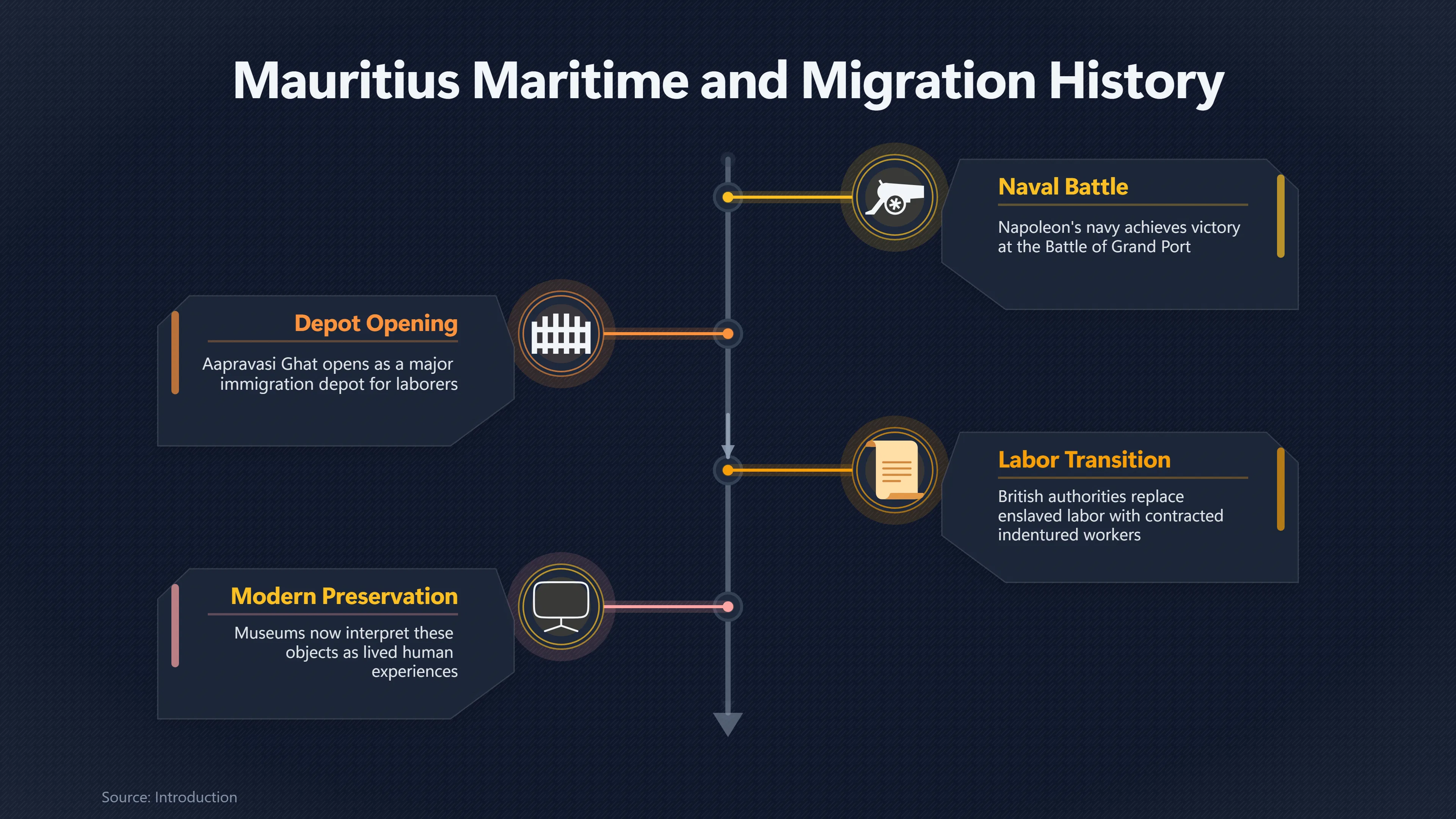
Among its best-known exhibits are artefacts recovered from the British frigates HMS Sirius and La Magicienne, both lost during the Battle of Grand Port in 1810, the only major naval victory won by Napoleon’s navy over the Royal Navy. Visitors encounter cannon, weapons, navigational instruments and other marine archaeological finds that survived beneath the sea long after the ships themselves disappeared. Rather than functioning simply as military trophies, these objects illustrate how control of maritime routes determined the fortunes of colonial Mauritius.[mauritiusmuseums.govmu.org]mauritiusmuseums.govmu.orgAbout The Museum – Mauritius Museums CouncilAbout The Museum – Mauritius Museums Council
The museum deliberately places these shipwreck finds within a broader social story. Upstairs galleries move beyond naval conflict to show how the British conquest transformed Mauritius into a sugar-producing colony whose prosperity depended first upon enslaved labour and later upon indentured migration. This curatorial approach encourages visitors to see wrecked ships not as isolated archaeological curiosities but as part of the same imperial system that transported soldiers, merchants, enslaved people and migrant workers across the Indian Ocean.[mauritiusmuseums.govmu.org]mauritiusmuseums.govmu.orgAbout The Museum – Mauritius Museums CouncilAbout The Museum – Mauritius Museums Council
Shipwreck objects also possess an emotional quality that paper archives cannot reproduce. Corroded cannon, damaged ceramics and personal belongings bear the physical marks of salt water, fire and time, reminding visitors that historical events were experienced by individuals whose possessions sometimes became the only surviving evidence of their lives.
Everyday objects linked to enslaved people
Objects connected directly to enslaved Mauritians are often fragmentary. This reflects the historical reality that enslaved people rarely possessed durable personal property that was preserved in official collections. As a result, museums increasingly rely on archaeological evidence, surviving domestic artefacts, architectural remains and oral history to reconstruct everyday experience.
The Intercontinental Slavery Museum in Port Louis was established specifically to address this historical imbalance. Located in a former military hospital built by enslaved labour during the eighteenth century, the museum aims to collect artefacts, documents and oral histories relating to slavery in Mauritius and the wider Indian Ocean. Its mission reflects a shift away from presenting slavery as a brief colonial episode and towards recognising it as a foundational part of Mauritian society.[UNESCO]unesco.orgMauritius establishes an International Slavery Museum | UNESCOMauritius establishes an International Slavery Museum | UNESCO…
Instead of focusing exclusively on plantation owners or colonial administrators, exhibitions increasingly highlight ordinary material culture:
- domestic pottery and cooking vessels recovered through archaeology;
- tools associated with plantation labour;[aapravasi.govmu.org]aapravasi.govmu.orgLabour Intangible Cultural HeritageINTANGIBLE CULTURAL HERITAGE INTANGIBLE HERITAGE ASSOCIATED WITH INDENTURED LABOUR Image On June 24, 2…
- household objects used by enslaved communities;
- architectural remains built through enslaved labour;
- documents recording sales, emancipation and ownership alongside evidence of individual lives.
These items rarely appear spectacular in themselves. Their significance lies in restoring visibility to people whose names often survive only in estate records or legal documents. A cracked ceramic bowl or a worn iron tool may reveal more about daily existence than portraits of colonial governors.
Modern interpretation also places these artefacts within wider Indian Ocean networks. Mauritius received enslaved people from Madagascar, Mozambique, mainland East Africa and other parts of the region, making the island’s collections relevant to a much broader history of forced migration than a purely national narrative would suggest.[UNESCO]unesco.orgMauritius establishes an International Slavery Museum | UNESCOMauritius establishes an International Slavery Museum | UNESCO…
Migration archives and indentured labour
If slavery is represented partly through archaeological fragments, indentured migration is documented through an unusually rich combination of surviving buildings, official paperwork and personal possessions.
The most important site is Aapravasi Ghat in Port Louis, the remains of the immigration depot established in 1849. After the abolition of slavery in the British Empire, Mauritius became the testing ground for what British authorities called the “Great Experiment”: replacing enslaved labour with contracted workers. Nearly half a million indentured labourers arrived through this depot between the nineteenth and early twentieth centuries, making it one of the world’s most significant migration sites.[UNESCO World Heritage Centre]whc.unesco.orgWorld Heritage Centre Aapravasi GhatUNESCO World Heritage CentreAapravasi Ghat - UNESCO World Heritage Centre…
Although the surviving architecture is itself the principal artefact, the adjoining Beekrumsing Ramlallah Interpretation Centre expands the story through museum displays that explain how migrants were registered, medically examined, housed and assigned to plantations. Rather than presenting migration only through statistics, exhibitions use official registers, photographs, reproduced contracts and personal belongings to show how individuals experienced arrival in an unfamiliar colony.[aapravasi.govmu.org]aapravasi.govmu.orgPlan Your VisitPlan Your Visit
The symbolic power of apparently ordinary objects becomes clear in this setting. Immigration passes, shipping registers, identity records and family heirlooms demonstrate that migration involved not simply labour but the transport of languages, religions, food traditions and family memories that continue to shape modern Mauritius.
The National History Museum reinforces this story by displaying material connected with Indian immigration and the broader peopling of Mauritius alongside maps, photographs, Victorian domestic objects and colonial documents. Presenting migration objects within the same galleries as shipwreck relics and slavery-related displays allows visitors to trace the transition from forced labour to indenture without pretending that the two systems were identical.[mauritiusmuseums.govmu.org]mauritiusmuseums.govmu.orgAbout The Museum – Mauritius Museums CouncilAbout The Museum – Mauritius Museums Council
Why these collections matter
Unlike cabinets of curiosities built around bizarre or spectacular objects, these Mauritian collections derive their impact from their intimacy. Many exhibits are visually modest: a damaged cannon, an immigration ledger, an old coin, a cooking pot, a fragment of clothing or a simple household tool. Their importance comes from the stories attached to them.
Together they challenge visitors to understand Mauritius through movement rather than isolation. The island’s museums reveal repeated journeys across the Indian Ocean—by soldiers, sailors, enslaved Africans, Malagasy captives, indentured labourers from India and Asia, merchants and colonial officials. Material culture makes these movements tangible in ways that written history alone cannot.
Within Mauritius’s wider landscape of unusual collections, these museums occupy a distinctive place. They preserve not mysterious relics or legendary artefacts, but objects whose extraordinary quality lies in their ability to recover forgotten lives. Through shipwreck remains, archaeological fragments and personal possessions, they transform anonymous historical systems into individual human stories that continue to shape the country’s identity today.
Amazon book picks
Further Reading
Books and field guides related to What Mauritius's Most Personal Museum Objects Reveal. Use these as the next step if you want deeper reading beyond the article.
The Slave Ship: A Human History
The slave ship was the instrument of history's greatest forced migration and a key to the origins and growth of global capitalism, yet mu...
The ^AIndian Ocean in World History
The Indian Ocean in World History explores the cultural exchanges that took place in this region from ancient to modern times. Alpers exp...
Saltwater Slavery: A Middle Passage from Africa to American D...
This bold, innovative book promises to radically alter our understanding of the Atlantic slave trade, and the depths of its horrors. Step...

The Indian Ocean in World History
First published 2013. Subjects: Indian ocean region, Civilization, History.
eBay marketplace picks
Marketplace Samples
Live-tested eBay searches with available results related to this page.
Selected fromshipwreck collectible oneBay.co.uk.



Endnotes
1.
Source: govmu.org
Title: Government of Mauritius Republic of Mauritius
Link:https://www.govmu.org/EN/Pages/exploremauritius.aspx
2.
Source: whc.unesco.org
Title: World Heritage Centre Aapravasi Ghat
Link:https://whc.unesco.org/en/list/1227/
Source snippet
UNESCO World Heritage CentreAapravasi Ghat - UNESCO World Heritage Centre...
3.
Source: unesco.org
Title: Mauritius establishes an International Slavery Museum | UNESCO
Link:https://www.unesco.org/en/articles/mauritius-establishes-international-slavery-museum?hub=417
Source snippet
Mauritius establishes an International Slavery Museum | UNESCO...
4.
Source: mauritiusmuseums.govmu.org
Title: About The Museum – Mauritius Museums Council
Link:https://mauritiusmuseums.govmu.org/mauritiusmuseums/?page_id=1843
5.
Source: aapravasi.govmu.org
Title: Aapravasi Ghat World Heritage Property
Link:https://aapravasi.govmu.org/aapravasi/?page_id=794
6.
Source: aapravasi.govmu.org
Title: Plan Your Visit
Link:https://aapravasi.govmu.org/aapravasi/?page_id=816
7.
Source: unesco.org
Link:https://www.unesco.org/en/articles/aapravasi-ghat-how-unesco-world-heritage-site-keeps-memory-indentured-labour-alive
Source snippet
September 9, 2025 — AAPRAVASI GHAT: HOW A UNESCO WORLD HERITAGE SITE KEEPS THE MEMORY OF INDENTURED LABOUR ALIVE Between 1834 and 1920, o...
Published: September 9, 2025
8.
Source: aapravasi.govmu.org
Link:https://aapravasi.govmu.org/aapravasi/?page_id=3497
Source snippet
Universal ValueImage OUTSTANDING UNIVERSAL VALUE Retrospective statement of Outstanding Universal Value for the Aapravasi Ghat site Brief...
9.
Source: mauritiusmuseums.govmu.org
Title: It is housed in Chatea
Link:https://mauritiusmuseums.govmu.org/mauritiusmuseums/?page_id=1854
Source snippet
Background – Mauritius Museums CouncilNational History Museum HISTORICAL BACKGROUND The National History Museum is situated at Mahebourg...
10.
Source: aapravasi.govmu.org
Link:https://aapravasi.govmu.org/aapravasi/?page_id=841
Source snippet
Labour Intangible Cultural HeritageINTANGIBLE CULTURAL HERITAGE INTANGIBLE HERITAGE ASSOCIATED WITH INDENTURED LABOUR Image On June 24, 2...
12.
Source: youtube.com
Link:https://www.youtube.com/watch?v=7AljArIgFcw
Source snippet
Indenture in Mauritius HISTORY AND HERITAGE 2018...
13.
Source: youtube.com
Link:https://www.youtube.com/watch?v=1n2K-bLMcas
Source snippet
We visit 'Aapravasi Ghat' a world heritage museum in Port Louis Mauritius...
14.
Source: youtube.com
Title: Historic Mahebourg, Mauritius
Link:https://www.youtube.com/watch?v=UCR2Awidl4E
Source snippet
Aapravasi Ghat Mauritius museum AAPRAVASI GHAT MUSEUM #portlouis #mauritius Across The World...
15.
Source: youtube.com
Title: We visit ‘Aapravasi Ghat’ a world heritage museum in Port Louis Mauritius
Link:https://www.youtube.com/watch?v=Ftq70IQu0ZA
Source snippet
Historic Mahebourg, Mauritius...