What Makes the DR Congo's Collections So Unusual?
The Democratic Republic of the Congo does not have a well-documented circuit of witchcraft museums, cryptid exhibitions or commercial cabinets of curiosity.
Page outline Jump by section
Introduction
The most dependable starting points are the National Museum in Kinshasa and the National Museum of Lubumbashi. Smaller collections in Bukavu and the Kuba royal centre of Mushenge are potentially more atmospheric, but their opening arrangements and current condition are poorly documented. A further complication is that an enormous quantity of Congolese material remains in European museums, where objects once labelled as “fetishes” or curiosities are now being reinterpreted as religious, legal and political instruments.[imnc.cd]imnc.cdImage: Ishango BoneMusées Nationaux du CongoIMNC - Institut des Musées Nationaux du CongoL'Institut des Musées Nationaux du Congo (IMNC) est une inst…
Where can visitors see unusual collections?
The Institut of National Museums of Congo manages the country’s principal public museum network, including national museums in Kinshasa, Lubumbashi and Mbandaka. These are broad cultural institutions rather than specialist museums of the macabre or supernatural, but their ethnographic and archaeological displays contain many of the objects most relevant to an offbeat-history visitor.[IMNC - Musées Nationaux du Congo]imnc.cdImage: Ishango BoneMusées Nationaux du CongoIMNC - Institut des Musées Nationaux du CongoL'Institut des Musées Nationaux du Congo (IMNC) est une inst…
The National Museum of the Democratic Republic of the Congo in Kinshasa presents Congolese history through archaeological material, sculpture, masks, musical instruments and objects associated with different regional traditions. The institution describes itself as a scientific public museum, not a tourist curiosity attraction, and its displays are intended to return cultural context to objects that have often been treated abroad simply as “tribal art”. Recent visitor accounts describe a relatively compact sequence of exhibition rooms rather than an enormous encyclopaedic museum.[IMNC - Musées Nationaux du Congo]imnc.cdL'édifice historique, autrefois connu sous le nom de 'Congo Frigo', a été métamorphosé pour devenir le gardien du patrimoine congolais…
Lubumbashi’s national museum is particularly relevant to visitors who enjoy collections that cross conventional boundaries. Alongside ethnographic material, it has developed holdings in archaeology and entomology. Its history also illustrates the uneven survival of Congolese museums: the institution deteriorated through lack of resources before renovation work around 2000, after which part of the building was also used for contemporary art.[biennaledelubumbashi.com]biennaledelubumbashi.comEn 2000, le Musée national de Lubumbashi qui tombait peu à peu en désuétude faute de moyens, a bénéficié d'importants travaux de rénovati…
Elsewhere, documentation becomes less reliable. Museums or collections have been reported in Bukavu, Mushenge, Mbandaka, Kananga, Kisangani and Butembo, but published lists do not necessarily prove regular public opening. In the DRC, a named museum may be an active national institution, a small regional store, a mission collection, or a historic establishment whose present visitor arrangements require local confirmation.[Wikipedia]WikipediaList of museums in the Democratic Republic of the CongoList of museums in the Democratic Republic of the Congo
Power figures are not horror props
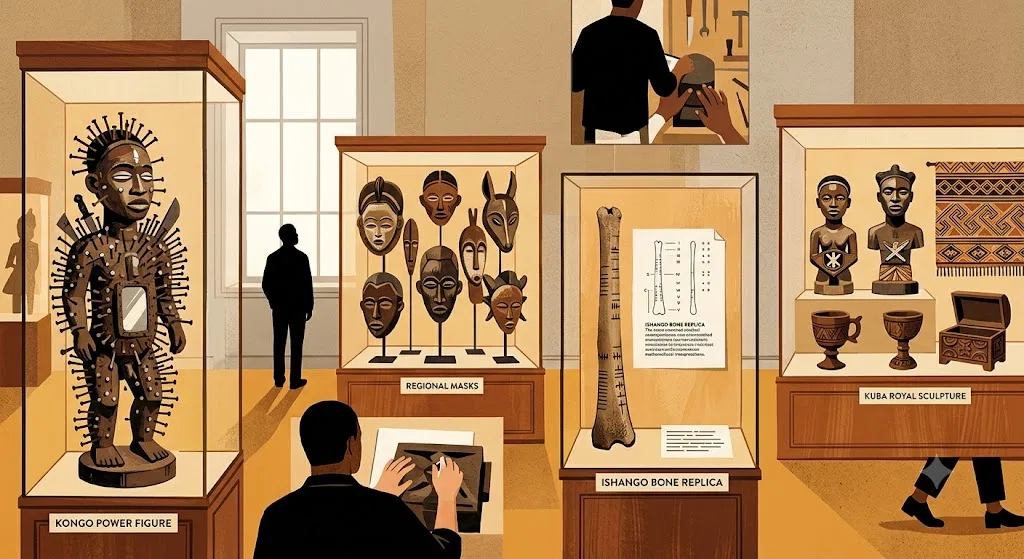
Among the most visually startling objects associated with the DRC are Kongo power figures, especially wooden forms containing inserted substances, mirrors, pegs, blades or nails. Older European catalogues commonly called such objects “fetishes”, a word that encouraged visitors to imagine irrational magic or malevolent witchcraft. That interpretation is now considered seriously misleading.
These figures were made effective by ritual specialists who placed prepared materials within cavities in the sculpture. Depending on their purpose, they could be used in healing, oath-taking, dispute settlement, protection, divination or the pursuit of wrongdoers. A nail or blade driven into a figure might record an agreement or activate a request; it was not necessarily an act of torture directed at the statue. Animal forms, particularly dogs, could symbolise the ability to track hidden threats.[KU Leuven]kuleuven.beKU Leuven Congolese Masters of MagicKU Leuven Congolese Masters of Magic
The connection with witchcraft is real but easily sensationalised. Some figures were intended to identify, repel or punish harmful supernatural action. That does not make them equivalent to exhibits in a European-style witchcraft museum. They belonged to systems of medicine, justice, spiritual authority and community protection in which the boundaries between religion, law and healing were drawn differently.
Museum display can strip away precisely what made such an object powerful. Charges may have been removed, surfaces cleaned, accompanying medicines lost and the identity of the ritual specialist forgotten. What remains in a case may therefore look like a complete supernatural artefact while actually being only the visible shell of a much larger practice.
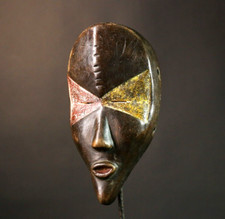
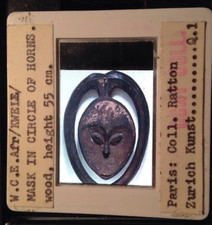
That distinction matters when judging commercial examples. Nail figures and dramatic masks are widely reproduced for the tourist and international art markets. Age, ritual use and provenance cannot be established merely from an object’s frightening appearance. A responsible museum label should identify the community, collection history and known function, while admitting uncertainty where documentation is incomplete.

Bukavu’s hidden mission collection
One of the DRC’s most intriguing smaller institutions is the ethnographic collection associated with the Xaverian Fathers in Bukavu. International reporting in 2015 described it as a museum concealed within a Catholic mission compound rather than promoted as a conventional city attraction. Its holdings included masks, carvings, weapons, household objects and representations connected with communities of the Kivu region.[www.ndtv.com]ndtv.comOpen source on ndtv.com.
Its unusual character comes partly from the setting. Mission museums occupy an ambiguous place in Central African heritage. Missionaries sometimes preserved objects, oral accounts and craft traditions that might otherwise have disappeared. At the same time, Christian collecting frequently removed ritual objects from active religious life and reclassified them as evidence of custom, superstition or a vanishing pre-Christian past.
That history should make visitors cautious about treating the collection as a transparent record of local belief. The selection may reflect what missionaries considered worth saving, what converts surrendered, or what collectors found visually distinctive. Labels may preserve valuable local names and stories, but they may also carry older religious or colonial assumptions.
Current public access is difficult to establish from dependable online information. The safest description is therefore a historically documented mission collection, not a guaranteed walk-in attraction. Anyone planning a visit should seek confirmation locally through cultural or church contacts rather than relying on old tourism references.
The Ishango Bone: ancient calculator or famous mystery object?
The DRC’s best-known archaeological curiosity is the Ishango Bone, found during excavations near Lake Edward in the early 1950s. It is a small bone bearing grouped incisions in several columns, with a piece of quartz fixed at one end. The original is held by Belgium’s Institute of Natural Sciences; a replica is displayed because the ancient object has cracks that make exhibition risky.[Institute of Natural Sciences]naturalsciences.beOpen source on naturalsciences.be.
The notches have generated a remarkable range of interpretations. They have been described as tally marks, a mathematical table, a device based on repeating number patterns, a lunar record and evidence of sophisticated prehistoric calculation. The Smithsonian presents it within the history of recording information, while newer mathematical studies continue to propose structural explanations for its markings.[si.edu]humanorigins.si.eduOpen source on si.edu.
The important word is propose. No surviving inscription explains what the maker intended, and numerical patterns can support more than one reconstruction. Claims that the bone is definitively the world’s first calculator or a proven lunar calendar go beyond the evidence.
As a curiosity object, however, it is unusually powerful. It links deep prehistory, mathematics, symbolism and modern debates about who gets credited in histories of science. Its physical absence from the DRC also mirrors the wider story of Congolese heritage: an object found locally, interpreted internationally and preserved primarily in a former colonial power.
The Kinshasa national museum highlights Ishango as part of Congolese intellectual and archaeological heritage. Visitors should expect its significance to be conveyed through interpretation or reproduction rather than assume that the original bone is in the country.[IMNC - Musées Nationaux du Congo]imnc.cdL'édifice historique, autrefois connu sous le nom de 'Congo Frigo', a été métamorphosé pour devenir le gardien du patrimoine congolais…
Kuba royal objects at Mushenge
Mushenge, in the Kasai region, is the royal centre of the Kuba kingdom and one of the most culturally distinctive places associated with Congolese collecting. Kuba court art includes portrait figures of rulers, elaborately patterned textiles, carved cups, boxes, masks, stools and prestige objects. These works were not merely decorative: they recorded rank, royal continuity, initiation, political identity and relationships between the court and its constituent communities.
Royal portrait figures are especially unusual. Rather than attempting a realistic likeness, they identify a ruler through a personal emblem and carefully controlled posture. Examples collected at Mushenge in the early twentieth century are now held by institutions including the British Museum, while other Kuba court objects entered American museum collections through photographers, ethnographers and dealers.[si.edu]africa.si.eduOpen source on si.edu.
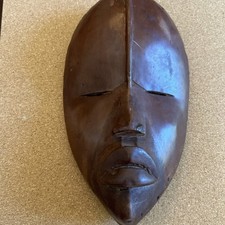
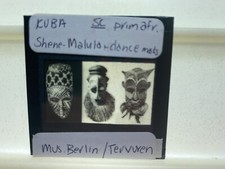
Masks can be even harder for outsiders to interpret. Some combine animal and human features or embody named characters within performances. Removed from dance, costume, sound and restricted ritual knowledge, they may be presented overseas as isolated sculptures. In their original setting they belonged to moving, socially regulated events rather than silent displays.
Mushenge is sometimes described as having a museum or royal collection, but reliable, current visitor information is scarce. Travel to the region can also be demanding. It is better understood as a living royal and cultural centre with collected heritage than as a predictable commercial museum stop. An online documentation project that gained access through the Kuba royal family emphasised how difficult entry and cultural recording could be even for an organised research team.[Africa Online Museum]africaonlinemuseum.orgOpen source on africaonlinemuseum.org.
Why so many Congolese curiosities are abroad
No account of unusual collections in the DRC is complete without explaining why many of the country’s most famous objects are in Belgium, Britain and the United States. Belgium’s AfricaMuseum states that the vast majority of its cultural material comes from the DRC and was collected during the colonial period. Its cultural heritage department manages about 120,000 ethnographic objects, including sculptures, masks, weapons, cups, combs and everyday artefacts.[Africa Museum]africamuseum.beAfrica MuseumOrigin of the collectionsThe vast majority of the objects come from the DR Congo and were collected during the colonial peri…
Some objects were purchased or received through exchanges. Others were taken during military campaigns, coercive encounters or circumstances in which meaningful consent cannot be demonstrated. The power figure associated with the ruler Ne Kuko is a prominent example: museum provenance research concluded that it had been looted near Boma in 1878.[The Bulletin]thebulletin.beafrica museum begins large scale investigation looted artefactsafrica museum begins large scale investigation looted artefacts
This history transformed Congolese sacred, legal and royal objects into European curiosities. Objects that had mediated contracts or healing were displayed as evidence of “primitive magic”. Human communities became anonymous cultural labels, while collectors and colonial officers were individually named. Modern reinterpretation is gradually reversing that hierarchy by asking who made an object, how it functioned and how it left its community.
Belgium adopted a legal framework in 2022 allowing state-owned objects linked to the colonial past to be returned. The framework does not automatically transfer every contested artefact, and it excludes categories such as archives and human remains. Provenance research, legal ownership and negotiations with the Congolese state remain necessary.[africamuseum.be]africamuseum.beAfrica Museum RestitutionAfrica Museum Restitution
Restitution is therefore not just an argument about where an attractive statue should stand. It concerns whether Congolese institutions and communities can recover the material evidence needed to explain their own religious, political and artistic histories. It also affects what visitors can see: at present, a more extensive survey of Congolese ritual art may still be possible in Tervuren or London than in many cities inside the DRC.
How to judge a collection’s credibility
A strange-looking object is not automatically ancient, sacred or supernatural. Congolese art has been heavily collected for more than a century, creating a market in reproductions, workshop pieces, altered objects and works deliberately aged for sale. Even major museums retain objects whose cultural attribution is disputed; the Smithsonian, for example, notes uncertainty over whether one group of masks traditionally labelled as Tetela has been identified correctly.[National Museum of African Art]africa.si.eduOpen source on si.edu.
The most useful questions are practical:
- Where was it collected? A precise village, region and date are more valuable than a broad label such as “Congo”.
- Who recorded its purpose? Information from makers, users or local specialists is stronger than a dealer’s dramatic description.
- Is the object complete? Medicines, fibres, costume parts and ritual contents may have been removed.
- Was it made for use or sale? Tourist production is not inherently worthless, but it should not be passed off as a historic ritual object.
- Does the label distinguish belief from fact? Museums should explain supernatural claims as part of a cultural system rather than declare that an object literally possesses magical power.
- Is the acquisition history known? Missing provenance may conceal looting, colonial seizure or recent trafficking.
Good curation does not drain the mystery from these collections. It makes the mystery more specific. A power figure becomes more compelling when understood as an instrument of law and spiritual enforcement; a royal sculpture becomes stranger when its emblem is recognised as a political identity; and the Ishango Bone becomes more interesting when its unresolved interpretations are presented honestly.
What makes the DRC’s curiosity culture distinctive?
The DRC’s unusual collections are not concentrated in novelty museums. They sit at the meeting point of national museums, royal heritage, mission collecting, archaeological research, living religious traditions and colonial dispersal.
For visitors, the clearest public route begins with the national museums in Kinshasa and Lubumbashi. Bukavu’s mission collection and heritage connected with Mushenge offer more unusual possibilities, but require greater preparation and should not be assumed to operate like regular tourist attractions. The most famous Congolese “curiosities” abroad should meanwhile be approached not as exotic trophies but as displaced parts of social systems that joined medicine, spirituality, politics and justice.
That tension is what gives the country’s strange-history landscape its power. The central question is rarely whether an object is eerie enough. It is whether the case, label and institution allow it to speak as something more than an anonymous relic of “magic”.
Amazon book picks
Further Reading
Books and field guides related to What Makes the DR Congo's Collections So Unusual?. Use these as the next step if you want deeper reading beyond the article.

Congo Masks: Masterpieces from Central Africa
First published 2019. Subjects: Masks, Exhibitions, Catalogs, Maske.
eBay marketplace picks
Marketplace Samples
Example marketplace items related to this page. Use the search link to explore similar finds on eBay.
Selected fromCongo mask replica oneBay.co.uk.
Endnotes
1.
Source: imnc.cd
Title: Image: Ishango Bone
Link:https://imnc.cd/
Source snippet
Musées Nationaux du CongoIMNC - Institut des Musées Nationaux du CongoL'Institut des Musées Nationaux du Congo (IMNC) est une inst...
2.
Source: imnc.cd
Link:https://imnc.cd/mnrdc
Source snippet
L'édifice historique, autrefois connu sous le nom de 'Congo Frigo', a été métamorphosé pour devenir le gardien du patrimoine congolais...
3.
Source: africamuseum.be
Link:https://www.africamuseum.be/en/discover/origin_collections
Source snippet
Africa MuseumOrigin of the collectionsThe vast majority of the objects come from the DR Congo and were collected during the colonial peri...
4.
Source: africamuseum.be
Link:https://www.africamuseum.be/en/research/discover/collections_management/cultural_heritage_collections
Source snippet
Africa MuseumCultural heritage CollectionsThe figurative sculptures (masks, statues, etc.) are the most well-known, but it also contains...
5.
Source: biennaledelubumbashi.com
Link:https://www.biennaledelubumbashi.com/fr/lieux/musee-national-de-lubumbashi/
Source snippet
En 2000, le Musée national de Lubumbashi qui tombait peu à peu en désuétude faute de moyens, a bénéficié d'importants travaux de rénovati...
6.
Source: biennaledelubumbashi.com
Link:https://biennaledelubumbashi.com/en/venues/national-museum-of-lubumbashi/
Source snippet
In 2000, the National Museum of Lubumbashi, which was falling into disuse due to lack of resources, benefited from major renovation works...
7.
Source: Wikipedia
Title: List of museums in the Democratic Republic of the Congo
Link:https://en.wikipedia.org/wiki/List_of_museums_in_the_Democratic_Republic_of_the_Congo
8.
Source: ndtv.com
Link:https://www.ndtv.com/world-news/hidden-democratic-republic-of-congo-museum-safeguards-endangered-tradition-748623
9.
Source: arxiv.org
Link:https://arxiv.org/abs/2504.06412
10.
Source: arxiv.org
Link:https://arxiv.org/abs/1204.1019
11.
Source: africamuseum.be
Title: Africa Museum Restitution
Link:https://www.africamuseum.be/en/about_us/restitution
12.
Source: africamuseum.be
Title: Discover | Royal Museum for Central Africa
Link:https://www.africamuseum.be/en/discover
13.
Source: provenance.africamuseum.be
Link:https://provenance.africamuseum.be/lobject.php?id=MO.1995.16.1&language=en
14.
Source: georiska.africamuseum.be
Link:https://georiska.africamuseum.be/en/activities/collection_management
15.
Source: africamuseum.be
Link:https://www.africamuseum.be/sites/default/files/media/research/discover%20our%20research/doc/MRAC-RDC_EN.pdf
16.
Source: Wikipedia
Title: Central London
Link:https://en.wikipedia.org/wiki/Central_London
17.
Source: 2019.biennaledelubumbashi.com
Title: musee national de lubumbashi
Link:https://2019.biennaledelubumbashi.com/venues/musee-national-de-lubumbashi
18.
Source: kuleuven.be
Title: KU Leuven Congolese Masters of Magic
Link:https://www.kuleuven.be/ci/29/ci29mayombe.html
19.
Source: naturalsciences.be
Link:https://www.naturalsciences.be/en/museum/exhibitions-activities/exhibitions/250-years-of-natural-sciences/the-ishango-bone
20.
Source: humanorigins.si.edu
Link:https://humanorigins.si.edu/evidence/behavior/recording-information/ishango-bone
21.
Source: africa.si.edu
Link:https://africa.si.edu/collection/object/nmafa
22.
Source: britishmuseum.org
Link:https://www.britishmuseum.org/collection/object/E_Af1909
23.
Source: britishmuseum.org
Link:https://www.britishmuseum.org/collection/object/E_Af1909
24.
Source: africaonlinemuseum.org
Link:https://africaonlinemuseum.org/map/dr-congo/kuba-kingdom/
25.
Source: thebulletin.be
Title: africa museum begins large scale investigation looted artefacts
Link:https://www.thebulletin.be/africa-museum-begins-large-scale-investigation-looted-artefacts
26.
Source: equaltimes.org
Title: restitution of historical objects
Link:https://www.equaltimes.org/restitution-of-historical-objects
27.
Source: africa.si.edu
Link:https://africa.si.edu/collection/object/nmafa_84-6-6.1
28.
Source: kadoc.kuleuven.be
Link:https://kadoc.kuleuven.be/english/3_research/31_ourresearch/angles/whitefatherfilmcollection
29.
Source: si.edu
Link:https://www.si.edu/object/archives/components/sova-eepa-1973-001-ref28264
30.
Source: africa.si.edu
Link:https://africa.si.edu/collection/object/nmafa
31.
Source: africa.si.edu
Link:https://africa.si.edu/collection/object/nmafa
32.
Source: africa.si.edu
Link:https://africa.si.edu/collection/object/nmafa
33.
Source: africa.si.edu
Link:https://africa.si.edu/collection/object/nmafa
34.
Source: africa.si.edu
Link:https://africa.si.edu/collection/object/nmafa
35.
Source: africa.si.edu
Title: selected artwork
Link:https://africa.si.edu/collection/selected-artwork/1699
36.
Source: si.edu
Link:https://www.si.edu/object/face-mask%3Anmafa
37.
Source: africa.si.edu
Title: sova eepa 1973 001 ref13702
Link:https://africa.si.edu/archives/object/sova-eepa-1973-001-ref13702
38.
Source: africa.si.edu
Title: sova eepa 1973 001 ref28273
Link:https://africa.si.edu/archives/object/sova-eepa-1973-001-ref28273
39.
Source: africa.si.edu
Title: sova eepa 1973 001 ref30490
Link:https://africa.si.edu/archives/object/sova-eepa-1973-001-ref30490
40.
Source: africa.si.edu
Link:https://africa.si.edu/collection/object/nmafa
41.
Source: britishmuseum.org
Link:https://www.britishmuseum.org/collection/term/x84051
42.
Source: britishmuseum.org
Link:https://www.britishmuseum.org/collection/object/E_Af1909
43.
Source: britishmuseum.org
Link:https://www.britishmuseum.org/collection/term/x67959
44.
Source: africaonlinemuseum.org
Link:https://africaonlinemuseum.org/map/dr-congo/kuba-kingdom/video/
45.
Source: artmuseum.princeton.edu
Link:https://artmuseum.princeton.edu/art/collections/objects/32921
46.
Source: ishango.naturalsciences.be
Link:https://ishango.naturalsciences.be/en/en-ishango-13.html
Additional References
47.
Source: tripadvisor.co.uk
Link:https://www.tripadvisor.co.uk/Attraction_Review-g294187-d18980223-Reviews-Musee_National_de_la_Republique_Democratique_du_Congo-Kinshasa.html
Source snippet
All You SHOULD Know Before You Go (w/ 2026 Reviews)The museum presents a beautiful collection of objects distributed in three...
48.
Source: youtube.com
Link:https://www.youtube.com/watch?v=xWn-ullFguE
Source snippet
Hidden DR Congo Museum Safeguards Endangered Tradition...
49.
Source: researchgate.net
Link:https://www.researchgate.net/publication/394506701_Restitution_of_colonial_heritage_collections_Partial_norm_implementation_in_Belgium_and_the_United_Kingdom
50.
Source: academia.edu
Link:https://www.academia.edu/145087207/Studies_on_the_iboga_cults_VI_The_divinatory_practices
51.
Source: researchgate.net
Link:https://www.researchgate.net/publication/371765355_Problems_of_preservation_protection_and_restoration_of_cultural_heritage_objects_and_museum_collections_in_the_conditions_of_war
52.
Source: facebook.com
Link:https://www.facebook.com/poaenglish/posts/a-uk-museum-has-opened-a-new-gallery-displaying-thousands-of-african-artefacts-w/122165211086683092/
53.
Source: instagram.com
Link:https://www.instagram.com/archives_du_burundi/?hl=en
54.
Source: restitutionmatters.org
Link:https://restitutionmatters.org/publication-type/article/
55.
Source: centralbedfordshire.gov.uk
Link:https://www.centralbedfordshire.gov.uk/
56.
Source: centrallondonforward.gov.uk
Link:https://centrallondonforward.gov.uk/