Within Strange Bulgaria
Were Bulgaria's Vampire Burials Really About Vampires?
Bulgaria's so-called vampire graves reveal real funerary precautions shaped by fear of the restless dead.
On this page
- The Sozopol burial and its iron pin
- How anti revenant rituals worked
- Archaeology, folklore and tourism labels
Page outline Jump by section
Introduction
Bulgaria’s so-called “vampire burials” are among the country’s most famous archaeological discoveries, but the skeletons do not provide evidence that medieval people encountered supernatural creatures. Instead, they preserve evidence of something arguably more revealing: the fears, rituals and beliefs of the communities that buried them. Modified graves in which bodies were pinned, nailed or otherwise restrained show how seriously some medieval Bulgarians took the possibility that certain dead individuals might return as dangerous revenants. The best-known example, discovered at Sozopol on the Black Sea coast, has become an international tourist attraction, yet its real importance lies in the way archaeology allows folklore to be examined through physical evidence rather than legend alone.[EITB]eitb.eusVampires in Bulgaria | Archaeologists unearth suspected vampires bones | EITB NewsJuly 6, 2012…
Were Bulgaria’s Vampire Burials Really About Vampires?
The label “vampire burial” is a modern shorthand rather than an archaeological diagnosis. Excavators use it to describe graves containing deliberate measures intended to prevent the deceased from returning after death according to contemporary belief.
These burials belong to a much wider European tradition of anti-revenant practices. Medieval communities across parts of eastern and south-eastern Europe believed that some individuals—whether because of an unusual death, suspected wrongdoing, social exclusion or unexplained misfortune affecting the living—could become restless dead. Rather than proving belief in the literary vampire popularised centuries later, the graves reveal practical attempts to neutralise a feared corpse.
For archaeologists, the value of these discoveries lies in the combination of physical evidence and historical folklore. A skeleton pierced with iron, weighted down or otherwise restrained demonstrates that protective rituals were actually carried out, rather than existing only in oral tradition.[Регионален исторически музей Бургас]burgasmuseums.bgOpen source on burgasmuseums.bg.
The Sozopol Burial and Its Iron Pin
The most famous Bulgarian case emerged during excavations at medieval Sozopol in 2012. Archaeologists uncovered the skeleton of an adult male with a heavy iron object driven through the chest. Another burial from the same excavation showed similar treatment, indicating that this was not an isolated act but part of an established local practice. The finds attracted worldwide attention under headlines about “vampire skeletons”, although the excavators repeatedly explained that the bodies represented anti-vampire rituals rather than supernatural evidence.[EITB]eitb.eusVampires in Bulgaria | Archaeologists unearth suspected vampires bones | EITB NewsJuly 6, 2012…
The burial came from the extensive medieval cemetery surrounding the former monastery and church complex at Sozopol. Archaeological investigations have documented hundreds of graves spanning several centuries, with only a tiny minority showing anti-revenant modifications. The rarity of these burials makes them more significant, suggesting that such precautions were reserved for particular individuals rather than forming part of normal funeral practice.[Sozopol Museums]sozopol-museums.bgSozopol Museums South fortress wall and Monastery of St. NicholasSozopol MuseumsSouth fortress wall and Monastery of St. Nicholas - Museum Center SozopolMay 27, 2020…
The skeleton itself became closely associated with Sozopol’s Archaeological Museum through exhibitions and facial reconstructions, making it one of Bulgaria’s best-known archaeological curiosities. Visitors therefore encounter both a genuine medieval burial and the modern story of how archaeology became international news.
How Anti-Revenant Rituals Worked
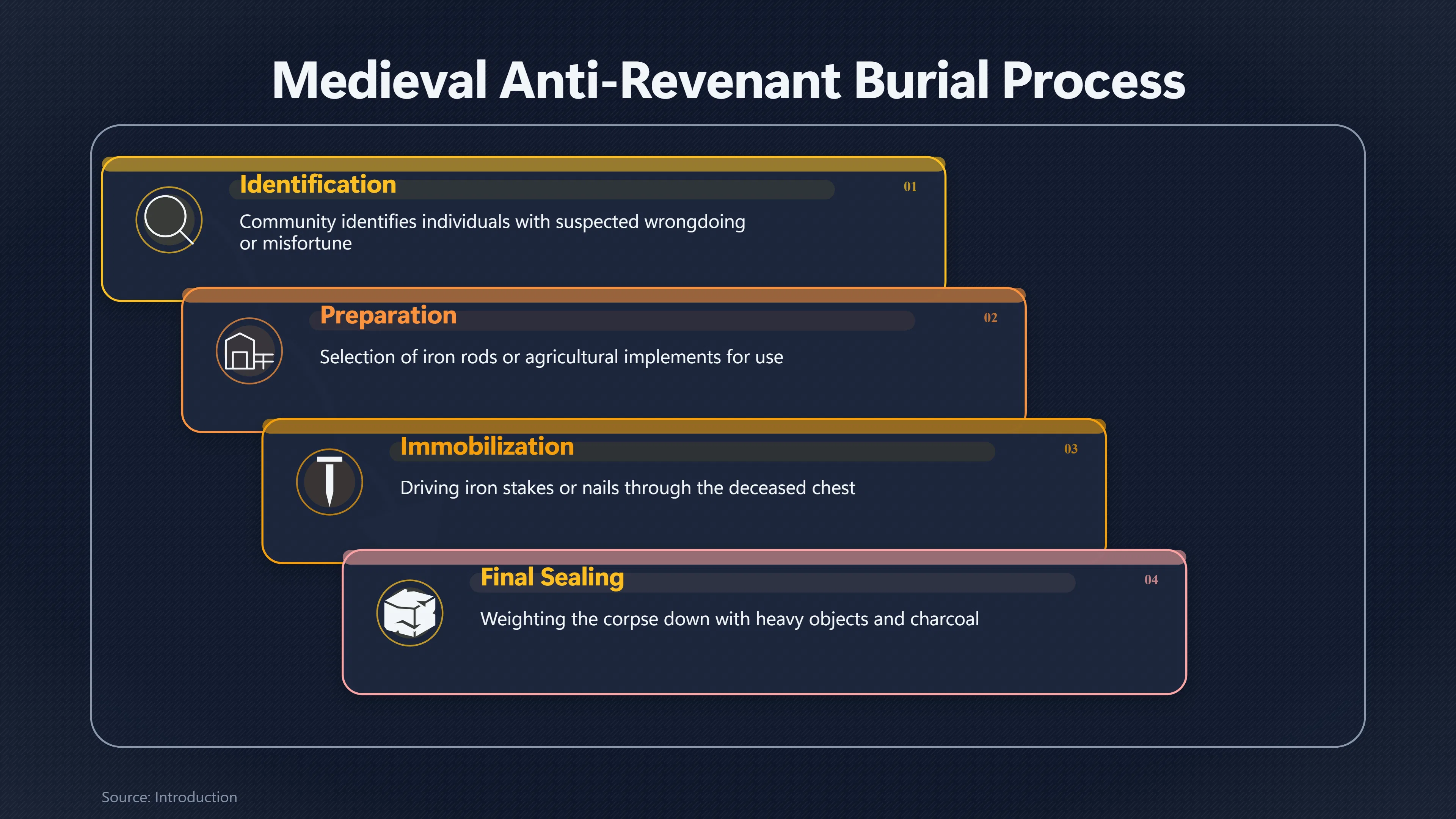
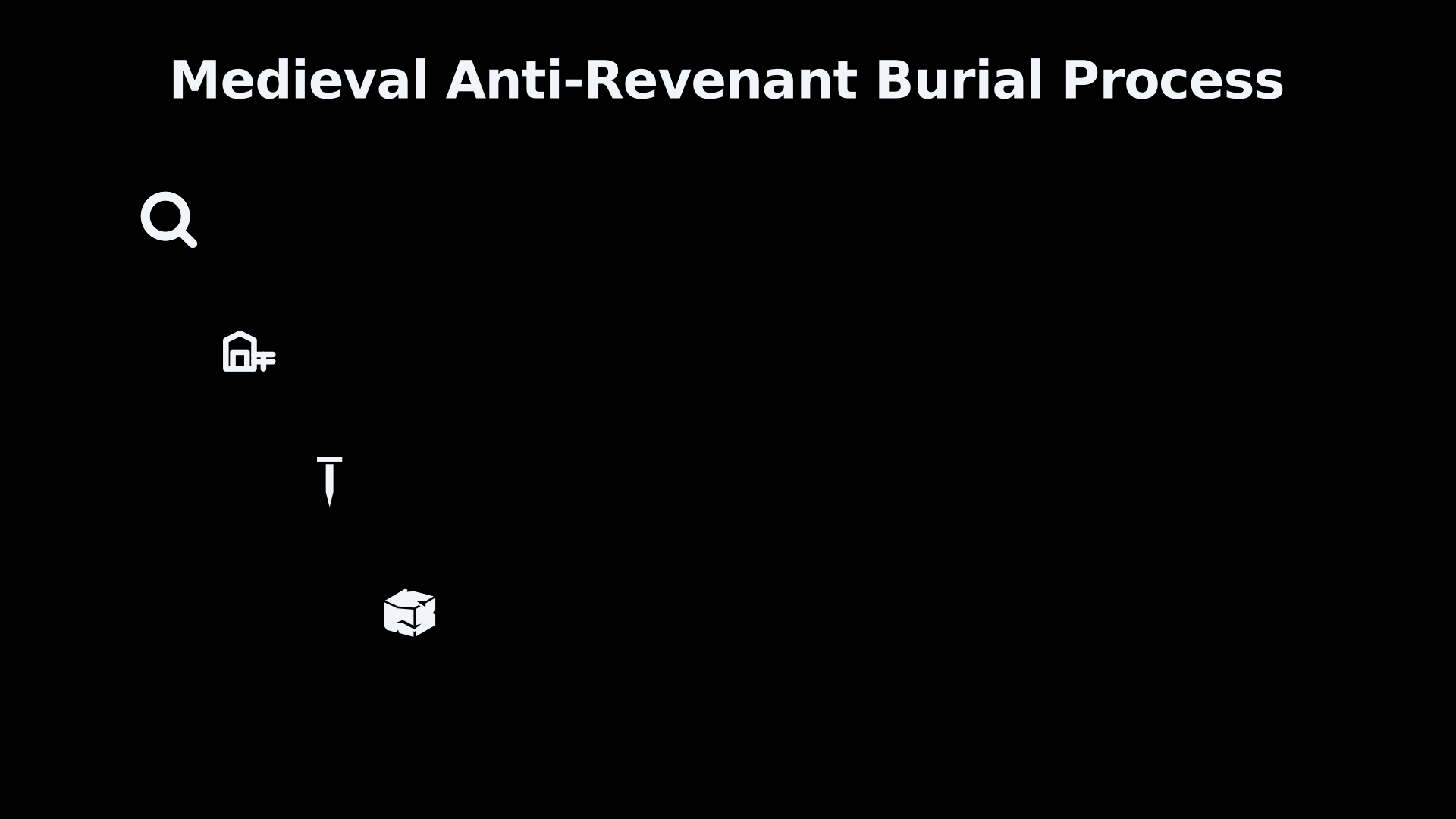
The Sozopol burial is only one example of a broader pattern recognised by Bulgarian archaeologists. Excavations elsewhere have revealed several methods used to prevent an expected return of the dead.
Common measures include:
- Driving an iron rod, stake or agricultural implement through the chest.
- Hammering iron nails into different parts of the body.
- Binding the limbs.
- Weighing the corpse down with heavy objects.
- Placing charcoal or other materials around the head or body as part of protective rites.
These actions were not intended to destroy an already-risen vampire. Instead, they were preventive measures performed during burial. The goal was to immobilise the deceased or symbolically prevent their return to the community. Regional museum specialists describe these practices as part of medieval “disposal” or neutralisation rituals directed at the feared restless dead.[Регионален исторически музей Бургас]burgasmuseums.bgOpen source on burgasmuseums.bg.
The archaeological evidence also demonstrates that there was no single “vampire burial” formula. Different communities adopted different combinations of protective acts, reflecting local customs rather than a universal religious rule.

What Archaeologists Can—and Cannot—Say
One reason the Bulgarian discoveries attracted such attention is that they combine folklore with unusually clear physical evidence. Nevertheless, archaeologists are careful about the limits of interpretation.
The skeletons cannot identify why a particular individual received anti-revenant treatment. In most cases there is no written record naming the deceased or explaining the community’s fears. A person may have been regarded as dangerous because of reputation, unusual illness, violent death, social conflict or circumstances that are now impossible to reconstruct.
Nor does every disturbed burial indicate vampire belief. Archaeologists must distinguish deliberate anti-revenant practices from later grave disturbance, accidental damage or ordinary funerary variation. Interpretation depends on the wider burial context, the position of the body, associated artefacts and comparisons with similar excavated graves.[Регионален исторически музей Бургас]burgasmuseums.bgOpen source on burgasmuseums.bg.
This cautious approach explains why specialists generally speak of anti-revenant or anti-vampire rituals rather than declaring that any excavated individual was believed to have actually become a vampire.
Archaeology, Folklore and Tourism Labels
The international media transformed the Sozopol skeleton into the “Vampire of Sozopol”, creating one of Bulgaria’s most recognisable archaeological stories. The nickname has undoubtedly increased public interest and tourism, drawing visitors who might never otherwise have explored a medieval cemetery or regional museum.[EITB]eitb.eusVampires in Bulgaria | Archaeologists unearth suspected vampires bones | EITB NewsJuly 6, 2012…
Museums and historians, however, increasingly frame the discovery as an opportunity to explain medieval belief rather than to reinforce supernatural claims. Educational programmes at the Regional Historical Museum in Burgas explicitly combine archaeological evidence with Bulgarian folk traditions, showing how vampire stories developed within a wider landscape of beliefs about revenants, goblins and other dangerous beings while distinguishing folklore from archaeological interpretation.[Регионален исторически музей Бургас]burgasmuseums.bgOpen source on burgasmuseums.bg.
This balance is what makes the Sozopol finds especially valuable within Bulgaria’s culture of unusual heritage. The attraction is not that archaeologists uncovered a real vampire, but that they uncovered tangible proof that ordinary medieval people organised their burials around the fear that the dead might return.
Why These Graves Matter
The Bulgarian vampire burials demonstrate how archaeology can illuminate beliefs that written sources only hint at. They preserve physical traces of anxiety, ritual and community decision-making, revealing how folklore influenced real funerary practice.
For visitors interested in Bulgaria’s stranger history, the graves also illustrate an important distinction. The skeletons themselves are authentic archaeological discoveries, while the word “vampire” belongs to the beliefs of the people who buried them and to the modern language of tourism. Appreciating both perspectives makes the finds more compelling than any horror story: they are evidence of how fear shaped the treatment of the dead, and how archaeology can recover the cultural logic behind legends that still capture the imagination today.
Amazon book picks
Further Reading
Books and field guides related to Were Bulgaria's Vampire Burials Really About Vampires?. Use these as the next step if you want deeper reading beyond the article.
The Archaeology of Death and Burial
The archaeology of death and burial is central to our attempts to understand vanished societies. Through the remains of funerary rituals...
The Vampire: A New History
An authoritative new history of the vampire, two hundred years after it first appeared on the literary scene Published to mark the bicent...
Vampires, Burial, and Death: Folklore and Reality
Rating: 4.5/5 from 5 Google Books ratings
Surveys centuries of folklore about vampires and offers a scientific explanation for the origins of the legends.
Archaeology: A Very Short Introduction
This 'Very Short Introduction' provides an up-to-date account of the problems, concerns and nature of archaeology, with reference to all...
eBay marketplace picks
Marketplace Samples
Live-tested eBay searches with available results related to this page.
Selected frommedieval decor oneBay.co.uk.
Endnotes
1.
Source: eitb.eus
Link:https://www.eitb.eus/en/news/detail/901403/vampires-bulgaria–archaeologists-unearth-suspected-vampires-bones/
Source snippet
Vampires in Bulgaria | Archaeologists unearth suspected vampires bones | EITB NewsJuly 6, 2012...
Published: July 6, 2012
2.
Source: sozopol-museums.bg
Title: Sozopol Museums South fortress wall and Monastery of St. Nicholas
Link:https://sozopol-museums.bg/en/south-fortress-wall-and-monastery-of-st-nicholas/
Source snippet
Sozopol MuseumsSouth fortress wall and Monastery of St. Nicholas - Museum Center SozopolMay 27, 2020...
Published: May 27, 2020
3.
Source: sozopol-museums.bg
Title: Archaeological Museum
Link:https://sozopol-museums.bg/en/archaeological-museum/
4.
Source: burgas.bg
Link:https://www.burgas.bg/bg/posts/view/17555/
5.
Source: burgasmuseums.bg
Link:https://www.burgasmuseums.bg/en/article/lecture-vampires-goblins-289
6.
Source: burgasmuseums.bg
Link:https://www.burgasmuseums.bg/bg/article/lektoriya-vampiri-talasumi-289
7.
Source: burgasmuseums.bg
Title: Регионален исторически музей БургасLecture "VAMPIRES AND GOBLINS"
Link:https://www.burgasmuseums.bg/en/article/lecture-vampires-goblins-17-21-february-241
Source snippet
17 to 21 February | Regional historical museum Burgas...
8.
Source: burgasmuseums.bg
Link:https://www.burgasmuseums.bg/en
9.
Source: burgasmuseums.bg
Link:https://burgasmuseums.bg/en/article/new-exciting-thematic-talks-will-await-visitors-2023-four-expositions-regional-historical-museum-burgas-915
10.
Source: burgasmuseums.bg
Link:https://www.burgasmuseums.bg/en/home
11.
Source: burgasmuseums.bg
Link:https://www.burgasmuseums.bg/?lang=en
Additional References
12.
Source: archaeologyinbulgaria.com
Link:https://archaeologyinbulgaria.com/2016/06/26/bulgarian-minister-invokes-vampires-found-in-2004-near-deultum-archaeological-preserve-to-promote-cultural-tourism/
Source snippet
Archaeology in BulgariaBulgarian Minister Invokes ‘Vampires’ Found in 2004 near Deultum Archaeological Preserve to Promote Cultural Touri...
13.
Source: new.bnr.bg
Link:https://new.bnr.bg/en/post/102063069/archaeologists-discover-a-second-vampire-grave-in-the-necropolis-of-perperikon?page_1_3=3
Source snippet
discover a second ''vampire'' grave in the necropolis of Perperikon - NewsOctober 22, 2024 — ARCHAEOLOGISTS DISCOVER A SECOND ''VAMPIRE''...
Published: October 22, 2024
14.
Source: bnt.bg
Title: Bulgarian archaeologists uncover ‘vampire’ burial at Perperikon (see pics)
Link:https://bnt.bg/news/bulgarian-archaeologists-uncover-39vampire-39-burial-at-perperikon-see-pics-333194news.html
Source snippet
Българска национална телевизияOctober 22, 2024 — BULGARIAN ARCHAEOLOGISTS UNCOVER 'VAMPIRE' BURIAL AT PERPERIKON (SEE PICS) 16:52, 22.10...
Published: October 22, 2024
15.
Source: youtube.com
Title: A Guide to Eastern European Vampire Burials | Human Voiced, No Ads
Link:https://www.youtube.com/watch?v=pR_219Tph1Y
Source snippet
7 Graves That Terrified Archaeologists: Why Did Our Ancestors Fear the Dead?...
16.
Source: bnrnews.bg
Link:https://bnrnews.bg/ro/post/207298/in-necropola-din-perperikon-arheologii-au-descoperit-un-al-doilea-mormant-al-unui-vampir
17.
Source: sofiaglobe.com
Link:https://sofiaglobe.com/2013/09/02/bulgarian-archaeologists-find-twin-of-sozopol-vampire-at-perperikon/
18.
Source: burgas24.bg
Link:https://www.burgas24.bg/novini/burgas/Muzeini-specialisti-zapoznavat-burgazlii-s-poveriyata-za-suzdaniyata-na-tumninata-478528
19.
Source: youtube.com
Title: Vampire Origins – Mythical Beasts
Link:https://www.youtube.com/watch?v=MbZv8Kw2MOE
Source snippet
A Guide to Eastern European Vampire Burials | Human Voiced, No Ads...
20.
Source: youtube.com
Title: 7 Graves That Terrified Archaeologists: Why Did Our Ancestors Fear the Dead?
Link:https://www.youtube.com/watch?v=iSptTqUAT08
Source snippet
"Vampire" graves unearthed in Bulgaria...
21.
Source: bnrnews.bg
Link:https://bnrnews.bg/en/post/116698/archaeologists-discover-a-second-vampire-grave-in-the-necropolis-of-perperikon