Within Kiribati Curiosities
Kiribati Legends Beyond Magical Artefacts
Kiribati folklore preserves stories of ancestors, spirits, and the sea through oral traditions rather than collections of proven supernatural objects.
On this page
- Stories, ancestors, and relationships with nature
- Oral traditions instead of supernatural collections
- Separating folklore from documented heritage
Page outline Jump by section
Introduction
Kiribati’s folklore traditions are not preserved through famous collections of magical objects or verified supernatural artefacts. Their unusual quality lies elsewhere: in stories of creation, ancestors, spirits, the ocean and the forces of nature that have been passed through generations by spoken tradition. For visitors interested in strange history and unusual collections, Kiribati offers a different kind of mystery culture — one held in memories, performances, genealogies and community knowledge rather than in cabinets displaying supposed relics of the unknown.[IRCI]irci.jpResearch Database · An Anthology of Gilbertese: Oral tradition · IRCI DatabaseIRCI Research Database · An Anthology of Gilbertese: Oral tradition · IRCI Database…

The closest thing to a “belief collection” in Kiribati is therefore not a room of enchanted objects but a network of recorded stories, songs, family histories and cultural practices. These traditions help explain how I-Kiribati communities understood their origins, their relationship with the sea and the continuing presence of ancestors.[IRCI]irci.jpResearch Database · An Anthology of Gilbertese: Oral tradition · IRCI DatabaseIRCI Research Database · An Anthology of Gilbertese: Oral tradition · IRCI Database…
Stories, ancestors, and relationships with nature
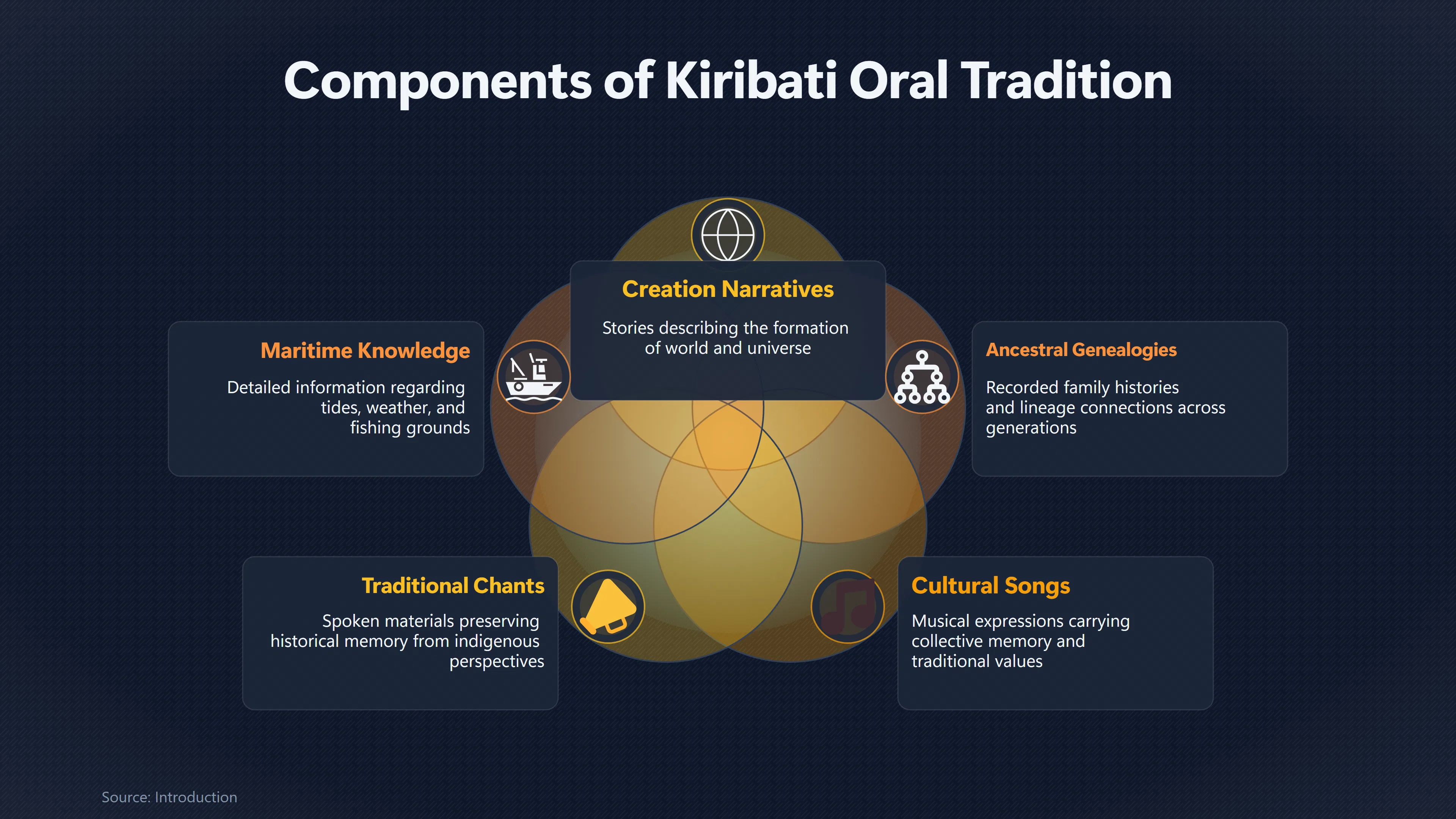
Kiribati legends often connect the beginnings of the world with powerful ancestral beings and the natural environment of the islands. Creation stories surrounding Nareau, a major figure in Gilbertese mythology, describe the formation of the world through acts of creation involving sky, sea, land and living beings. Different versions exist, reflecting the way oral traditions change between communities and storytellers rather than functioning as a single fixed religious text.[IRCI]irci.jpResearch Database · An Anthology of Gilbertese: Oral tradition · IRCI DatabaseIRCI Research Database · An Anthology of Gilbertese: Oral tradition · IRCI Database…
The importance of these stories is closely tied to island life. Kiribati is a nation of coral atolls where survival has historically depended on detailed knowledge of tides, weather, fishing grounds and relationships between people and place. Folklore therefore works as more than entertainment: it preserves ideas about where people came from, how communities are connected and how the natural world should be treated. Research on Kiribati oral traditions highlights myths, genealogies, chants and other spoken materials as ways of preserving historical memory from an indigenous perspective.[USP Electronic Research Repository]repository.usp.ac.fjUSP Electronic Research RepositoryIn their own words: history and society in Gilbertese oral tradition - USP Electronic Research Repository…
Creation stories rather than “mythical artefacts”
One of the most recognisable figures in Kiribati folklore is Nareau, sometimes described as a creator figure associated with the spider. Stories about Nareau vary, but many versions present him as a force connected with shaping the universe and ordering existence. The details differ between sources and islands, which is typical of oral storytelling traditions where meaning is carried through performance and interpretation rather than through a single authoritative manuscript.[IRCI]irci.jpResearch Database · An Anthology of Gilbertese: Oral tradition · IRCI DatabaseIRCI Research Database · An Anthology of Gilbertese: Oral tradition · IRCI Database…
For a collector of curiosities, this creates an important distinction. A carved object representing Nareau, for example, would be a cultural item connected to belief, not proof that a supernatural being once physically existed. The unusual element is the survival of the story system itself: the way an invisible world of ancestors, spirits and creation narratives continues to shape cultural identity.[Intangible Cultural Heritage]ich.unesco.orgIntangible Cultural HeritageOral traditions and expressions including language as a vehicle of the intangible cultural heritage - UNESCO…

Oral traditions instead of supernatural collections
Kiribati has relatively little in the way of public collections devoted specifically to folklore creatures, magic or unexplained phenomena. Unlike countries with dedicated witchcraft museums, monster exhibitions or occult archives, Kiribati’s heritage is mainly preserved through cultural institutions, recordings, publications and living practice. The documentation of Gilbertese oral tradition includes legends, songs, genealogies and accounts of ancestral life rather than collections of objects claimed to possess supernatural powers.[IRCI]irci.jpResearch Database · An Anthology of Gilbertese: Oral tradition · IRCI DatabaseIRCI Research Database · An Anthology of Gilbertese: Oral tradition · IRCI Database…
This makes Kiribati interesting within the wider world of unusual collections. The “curiosity” is not a strange object behind glass; it is the challenge of preserving knowledge that exists through people. UNESCO describes oral traditions globally as including legends, myths, songs, chants and other spoken forms that carry collective memory, while also noting that such traditions can be fragile because they depend on continued transmission between generations.[Intangible Cultural Heritage]ich.unesco.orgIntangible Cultural HeritageOral traditions and expressions including language as a vehicle of the intangible cultural heritage - UNESCO…
Modern documentation efforts have helped preserve some of this material. Collections such as An Anthology of Gilbertese: Oral Tradition brought together myths, legendary stories, genealogies and songs connected with Kiribati heritage. Such works are valuable because they record narratives that might otherwise become less widely known, while still recognising that written versions cannot fully replace the original social setting in which stories were told.[IRCI]irci.jpResearch Database · An Anthology of Gilbertese: Oral tradition · IRCI DatabaseIRCI Research Database · An Anthology of Gilbertese: Oral tradition · IRCI Database…
Separating folklore from documented heritage
The boundary between belief, history and heritage is especially important when presenting Kiribati traditions to visitors. Stories about spirits, ancestors and creation beings belong to a cultural worldview, but they should not automatically be treated as historical records or evidence of supernatural events. Their importance lies in what they reveal about values, memory and relationships between people and their environment.[USP Electronic Research Repository]repository.usp.ac.fjUSP Electronic Research RepositoryIn their own words: history and society in Gilbertese oral tradition - USP Electronic Research Repository…
This distinction also changes how museums and heritage centres interpret Kiribati culture. A visitor looking for mysterious artefacts may find something more subtle: objects, songs and stories that show how communities understood the ocean, family connections and the unseen forces believed to influence life. The unusual collection is therefore a collection of meanings rather than a collection of magical evidence.
Kiribati’s folklore traditions belong to the category of living heritage. They are not frozen relics from a vanished past but continuing cultural expressions that can adapt as they are retold. Kiribati’s participation in international safeguarding work for intangible cultural heritage reflects this wider approach, focusing on protecting traditions and knowledge rather than simply storing old objects.[Intangible Cultural Heritage]ich.unesco.orgIntangible Cultural Heritage KiribatiIntangible Cultural HeritageKiribati - UNESCO Intangible Cultural Heritage…

Why Kiribati folklore matters in the world of unusual collections
For a country-level exploration of strange museums and curious collections, Kiribati demonstrates that mystery does not always come from disputed artefacts, paranormal claims or forgotten objects. Some of the most distinctive collections are intangible: stories carried by elders, family histories, songs, performances and explanations of the natural world.
The lasting appeal of Kiribati folklore is that it preserves a different way of organising knowledge. Ancestors are not merely figures from the past, and nature is not simply scenery. Through oral tradition, the sea, land and human communities are connected within a shared story landscape. That makes Kiribati’s folklore a rare kind of cultural collection — one that exists wherever people continue to remember, perform and pass it on.
Amazon book picks
Further Reading
Books and field guides related to Kiribati Legends Beyond Magical Artefacts. Use these as the next step if you want deeper reading beyond the article.
The Hero with a Thousand Faces
Traces the concept of heroes and places Christ in that category along with myths and folk heroes.
The Power of Myth
Rating: 4.5/5 from 14 Google Books ratings
Onversations between Joseph Campbell and Bill Moyers, a television journalist, discussing mythology and our ties to the past.
Myth and Meaning
Ever since the rise of science and the scientific method in the seventeenth century, we have rejected mythology as the product of superst...

African Religions and Philosophy
First published 1970. Subjects: Religion, African Philosophy.
eBay marketplace picks
Marketplace Samples
Live-tested eBay searches with available results related to this page.
Selected fromPacific folklore art oneBay.co.uk.

Endnotes
1.
Source: irci.jp
Title: Research Database · An Anthology of Gilbertese: Oral tradition · IRCI Database
Link:https://www.irci.jp/rdb/item/7683
Source snippet
IRCI Research Database · An Anthology of Gilbertese: Oral tradition · IRCI Database...
2.
Source: ich.unesco.org
Link:https://ich.unesco.org/en/oral-traditions-and-expressions-00053
Source snippet
Intangible Cultural HeritageOral traditions and expressions including language as a vehicle of the intangible cultural heritage - UNESCO...
3.
Source: ich.unesco.org
Title: Intangible Cultural Heritage Kiribati
Link:https://ich.unesco.org/en/state/kiribati-KI
Source snippet
Intangible Cultural HeritageKiribati - UNESCO Intangible Cultural Heritage...
4.
Source: unesco.org
Link:https://www.unesco.org/en/countries/ki/conventions
Source snippet
Kiribati - Convention | UNESCO...
5.
Source: repository.usp.ac.fj
Link:https://repository.usp.ac.fj/id/eprint/7154/
Source snippet
USP Electronic Research RepositoryIn their own words: history and society in Gilbertese oral tradition - USP Electronic Research Repository...
Additional References
6.
Source: researchgate.net
Link:https://www.researchgate.net/publication/350607410_Gods_Spirits_and_Natural_Hazards_Ontologies_and_Epistemologies_of_Natural_Hazards_and_Climate_Change_in_Kiribati_and_Papua_New_Guinea
7.
Source: youtube.com
Title: Ambo Dancers, Kiribati
Link:https://www.youtube.com/watch?v=Tg1qvWABTY8
Source snippet
Kiribati: Pacific at Its Heart - Tracing the Rich History and Cultural Legacy of Island Life...
8.
Source: youtube.com
Title: Tales from Kiribati Part 1
Link:https://www.youtube.com/watch?v=D_ofMx_iSlY
Source snippet
Frontline Truths: Karaki mai Kiribati (Stories from Kiribati)...
9.
Source: youtube.com
Title: Kiribati: Pacific at Its Heart
Link:https://www.youtube.com/watch?v=z2S7JFmxUnY
10.
Source: youtube.com
Title: Frontline Truths: Karaki mai Kiribati (Stories from Kiribati)
Link:https://www.youtube.com/watch?v=4jKgLpBmIWY
Source snippet
Ambo Dancers, Kiribati...
11.
Source: youtube.com
Title: Nareau: The Micronesian Spider God Who Wove the Universe
Link:https://www.youtube.com/watch?v=_UT2O9ITPOM
Source snippet
Tales from Kiribati Part 1...