Within Curious Palau
Why Palau's Money Was More Than Currency
Palau's bead money and vast quarry-cut stone discs reveal forms of value shaped by ancestry, danger, labour and remembered exchange.
On this page
- Bead money, inheritance and ceremonial obligation
- How Yapese crews quarried stone in Palau
- Why ownership mattered more than physical movement
Page outline Jump by section
Introduction
Palau’s ceremonial wealth is remarkable because its most famous “money” was never simply a medium of exchange. Instead, value was created through ancestry, labour, danger, reputation and shared memory. The country’s museums and archaeological sites preserve evidence of exchange systems in which ownership could matter more than possession, and where a beautiful bead or an enormous limestone disc carried meaning because communities remembered the story behind it. This makes Palau one of the Pacific’s most distinctive places for understanding wealth as a social relationship rather than a collection of valuable objects.
For visitors interested in unusual collections, the story extends beyond museum display cases. Traditional bead money, archaeological quarry sites and the surviving evidence of stone-money production reveal how ceremonial wealth linked Palau with neighbouring Yap across hundreds of kilometres of open ocean, creating one of Oceania’s most extraordinary exchange networks.[unesco.org]whc.unesco.orgWorld Heritage Centre Yapease Quarry SitesUNESCO World Heritage CentreYapease Quarry Sites - UNESCO World Heritage CentreAugust 26, 2004…
Bead money, inheritance and ceremonial obligation
Traditional Palauan wealth included a wide variety of ceremonial valuables rather than a single currency. Among the most important were glass and mineral beads, many of which reached Palau through long-distance trade before becoming deeply embedded in local social life. Their value came less from their raw material than from their recognised history, rarity and accepted place within customary exchange.
These valuables traditionally played roles in events such as:
- Marriage and alliance-building between families.
- Inheritance and the transfer of status across generations.
- Compensation and settlement after disputes.
- Ceremonial obligations surrounding births and deaths.
- Exchanges that confirmed political and clan relationships.
Unlike modern money, many prestigious beads were not intended for everyday purchases. Particular pieces accumulated reputations over generations, with ownership histories remembered by families and communities. Some heirlooms became recognised ceremonial treasures whose importance far exceeded their physical appearance.
Recent archaeological research has added another layer to this picture. Chemical analysis of glass beads recovered from a Yapese stone-money quarry in Palau showed that many were manufactured in nineteenth-century Bohemia before entering Pacific exchange networks. Once they arrived in Micronesia, they acquired new cultural meanings as traditional money. Researchers also found evidence that some bead types eventually lost prestige because imported examples became easier to imitate, demonstrating that social trust remained central to ceremonial value.[ScienceDirect]sciencedirect.comChemical analysis of glass beads in Palau, western Micronesia reveals 19th century inter-island exchange systems in transiti…
Museums such as the Etpison Museum interpret these traditional money systems alongside other aspects of Palauan culture, helping visitors understand that ceremonial wealth formed part of a broader network of kinship, obligation and social identity rather than functioning as an isolated economic curiosity.[Etpison Museum]etpisonmuseum.orgEtpison Museum About Us — Etpison MuseumEtpison Museum About Us — Etpison Museum
How Yapese crews quarried stone in Palau
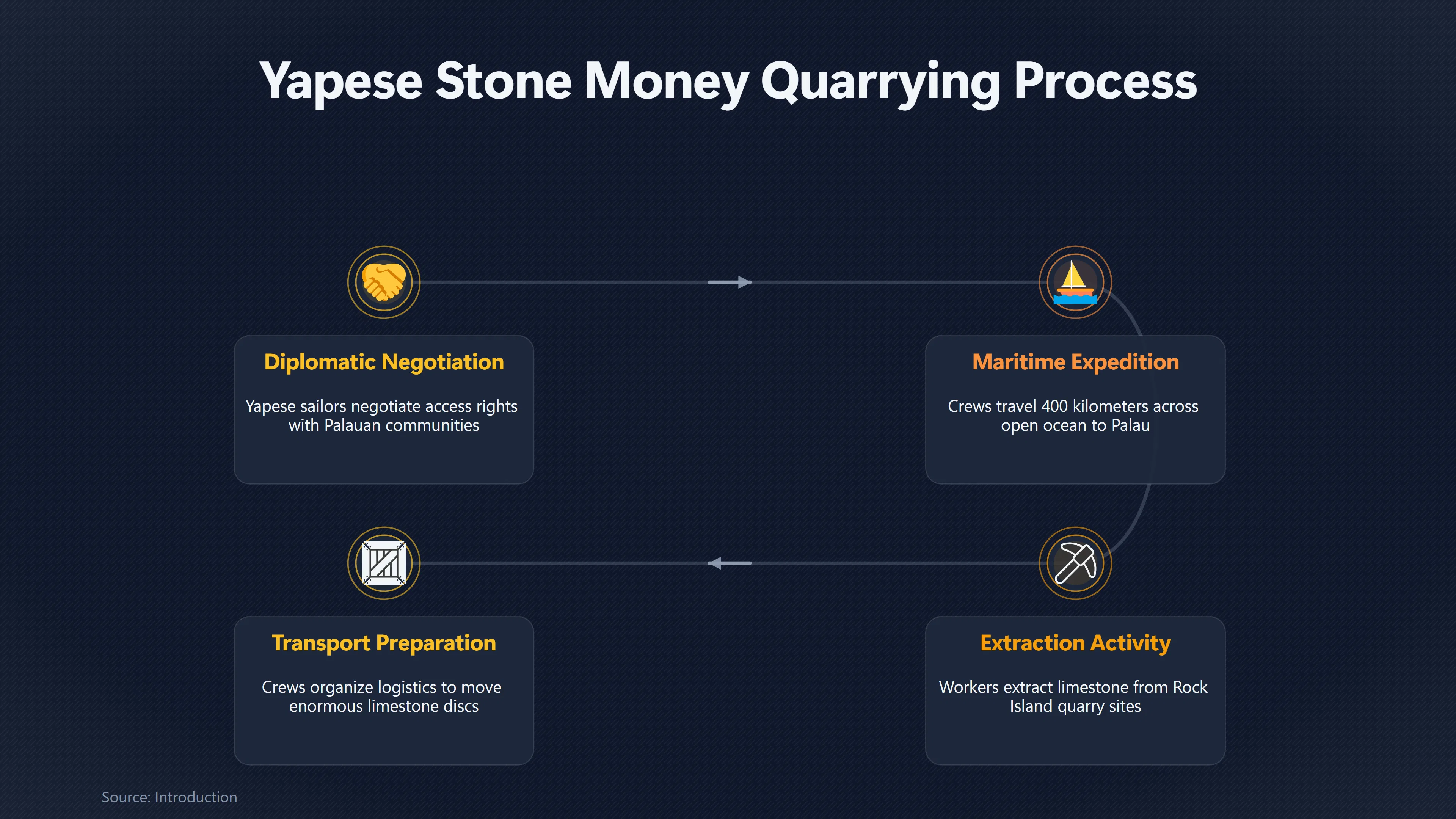
The giant limestone discs commonly called stone money are usually associated with Yap, but one of the most important parts of their story belongs to Palau. Yap itself lacks suitable limestone, so generations of Yapese sailors travelled roughly 400 kilometres across open sea to quarry stone in Palau’s Rock Islands.[UNESCO World Heritage Centre]whc.unesco.orgWorld Heritage Centre Yapease Quarry SitesUNESCO World Heritage CentreYapease Quarry Sites - UNESCO World Heritage CentreAugust 26, 2004…
According to archaeological and historical evidence, quarrying rights were not taken automatically. Yapese groups negotiated access with Palauan communities, exchanging valuable goods and building political alliances with those who controlled particular islands. The resulting relationship combined diplomacy, specialised craftsmanship and dangerous seafaring.[UNESCO World Heritage Centre]whc.unesco.orgWorld Heritage Centre Yapease Quarry SitesUNESCO World Heritage CentreYapease Quarry Sites - UNESCO World Heritage CentreAugust 26, 2004…
The principal quarry sites identified in Palau include:
- Chelechol ra Orrak, where caves, unfinished stone discs, shell middens, retaining walls and archaeological deposits document quarrying activities.
- Uet el Daob ma Uet el Beluu, an inland quarry between marine lakes where unfinished discs and quarry features survive within a dramatic limestone landscape.
Together these sites preserve evidence not only of carving techniques but also of camps, transport preparations and the wider organisation required to extract and move enormous limestone discs. UNESCO’s Tentative World Heritage nomination describes them as exceptional evidence for long-distance interaction between culturally distinct island societies.[UNESCO World Heritage Centre]whc.unesco.orgWorld Heritage Centre Yapease Quarry SitesUNESCO World Heritage CentreYapease Quarry Sites - UNESCO World Heritage CentreAugust 26, 2004…
Archaeological excavation at Omis Cave and related quarry locations has reinforced historical accounts by documenting stone-working debris, occupation evidence and quarry infrastructure. These investigations demonstrate that quarrying involved repeated expeditions rather than isolated voyages and represents one of the clearest archaeological examples of prehistoric and early historic maritime exchange in Oceania.[DOI]doi.orgArchaeological investigation of Omis Cave: a Yapese stone money quarry in PalauArchaeological investigation of Omis Cave: a Yapese stone money quarry in Palau - Fitzpatrick - 2001 - Archaeology in Oceania - Wiley…
Why ownership mattered more than physical movement
Perhaps the most surprising feature of the stone-money system is that moving the stone was often unnecessary.
Many completed limestone discs became so large that transporting them after arrival in Yap was impractical. Instead, the community collectively recognised who owned each stone. A transfer of ownership could therefore occur through public agreement while the object itself remained exactly where it stood. The stone functioned as a visible record of wealth, but the true transaction existed within shared social memory rather than physical possession.[National Museum of American History]americanhistory.si.eduOpen source on si.edu.
The value of an individual stone depended on much more than its diameter. Communities considered factors including:
- The difficulty of obtaining permission to quarry.
- The dangers faced during carving and transport.
- Whether lives had been lost during the expedition.
- The skill required to complete the work.
- The recognised history of previous ownership.
A larger stone was often prestigious, but its biography could matter even more than its size. A disc associated with an especially hazardous voyage or famous lineage might command greater respect than another of similar dimensions. This emphasis on remembered history explains why scholars describe the system as one in which social knowledge effectively acted as a public record of ownership.[doi.org]doi.orgArchaeological investigation of Omis Cave: a Yapese stone money quarry in PalauArchaeological investigation of Omis Cave: a Yapese stone money quarry in Palau - Fitzpatrick - 2001 - Archaeology in Oceania - Wiley…
Why these collections remain unusual today
For visitors, Palau’s ceremonial wealth stands apart from many museum collections because the most significant objects cannot be understood by appearance alone. A glass bead may represent centuries of inheritance. An unfinished limestone disc abandoned in a quarry tells a story of international exchange rather than local production. Even the absence of movement can itself be meaningful, since ownership traditionally depended upon community recognition rather than constant circulation.
This also explains why archaeological quarry sites are as important as museum displays. Removing a stone from its landscape would preserve the object but obscure the evidence of how it was quarried, who controlled access to the limestone and how maritime expeditions linked Palau and Yap across the western Pacific. The quarry landscapes therefore function as open-air collections, preserving the material traces of an exchange system whose true value lay in remembered relationships, ceremonial obligation and shared historical knowledge.[UNESCO World Heritage Centre]whc.unesco.orgWorld Heritage Centre Yapease Quarry SitesUNESCO World Heritage CentreYapease Quarry Sites - UNESCO World Heritage CentreAugust 26, 2004…
Amazon book picks
Further Reading
Books and field guides related to Why Palau's Money Was More Than Currency. Use these as the next step if you want deeper reading beyond the article.
Debt: The First 5,000 Years
A fascinating chronicle of little known history of Debt Must we always repay our debts? Wasnt money invented to replace ancient barter sy...
Money: The True Story of a Made-Up Thing
Humans invented money from nothing, so why can't we live without it? And why does no one understand what it really is? In this lively tou...
The archaeology of Micronesia
First published 2003. Subjects: Anthropology, Antiquities, Civilization, History, Material culture.
The Anthropology of Money
This review surveys anthropological and other social research on money and finance. It emphasizes money's social roles and meanings as we...
eBay marketplace picks
Marketplace Samples
Live-tested eBay searches with available results related to this page.
Selected fromisland decor oneBay.co.uk.

Endnotes
1.
Source: whc.unesco.org
Title: World Heritage Centre Yapease Quarry Sites
Link:https://whc.unesco.org/en/tentativelists/1932/
Source snippet
UNESCO World Heritage CentreYapease Quarry Sites - UNESCO World Heritage CentreAugust 26, 2004...
Published: August 26, 2004
2.
Source: doi.org
Title: Archaeological investigation of Omis Cave: a Yapese stone money quarry in Palau
Link:https://doi.org/10.1002%2Fj.1834-4453.2001.tb00489.x
Source snippet
Archaeological investigation of Omis Cave: a Yapese stone money quarry in Palau - Fitzpatrick - 2001 - Archaeology in Oceania - Wiley...
3.
Source: sciencedirect.com
Link:https://www.sciencedirect.com/science/article/pii/S2352409X2200205X
Source snippet
Chemical analysis of glass beads in Palau, western Micronesia reveals 19th century inter-island exchange systems in transiti...
4.
Source: whc.unesco.org
Title: World Heritage Centre Yapese Disk Money Regional Sites
Link:https://whc.unesco.org/en/tentativelists/1994/
Source snippet
Disk Money Regional Sites - UNESCO World Heritage CentreDecember 29, 2004 — YAPESE DISK MONEY REGIONAL SITES Micronesia (Federated States...
Published: December 29, 2004
5.
Source: whc.unesco.org
Title: World Heritage Centre UNESCO World Heritage Centre
Link:https://whc.unesco.org/en/decisions/4298
Source snippet
World Heritage Centre - Decision - 35 COM 8B.27Decision [Input] [Input: Search resolutions / decisions] Decision 35 COM 8B.27 Cultural Pr...
6.
Source: whc.unesco.org
Link:https://whc.unesco.org/en/intassistance/2509/
Source snippet
old nomination and compile data to complete the nomination of the transboundary site of Chelchol Ra Orrak, Wet El Daob Me A Wet El Beluu...
7.
Source: whc.unesco.org
Link:https://whc.unesco.org/fr/listesindicatives/1932/
Source snippet
Quarry Sites - UNESCO Centre du patrimoine mondialAugust 26, 2004 — YAPEASE QUARRY SITES Palaos Date de soumission: 26/08/2004 Critères...
Published: August 26, 2004
8.
Source: sciencedirect.com
Title: Napolitano ^{a} ^{b}, Elliot
Link:https://www.sciencedirect.com/science/article/abs/pii/S2352409X2200205X
Source snippet
Chemical analysis of glass beads in Palau, western Micronesia reveals 19th century inter-island exchange systems in transition - ScienceD...
9.
Source: etpisonmuseum.org
Title: Etpison Museum About Us — Etpison Museum
Link:https://www.etpisonmuseum.org/about-us/
10.
Source: americanhistory.si.edu
Link:https://americanhistory.si.edu/ar/collections/object/nmah_1069139
11.
Source: americanhistory.si.edu
Title: nmah 1069139
Link:https://americanhistory.si.edu/it/collections/object/nmah_1069139
Source snippet
For more information, visit the Smithsonian's Terms of Use page. International media Int...
12.
Source: americanhistory.si.edu
Title: nmah 1967502
Link:https://americanhistory.si.edu/collections/object/nmah_1967502
Source snippet
For more information, visit the Smithsonian's Terms of Use page. International media Interoperability Frame...
Additional References
13.
Source: youtube.com
Title: The Island With 12-Foot Stones That People Use as Money | The Story of Money
Link:https://www.youtube.com/watch?v=MFM_JqnJVog
Source snippet
Ancient Pacific Currency Yapese Rai Stones: The Fascinating History...
14.
Source: youtube.com
Title: Ancient Pacific Currency Yapese Rai Stones: The Fascinating History
Link:https://www.youtube.com/watch?v=Byy6RMVNkvo
Source snippet
Palau's Ancient Stone Money: The First Bitcoin of 2000 Years Ago...
15.
Source: youtube.com
Link:https://www.youtube.com/watch?v=AhCh8H7iWUQ
Source snippet
Stone Money of Yap: The Island Where Wealth Was Too Heavy to Steal...
16.
Source: youtube.com
Title: WE ARE AUSTRONESIA | HISTORY OF REPUBLIC OF PALAU | BELAU NATIONAL MUSEUM
Link:https://www.youtube.com/watch?v=TLi9rCXkfr0