Where Suriname Keeps Its Strangest Histories
Suriname does not appear to have a purpose-built museum of witchcraft, monsters, medical horrors or theatrical “oddities”. Its curiosity culture is quieter and more historically charged.
Page outline Jump by section
Introduction
For travellers seeking the uncanny or unconventional, the strongest places are Fort Zeelandia and Fort Nieuw Amsterdam, the Saamaka Marron Museum at Pikin Slee, the community-run Diitabiki Museum Fositen Gudu, the Koto Museum and the ruins and burial grounds of Jodensavanne. These are not novelty attractions. Their strangeness comes from the collision between beautiful objects and difficult histories, and from the fact that some collections preserve living knowledge rather than safely distant folklore.
Why Suriname’s strange collections look different
Suriname’s museum landscape reflects an unusually diverse population shaped by Indigenous communities, African slavery, Maroon resistance, Dutch colonial rule and later migration from India, Java, China and elsewhere. The Surinaams Museum describes national culture not as a single inherited tradition but as the result of communities originating on several continents.[International Heritage]internationalheritage.dutchculture.nlInternational Heritage Suriname MuseumInternational HeritageSuriname Museum - Fort ZeelandiaThe Suriname Museum is not a museum that introduces foreign cultures to the Surinam…
That history affects what counts as a “curiosity”. In a European cabinet of curiosities, an unfamiliar carved object might once have been displayed primarily because it looked exotic. In Suriname, similar objects may still belong to an active artistic, spiritual or social tradition. Treating them merely as spooky artefacts can strip away the relationships that gave them meaning.
This is particularly important with Maroon and Indigenous material. Recent research into Surinamese natural-history and ethnographic collections held in the Netherlands shows that local guides, collectors and knowledge-holders played essential roles in creating those collections, although European expedition accounts often reduced or omitted their contributions.[Naturalis Repository]repository.naturalis.nlNaturalis RepositorySurinamese Maroon and Indigenous Knowledge in the…by I de Ruiter · 2025 · Cited by 2 — This article seeks to recti… Suriname’s community museums offer a partial corrective: people whose cultures were once collected by outsiders increasingly determine how their own histories are preserved and explained.
Fort Zeelandia: a museum inside a place of violence
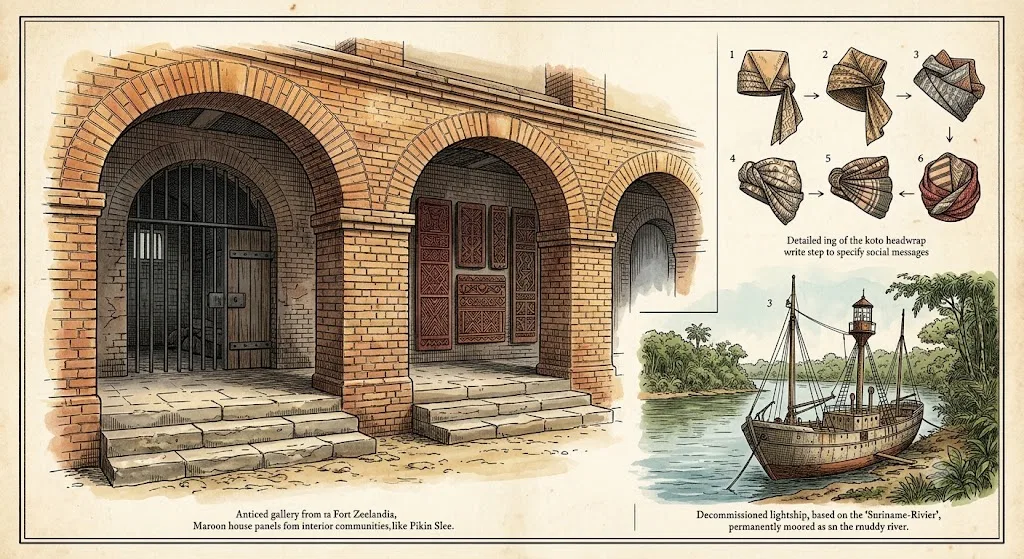
Fort Zeelandia in Paramaribo is the country’s most layered museum site. The fort is associated with early British and Dutch colonial settlement and now houses the Surinaams Museum, whose holdings include archaeology, historic photographs, furniture, textiles, art and ethnographic objects connected with Suriname’s many communities. Reconstructed spaces have included an old pharmacy, a cobbler’s workshop and a surviving prison cell.[Wikipedia]WikipediaSurinaams MuseumSurinaams Museum
The pharmacy reconstruction is the closest the country comes to a traditional medical-curiosity display: bottles, instruments and shop fittings turn everyday healthcare into material history. Yet the fort itself is the more unsettling exhibit. Its military architecture, cells and punishment history prevent the galleries from feeling like neutral rooms.
The site is also inseparable from the killings of 8 December 1982, when fifteen critics of Suriname’s military government were killed at the fort. A memorial plaque marks the event, and accounts of the site note surviving bullet damage on the riverside wall. In December 2023, Suriname’s Court of Justice upheld former president and military ruler Desi Bouterse’s conviction in the case.[cuba.klm.com]cuba.klm.comold fort zeelandia in paramariboTravel Tips & Articles ParamariboA memorial plaque on one of the bastions recalls a more recent tragedy, the December murders of 1982. Th…
Visitors should therefore understand Fort Zeelandia as three things at once:[brill.com]brill.comSource details in endnotes.
- a national history museum;[whichmuseum.com]whichmuseum.comHistory museums in SurinameHistory museums in Suriname
- a surviving colonial fort and former detention site;
- a place of modern political trauma and commemoration.
That mixture makes it one of Suriname’s most important dark-heritage locations. The unusual experience does not depend on staged horror. It comes from recognising that picturesque brickwork, museum cases and evidence of state violence occupy the same ground.
Fort Nieuw Amsterdam: cannons, prison buildings and a stranded ship
Fort Nieuw Amsterdam offers a more open-air form of historical curiosity. Built in the eighteenth century at the meeting of the Suriname and Commewijne rivers, the complex later served as a prison from the nineteenth century until 1967. It now operates as an open-air museum and heritage centre.[International Heritage]internationalheritage.dutchculture.nlInternational Heritage Fort Nieuw AmsterdamInternational HeritageFort Nieuw Amsterdam - International Heritage CooperationThe Fort currently operates as an Open air museum and heri…
Its appeal lies in the accumulation of objects that seem displaced from their original worlds. Visitors encounter old defensive works, artillery, prison structures, monuments and miscellaneous industrial or maritime remains. A decommissioned lightship, the Suriname-Rivier, is permanently moored within the fort’s wet dock.[Wikipedia]WikipediaFort Nieuw-AmsterdamFort Nieuw-Amsterdam The resulting landscape feels less like a conventional gallery than a historical storage ground where military, penal and maritime Suriname overlap.
The former prison gives the place its darker edge. Cells and institutional buildings illustrate how a fort designed to resist foreign attack was repurposed to confine people after emancipation. This change of use is more revealing than any single artefact: colonial machinery did not disappear when military needs changed but found new administrative functions.
Fort Nieuw Amsterdam is public and commonly included in excursions through the Commewijne district. Conditions, accessible buildings and interpretation can vary, so practical arrangements are best checked locally rather than assumed from old travel listings.
Maroon museums where objects remain connected to life
Suriname’s most distinctive museums may be those established in Maroon communities in the forested interior. Unlike ethnographic displays assembled far from their source, these institutions place carved objects, buildings, photographs and oral histories within landscapes where the traditions developed.
Saamaka Marron Museum
The Saamaka Marron Museum stands at Pikin Slee on the Upper Suriname River. It is devoted to Saamaka history and culture, preserving material associated with communities descended from people who escaped plantations and established independent societies in the interior. The grounds include artworks and reconstructions of characteristic houses, while collections include photographs, domestic material and carved architectural decoration gathered from river villages.[whichmuseum.com]whichmuseum.comWhich Museum Saamaka Marron Museum (TotnessWhich Museum Saamaka Marron Museum (Totness
For an outsider, the carved forms may initially resemble mysterious symbols or decorative curiosities. Their real interest is that art, architecture and social knowledge are intertwined. Community representatives have stressed that knowledge was often carried in memory and embedded in artistic practice rather than recorded in books.[de Ware Tijd]dwtonline.comsaamaka museum pikin slee onbekend maakt onbemindsaamaka museum pikin slee onbekend maakt onbemind
This makes the museum less a cabinet of strange objects than an archive of techniques, relationships and ways of remembering. A guided visit is especially valuable because interpretation cannot always be read directly from the object’s appearance.
Diitabiki Museum Fositen Gudu
The Diitabiki Museum Fositen Gudu represents a similar community-led approach for the Aukan Maroons. Its official description calls it a museum “of and for” the local community, intended to demonstrate Aukan creativity and strength. Its name is translated by the museum as “riches of the past”, while its guiding idea is that the present cannot be understood without older knowledge.[Diitabiki Museum Fositen Gudu]fositengudu.orgOpen source on fositengudu.org.
The institution matters because it reverses the usual direction of ethnographic collecting. Rather than objects travelling from the Surinamese interior to a European museum, visitors travel to the community and encounter material under locally shaped interpretation.
Its remote setting also changes the nature of a visit. Diitabiki is not a walk-in city attraction, and transport, guides and opening arrangements require advance planning. That practical difficulty is part of the broader story: Suriname’s national collections are geographically uneven, with many important cultural histories located far from Paramaribo.

The Koto Museum and clothing that communicates
The Koto Museum in Paramaribo is a small specialist collection devoted to the elaborate dress traditionally associated with Afro-Surinamese women. The museum opened in 2009 and has been described as a “women’s treasury”, created to prevent knowledge of the clothing tradition from disappearing.[Popular Places Suriname]popular-places.comPopular Places Suriname Koto MuseumPopular Places Suriname Koto Museum
The collection is unusual because garments that may look ceremonial or extravagantly decorative also function as social documents. The koto developed during the colonial period and remains visible at weddings, birthdays, commemorations and dance gatherings.[Research Center for Material Culture]materialculture.nlOpen source on materialculture.nl. Its associated head coverings can be folded into different forms, traditionally allowing wearers to communicate attitudes or messages through dress.
Popular accounts sometimes romanticise these folds as a complete “secret language”. The safer interpretation is that named styles and arrangements carried recognisable social associations, humour and commentary within particular communities. Meanings could depend on occasion and context rather than operating as a fixed codebook.
For readers interested in coded objects, women’s history and wearable archives, this is among Suriname’s strongest curiosity collections. Its subject may be clothing, but its deeper concern is how people preserved identity and agency within restrictive colonial society.
Jodensavanne: ruins and graves in the rainforest
Jodensavanne is not primarily a museum. It is an archaeological landscape containing the remains of a seventeenth-century Jewish settlement, synagogue foundations, cemeteries, building traces, landing areas and a military post beside the Suriname River. Together with Cassipora Creek Cemetery, it was inscribed on UNESCO’s World Heritage List in 2023.[UNESCO World Heritage Centre]whc.unesco.orgOpen source on unesco.org.
Its unusual power comes from the contrast between forest and masonry. Gravestones and brick ruins survive amid dense tropical growth, creating a place that can feel lost or enigmatic even though its basic history is well documented. The cemeteries record early Jewish settlement in the Atlantic world, including a community whose prosperity was tied to plantation slavery. The site therefore resists a simple story of religious refuge: it preserves evidence of both minority autonomy and participation in a violent colonial economy.
Visitors should approach it as an archaeological and commemorative site rather than a romantic “lost city”. The ruins are authentic, but vegetation, river travel and selective survival can make the settlement seem more mysterious than it was. What remains is a fragmentary archive shaped by abandonment, climate, conservation and the unequal survival of records.
Spiritual traditions without an occult museum
Suriname’s association with spirits, forest beings, ancestor traditions and ritual healing might suggest the existence of a witchcraft museum. Live public sources, however, do not identify a well-established, dedicated Surinamese museum of magic or the occult. Spiritual material is more likely to appear within broader cultural collections, temporary exhibitions, religious practice or collections held outside the country.
One important tradition is Winti, an Afro-Surinamese religion that developed under slavery from several West and Central African belief systems. It includes relationships with nature spirits and ancestors, ritual healing and an understanding of bodily, social and spiritual wellbeing as connected. Practitioners and museum projects caution against reducing it to “sorcery”, since that label reproduces an old tendency to treat an active religion as superstition.[wereldmuseum.nl]leiden.wereldmuseum.nlOpen source on wereldmuseum.nl.
This distinction matters for curiosity tourism. A ritual object does not become an occult prop simply because an outsider does not recognise its use. Some items may be unsuitable for casual exhibition, while others lose much of their meaning when removed from performance, sound, movement and community participation. Discussion of a Surinamese ancestor mask has made precisely this point: once enclosed in a museum case, an object created to move and mediate relationships with ancestors may cease to perform its original social function.[AFRICANAH.ORG]africanah.orgThe Dancing Kabra MaskThe Dancing Kabra Mask
The absence of a commercial “voodoo museum” is therefore not a cultural gap. It reflects, at least in part, the difficulty and sensitivity of converting living spiritual traditions into tourist spectacle.
Collections abroad and the problem of who gets to interpret them
A considerable part of Suriname’s material heritage is held in Dutch and other overseas institutions. The scale became visible during the Great Suriname Exhibition in Amsterdam, which brought together more than 300 archaeological objects, garments, documents, photographs and artworks from public and private collections in Suriname and the Netherlands.[De Nieuwe Kerk]nieuwekerk.nlOpen source on nieuwekerk.nl.
Overseas collections can preserve fragile objects and make them accessible to large audiences, but they also raise questions about colonial collecting, attribution and authority. Scientific expeditions depended heavily on Indigenous and Maroon expertise, yet museum catalogues traditionally foregrounded European collectors.[Naturalis Repository]repository.naturalis.nlNaturalis RepositorySurinamese Maroon and Indigenous Knowledge in the…by I de Ruiter · 2025 · Cited by 2 — This article seeks to recti… A carved, botanical or ritual object may consequently have a detailed acquisition number while lacking the name of the person who found, made, explained or selected it.
For anyone exploring Suriname’s curiosity culture, provenance is part of the attraction rather than an administrative footnote. The most revealing question is often not merely “What is this strange object?” but “Who decided it was collectible, how did it leave its community, and whose explanation appears on the label?”

What is genuinely worth seeking out
Suriname rewards travellers who prefer historically complicated places to manufactured weirdness. Fort Zeelandia is the essential site for colonial, prison and political dark history. Fort Nieuw Amsterdam offers the most atmospheric accumulation of military, penal and maritime remains. The Koto Museum turns clothing into a record of communication and women’s cultural memory. The Saamaka and Diitabiki museums demonstrate how community-controlled collections can challenge older ethnographic habits. Jodensavanne adds an archaeological landscape of ruins, graves, migration and moral contradiction.
The central lesson is that Suriname’s strangest collections are rarely “freakish”. They are strange because familiar museum categories break down. A fort is also a prison and crime scene. A dress is also a message. A carving is also stored knowledge. A cemetery is also evidence of religious freedom, colonial ambition and enslavement. The country’s curiosity culture is strongest where objects refuse to remain merely objects.
Amazon book picks
Further Reading
Books and field guides related to Where Suriname Keeps Its Strangest Histories. Use these as the next step if you want deeper reading beyond the article.
Alabi's World
In the early 18th century, the Dutch colony of Suriname was the envy of all others in the Americas. There, seven hundred Europeans lived...
The Black Jacobins: Toussaint L'Ouverture and the San Domingo...
A powerful and impassioned historical account of the largest successful revolt by enslaved people in history: the Haitian Revolution of 1...
eBay marketplace picks
Marketplace Samples
Live-tested eBay searches with available results related to this page.
Selected fromSuriname art print oneBay.co.uk.
Current eBay listing
Suriname tropical forest Framed Wall Art Poster Canvas Print Picture
Current eBay listing
Suriname vintage flag Framed Wall Art Poster Canvas Print Picture
Endnotes
1.
Source: repository.naturalis.nl
Link:https://repository.naturalis.nl/pub/801080
Source snippet
Naturalis RepositorySurinamese Maroon and Indigenous Knowledge in the...by I de Ruiter · 2025 · Cited by 2 — This article seeks to recti...
2.
Source: Wikipedia
Title: Surinaams Museum
Link:https://en.wikipedia.org/wiki/Surinaams_Museum
3.
Source: cuba.klm.com
Title: old fort zeelandia in paramaribo
Link:https://cuba.klm.com/travel-guide/inspiration/old-fort-zeelandia-in-paramaribo
Source snippet
Travel Tips & Articles ParamariboA memorial plaque on one of the bastions recalls a more recent tragedy, the December murders of 1982. Th...
4.
Source: Wikipedia
Title: Fort Nieuw-Amsterdam
Link:https://en.wikipedia.org/wiki/Fort_Nieuw-Amsterdam
5.
Source: whichmuseum.com
Title: Which Museum Saamaka Marron Museum (Totness)
Link:https://whichmuseum.com/museum/saamaka-marron-museum-totness-22920
6.
Source: Wikipedia
Link:https://nl.wikipedia.org/wiki/Saamaka_Marron_Museum
7.
Source: popular-places.com
Title: Popular Places Suriname Koto Museum
Link:https://popular-places.com/places-to-go/koto-museum/
8.
Source: leiden.wereldmuseum.nl
Link:https://leiden.wereldmuseum.nl/en/collection-stories/fashion-and-heritage-from-surinam
9.
Source: whc.unesco.org
Link:https://whc.unesco.org/en/news/2675
10.
Source: whc.unesco.org
Link:https://whc.unesco.org/en/decisions/8431/
11.
Source: leiden.wereldmuseum.nl
Link:https://leiden.wereldmuseum.nl/en/ritual-specialists
12.
Source: kunstinstituutmelly.nl
Title: Rotterdam Cultural Histories #24: Mama Aisa
Link:https://www.kunstinstituutmelly.nl/en/exhibitions/7202-rotterdam-cultural-histories-24-mama-aisa
13.
Source: leiden.wereldmuseum.nl
Title: Leiden HEALING POWER
Link:https://leiden.wereldmuseum.nl/en/about-volkenkunde/press/healing-power-winti-shamanism-and-more
14.
Source: africanah.org
Title: The Dancing Kabra Mask
Link:https://africanah.org/dancing-kabra-mask/
15.
Source: unesco.org
Title: document 6685
Link:https://www.unesco.org/archives/multimedia/document-6685
16.
Source: whc.unesco.org
Link:https://whc.unesco.org/en/list/1680/maps/
17.
Source: Wikipedia
Title: Museum of Witchcraft and Magic
Link:https://en.wikipedia.org/wiki/Museum_of_Witchcraft_and_Magic
18.
Source: Wikipedia
Title: Diitabiki Museum Fositen Gudu
Link:https://nl.wikipedia.org/wiki/Diitabiki_Museum_Fositen_Gudu
19.
Source: Wikipedia
Title: Koto (traditional clothing)
Link:https://en.wikipedia.org/wiki/Koto_%28traditional_clothing%29
20.
Source: Wikipedia
Link:https://en.wikipedia.org/wiki/Winti
21.
Source: whichmuseum.com
Title: History museums in Suriname
Link:https://whichmuseum.com/place/suriname-9939/history
22.
Source: jodensavanne.org
Link:https://www.jodensavanne.org/
23.
Source: internationalheritage.dutchculture.nl
Title: International Heritage Suriname Museum
Link:https://internationalheritage.dutchculture.nl/en/location/suriname-museum-fort-zeelandia
Source snippet
International HeritageSuriname Museum - Fort ZeelandiaThe Suriname Museum is not a museum that introduces foreign cultures to the Surinam...
24.
Source: internationalheritage.dutchculture.nl
Title: International Heritage Fort Nieuw Amsterdam
Link:https://internationalheritage.dutchculture.nl/en/location/fort-nieuw-amsterdam
Source snippet
International HeritageFort Nieuw Amsterdam - International Heritage CooperationThe Fort currently operates as an Open air museum and heri...
25.
Source: dwtonline.com
Title: saamaka museum pikin slee onbekend maakt onbemind
Link:https://dwtonline.com/saamaka-museum-pikin-slee-onbekend-maakt-onbemind/
26.
Source: fositengudu.org
Link:https://fositengudu.org/en/
27.
Source: fositengudu.org
Link:https://fositengudu.org/
28.
Source: materialculture.nl
Link:https://www.materialculture.nl/en/research/projects/koto
29.
Source: nieuwekerk.nl
Link:https://www.nieuwekerk.nl/en/press/press-releases/the-great-suriname-exhibition/
30.
Source: tripadvisor.com
Title: Saamaka Marron Museum
Link:https://www.tripadvisor.com/Attraction_Review-g12330705-d12311987-Reviews-Saamaka_Marron_Museum-Pikin_Slee_Sipaliwini_District.html
31.
Source: fositengudu.org
Link:https://fositengudu.org/en/education/
32.
Source: whichmuseum.co.uk
Title: Museum of Sorcery and Witchcraft (Hólmavík)
Link:https://whichmuseum.co.uk/museum/museum-of-sorcery-and-witchcraft-holmavik-21655
33.
Source: whichmuseum.co.uk
Title: Suriname: Museums, Exhibitions & Discounts
Link:https://whichmuseum.co.uk/place/suriname-9939
34.
Source: 50bestmuseums.com
Link:https://www.50bestmuseums.com/directory/suriname/Q124655223
35.
Source: rivileo.com
Title: Saamaka Marron Museum
Link:https://rivileo.com/destination/south-america/suriname/sipaliwini-district/saamaka-marron-museum
36.
Source: lonelyplanet.com
Link:https://www.lonelyplanet.com/points-of-interest/fort-nieuw-amsterdam/1600792
37.
Source: sharedcemeteries.net
Link:https://sharedcemeteries.net/en/general/news/suriname-nomination-jodensavanne-world-heritage-list
Additional References
38.
Source: nuhanovicfoundation.org
Title: Case Against Desi Bouterse (December Murders Case)On
Link:https://nuhanovicfoundation.org/case/december-murders-case/
Source snippet
December 20, 2023, the Court of Justice in Paramaribo upheld the court-martial's verdict against former president and military dictator D...
Published: December 20, 2023
39.
Source: researchgate.net
Link:https://www.researchgate.net/publication/389776585_Surinamese_Maroon_and_Indigenous_Knowledge_in_the_Creation_of_Natural_and_Ethnographic_Collections_Housed_in_The_Netherlands
Source snippet
March 2025; New...
Published: March 2025
40.
Source: facebook.com
Link:https://www.facebook.com/groups/269202760462518/posts/1187553075294144/
41.
Source: brill.com
Link:https://brill.com/edcollchap/book/9789004714106/BP000044.pdf?srsltid=AfmBOooywIWRsslWnSbio2kJEWL-A3M8C2AOmT0MYHY9V2kgyZrltzDF
42.
Source: dark-tourism.com
Link:https://www.dark-tourism.com/index.php/1328-fort-nieuw-amsterdam
43.
Source: facebook.com
Link:https://www.facebook.com/groups/surinametraveltips/posts/4462563863955243/
44.
Source: traveladventures.org
Link:https://www.traveladventures.org/continents/americas/fort-nieuw-amsterdam.html
45.
Source: gettyimages.com
Link:https://www.gettyimages.com/photos/fort-zeelandia-%28paramaribo%29
46.
Source: instagram.com
Link:https://www.instagram.com/p/CxCFADFMARJ/
47.
Source: galdrasyning.is
Link:https://galdrasyning.is/en/