Within Curious Eswatini
How Should Eswatini Preserve Dangerous Industries?
Bulembu and other industrial collections preserve the machinery and community life created by industries with transformative and sometimes hazardous legacies.
On this page
- Bulembu's asbestos town time capsule
- Machinery, medical equipment and company town life
- Sugar processing and the wider industrial heritage trail
Page outline Jump by section
Introduction
Eswatini has relatively few industrial museums, but those it does have ask unusually difficult questions. Rather than celebrating technology alone, they preserve places shaped by industries that brought employment, transformed landscapes and, in some cases, left enduring health and environmental consequences. The country’s most striking example is Bulembu, a former asbestos-mining town where a small museum and preserved company settlement exist alongside the legacy of one of the world’s largest chrysotile asbestos operations. Together with the Sugarcane Museum, these sites show how industrial heritage can educate visitors without romanticising dangerous work or ignoring long-term risks. They are less about nostalgia than about understanding how entire communities were built around industries whose benefits and costs are now viewed very differently.[thekingdomofeswatini.com]thekingdomofeswatini.comThe Kingdom of Eswatini Bulembu | The Kingdom of Eswatini (SwazilandThe Kingdom of Eswatini Bulembu | The Kingdom of Eswatini (Swaziland
How Should Eswatini Preserve Dangerous Industries?
Industrial heritage often presents a dilemma. Old mines, mills and factories are historically important, yet many are associated with occupational disease, environmental damage or exploitative labour systems. In Eswatini this tension is especially visible because several heritage sites remain closely connected to communities that still live with the consequences of twentieth-century industrial development.
Instead of presenting machinery simply as engineering achievements, successful interpretation must explain how technology shaped everyday life, who benefited from it, who bore the risks, and what remains today. That approach is particularly important at former asbestos sites, where preservation cannot be separated from public health.
Bulembu’s asbestos-town time capsule
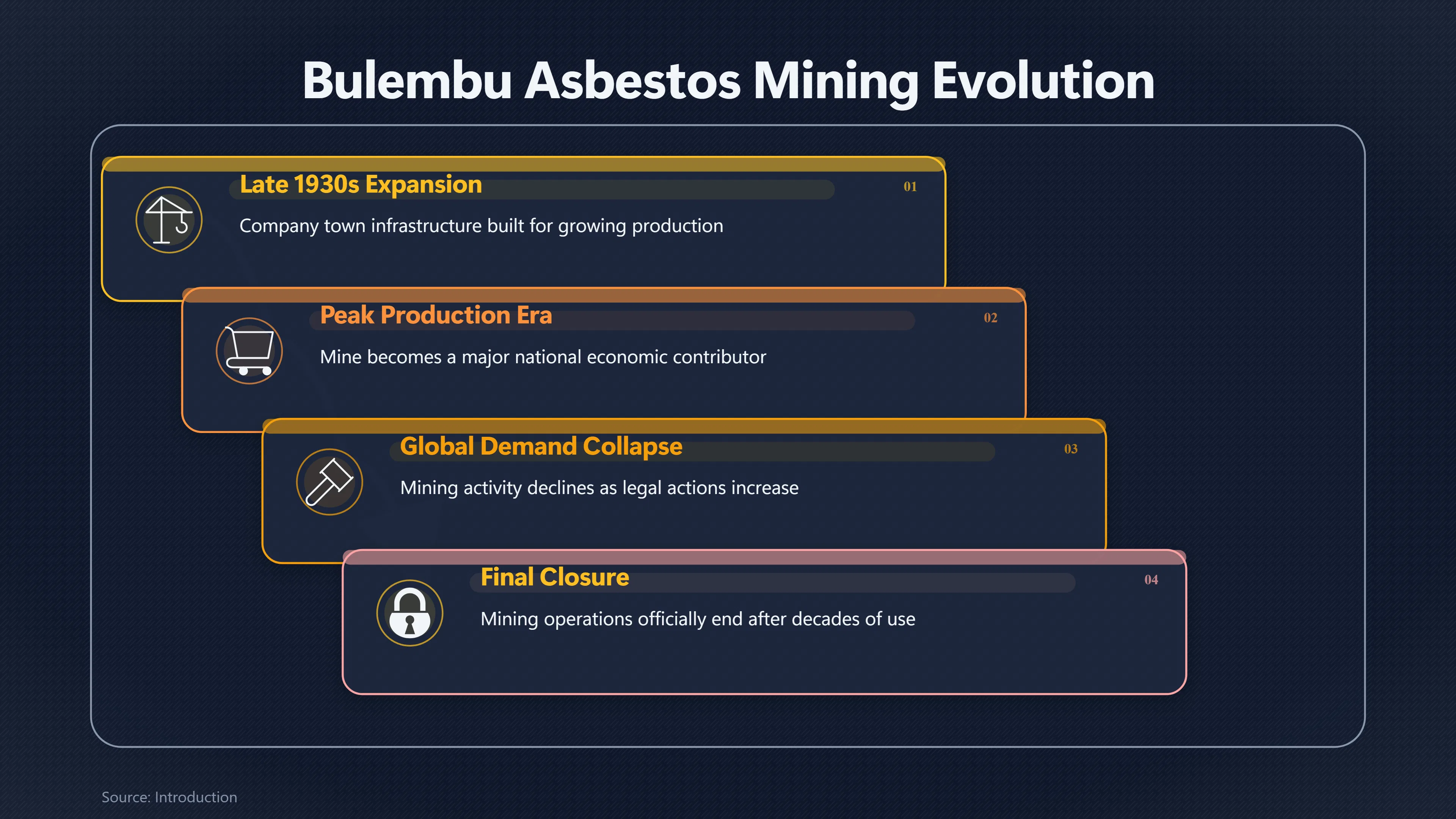
Bulembu, formerly centred on the Havelock asbestos mine, is Eswatini’s most distinctive example of dangerous industrial heritage. Built during the late 1930s and expanded as asbestos production increased, it functioned as a classic company town. Housing, schools, shops, recreational facilities and transport infrastructure were all organised around the mine, which at its peak was one of the country’s largest employers and a major contributor to the national economy.[The Kingdom of Eswatini]thekingdomofeswatini.comThe Kingdom of Eswatini Bulembu | The Kingdom of Eswatini (SwazilandThe Kingdom of Eswatini Bulembu | The Kingdom of Eswatini (Swaziland
When global demand for asbestos collapsed and legal action against asbestos producers increased, mining declined before finally ending in 2001. The town rapidly lost most of its population and briefly became known as a ghost town. Later redevelopment transformed Bulembu into a community with schools, children’s homes, small industries and tourism, while retaining much of its original built environment. The preserved streets, miners’ housing and public buildings now form an unusually complete industrial landscape rather than a single museum building.[thekingdomofeswatini.com]thekingdomofeswatini.comThe Kingdom of Eswatini Bulembu | The Kingdom of Eswatini (SwazilandThe Kingdom of Eswatini Bulembu | The Kingdom of Eswatini (Swaziland
Visitors can explore a mining museum alongside surviving colonial-era buildings, making Bulembu one of the few places in Eswatini where industrial archaeology, community history and tourism overlap directly. The attraction lies as much in the preserved settlement as in the exhibits themselves.[The Kingdom of Eswatini]thekingdomofeswatini.comThe Kingdom of Eswatini Museums & History | The Kingdom of Eswatini (SwazilandThe Kingdom of Eswatini Museums & History | The Kingdom of Eswatini (Swaziland
Machinery, medical equipment and company-town life
The Bulembu Mining Museum focuses on more than extraction technology. Displays typically include mining machinery, tools, photographs, domestic objects and equipment associated with everyday life in the settlement. Together they explain how a remote mountain community functioned when virtually every aspect of life depended on a single employer.[The Kingdom of Eswatini]thekingdomofeswatini.comThe Kingdom of Eswatini Bulembu | The Kingdom of Eswatini (SwazilandThe Kingdom of Eswatini Bulembu | The Kingdom of Eswatini (Swaziland
One of the more unusual aspects of the collection is its ability to connect industrial equipment with social infrastructure. Medical facilities, schools and recreational spaces were all products of the mining economy. This makes the museum valuable not because the artefacts themselves are rare, but because they illustrate how hazardous industries created complete communities with their own routines, services and identities.
At the same time, modern interpretation cannot avoid asbestos itself. Chrysotile asbestos was once marketed internationally as a useful industrial mineral, but it is now recognised as a cause of serious diseases including mesothelioma, lung cancer and asbestosis. This changes how visitors read every preserved machine or processing artefact. Equipment that once symbolised prosperity now also represents occupational exposure and environmental contamination.[ScienceDirect]sciencedirect.comOpen source on sciencedirect.com.
Why Bulembu remains a difficult heritage site
Unlike many former mining museums where extraction ended centuries ago, Bulembu’s legacy is still unfolding. Scientific research continues to examine contamination from asbestos waste dumps, fibre dispersal and impacts on local water systems. Large tailings deposits remain visible features of the landscape, making the environmental story impossible to separate from the heritage story.[ScienceDirect]sciencedirect.comOpen source on sciencedirect.com.
This creates several competing responsibilities:
- preserving historically important mining buildings;
- protecting visitors and residents from potential exposure;
- explaining asbestos honestly rather than nostalgically;
- recognising the economic importance the mine once held for Eswatini;
- acknowledging the experiences of miners and their families.
The result is heritage interpretation centred on critical reflection rather than celebration. Visitors are encouraged to understand why asbestos towns existed and why preserving their history matters, even though the industry itself is no longer regarded as acceptable.
Sugar processing and the wider industrial heritage trail
Eswatini’s industrial story is not confined to mining. The Sugarcane Museum at Tambankulu Sugar Estate presents another side of industrial development by focusing on agricultural processing rather than mineral extraction. Although sugar production lacks the same public-health associations as asbestos mining, it demonstrates how technology, transport and large-scale processing transformed landscapes and rural economies.[sugarcanemuseum.com]sugarcanemuseum.comThe Swaziland Sugarcane MuseumThe Swaziland Sugarcane Museum
The museum combines restored machinery, multimedia displays and historical interpretation. Visitors encounter vintage agricultural equipment, including a century-old steam engine, alongside explanations of cultivation, milling, transport and export. Rather than displaying isolated machines, the museum explains the complete industrial chain that turns sugarcane into commercial sugar.[sugarcanemuseum.com]sugarcanemuseum.comThe Swaziland Sugarcane MuseumThe Swaziland Sugarcane Museum
Its emphasis is notably different from Bulembu’s. Instead of examining industrial decline, it explores an industry that remains economically significant while acknowledging changing farming practices and the increasing role of smallholder producers. The museum therefore complements, rather than duplicates, Eswatini’s mining heritage.[European External Action Service]eeas.europa.euOpen source on europa.eu.
What makes Eswatini’s industrial heritage unusual?
For travellers interested in unusual museums, Eswatini’s industrial collections stand out because they preserve entire historical systems rather than simply displaying old machinery.
Several characteristics distinguish them:
- Communities instead of isolated artefacts. Bulembu preserves an entire mining settlement, allowing visitors to understand daily life alongside industrial technology.
- Visible ethical complexity. The exhibits cannot be separated from debates about asbestos disease, environmental responsibility and corporate history.
- Working industrial context. The Sugarcane Museum interprets an industry that still shapes the country’s economy rather than presenting a completely vanished past.
- Links with archaeology and landscape. These sites connect naturally with nearby heritage attractions such as Ngwenya Mine, where visitors encounter a much longer history of mineral extraction, demonstrating that mining has influenced the region for tens of thousands of years through very different technologies and social systems.[The Kingdom of Eswatini]thekingdomofeswatini.comThe Kingdom of Eswatini Museums & History | The Kingdom of Eswatini (SwazilandThe Kingdom of Eswatini Museums & History | The Kingdom of Eswatini (Swaziland
Taken together, these collections show that Eswatini’s most distinctive industrial museums are not monuments to technological triumph. They are places where preserved machinery, company housing and everyday objects become evidence for larger questions about labour, health, environmental responsibility and the changing meaning of industrial progress.
Amazon book picks
Further Reading
Books and field guides related to How Should Eswatini Preserve Dangerous Industries?. Use these as the next step if you want deeper reading beyond the article.
The Prize
The Prize recounts the panoramic history of oil -- and the struggle for wealth power that has always surrounded oil. This struggle has sh...
The Scramble For Africa
In 1880 the continent of Africa was largely unexplored by Europeans. Less than thirty years later, only Liberia and Ethiopia remained unc...

eBay marketplace picks
Marketplace Samples
Live-tested eBay searches with available results related to this page.
Selected fromindustrial heritage poster oneBay.co.uk.


Endnotes
1.
Source: sciencedirect.com
Link:https://www.sciencedirect.com/science/article/abs/pii/S1464343X24003674
2.
Source: sugarcanemuseum.com
Title: The Swaziland Sugarcane Museum
Link:https://www.sugarcanemuseum.com/
3.
Source: Wikipedia
Link:https://en.wikipedia.org/wiki/Bulembu
4.
Source: bulembu.org
Link:https://bulembu.org/
5.
Source: bulembu.org
Link:https://bulembu.org/activities-tours/
6.
Source: thekingdomofeswatini.com
Title: The Kingdom of Eswatini Bulembu | The Kingdom of Eswatini (Swaziland)
Link:https://www.thekingdomofeswatini.com/north-west-eswatini/bulembu/
7.
Source: thekingdomofeswatini.com
Title: The Kingdom of Eswatini Museums & History | The Kingdom of Eswatini (Swaziland)
Link:https://www.thekingdomofeswatini.com/eswatini-experiences/culture/museums-history/
8.
Source: eeas.europa.eu
Link:https://www.eeas.europa.eu/node/31306_en
9.
Source: thekingdomofeswatini.com
Link:https://www.thekingdomofeswatini.com/north-east-eswatini/the-sugarcane-museum/
10.
Source: thekingdomofeswatini.com
Link:https://www.thekingdomofeswatini.com/news-blogs/escape-explore-experience-bulembu-country-lodge/
11.
Source: tripadvisor.com
Title: The Sugarcane Museum
Link:https://www.tripadvisor.com/Attraction_Review-g4213058-d13370723-Reviews-The_Sugarcane_Museum-Simunye_Lubombo_District.html
12.
Source: sugarmuseum.com
Link:https://www.sugarmuseum.com/exhibits
Additional References
13.
Source: confrontpower.org
Link:https://confrontpower.org/civil-society-eswatini/
Source snippet
February 2, 2026 — Eswatini URGENT ACTION NEEDED TO PROTECT PEOPLE FROM ESWATINI’S ASBESTOS CONTAMINATION, SAY CIVIL SOCIETY GROUPS As th...
Published: February 2, 2026
14.
Source: ijhub.org.za
Link:https://ijhub.org.za/the-small-town-living-alongside-50-million-tons-of-asbestos-waste-inhlase-on-august-29-2025-at-751-am/
Source snippet
August 29, 2025 at 7:51 am – IJ HubAugust 29, 2025 — THE SMALL TOWN LIVING ALONGSIDE 50 MILLION TONS OF ASBESTOS WASTE INHLASE ON AUGUST...
Published: August 29, 2025
15.
Source: asbestosclaims.law
Title: The Asbestos Industry’s Exploitation of People and Countries in Africa
Link:https://www.asbestosclaims.law/asbestos-blog/the-asbestos-industrys-exploitation-of-people-and-countries-in-africa/
Source snippet
The Law Offices of Justinian C. Lane, Esq. – PLLC...
16.
Source: youtube.com
Link:https://www.youtube.com/watch?v=XsTh1AM4cT8
Source snippet
Havelock (Bulembu) Asbestos Mine in Swaziland 1952...
17.
Source: tripadvisor.ca
Link:https://www.tripadvisor.ca/Attraction_Review-g4213058-d13370723-Reviews-The_Sugarcane_Museum-Simunye_Lubombo_District.html
18.
Source: tripadvisor.co.uk
Link:https://www.tripadvisor.co.uk/Attraction_Review-g4213058-d13370723-Reviews-The_Sugarcane_Museum-Simunye_Lubombo_District.html
19.
Source: tripadvisor.co.za
Link:https://www.tripadvisor.co.za/Attraction_Review-g4213058-d13370723-Reviews-The_Sugarcane_Museum-Simunye_Lubombo_District.html
20.
Source: swazilandhappenings.co.za
Link:https://www.swazilandhappenings.co.za/ngwenyahomepage.htm
21.
Source: youtube.com
Title: The Asbestos Mine Printed on African Money
Link:https://www.youtube.com/watch?v=IWeVyTuKqRU
Source snippet
Bulembu 1960 (Havelock) Asbestos Mining Village in Swaziland...
22.
Source: ipsnews.net
Title: Inter Press Service SWAZILAND: Resurrecting Bulembu | Inter Press Service
Link:https://www.ipsnews.net/2009/07/swaziland-resurrecting-bulembu/