Where Does Morocco Keep Its Strangest Objects?
Morocco does not have a well-documented public museum devoted entirely to witchcraft, monsters, UFOs or medical horrors. Its strange-collection culture is subtler.
Page outline Jump by section
Introduction
The result is less a trail of theatrical “weird museums” than a network of places where everyday objects carry unusual meanings. Jewellery may have been worn for protection as well as beauty; weapons become feats of engineering and symbols of royal authority; household collections preserve vanished trades and regional identities; and private museums reflect one collector’s personal idea of Morocco. Visitors should also be cautious: several famous collections have closed, changed purpose or have uncertain opening arrangements. Morocco’s curiosity landscape rewards verification and patient interpretation rather than a checklist of sensational attractions.
Where Morocco’s strangest collections are found
Morocco’s museum system has expanded and modernised, particularly under the National Foundation of Museums, which manages numerous state institutions and promotes wider public access. Yet the country’s unusual material is rarely separated into a category labelled “the occult”, “the uncanny” or “curiosities”. It is usually embedded in museums of archaeology, regional life, jewellery, craftsmanship or faith.[wikipedia.org]WikipediaNational Foundation of Museums of MoroccoNational Foundation of Museums of Morocco
That matters because many objects now admired as decorative art once had several functions. A silver pendant could indicate origin, wealth or marital status while also being regarded as protective. A manuscript might be devotional, legal, scientific or connected with healing practices. Ceremonial clothing could encode religious, family and regional identities that are difficult to understand from appearance alone. Good displays explain these overlapping uses; weak ones reduce charged objects to attractive craftwork.
Morocco’s strongest curiosity museums therefore fall into three broad groups:
- Highly curated public institutions, where objects are documented within national history, archaeology or the decorative arts.
- Private collector museums, which are often more eccentric and densely packed but may provide uneven interpretation.
- Historic or fragile attractions, remembered because of an extraordinary collection even though they are closed, dispersed or no longer publicly accessible.
The most distinctive public collections
Borj Nord and its monumental armoury
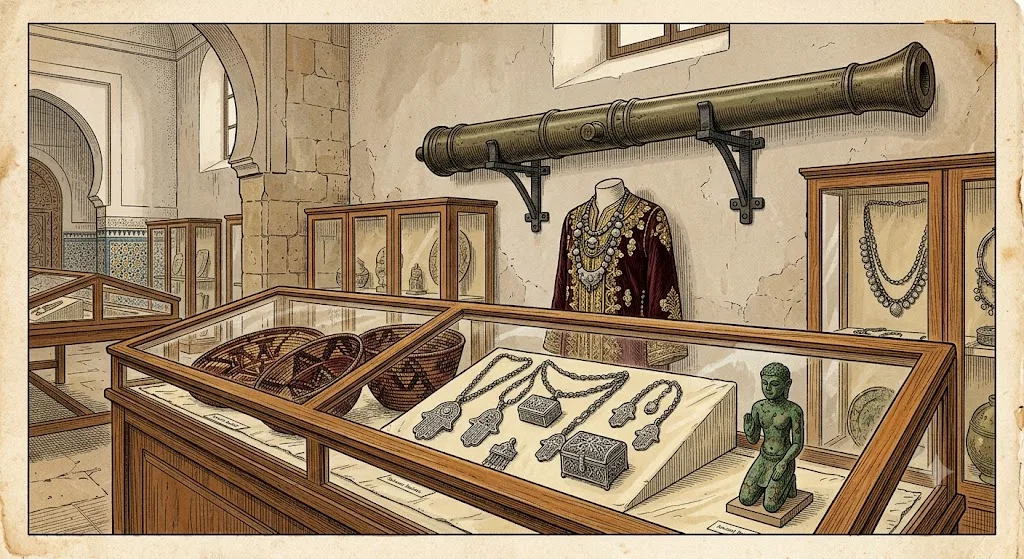
The Arms Museum at Borj Nord in Fez is the clearest conventional “oddity museum” in Morocco. It occupies a fortified structure established in the late sixteenth century and displays weapons from Morocco and numerous other countries, ranging across several historical periods. Its holdings are commonly described as numbering roughly 5,000 pieces, although only part of the collection is exhibited.[atlasobscura.com]atlasobscura.comAtlas Obscura Borj Nord Arms Museum in FezAtlas ObscuraBorj Nord Arms Museum in FezNovember 13, 2018 — 13 Nov 2018 — it exhibits some 5,000 weapons, from a 12-ton cannon used in t…
The unforgettable object is an enormous Saadian cannon associated with the 1578 Battle of the Three Kings. Nearly five metres long and weighing about 12 tonnes, it turns an arms display into a study of technological ambition, royal propaganda and the arrival of gunpowder warfare. The fort itself adds another layer: the museum is not merely displaying military history but occupying a building created for it.[Atlas Obscura]atlasobscura.comAtlas Obscura Borj Nord Arms Museum in FezAtlas ObscuraBorj Nord Arms Museum in FezNovember 13, 2018 — 13 Nov 2018 — it exhibits some 5,000 weapons, from a 12-ton cannon used in t…
Visitors should expect historic firearms, blades, armour and ceremonial weapons rather than staged horror or battlefield spectacle. The collection’s unusual value lies in scale and concentration. It shows how objects designed to injure could also become prestige goods, diplomatic gifts and demonstrations of specialist craftsmanship.
The National Jewellery Museum and protective adornment
Rabat’s National Jewellery Museum, housed within the Kasbah of the Udayas, reopened in its present form in January 2023. Its collection contains thousands of pieces connected with clothing, jewellery and regional adornment, including historical caftans, bridal ensembles and royal donations of Amazigh silverwork.[Wikipedia]WikipediaNational Jewellery Museum (MoroccoNational Jewellery Museum (Morocco
For readers interested in magical or protective objects, the most relevant pieces are hand-shaped amulets and other jewellery whose significance exceeds decoration. Such objects belong to a wider North African and Middle Eastern tradition in which materials, written signs, bodily placement and inherited symbolism could all contribute to an object’s perceived power. Scholarship on amulets stresses that they should be understood through their social use and physical setting, not simply categorised as superstition or ornament.[wikipedia.org]WikipediaNational Jewellery Museum (MoroccoNational Jewellery Museum (Morocco
The museum does not present itself as a museum of magic. Its strength is precisely that it places protective forms within clothing, marriage, craftsmanship and community identity. Visitors looking only for “occult artefacts” may overlook the richer question: how did an object operate simultaneously as jewellery, social language and spiritual safeguard?
The Museum of History and Civilisations
Rabat’s Museum of History and Civilisations offers Morocco’s most important archaeological concentration, bringing together prehistoric objects, inscriptions, sculpture, bronzes and material from ancient settlements such as Volubilis and Chellah. The museum grew from an archaeological institution created during the French Protectorate and reopened after renovation under its current name in 2017.[Wikipedia]WikipediaMuseum of History and CivilizationsMuseum of History and Civilizations
Its most memorable galleries include ancient bronzes and marble figures representing rulers, deities and mythological subjects. Images of Venus, Eros, Neptune and other figures can feel unexpected in a country whose public heritage is often presented primarily through Islamic architecture and craft. They are not archaeological anomalies, however. They testify to Morocco’s connections with Phoenician, Mauretanian and Roman worlds.[Wikipedia]WikipediaMuseum of History and CivilizationsMuseum of History and Civilizations
The museum is particularly useful for separating genuine archaeological strangeness from invented mystery. Mythic figures, unfamiliar inscriptions and ritual objects may look enigmatic, but they sit within excavated historical contexts. The collection’s curiosity lies in the layered religions and political cultures that occupied the same landscape, not in claims of lost civilisations or unexplained technology.
The Museum of Moroccan Judaism
Casablanca’s Museum of Moroccan Judaism preserves ritual objects, textiles, clothing, photographs and domestic material associated with Jewish life in Morocco. It is widely noted as a rare institution in the region and is essential to understanding religious objects that tourist shops or poorly labelled collections may strip of context.[hespress.com]en.hespress.com87332 explore moroccos must see museums this summer87332 explore moroccos must see museums this summer
Its significance for curiosity culture lies in the intimacy of its objects. Ceremonial textiles, marriage clothing, lamps, scroll fittings and protective items connect faith with the home, body and community. These are devotional and historical artefacts, not exotic props. Their preservation also complicates any simplistic idea of Moroccan identity as culturally uniform.
The museum is strongest when read alongside displays of Muslim, Amazigh and regional material elsewhere. Similar forms—hands, stars, written blessings, precious metals and embroidered symbols—can circulate across communities while carrying distinct meanings. The comparison reveals exchange without erasing difference.
Private museums and collector-built worlds
Dar Tiskiwin’s trans-Saharan cabinet
Dar Tiskiwin in Marrakech grew from the collection of Dutch anthropologist and collector Bert Flint. Its rooms have been arranged around Morocco’s connections with the Sahara and West Africa, using textiles, jewellery, baskets, clothing and domestic objects to evoke historic trade and cultural routes. Older visitor descriptions often treat it as a journey southwards from Marrakech through the desert.[ExcursionMania]excursionmania.comExcursion Mania Marrakech Tiskiwin MuseumExcursion Mania Marrakech Tiskiwin Museum
The museum is unusual because it reflects a collector’s intellectual map rather than a standard national chronology. Objects are grouped to demonstrate movement, exchange and shared visual traditions across regions now divided by modern borders. This produces a cabinet-of-curiosity atmosphere, but it also raises questions familiar to private ethnographic museums: who collected the objects, how were they acquired, and how much of the interpretation comes from the originating communities?
Most importantly, current access should not be assumed. Cadi Ayyad University states that the museum is closed for maintenance, while commercial listings have variously described it as temporarily closed or supplied outdated opening hours. Visitors should regard the university notice as the more authoritative status indicator and confirm reopening before travelling.[tripadvisor.com]tripadvisor.comMusée TiskiwinMusée Tiskiwin
Dar Belghazi and the collector’s Morocco
The privately run Belghazi Museum near Salé is associated with a large family collection of Moroccan craftsmanship and historical objects. Reported holdings include jewellery, manuscripts, musical instruments, woodwork, pottery, clothing and weapons. Unlike a minimalist modern museum, it is generally described as abundant and collector-led.[lamaisonmusee.com]lamaisonmusee.comdiscover dar belghazi museum sale cultural gemdiscover dar belghazi museum sale cultural gem
Its appeal lies in accumulation. Visitors encounter not one narrow theme but an attempt to preserve an entire material world: architectural fragments, household goods, textiles and rare objects gathered across generations. That density can create valuable connections between elite art and ordinary craftsmanship, but interpretation may depend heavily on guides and local knowledge.
Claims that it is Africa’s largest private museum appear in tourism material but are difficult to verify against a consistent continent-wide measure. It is safer to describe it as an extensive private Moroccan collection rather than repeat a superlative as established fact.[Kuna]kuna.net.kwArticle Details.aspxArticle Details.aspx
A museum built around living bees
The Living Bee Museum in Salé is one of Morocco’s most literally unusual specialist attractions. It presents beekeeping, honey and bee biology, reportedly using educational displays and transparent hives that allow visitors to observe a functioning colony. The museum describes itself as a pioneering bee institution in Africa and the Arab world, although that marketing claim is not independently documented well enough to treat as definitive.[tripadvisor.com]tripadvisor.comMusee De l'Abeille VivanteMusee De l'Abeille Vivante
Its curiosity value is not supernatural but sensory and biological. A colony is both exhibit and living system: constantly moving, producing, regulating temperature and communicating. The museum also connects natural history with rural practice and the cultural importance of honey.
Because reliable official visitor information is limited, opening arrangements should be checked directly. It is best understood as a small educational private attraction, not a large natural-history institution.
Palaces where ordinary objects become strange
The Museum of Confluences at Dar el Bacha in Marrakech occupies an early twentieth-century residence associated with Thami El Glaoui, the powerful former pasha of the city. Its collections include Moroccan decorative art, ceramics, jewellery, manuscripts, textiles and ethnographic objects, while temporary exhibitions explore wider cultural encounters.[Fondation Nationale des Musées]fnm.maOpen source on fnm.ma.
The unusual experience comes partly from the setting. Visitors move through courtyards, salons and a historic bath complex rather than neutral white galleries. Household architecture becomes an exhibit, and the distinction between palace, political monument and museum remains visible.
This is also a useful place to resist romanticised storytelling. El Glaoui’s residence represents wealth and craftsmanship, but it is tied to political power during the Protectorate era. The building can therefore be read both as a beautiful preserved interior and as evidence of an unequal historical order.
Meknes’s Dar Jamai offers a comparable transformation. Built for an elite family in the nineteenth century, it was confiscated after a political reversal, then used under French rule as a hospital, military court and museum of so-called “indigenous arts”. Its later life reveals how colonial institutions collected and reclassified Moroccan objects, often turning living traditions into fixed museum categories.[Wikipedia]wikipedia.orgDar Jamai MuseumDar Jamai Museum
Morocco’s famous lost curiosity museum
Tangier once had one of the world’s more eccentric military-miniature collections. American publisher Malcolm Forbes converted the former residence of the Sultan’s representative into a museum filled with tens of thousands of model soldiers. Elaborate tableaux recreated battles and historic ceremonies with figures, lighting and sound. Accounts differ on the exact total, but the collection was unquestionably vast.[independent.co.uk]independent.co.ukforbes he had 10 000 men 1288873forbes he had 10 000 men 1288873
The Forbes Museum closed in the 1990s after Forbes’s death. Around 60,000 figures were sold at Christie’s auctions in 1997, while the Moroccan state acquired the property and converted it for official use. It is no longer a public museum.[audiala.com]audiala.comforbes museum of tangierforbes museum of tangier
Its history matters because it demonstrates how vulnerable private museums can be. A spectacular collection may be inseparable from one wealthy owner; once that owner dies, the displays can be sold, divided and stripped from the building that gave them meaning. Tangier’s toy armies survive mainly through auction records, photographs and memories rather than as an intact Moroccan attraction.
The building acquired an additional layer of popular mythology after appearing as a villain’s residence in the 1987 James Bond film The Living Daylights. That cinematic connection is real, but modern travel pages sometimes blur the former museum with the present official residence. Visitors cannot treat it as an operating attraction.[Wikipedia]WikipediaMendoub's ResidenceMendoub's Residence

Magic, healing and folklore without a witchcraft museum
Moroccan folklore includes spirits, protective practices, pilgrimage traditions, healing rites and objects believed to guard against misfortune. Yet these subjects are not gathered into a nationally prominent museum of magic. Their material traces are dispersed among jewellery displays, manuscripts, ethnographic collections, religious sites and archives.
This absence should not be mistaken for an absence of belief. Historical collections outside Morocco preserve Moroccan writings concerning talismans, healing, astrology and magic, while broader scholarship shows that amulets were activated and understood through combinations of text, material, bodily use and ritual setting.[yale.edu]archives.yale.eduarchival objectsarchival objects
There are several reasons why such material may resist conventional museum treatment. Some objects were personal and intended to remain concealed. Others are connected with living religious practices whose holders may reject the labels “magic” or “occult”. Collecting them can also reproduce colonial habits of treating unfamiliar faith and healing systems as primitive curiosities.
For visitors, the most responsible approach is to ask what an object was believed to do, who used it and whether its meaning came from its form, inscription, blessing, material or family history. A hand-shaped pendant is not automatically a magical charm; a manuscript containing unusual diagrams is not automatically a spell book. Interpretation depends on provenance and context.
How credible are Morocco’s curiosity attractions?
Morocco’s state museums generally provide the strongest institutional curation, but even there English-language interpretation may vary. Private museums often offer greater eccentricity and personal atmosphere, yet their cataloguing, provenance information and published opening details can be limited.
A practical credibility check should consider four questions:
-
Is the attraction still operating? Dar Tiskiwin is officially listed as closed for maintenance, while the Forbes Museum is permanently gone as a public institution. Old travel articles frequently survive long after circumstances change. Université Cadi Ayyad
- Who owns and interprets the collection? A national archaeological museum, a family collection and a commercial attraction have different aims and standards.
- Are extraordinary claims documented? Labels such as “largest”, “first” or “unique in the world” are often promotional and should not be repeated without independent support.
- Are belief and historical fact separated? Museums should explain that an object was regarded as protective or healing rather than claim that it possessed supernatural power.
The strongest Moroccan collections do not need exaggerated mysteries. Their interest comes from real historical crossings: Roman gods excavated from North African soil, amuletic forms worn as jewellery, battle cannons preserved inside a gunpowder fort, Jewish ritual objects surviving major demographic change, and private collections attempting to hold together cultures connected by desert trade.
Why Morocco’s curiosity culture matters
Morocco’s unusual collections reveal that “strange” heritage is often produced by a change of context. A weapon becomes uncanny when displayed as a beautifully decorated object. A living hive becomes a museum exhibit. A protective pendant becomes jewellery after its belief system fades from view. A palace becomes a national gallery, while a private toy army disappears into an auction catalogue.
They also show how museums shape national memory. Earlier colonial institutions often classified Moroccan culture as timeless “indigenous art”, separating objects from contemporary makers and users. Newer institutions increasingly present them as evidence of a diverse history formed by Amazigh, Arab, Jewish, Mediterranean, Saharan and African connections. Dar Jamai’s institutional history and Dar Tiskiwin’s trans-Saharan arrangement make that change especially visible. Wikipedia+2ExcursionMania
For strange-museum travellers, Morocco is therefore best approached as a country of embedded curiosities rather than spectacular freak-show collections. The richest experiences come from noticing how museums classify ambiguous objects—and how much meaning is lost when craftsmanship, faith, protection, politics and trade are treated as separate subjects.
Amazon book picks
Further Reading
Books and field guides related to Where Does Morocco Keep Its Strangest Objects?. Use these as the next step if you want deeper reading beyond the article.
The Arabs: A History
Eugene Rogan has written an authoritative new history of the Arabs in the modern world. Starting with the Ottoman conquests in the sixtee...
The Travels of Ibn Battuta
An engrossing account of a 1326 pilgrimage to Mecca provides vivid details of Morocco, Russia, India, China, and elsewhere. "The ultimate...
A history of modern Morocco
First published 2012. Subjects: HISTORY / Middle East / General, History, Morocco, history.
A History of Islamic Societies
Rating: 4.0/5 from 8 Google Books ratings
Ira Lapidus' classic history of the origins and evolution of Muslim societies, revised and updated for this second edition, first publish...
eBay marketplace picks
Marketplace Samples
Live-tested eBay searches with available results related to this page.
Selected fromMoroccan wall art oneBay.co.uk.
Endnotes
1.
Source: Wikipedia
Title: National Foundation of Museums of Morocco
Link:https://en.wikipedia.org/wiki/National_Foundation_of_Museums_of_Morocco
2.
Source: morocco.com
Title: borj nord
Link:https://www.morocco.com/attractions/museums/borj-nord/
Source snippet
Borj-Nord Musuem – Housed in a 16th Century FortressOverall, there are more than 5000 different arms in the collection which inclu...
3.
Source: Wikipedia
Title: Borj Nord
Link:https://en.wikipedia.org/wiki/Borj_Nord
4.
Source: Wikipedia
Title: National Jewellery Museum (Morocco)
Link:https://en.wikipedia.org/wiki/National_Jewellery_Museum_%28Morocco%29
5.
Source: uplopen.com
Link:https://uplopen.com/books/13694/files/64996d64-1bca-4d89-a804-7b7d4aad8bd2.pdf
Source snippet
Amulets and Talismans of the Middle East and North Africa...Amulets and talismans of the Middle East and North Africa ・ occult sc...
6.
Source: Wikipedia
Title: Museum of History and Civilizations
Link:https://en.wikipedia.org/wiki/Museum_of_History_and_Civilizations
7.
Source: en.hespress.com
Title: 87332 explore moroccos must see museums this summer
Link:https://en.hespress.com/87332-explore-moroccos-must-see-museums-this-summer.html
8.
Source: moroccotravelblog.com
Link:https://moroccotravelblog.com/museum-of-moroccan-judaism-jewish-museum-in-casablanca/
9.
Source: newyorkjewishtravelguide.com
Title: hidden in the souks tracing moroccos jewish artistic heritage
Link:https://newyorkjewishtravelguide.com/2026/02/21/hidden-in-the-souks-tracing-moroccos-jewish-artistic-heritage/
10.
Source: excursionmania.com
Title: Excursion Mania Marrakech Tiskiwin Museum
Link:https://www.excursionmania.com/ttd/1456/tiskiwin-museum-blg-1456?srsltid=AfmBOor5aQxKrAKQX8eKeQi10vKF-g5WbNbvRmORexdZecC6bgmKuvuq
11.
Source: tripadvisor.com
Title: Musée Tiskiwin
Link:https://www.tripadvisor.com/Attraction_Review-g293734-d318059-Reviews-Musee_Tiskiwin-Marrakech_Marrakech_Safi.html
12.
Source: trip.com
Title: muse tiskiwin marrakech 38545176
Link:https://www.trip.com/travel-guide/attraction/marrakech/muse-tiskiwin-marrakech-38545176/
13.
Source: lamaisonmusee.com
Title: discover dar belghazi museum sale cultural gem
Link:https://www.lamaisonmusee.com/2024/08/discover-dar-belghazi-museum-sale-cultural-gem.html
14.
Source: tripadvisor.com
Title: Musee De l’Abeille Vivante
Link:https://www.tripadvisor.com/Attraction_Review-g660175-d16652965-Reviews-Musee_De_l_Abeille_Vivante-Sale_Rabat_Sale_Kenitra.html
15.
Source: facebook.com
Title: Musée de l’abeille vivante
Link:https://www.facebook.com/museeabeille.maroc/
17.
Source: Wikipedia
Title: Mendoub’s Residence
Link:https://en.wikipedia.org/wiki/Mendoub%27s_Residence
18.
Source: morocco.com
Link:https://www.morocco.com/attractions/museums/forbes/
19.
Source: audiala.com
Title: forbes museum of tangier
Link:https://audiala.com/en/morocco/tangier/forbes-museum-of-tangier
20.
Source: archives.yale.edu
Title: archival objects
Link:https://archives.yale.edu/repositories/12/archival_objects/2006848
21.
Source: tripadvisor.com
Title: Attractions g293730 Activities c49 t161 Morocco
Link:https://www.tripadvisor.com/Attractions-g293730-Activities-c49-t161-Morocco.html
22.
Source: tripadvisor.com
Link:https://www.tripadvisor.com/Attraction_Review-g186235-d24829409-Reviews-Gwithti_an_Pystri_a_Cabinet_of_Folklore_and_Magic-Falmouth_Cornwall_England.html
23.
Source: tripadvisor.com
Title: Belghazi Museum
Link:https://www.tripadvisor.com/Attraction_Review-g660175-d6642662-Reviews-Belghazi_Museum-Sale_Rabat_Sale_Kenitra.html
24.
Source: tripadvisor.com
Title: Musee des armes
Link:https://www.tripadvisor.com/Attraction_Review-g293733-d4754534-Reviews-Musee_des_armes-Fez_Fez_Meknes.html
25.
Source: tripadvisor.com
Title: Musee Riad Belghazi
Link:https://www.tripadvisor.com/Attraction_Review-g293733-d7399429-Reviews-Musee_Riad_Belghazi-Fez_Fez_Meknes.html
26.
Source: tripadvisor.com
Title: Attractions g660175 Activities c49 Sale Rabat Sale Kenitra
Link:https://www.tripadvisor.com/Attractions-g660175-Activities-c49-Sale_Rabat_Sale_Kenitra.html
27.
Source: lamaisonmusee.com
Title: unearthing moroccos quirky collections
Link:https://www.lamaisonmusee.com/2026/02/unearthing-moroccos-quirky-collections.html
28.
Source: morocco.com
Link:https://www.morocco.com/attractions/museums/
29.
Source: Wikipedia
Title: Museum of Moroccan Judaism
Link:https://en.wikipedia.org/wiki/Museum_of_Moroccan_Judaism
30.
Source: sg.trip.com
Title: muse tiskiwin marrakech 38545176
Link:https://sg.trip.com/travel-guide/attraction/marrakech/muse-tiskiwin-marrakech-38545176?poiType=3
31.
Source: fnm.ma
Link:https://fnm.ma/
Source snippet
Fondation Nationale des MuséesFondation Nationale des MuséesEl Bacha Musée. Musée des Confluences Dar El Bacha Musée National de la Photo...
32.
Source: fnm.ma
Link:https://fnm.ma/museums/
Source snippet
Fondation Nationale des MuséesTous nos muséesDécouvrir MUSÉE DES CONFLUENCES DAR EL BACHA. Dar el Bacha est un musée qui représente un be...
33.
Source: atlasobscura.com
Title: Atlas Obscura Borj Nord Arms Museum in Fez
Link:https://www.atlasobscura.com/places/borj-nord-arms-museum
Source snippet
Atlas ObscuraBorj Nord Arms Museum in FezNovember 13, 2018 — 13 Nov 2018 — it exhibits some 5,000 weapons, from a 12-ton cannon used in t...
Published: November 13, 2018
35.
Source: kuna.net.kw
Title: Article Details.aspx
Link:https://www.kuna.net.kw/ArticleDetails.aspx?id=1959005&language=en
36.
Source: 7toucans.com
Title: Belghazi Museum
Link:https://7toucans.com/en/things-to-do-when-traveling/africa/morocco/sale/3626-belghazi-museum
37.
Source: petitfute.co.uk
Title: Petit FutéNatural Crafts
Link:https://www.petitfute.co.uk/v46125-sale/c1173-visites-points-d-interet/c976-archeologie-artisanat-science-et-technique/c981-nature/
38.
Source: fnm.ma
Link:https://fnm.ma/museums/26
39.
Source: independent.co.uk
Title: forbes he had 10 000 men 1288873
Link:https://www.independent.co.uk/arts-entertainment/forbes-he-had-10-000-men-1288873.html
40.
Source: atlasobscura.com
Link:https://www.atlasobscura.com/things-to-do/morocco/museums
41.
Source: atlasobscura.com
Link:https://www.atlasobscura.com/places/the-museum-of-witchcraft-boscastle-cornwall-boscastle-england
42.
Source: atlasobscura.com
Title: tangier american legation museum
Link:https://www.atlasobscura.com/places/tangier-american-legation-museum
43.
Source: fnm.ma
Link:https://fnm.ma/uploads/press-archives/2017-Lieux%20saints%20partag%C3%A9s.pdf
44.
Source: fnm.ma
Title: 2024 ARMAN L’OBJET DE L’ART
Link:https://fnm.ma/uploads/press-archives/2024-ARMAN%20-%20L%27OBJET%20DE%20L%27ART.pdf
45.
Source: fnm.ma
Title: communiquedepressedarelbacha14471 69002ec9b0226
Link:https://fnm.ma/uploads/press-releases/communiquedepressedarelbacha14471-69002ec9b0226.pdf
46.
Source: fnm.ma
Link:https://fnm.ma/uploads/press-releases/dossier_de_presse_exposition_mohamed_azouzi_compressed-691ec76dd2639.pdf
47.
Source: fnm.ma
Link:https://fnm.ma/expositions
48.
Source: fnm.ma
Link:https://fnm.ma/exposition/les-splendeurs-de-l-atlas
49.
Source: fnm.ma
Title: sous le signe du noun
Link:https://fnm.ma/exposition/sous-le-signe-du-noun
50.
Source: fnm.ma
Link:https://fnm.ma/uploads/press-archives/2018-Ouverture%20du%20mus%C3%A9e%20national%20du%20Tissage%20et%20du%20Tapis%2C%20Dar%20Si%20Said.pdf
51.
Source: tripadvisor.co.uk
Link:https://www.tripadvisor.co.uk/Attraction_Review-g293734-d29550912-Reviews-Museum_Of_Moroccan_Elegance-Marrakech_Marrakech_Safi.html
52.
Source: travelsquire.com
Link:https://travelsquire.com/morocco-a-magical-mystery-tour/
53.
Source: petitfute.co.uk
Title: LIVIN G BEE MUSEUM VALLEE DU BOUREGREG
Link:https://www.petitfute.co.uk/v46125-sale/c1173-visites-points-d-interet/c976-archeologie-artisanat-science-et-technique/c981-nature/1861889-musee-abeille-vivante-vallee-du-bouregreg.html
54.
Source: morocco-traveler.com
Link:https://morocco-traveler.com/travel-guide/fascinating-museums-in-morocco/
55.
Source: morocco.falktime.com
Title: borj nord viewpoint and museum of arms
Link:https://morocco.falktime.com/borj-nord-viewpoint-and-museum-of-arms/
56.
Source: getyourguide.com
Title: Museum of Moroccan Judaism
Link:https://www.getyourguide.com/museum-of-moroccan-judaism-l238057/
Additional References
57.
Source: youtube.com
Title: Marrakech Dar Si Said Palace Museum
Link:https://www.youtube.com/watch?v=VYoItitP_vQ
Source snippet
Dar Si Said Museum Marrakech Morocco DAR SI SAID (MARRAKECH): THE NATIONAL MUSEUM OF MOROCCAN WEAVINGS & CARPETS...
58.
Source: youtube.com
Title: DAR SI SAID (MARRAKECH): THE NATIONAL MUSEUM OF MOROCCAN WEAVINGS & CARPETS
Link:https://www.youtube.com/watch?v=pieGdXSRq0M
Source snippet
In journey to past, Morocco's rich history on show...
59.
Source: liverpoolmuseums.org.uk
Link:https://www.liverpoolmuseums.org.uk/artifact/amulets-and-jewellery
60.
Source: mindtrip.ai
Link:https://mindtrip.ai/attraction/bouknadel-rabat-sale-kenitra/belghazi-house-museum/at-NT6xIqYs
61.
Source: gpsmycity.com
Link:https://www.gpsmycity.com/attractions/borj-nord-fortress—museum-of-arms-1778.html
62.
Source: mindtrip.ai
Link:https://mindtrip.ai/attraction/fes-meknes/borj-nord/at-SK0jenIX
63.
Source: synotrip.com
Link:https://www.synotrip.com/moroccojourney/forbes-museum-tangier
64.
Source: dreamnetworkjournal.com
Link:https://dreamnetworkjournal.com/bcpoz1jotrtm/jinns-on-the-road-to-morocco
65.
Source: scribd.com
Link:https://www.scribd.com/document/358842892/The-Invisible-Museum-History-and-Memory-of-Morocco-Cases
66.
Source: ethnicjewelsmagazine.co.uk
Link:https://www.ethnicjewelsmagazine.co.uk/articles-moroccan-judaica/