Within Cape Verde Curiosities
What Cape Verde's Shipwreck Objects Really Reveal
Cape Verde's wreck museums turn cannons, coins and intimate personal objects into evidence of dangerous Atlantic journeys.
On this page
- The Praia and Boa Vista collections
- Everyday life recovered from the seabed
- Why provenance and excavation records matter
Page outline Jump by section
Introduction
Cape Verde’s shipwreck museums are unusual because they do not simply display maritime treasures. Instead, they use objects recovered from the seabed to reconstruct the lives, trade networks and dangers of centuries of Atlantic travel. Cannons, coins and anchors certainly feature, but some of the most revealing exhibits are toothbrushes, medicine bottles, cooking utensils, clothing accessories and fragments of everyday equipment that belonged to ordinary people aboard long-distance sailing ships. Together these collections show that the Atlantic was not just a route for commerce but also a place where ships, cargoes and personal possessions disappeared beneath the sea.
Most of this material is preserved in two public institutions: the Archaeology Museum in Praia on Santiago and the Archaeology Museum of Boa Vista. Both present underwater archaeology as evidence rather than treasure hunting, although the history of how some collections were recovered has prompted important debates about archaeological standards, commercial salvage and the importance of recording exactly where every object was found.[ipc.cv]ipc.cvMuseu de Arqueologia – Instituto do Património CulturalMuseu de Arqueologia – Instituto do Património Cultural
What Cape Verde’s Shipwreck Objects Really Reveal
Cape Verde sits close to the junction of Atlantic routes linking Europe, West Africa and the Americas. For centuries, merchant vessels, naval ships and slaving voyages passed the islands. Strong currents, reefs, storms and incomplete charts caused numerous wrecks, leaving an unusually rich underwater archaeological record. Rather than treating each recovered object as an isolated curiosity, modern museums interpret them as pieces of larger archaeological sites that reveal how ships operated and how people lived aboard them.[Asuch]asuch.orgCape Verde – Arqueonautas WorldwideCape Verde – Arqueonautas Worldwide…
The collections therefore answer questions that precious cargo alone cannot. A single coin may help date a wreck, but a combination of tableware, medical equipment, weapons, clothing fittings and navigation instruments can identify a vessel’s purpose, the social status of its passengers and crew, trading connections and even daily routines during long ocean crossings. The value of the collection lies in the relationships between these objects rather than in their individual rarity.[ipc.cv]ipc.cvMuseu de Arqueologia – Instituto do Património CulturalMuseu de Arqueologia – Instituto do Património Cultural
The Praia and Boa Vista Collections
Archaeology Museum in Praia
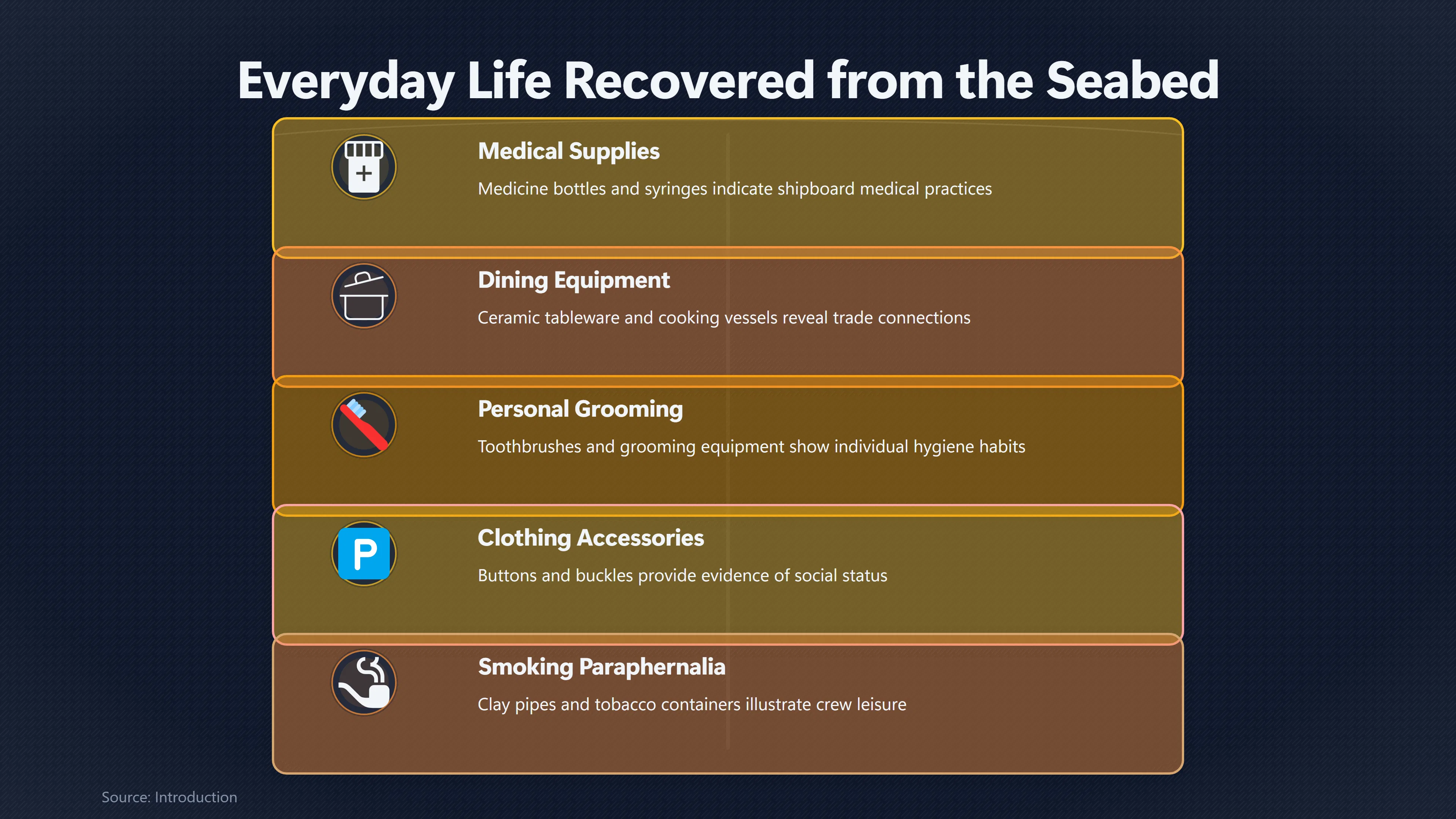
The Archaeology Museum in Praia opened in 2008 after years of conservation work on terrestrial and underwater finds recovered during archaeological projects carried out in the 1990s and early 2000s. Its displays include ship timbers, anchors, navigational equipment, amphorae, coins, weapons, ceramics, ivory, beads, watches, tobacco pipes and numerous domestic items. Particularly memorable are personal possessions such as toothbrushes, chamber pots, medicine bottles, mortars, syringes and grooming equipment that transform anonymous wrecks into human stories. The museum also preserves shackles and chains, reminding visitors that Atlantic shipping included warfare, forced migration and the slave trade alongside commercial exchange.[ipc.cv]ipc.cvMuseu de Arqueologia – Instituto do Património CulturalMuseu de Arqueologia – Instituto do Património Cultural
The museum links these finds with archaeological sites on land, especially around Cidade Velha, demonstrating how shipwreck archaeology contributes to understanding Cape Verde’s early colonial settlements rather than existing as a separate speciality.[ipc.cv]ipc.cvMuseu de Arqueologia – Instituto do Património CulturalMuseu de Arqueologia – Instituto do Património Cultural
Archaeology Museum of Boa Vista
Opened in 2023 in the restored former customs house at Sal Rei, Boa Vista’s Archaeology Museum focuses much more tightly on specific wrecks excavated around the island. Its collection is drawn primarily from five documented shipwrecks:
- Leijmudeen (1770)
- Hartwell (1787)
- Lady Burgess (1806)
- Varandinha (date uncertain)
- Santo André (1856)
The displays include structural ship components, artillery, coins, ceramics, kitchen utensils and personal belongings recovered from these vessels, alongside artefacts from the nearby Forte Duque de Bragança. By organising exhibits around identifiable wrecks rather than broad themes, the museum allows visitors to see how archaeological interpretation develops from individual sites rather than from disconnected objects.[ipc.cv]ipc.cvMuseu de Arqueologia da Boa Vista – Instituto do Património CulturalMuseu de Arqueologia da Boa Vista – Instituto do Património Cultural

Everyday Life Recovered from the Seabed
One reason these museums stand out within Cape Verde’s unusual heritage landscape is their emphasis on ordinary objects.
Visitors naturally notice cannons and silver coins first, yet archaeologists often gain more historical information from modest possessions. A medicine bottle may indicate medical practice aboard ship. Ceramic tableware can reveal trade connections or social hierarchy. Buttons, buckles and cufflinks provide evidence of clothing and status. Clay pipes, bottles and cooking vessels illustrate how crews spent long voyages and what supplies they carried. Even broken glass, animal bones and food containers contribute to reconstructing life on board.[ipc.cv]ipc.cvMuseu de Arqueologia – Instituto do Património CulturalMuseu de Arqueologia – Instituto do Património Cultural
These intimate finds also challenge popular ideas about “treasure”. Instead of focusing exclusively on valuable cargo, the museums present shipwrecks as frozen moments of everyday history. The most memorable artefact is not always the most expensive one; it is often the object that connects modern visitors most directly with an individual sailor, passenger or merchant who never completed the journey.
Why Provenance and Excavation Records Matter
Shipwreck museums depend on context as much as artefacts.
Unlike an isolated object found on land, every item underwater forms part of a wider archaeological site. Its depth, exact location, relationship to neighbouring finds and position within the wreck all help archaeologists reconstruct what happened when the vessel sank. Once these relationships are lost, much historical information disappears permanently.
Cape Verde’s collections illustrate why this matters. Much of the material now displayed in Praia originated in archaeological programmes undertaken between 1992 and 2002, including work involving the private company Arqueonautas Worldwide under government concession. Supporters point to significant achievements: dozens of wreck sites documented, local conservation facilities established, Cape Verdean divers trained and museum collections created.[ipc.cv]ipc.cvMuseu de Arqueologia – Instituto do Património CulturalMuseu de Arqueologia – Instituto do Património Cultural
At the same time, commercial involvement in underwater archaeology has attracted criticism from many maritime archaeologists. UNESCO’s approach to underwater cultural heritage emphasises careful scientific documentation, long-term preservation and resistance to commercial exploitation because archaeological information can be destroyed if objects are removed primarily for their market value. The debate is therefore not about whether the displayed artefacts are genuine—they are—but about whether excavation methods preserved enough contextual evidence to maximise their historical value.[Asuch]asuch.orgCape Verde – Arqueonautas WorldwideCape Verde – Arqueonautas Worldwide…
For museum visitors, provenance becomes part of the story. Knowing precisely which wreck an object came from, how it was excavated and how it was conserved is often as informative as the artefact itself.

From Treasure Hunting to Scientific Underwater Archaeology
Cape Verde’s museums also reflect changing attitudes towards submerged heritage.[asuch.org]asuch.orgCape Verde – Arqueonautas WorldwideCape Verde – Arqueonautas Worldwide…
Earlier generations often viewed wrecks primarily as sources of valuables. Contemporary underwater archaeology instead treats them as fragile historical sites that deserve the same careful documentation as excavations on land. Recent UNESCO-supported training at Cidade Velha has reinforced this approach by combining underwater survey, excavation techniques and museum collection management. Participants study both submerged archaeological sites and conserved artefacts held in the Archaeology Museum in Praia, linking fieldwork directly to public interpretation. As Nações Unidas em Cabo Verde[caboverde.un.org]caboverde.un.orgOpen source on un.org.
This shift helps explain why Cape Verde’s shipwreck museums feel different from traditional treasure exhibitions. Their most important achievement is not displaying spectacular objects but demonstrating how careful archaeological recording transforms scattered remains into evidence about navigation, commerce, colonial expansion, daily life and the human risks of crossing the Atlantic over more than five centuries.
Amazon book picks
Further Reading
Books and field guides related to What Cape Verde's Shipwreck Objects Really Reveal. Use these as the next step if you want deeper reading beyond the article.
The Oxford Handbook of Maritime Archaeology
This title is a comprehensive survey of maritime archaeology as seen through the eyes of nearly fifty scholars at a time when maritime ar...
The Great Sea: A Human History of the Mediterranean
"First published in Great Britain in 2011 by Allen Lane"--T.p. verso.
eBay marketplace picks
Marketplace Samples
Live-tested eBay searches with available results related to this page.
Selected fromocean decor oneBay.co.uk.
Endnotes
1.
Source: ipc.cv
Title: Museu de Arqueologia – Instituto do Património Cultural
Link:https://ipc.cv/en/museus/museu-de-arqueologia/
2.
Source: ipc.cv
Title: Museu de Arqueologia da Boa Vista – Instituto do Património Cultural
Link:https://ipc.cv/en/museus/museu-de-arqueologia-da-boa-vista/
3.
Source: asuch.org
Title: Cape Verde – Arqueonautas Worldwide
Link:https://asuch.org/archaeology/cape-verde/
Source snippet
Cape Verde – Arqueonautas Worldwide...
4.
Source: asuch.org
Title: About – Arqueonautas Worldwide
Link:https://asuch.org/about/
Source snippet
Dedicated to maritime archaeology, it aimed to contribute to the protection of Underwater Cultural H...
5.
Source: cabo-verde.cv
Title: Azores Bids for Portugal’s National Underwater Museum – Cabo Verde
Link:https://cabo-verde.cv/azores-bids-for-portugals-national-underwater-museum/
Source snippet
June 5, 2026 — * Azores Bids for Portugal’s National Underwater Museum Image: Azores Bids for Portugal’s National Underwater Museum Azore...
Published: June 5, 2026
6.
Source: unesco.org
Title: Best Practices in Latin America: New Museum on Underwater Archaeology
Link:https://www.unesco.org/en/articles/best-practices-latin-america-new-museum-underwater-archaeology-opens-mexico
Source snippet
January 4, 2018 — BEST PRACTICES IN LATIN AMERICA: NEW MUSEUM ON UNDERWATER ARCHAEOLOGY OPENS IN MEXICO Image © UNESCO 4 January 2018 Las...
Published: January 4, 2018
7.
Source: whc.unesco.org
Link:https://whc.unesco.org/en/tentativelists/6103/
Source snippet
historique de Praia - UNESCO World Heritage CentreMarch 15, 2016 — CENTRE HISTORIQUE DE PRAIA Cabo Verde Date of Submission: 15/03/2016 C...
Published: March 15, 2016
8.
Source: unesco.org
Title: shipwreck not santa maria unesco experts say
Link:https://www.unesco.org/en/articles/shipwreck-not-santa-maria-unesco-experts-say
Source snippet
Shipwreck is not Santa Maria, UNESCO experts say | UNESCOOctober 16, 2014 — SHIPWRECK IS NOT SANTA MARIA, UNESCO EXPERTS SAY Image © UNES...
Published: October 16, 2014
9.
Source: asuch.org
Link:https://asuch.org/archaeology/
Source snippet
Arqueonautas WorldwideArqueonautas Worldwide ARCHAEOLOGY Between 1995 and 2014, Arqueonautas Worldwide (AWW) developed into one of the wo...
10.
Source: ipc.cv
Title: BILHETEIRA Nacionais 100$00 | Estrangeiros
Link:https://ipc.cv/museus/museu-de-arqueologia/
Source snippet
Museu de Arqueologia – Instituto do Património CulturalMUSEUS MUSEU DE ARQUEOLOGIA INFORMAÇÕES ÚTEIS: HORÁRIO 3ª a 6ª feira: das 9:00 às...
11.
Source: caboverde.un.org
Link:https://caboverde.un.org/pt
Additional References
12.
Source: unl.pt
Title: Knowing to protect
Link:https://www.unl.pt/en/impacto/knowing-to-protect-the-importance-of-documenting-archaeological-underwater-cultural-heritage-for-its-preservation-management-and-dissemination/
Source snippet
The importance of documenting archaeological underwater cultural heritage for its preservation, management, and dissemination – UNLKNOWIN...
13.
Source: youtube.com
Title: St. Antão Wreck, Cape Verde
Link:https://www.youtube.com/watch?v=nR3yfZ9h6Kc
Source snippet
CAPE VERDE: The World's Most Underrated Island Nation? | 4K Travel Documentary...
14.
Source: youtube.com
Title: CAPE VERDE: The World’s Most Underrated Island Nation? | 4K Travel Documentary
Link:https://www.youtube.com/watch?v=rHZNu21YQuY
Source snippet
Archaeology with impact in Cabo Verde...
15.
Source: youtube.com
Title: St. Antão Wreck
Link:https://www.youtube.com/watch?v=jba2Ih6rp3Q
Source snippet
Cape Verde: Historical and Cultural Landmarks...
16.
Source: youtube.com
Title: Cape Verde: Historical and Cultural Landmarks
Link:https://www.youtube.com/watch?v=z9PYfE3jH-0
Source snippet
St. Antão Wreck, Cape Verde...
17.
Source: youtube.com
Title: Archaeology with impact in Cabo Verde
Link:https://www.youtube.com/watch?v=PV1wkUP9dsc