Within Congo Curiosities
Which Congo Museums Hold the Strangest Collections?
Kinshasa, Bukavu and Lubumbashi preserve striking ritual, archaeological and natural-history objects in very different settings.
On this page
- Kinshasa's national collection
- Bukavu's hidden missionary museum
- Lubumbashi's archaeology and insects
Page outline Jump by section
Introduction
The Democratic Republic of the Congo does not have a famous commercial “museum of oddities”, yet it offers some of Central Africa’s most intriguing public collections. Instead of displays built around shock value, Congolese museums preserve ritual objects, archaeological discoveries, insects, ethnographic collections and missionary-era artefacts whose original cultural roles were often far more complex than the labels once attached to them. Visitors interested in unusual collections are therefore rewarded less by sensational exhibits than by encounters with objects linked to initiation, healing, political authority, early mathematics and scientific collecting. The country’s most distinctive museums are found in Kinshasa, Bukavu and Lubumbashi, each presenting a different perspective on Congo’s remarkable cultural and natural heritage.[IMNC - Musées Nationaux du Congo]imnc.cdMusées Nationaux du Congo IMNCMusées Nationaux du CongoIMNC - Institut des Musées Nationaux du Congo…
Which Congo Museums Hold the Strangest Collections?
Kinshasa’s national collection
The National Museum of the Democratic Republic of the Congo in Kinshasa is the country’s principal destination for unusual historical collections. Rather than specialising in curiosities, it brings together material from more than 450 cultural communities, creating an extraordinary survey of ritual, political and artistic traditions from across the country.[IMNC - Musées Nationaux du Congo]imnc.cdMusées Nationaux du Congo Musée National de la RDC | IMNCMusées Nationaux du CongoMusée National de la RDC | IMNC…
Among the most striking displays are:
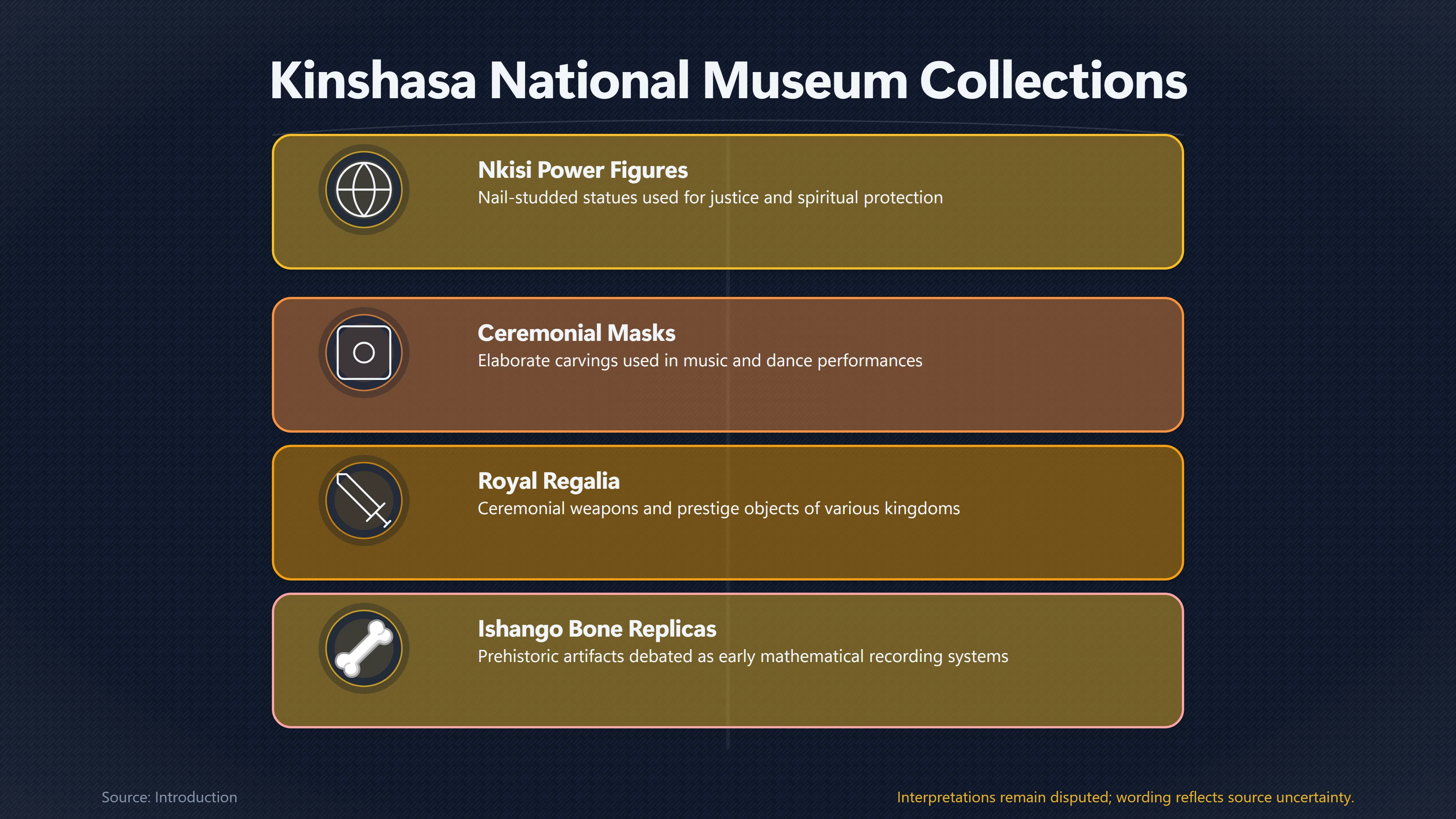
- Nail-studded nkisi power figures once used in systems of justice, healing and spiritual protection rather than as simple “fetish” objects.
- Elaborate masks employed during initiation ceremonies, where carving formed only one part of performances involving costume, music and dance.
- Royal regalia, ceremonial weapons and prestige objects illustrating political authority across different kingdoms.
- Archaeological finds including replicas and interpretation of the famous Ishango Bone, a prehistoric artefact discovered near Lake Edward whose engraved notches have generated long-running debate over whether they represent one of humanity’s earliest mathematical recording systems.[imnc.cd]imnc.cdMusées Nationaux du Congo Musée National de la RDC | IMNCMusées Nationaux du CongoMusée National de la RDC | IMNC…
What makes these collections unusual is not supernatural mystery but context. Many objects entered museums during the colonial period after being removed from living religious or political traditions. Modern interpretation increasingly explains their original social functions instead of repeating older colonial descriptions that portrayed them simply as instruments of “magic”. This shift makes the museum especially valuable for readers interested in the intersection of folklore, belief, archaeology and museum history.[IMNC - Musées Nationaux du Congo]imnc.cdMusées Nationaux du Congo IMNCMusées Nationaux du CongoIMNC - Institut des Musées Nationaux du Congo…
Bukavu’s hidden missionary museum
Bukavu’s small Kivu Museum, maintained within the Catholic Xaverian missionary complex, is one of Congo’s least-publicised but most distinctive collections. It lacks the scale of the national museums but compensates with an intimate mixture of ethnographic material gathered over decades by missionaries working in eastern Congo.[Wikipedia]WikipediaList of museums in the Democratic Republic of the CongoList of museums in the Democratic Republic of the Congo
Visitors may encounter ritual carvings, traditional household objects, musical instruments, ceremonial artefacts and historical material documenting the region’s many communities. Because the museum developed through missionary collecting rather than a modern national acquisition programme, its displays also illustrate changing attitudes towards indigenous belief systems. Objects once interpreted primarily through a missionary lens are increasingly appreciated as evidence of sophisticated local cultures and religious traditions rather than exotic curiosities.
Documentation on the museum remains relatively sparse compared with Kinshasa’s national institution, and opening arrangements have varied over time. That limited visibility is itself part of the museum’s appeal: it represents a surviving example of the small missionary collections that preserved local material culture long before purpose-built national museums expanded across the country.[Wikipedia]WikipediaList of museums in the Democratic Republic of the CongoList of museums in the Democratic Republic of the Congo
Lubumbashi’s archaeology and insects
Lubumbashi offers perhaps the most unexpected combination of collections in the country. Founded in 1946 from archaeological excavations, the National Museum of Lubumbashi gradually expanded into archaeology, ethnography and entomology, producing an unusual blend of human history and natural science under one roof.[biennaledelubumbashi.com]biennaledelubumbashi.comBiennale de Lubumbashi: National Museum of LubumbashiBiennale de Lubumbashi: National Museum of Lubumbashi
Its archaeological collections explore Katanga’s long human occupation through ceramics, metalworking and excavated artefacts, while the ethnographic galleries display regional ritual and domestic objects. Less expected is the museum’s substantial insect collection, reflecting the scientific interests of its founders and later researchers. This combination gives visitors an experience quite unlike most ethnographic museums, connecting human cultures with the extraordinary biodiversity of southern Congo.[biennaledelubumbashi.com]biennaledelubumbashi.comBiennale de Lubumbashi: National Museum of LubumbashiBiennale de Lubumbashi: National Museum of Lubumbashi
The museum has also experienced periods of decline followed by restoration and renewed activity. Renovation projects and collaborations with international museum partners have helped preserve collections that might otherwise have deteriorated, while contemporary exhibitions now sit alongside historic displays. Rather than replacing the older collections, these newer exhibitions encourage visitors to consider how colonial archaeology, scientific collecting and modern Congolese identity intersect within the same institution.[biennaledelubumbashi.com]biennaledelubumbashi.comBiennale de Lubumbashi: National Museum of LubumbashiBiennale de Lubumbashi: National Museum of Lubumbashi
Why these collections matter
Congolese museums stand apart because their most unusual objects were rarely created to be strange. Masks, power figures, ritual medicines, ceremonial staffs and archaeological finds originally belonged to functioning systems of governance, spirituality, education and healing. Their apparent mystery often arises from the distance between their original cultural role and the way they were historically displayed in museums.
For modern visitors, the greatest fascination lies in recovering those original meanings. A nail-covered power figure becomes evidence of conflict resolution and oath-taking rather than simply an object of fear. A ceremonial mask represents performance and community identity rather than decorative sculpture. Even prehistoric discoveries such as the Ishango Bone raise questions about the origins of mathematics, scientific thought and symbolic recording in Central Africa.
Unlike countries with commercial museums devoted to the bizarre or paranormal, Congo’s unusual collections reward careful interpretation. Their significance comes from the stories they preserve about belief, authority, archaeology and scientific curiosity, making them among the most intellectually engaging museum experiences in the region.[IMNC - Musées Nationaux du Congo]imnc.cdMusées Nationaux du Congo IMNCMusées Nationaux du CongoIMNC - Institut des Musées Nationaux du Congo…

Amazon book picks
Further Reading
Books and field guides related to Which Congo Museums Hold the Strangest Collections?. Use these as the next step if you want deeper reading beyond the article.
The Scramble For Africa
In 1880 the continent of Africa was largely unexplored by Europeans. Less than thirty years later, only Liberia and Ethiopia remained unc...
Things Fall Apart
First published in 1958, this novel tells the story of Okonkwo, the leader of an Igbo (Ibo) community who is banished for accidentally ki...
eBay marketplace picks
Marketplace Samples
Live-tested eBay searches with available results related to this page.
Selected fromethnographic poster oneBay.co.uk.
Current eBay listing
Vintage Ethnographic Figure wall art poster Historical Portrait
Current eBay listing
Vintage Ethnographic Exhibition 1895 Wall Art Poster Premium Quality
Endnotes
1.
Source: imnc.cd
Title: Musées Nationaux du Congo IMNC
Link:https://imnc.cd/
Source snippet
Musées Nationaux du CongoIMNC - Institut des Musées Nationaux du Congo...
2.
Source: imnc.cd
Title: Musées Nationaux du Congo Musée National de la RDC | IMNC
Link:https://imnc.cd/mnrdc
Source snippet
Musées Nationaux du CongoMusée National de la RDC | IMNC...
3.
Source: arxiv.org
Link:https://arxiv.org/abs/1204.1019
Source snippet
Does the Ishango Bone Indicate Knowledge of the Base 12? An Interpretation of a Prehistoric Discovery, the First Mathematical Tool o...
4.
Source: Wikipedia
Title: List of museums in the Democratic Republic of the Congo
Link:https://en.wikipedia.org/wiki/List_of_museums_in_the_Democratic_Republic_of_the_Congo
5.
Source: biennaledelubumbashi.com
Title: Biennale de Lubumbashi: National Museum of Lubumbashi
Link:https://biennaledelubumbashi.com/en/venues/national-museum-of-lubumbashi/
6.
Source: Wikipedia
Title: National Museum of Lubumbashi
Link:https://en.wikipedia.org/wiki/National_Museum_of_Lubumbashi
7.
Source: amnh.org
Link:https://www.amnh.org/research/research-library/virtual-resources/congo
Source snippet
Expedition 1909-1915 | American Museum of Natural HistoryAMERICAN MUSEUM CONGO EXPEDITION (1909-1915) More in Gottesman Research Library...
Additional References
8.
Source: journals.uhk.cz
Link:https://journals.uhk.cz/modernafrica/article/view/192
Source snippet
Historical and Cultural Identities with Exhibitions of the New National Museum in the Democratic Republic of Congo | Modern Africa: Polit...
9.
Source: nhm.ac.uk
Link:https://www.nhm.ac.uk/our-science/services/collections/entomology.html
10.
Source: ista-kin.org
Title: L’Institut des Musées Nationaux du Congo
Link:https://ista-kin.org/ista-kin/ista/index.php/departments/institut-des-musees-nationaux-du-congo/index.html
Source snippet
Boulevard du 30 juin n°154, BP 3164 et 3131 Kinshasa/Gombe. * * info@culture.gouv.cd L’INSTITUT DES MUSÉES NATIONAUX DU CONGO - MINISTÈRE...
11.
Source: youtube.com
Link:https://www.youtube.com/watch?v=xWn-ullFguE
Source snippet
Great Maths Stories for Curious Minds: Story of the Ishango Bone...
12.
Source: youtube.com
Title: Great Maths Stories for Curious Minds: Story of the Ishango Bone
Link:https://www.youtube.com/watch?v=dFY_j8Jbjgg
Source snippet
The Ishango Bone: Proof That Africans Invented Mathematics...
13.
Source: congovirtuel.com
Link:https://www.congovirtuel.com/page_rapport_travaux/page_memoire_kingana.php
14.
Source: youtube.com
Title: NATIONAL MUSEUM OF DRC
Link:https://www.youtube.com/watch?v=emtta3Pu5d8
Source snippet
One of the most beautiful museums in Africa? My opinion! National Museum of the DR Congo...
15.
Source: africamuseum.be
Title: Collections, archives and libraries | Royal Museum for Central Africa
Link:https://www.africamuseum.be/research/collections_libraries
16.
Source: youtube.com
Title: The Ishango Bone: Proof That Africans Invented Mathematics
Link:https://www.youtube.com/watch?v=9GQasag5ZQs
Source snippet
Power Figure: Male (Nkisi)...
17.
Source: afrikamuseum.be
Title: Collections Management | Royal Museum for Central Africa
Link:https://www.afrikamuseum.be/en/research/discover/collections_management