What Makes Guinea's Collections So Unusual?
Guinea does not have a well-documented circuit of witchcraft museums, cryptid exhibits or commercial cabinets of curiosities. Its unusual-collection landscape is smaller, less formal and more culturally sensitive.
Page outline Jump by section
Introduction
The National Museum of Sandervalia in Conakry is the main institutional anchor, although its displays and visitor conditions have varied and a major redevelopment was announced in 2026. Beyond the capital, small regional collections are patchily documented. Many of Guinea’s most remarkable objects are now better catalogued in museums abroad than in publicly searchable Guinean collections. That imbalance is itself central to the story: Guinea’s curiosity culture is partly about what survives locally, partly about what was destroyed or dispersed, and partly about how ritual things have been turned into art objects, national symbols and collectors’ pieces.[ambaguinee.org]de.ambaguinee.orgAmbassade de GuinéeGuinée: la Journée internationale des musées célébrée au…18 May 2026 — Conakry a abrité, ce lundi 18 mai 2026, la…

The national museum: Guinea’s main cabinet of culture
The National Museum of Sandervalia, usually called the National Museum of Guinea, occupies a site in the Kaloum district of Conakry. Founded around the beginning of the post-independence period, it was intended to preserve examples of the country’s traditional arts, regional cultures, archaeology and national history. Descriptions of its holdings commonly mention masks, carved figures, musical instruments, textiles, ritual objects and material from the colonial period.[tripadvisor.com]tripadvisor.comNational Museum (Musée NationalNational Museum (Musée National) - All You SHOULD…Located in the republic's capital, this museum contains a nice cross-sect…
For a reader looking for Guinea’s strangest museum material, the attraction is not a chamber of horror but the encounter between sacred objects and museum display. A mask that once appeared in an initiation, agricultural ceremony or protective rite becomes a stationary object behind glass. Labels may identify its people of origin and physical form, but they cannot reproduce the music, movement, controlled access or religious authority that originally gave it meaning.
The museum’s condition has long been difficult to describe confidently. Older accounts reported sparse rooms, missing early holdings and a strong craft-sales element. More recent evidence shows that the institution remains active: Guinea marked International Museum Day there in May 2026 with exhibitions and cultural events. The government also announced a €16 million renovation and expansion covering roughly 8,000 square metres, with redesigned galleries, temporary exhibitions and improved museum facilities. Visitors should therefore treat older reviews and photographs cautiously and verify what is accessible before travelling.[wikipedia.org]WikipediaSandervalia National MuseumSandervalia National Museum
The redevelopment matters beyond ordinary building improvement. Guinea has often lacked the conservation space, research infrastructure and public interpretation needed to explain difficult objects properly. A modernised national museum could distinguish more clearly between archaeological evidence, living religious traditions, colonial collecting, state folklore programmes and contemporary tourist art.
Giant masks that became national symbols
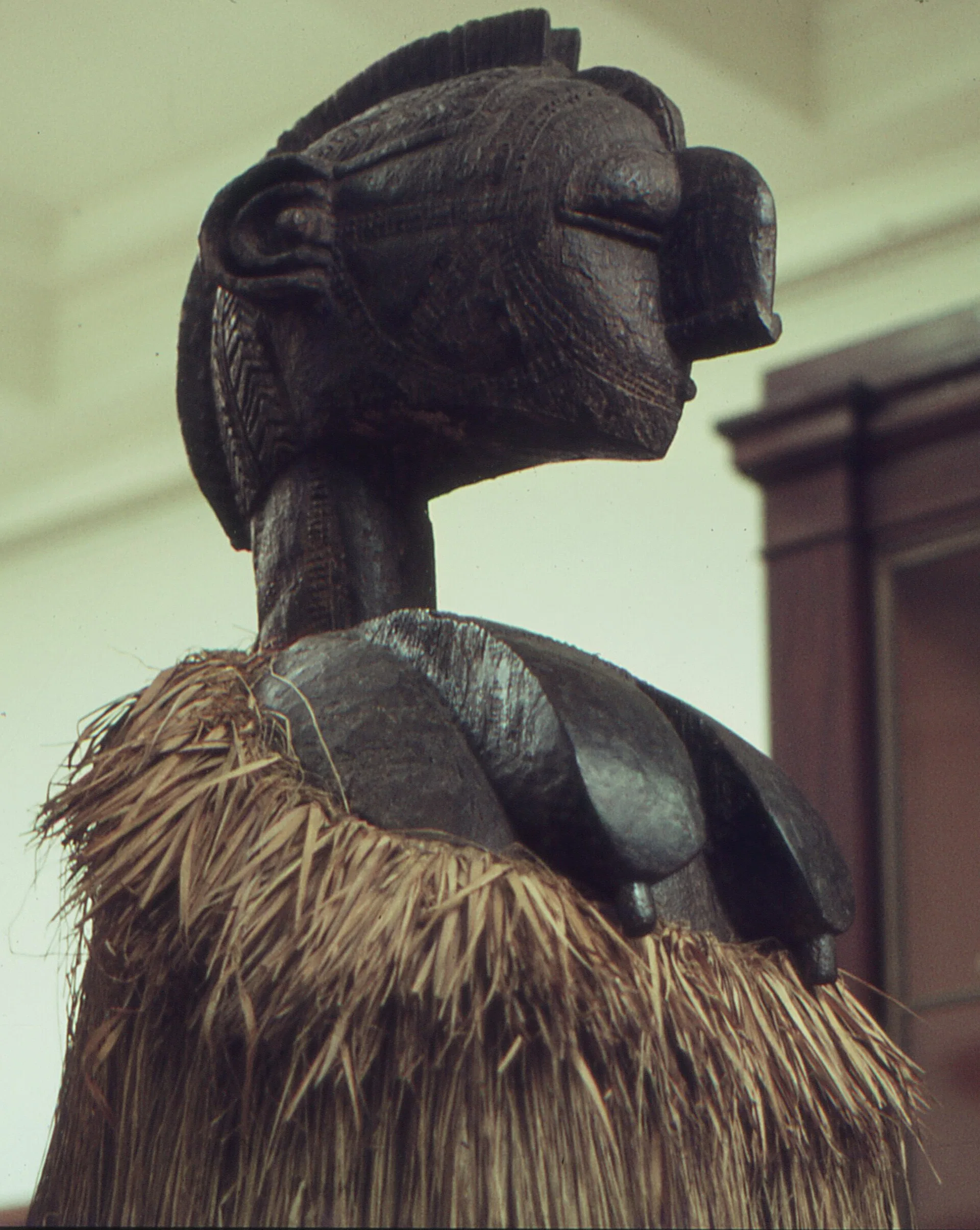
The most visually extraordinary objects associated with Guinea are the monumental shoulder masks made by Baga communities of the coastal region. The best-known form represents a powerful female figure with an enlarged head, sharply projecting nose, elaborate hairstyle and pendulous breasts. Rather than covering only the face, the carved structure rests on the dancer’s shoulders and is concealed by costume and fibre. One example in the British Museum weighs about 80 pounds, or more than 36 kilograms, and has a supporting structure that could help the performer manage its weight.[British Museum]britishmuseum.orgOpen source on britishmuseum.org.
These masks are often explained as images connected with fertility, agricultural prosperity, motherhood and social continuity. A version presented to the United Nations is described as representing a protective mother figure associated with pregnant women and farming ceremonies. The image has also become a widely recognised emblem of Guinea, appearing outside its original ritual setting as a symbol of national culture.[United Nations]un.orgOpen source on un.org.
That familiar interpretation is useful but incomplete. Museum catalogues have not always used the same names, and meanings could vary between communities, periods and ceremonial contexts. Earlier European labels often reduced complex objects to “fetishes” or treated them as timeless tribal art. Current museum interpretation is more likely to discuss performance, gender, initiation, rice agriculture and the effects of religious and political change.
Other coastal masks are stranger still. A Nalu mask in the Metropolitan Museum of Art combines human and animal features into a composite being rather than representing an ordinary face. Such masks challenge the modern assumption that a museum object should have one fixed identity. In performance, ambiguity could be part of its force: an image might embody danger, authority and several categories of creature at once.[The Metropolitan Museum of Art]metmuseum.orgThe Metropolitan Museum of Art Nalu artistThe Metropolitan Museum of Art Nalu artist
Guinea’s twentieth-century history also shaped what survived. Research on religious memory describes campaigns in which ritual authorities were denounced and masks, altars and medicinal objects were burned, surrendered or sold. The state simultaneously promoted selected forms of traditional culture as folklore and national performance. The result was not simple preservation or destruction, but a sorting process: some practices were suppressed, while visually impressive forms could be detached from religious control and recast as art, dance or national heritage.[ulisboa.pt]ics.ulisboa.ptOpen source on ulisboa.pt.
This makes the masks unusually important museum objects. They are not merely beautiful carvings. They record the uneasy movement from restricted ceremony to government collection, international art market and national branding.
The figures found beneath fields
Eastern Guinea is linked to one of West Africa’s most compelling archaeological mysteries: small stone figures discovered accidentally in farmland, streams, wells and mining areas. Among Kissi communities, examples are often known as figures of “the deceased”. Related sculptures found across Guinea, Sierra Leone and Liberia have been grouped by museums under regional names, although the boundaries between styles and traditions are not always certain.[si.edu]africa.si.eduOpen source on si.edu.
The figures usually have enlarged heads, emphatic facial features and compact bodies. Some show clothing, ornaments or gestures. They were not generally understood to have been carved by the communities who later found them. Because many were unearthed during farming or mining rather than controlled archaeological excavation, their original dates, makers and uses are difficult to reconstruct. The Metropolitan Museum notes that they were often separated from their archaeological context long before scholars examined them.[The Metropolitan Museum of Art]metmuseum.orgnomoli pomdo stone figuresnomoli pomdo stone figures
That uncertainty encouraged new layers of belief. Found objects could be interpreted as ancestral beings, spirits or powerful remains from an earlier population. Their meaning therefore has at least two histories: the unknown society that carved them, and the later communities that discovered, named and incorporated them into local understandings of the landscape.
This is exactly the kind of material that can be mishandled by an “ancient mystery” approach. There is no need to invent a vanished supernatural civilisation. The genuine puzzle is stronger: recognisably deliberate sculptures were created by people whose identity and historical setting remain incompletely known, then rediscovered by later societies that gave them new ritual lives.
For visitors, the difficulty is access. International museums hold well-catalogued examples, but reliable information about permanent public displays inside Guinea is limited. Some specialist tours mention a local collection in Kissidougou, yet public opening details and inventories are not consistently available. It is safer to regard such regional displays as potentially visitable rather than guaranteed attractions.[Native Eye Travel]nativeeyetravel.comOpen source on nativeeyetravel.com.
Iron money that looks nothing like a coin
Another memorable Guinean curiosity is the Kissi penny, a form of iron currency used in parts of present-day Guinea, Sierra Leone and Liberia. Despite the English nickname, it is not a small round coin. Surviving examples are elongated forged iron rods, often with twisted shafts and shaped ends. Museums classify them as alternative currency and associate them with the Kissi and neighbouring peoples.[si.edu]americanhistory.si.eduOpen source on si.edu.
Their unusual appearance reveals that money does not have to resemble modern coins or banknotes. Value can depend on recognised material, standardised form and community acceptance rather than an official portrait or stamped denomination. Iron also had practical and symbolic significance in societies where blacksmithing was a specialised skill.
Large museum collections abroad preserve numerous examples, including the Smithsonian’s National Numismatic Collection and the British Museum. However, those institutions warn, directly or indirectly, against assuming that every object in an online catalogue is on public display. The Smithsonian notes that only a fraction of its vast holdings can be exhibited at any one time, while individual British Museum records may mark objects as not on display.[si.edu]americanhistory.si.eduOpen source on si.edu.
In Guinea, Kissi pennies would make ideal objects for a well-designed regional museum. They connect metallurgy, trade, social relations and cross-border history in one immediately puzzling form. They also provide a useful contrast with ritual objects: their strangeness comes not from secrecy or supernatural belief, but from the distance between one culture’s idea of money and another’s.
Small museums and regional collections
Guinea’s regional museum network is less visible online than the national museum. One of the better-known small institutions is the Petit Musée du Fouta Djallon, associated with the highland region and its Fula heritage. Travel descriptions present it as a modest collection in which objects are arranged in small tableaux illustrating regional life and culture. It is closer to a community ethnographic display than to a fully documented national institution.[Lonely Planet]lonelyplanet.comOpen source on lonelyplanet.com.
Such museums can be valuable precisely because they preserve ordinary things that larger art museums ignore: domestic tools, clothing, manuscripts, craft equipment, musical objects and reconstructed interiors. Their displays may not meet international conservation or labelling standards, yet they can retain local connections that are lost when a ceremonial object is isolated in a foreign gallery.
The weakness is practical reliability. Opening hours, curatorial responsibility, photography rules and collection descriptions may be unavailable or outdated. Guinea’s government acknowledged this wider institutional gap in 2026 when it discussed modernising Sandervalia and developing additional museums outside the capital. That suggests regional museum provision remains a work in progress rather than a settled tourist network.[Guinee360]guinee360.comPatrimoine national guinéen: vers la mise en place de…18 May 2026 — Au cœur de cette stratégie figure la réhabilitation et l…
Readers should also distinguish between a museum and a staged cultural encounter. Tour operators may advertise mask performances, initiation-related traditions or visits to communities with sacred objects. These can be culturally significant, but they are not necessarily permanent public collections. Access may depend on local permission, seasonal ceremonies and community rules, and some knowledge is not intended for unrestricted tourist consumption.
Camp Boiro and the museum that has not been built
Guinea’s most disturbing potential museum site is Camp Boiro in Conakry, a former detention centre associated with political repression under the government of Ahmed Sékou Touré. Victims’ organisations have campaigned to preserve its memory, but the site has not developed into a conventional public museum with stable exhibitions and interpretation.
The International Centre for the Promotion of Human Rights, a UNESCO-category institution, records annual commemorations connected with the executions of January 1971. It also states that attempts to install a plaque or establish a memorial within the former camp had repeatedly failed. This makes Camp Boiro a place of contested memory rather than a functioning prison museum.[CIPDH]cipdh.gob.arCIPDHAnniversary of the hangings on the night of 25 JanuaryCIPDHAnniversary of the hangings on the night of 25 January
That distinction is essential. Online memorial projects contain testimonies, documents, names and historical material, but they do not prove the existence of an accessible physical exhibition. The Association of Victims of Camp Boiro maintains a digital memory presence and organises commemorative activity, yet visitors should not expect the type of curated cells, preserved personal effects and guided interpretation found at established prison museums elsewhere.[camp-boiro.org]camp-boiro.orgCamp BoiroCamp Boiro
Camp Boiro nevertheless belongs in Guinea’s landscape of unusual collections because absence is part of its meaning. The dispute concerns what should be preserved, whose testimony should be authoritative and how a state should display violence committed in the name of revolution and national security. A future museum would not merely collect prison relics. It would have to negotiate unresolved arguments about guilt, victimhood, independence and political legitimacy.
Why Guinea’s strangest objects are often abroad
Anyone researching Guinean masks, stone figures or ritual sculpture quickly encounters a striking fact: some of the clearest catalogues are maintained by institutions in London, New York, Washington, Jerusalem and other cities outside Guinea. The British Museum, Metropolitan Museum of Art and Smithsonian provide detailed records for Guinean objects, including dimensions, acquisition histories, cultural attributions and earlier scholarly interpretations.[britishmuseum.org]britishmuseum.orgOpen source on britishmuseum.org.
This dispersal has several causes. Objects entered collections through colonial administration, ethnographic expeditions, missionaries, dealers, private collectors and later art-market sales. Political campaigns against local religious practices also pushed some material into trade. Precise circumstances vary by object, and a catalogue entry should not be treated as proof of either legitimate purchase or illicit removal without further provenance research.
Foreign museums can preserve fragile material and make catalogues widely accessible, but they also alter interpretation. A restricted ceremonial object becomes “African art”; an unearthed figure becomes an archaeological enigma; iron currency becomes an ethnographic curiosity. Labels may preserve valuable information while flattening local disagreement or uncertainty.
Guinea’s planned museum investment therefore has an unusual opportunity. A stronger national and regional network could do more than request the return of famous masterpieces. It could document living knowledge, record local names and competing interpretations, investigate how objects left the country and create displays in which ritual authority, archaeological uncertainty and colonial provenance are visible rather than concealed.
What visitors can realistically expect
Guinea rewards travellers interested in strange heritage, but not in the form of a polished oddity trail. The most dependable institutional focus is Sandervalia in Conakry, whose redevelopment may affect access and displays. Small regional museums can offer worthwhile encounters, although current information may be difficult to verify. Sacred masks and community traditions should be approached as living culture, not as entertainment available on demand.
The country’s most distinctive curiosity themes are:
- monumental shoulder masks that combine performance, fertility symbolism and national identity;
- composite human-animal masks whose meanings cannot be reduced to decoration;
- ancient stone figures found by later farmers and reinterpreted as ancestral or spiritual beings;
- long iron currencies that undermine familiar ideas of what money should look like;
- sparse regional collections preserving local material culture;
- and an unresolved struggle to turn sites of political repression into public memory.
Guinea’s unusual heritage is therefore less about sensational exhibits than about objects crossing boundaries: from earth to shrine, ceremony to stage, prison to memorial campaign, village to art market and sacred presence to museum label. That movement is what makes the country’s collections both fascinating and difficult to interpret honestly.
Amazon book picks
Further Reading
Books and field guides related to What Makes Guinea's Collections So Unusual?. Use these as the next step if you want deeper reading beyond the article.
The Predicament of Culture: Twentieth-Century Ethnography, Li...
The Predicament of Culture is a critical ethnography of the West in its changing relations with other societies. Analyzing cultural pract...
Museums and the Interpretation of Visual Culture
This is a multi-disciplinary study that adopts an innovative and original approach to a highly topical question, that of meaning-making i...
eBay marketplace picks
Marketplace Samples
Live-tested eBay searches with available results related to this page.
Selected fromAfrican mask decor oneBay.co.uk.

Endnotes
1.
Source: guinee360.com
Link:https://www.guinee360.com/18/05/2026/patrimoine-national-guineen-vers-la-mise-en-place-de-nouveaux-musees-a-linterieur-du-pays/
Source snippet
Patrimoine national guinéen: vers la mise en place de...18 May 2026 — Au cœur de cette stratégie figure la réhabilitation et l...
Published: May 2026
2.
Source: tripadvisor.com
Title: National Museum (Musée National)
Link:https://www.tripadvisor.com/Attraction_Review-g293799-d480693-Reviews-National_Museum_Musee_National-Conakry_Conakry_Region.html
Source snippet
National Museum (Musée National) - All You SHOULD...Located in the republic's capital, this museum contains a nice cross-sect...
3.
Source: gpsmycity.com
Link:https://www.gpsmycity.com/attractions/musee-national-de-guinee-%28national-museum-of-guinea%29-46217.html
Source snippet
Musee National de Guinee (National Museum of Guinea)...It contains displays of the ethnography and prehistory of Guinea, and h...
4.
Source: Wikipedia
Title: Sandervalia National Museum
Link:https://en.wikipedia.org/wiki/Sandervalia_National_Museum
5.
Source: findtourguide.com
Title: sandervalia national museum 4338
Link:https://www.findtourguide.com/destinations/guinea/conakry-3071/sandervalia-national-museum-4338
6.
Source: gnakrylive.com
Link:https://www.gnakrylive.com/actualite/guineenne/73-culture/17924-patrimoine-16-millions-deuros-pour-lextension-et-la-renovation-du-musee-national
7.
Source: jstor.org
Link:https://www.jstor.org/stable/3805349
8.
Source: cipdh.gob.ar
Title: CIPDHAnniversary of the hangings on the night of 25 January
Link:https://www.cipdh.gob.ar/memorias-situadas/en/lugar-de-memoria/dia-de-los-ahorcamientos/
9.
Source: camp-boiro.org
Title: Camp Boiro
Link:https://www.camp-boiro.org/
10.
Source: campboiromemorial.org
Link:https://campboiromemorial.org/index.htm
11.
Source: camp-boiro.org
Title: Camp Boiro
Link:https://www.camp-boiro.org/association
12.
Source: whc.unesco.org
Link:https://whc.unesco.org/en/list/1746/
14.
Source: whc.unesco.org
Link:https://whc.unesco.org/en/tentativelists/6818/
15.
Source: whc.unesco.org
Link:https://whc.unesco.org/en/tentativelists/1521/
16.
Source: ich.unesco.org
Title: guinea GN
Link:https://ich.unesco.org/en/state/guinea-GN
17.
Source: ich.unesco.org
Title: guinea GN
Link:https://ich.unesco.org/en/state/guinea-GN?info=periodic-reporting
18.
Source: whc.unesco.org
Link:https://whc.unesco.org/en/statesparties/gn/
19.
Source: unesco.org
Link:https://www.unesco.org/en/countries/gn
20.
Source: whc.unesco.org
Link:https://whc.unesco.org/en/statesparties/gn/assistance/
21.
Source: whc.unesco.org
Link:https://whc.unesco.org/en/statesparties/gn/documents
22.
Source: unesco.org
Title: La nouvelle politique culturelle de la République de Guinée
Link:https://www.unesco.org/creativity/en/policy-monitoring-platform/la-nouvelle-politique-culturelle-de-la-republique-de-guinee
23.
Source: ich.unesco.org
Title: guinea GN
Link:https://ich.unesco.org/en/state/guinea-GN?cp=GN&info=contacts&topic=en-state
24.
Source: whc.unesco.org
Link:https://whc.unesco.org/en/list/155/
25.
Source: gpsmycity.com
Title: camp boiro 46469
Link:https://www.gpsmycity.com/attractions/camp-boiro-46469.html
26.
Source: campboiromemorial.org
Link:https://www.campboiromemorial.org/Pages/publications.html
27.
Source: campboiromemorial.org
Link:https://www.campboiromemorial.org/sitemap.htm
28.
Source: camp-boiro.org
Title: Camp Boiro
Link:https://www.camp-boiro.org/home-links
29.
Source: camp-boiro.org
Link:https://www.camp-boiro.org/white-books
30.
Source: camp-boiro.org
Link:https://www.camp-boiro.org/camps-detention
31.
Source: jstor.org
Link:https://www.jstor.org/stable/4104379
32.
Source: Wikipedia
Title: Ahmed Sékou Touré
Link:https://en.wikipedia.org/wiki/Ahmed_S%C3%A9kou_Tour%C3%A9
33.
Source: de.ambaguinee.org
Link:https://de.ambaguinee.org/?p=122954
Source snippet
Ambassade de GuinéeGuinée: la Journée internationale des musées célébrée au...18 May 2026 — Conakry a abrité, ce lundi 18 mai 2026, la...
Published: May 2026
34.
Source: visionguinee.info
Link:https://www.visionguinee.info/la-guinee-accelere-la-recherche-sur-ses-collections-et-la-modernisation-de-son-patrimoine/
Source snippet
Vision GuineeLa Guinée accélère la recherche sur ses collections et la...20 May 2026 — C'est au cœur de Kaloum, au Musée national de San...
Published: May 2026
35.
Source: britishmuseum.org
Link:https://www.britishmuseum.org/collection/object/E_Af1957-07-1-a-b
36.
Source: africa.si.edu
Link:https://africa.si.edu/collection/object/nmafa
37.
Source: un.org
Link:https://www.un.org/ungifts/nimba
38.
Source: metmuseum.org
Title: The Metropolitan Museum of Art Nalu artist
Link:https://www.metmuseum.org/art/collection/search/310750
39.
Source: ics.ulisboa.pt
Link:https://www.ics.ulisboa.pt/file/4693/download?token=UVKbSHOc
40.
Source: africa.si.edu
Link:https://africa.si.edu/collection/selected-artwork/2173
41.
Source: metmuseum.org
Title: nomoli pomdo stone figures
Link:https://www.metmuseum.org/essays/nomoli-pomdo-stone-figures
42.
Source: britishmuseum.org
Link:https://www.britishmuseum.org/collection/object/E_Af1970
43.
Source: nativeeyetravel.com
Link:https://nativeeyetravel.com/itineraries/the-fouta-djalon-beyond/
44.
Source: americanhistory.si.edu
Link:https://americanhistory.si.edu/collections/object/nmah_1255509
45.
Source: britishmuseum.org
Link:https://www.britishmuseum.org/collection/object/E_Af1954
46.
Source: si.edu
Link:https://www.si.edu/object/kissi-penny%3Anmah_1067029
47.
Source: britishmuseum.org
Link:https://www.britishmuseum.org/collection/object/E_Af1961
48.
Source: lonelyplanet.com
Link:https://www.lonelyplanet.com/points-of-interest/petit-musee-du-fouta-djallon/1555361
49.
Source: metmuseum.org
Title: The Metropolitan Museum of Art Timba
Link:https://www.metmuseum.org/art/collection/search/503620
50.
Source: britishmuseum.org
Link:https://www.britishmuseum.org/collection/object/E_Af1922-4
51.
Source: britishmuseum.org
Link:https://www.britishmuseum.org/collection/object/E_Af1948-26-1?selectedImageId=448316001
52.
Source: britishmuseum.org
Link:https://www.britishmuseum.org/collection/object/E_Af1970
53.
Source: americanhistory.si.edu
Title: nmah 1067030
Link:https://americanhistory.si.edu/collections/object/nmah_1067030
54.
Source: americanhistory.si.edu
Title: nmah 1003771
Link:https://americanhistory.si.edu/collections/object/nmah_1003771
55.
Source: americanhistory.si.edu
Title: nmah 1067026
Link:https://americanhistory.si.edu/collections/object/nmah_1067026
56.
Source: americanhistory.si.edu
Title: nmah 1067016
Link:https://americanhistory.si.edu/collections/object/nmah_1067016
57.
Source: americanhistory.si.edu
Title: nmah 1067027
Link:https://americanhistory.si.edu/collections/object/nmah_1067027
58.
Source: americanhistory.si.edu
Title: money and medals
Link:https://www.americanhistory.si.edu/explore/topics/money-and-medals
59.
Source: americanhistory.si.edu
Title: nmah 1067021
Link:https://americanhistory.si.edu/collections/object/nmah_1067021
60.
Source: africa.si.edu
Link:https://africa.si.edu/collection/object/nmafa
61.
Source: africa.si.edu
Link:https://africa.si.edu/collection/object/nmafa
62.
Source: si.edu
Link:https://www.si.edu/object/figure%3Anmafa
63.
Source: si.edu
Title: male figure:nmafa 2005 6 55
Link:https://www.si.edu/object/male-figure%3Anmafa
64.
Source: africa.si.edu
Title: selected artwork
Link:https://africa.si.edu/collection/selected-artwork/1167
65.
Source: si.edu
Title: cap mask:nmafa 99 20 1
Link:https://www.si.edu/object/cap-mask%3Anmafa
66.
Source: si.edu
Title: shoulder mask:nmafa 79 16 22
Link:https://www.si.edu/object/shoulder-mask%3Anmafa
67.
Source: africa.si.edu
Link:https://africa.si.edu/collection/object/nmafa
68.
Source: africa.si.edu
Link:https://africa.si.edu/collection/object/nmafa
69.
Source: si.edu
Link:https://www.si.edu/object/siris_sil_555501
70.
Source: si.edu
Title: female figure:nmafa 78 14 4
Link:https://www.si.edu/object/female-figure%3Anmafa
71.
Source: si.edu
Title: shrine figure:nmafa 79 16 23
Link:https://www.si.edu/object/shrine-figure%3Anmafa
72.
Source: tripadvisor.co.uk
Title: MORBITORIU M
Link:https://www.tripadvisor.co.uk/Attraction_Review-g186459-d21379868-Reviews-Morbitorium-Caerphilly_Caerphilly_County_South_Wales_Wales.html
73.
Source: tripadvisor.co.uk
Title: National Museum (Musée National)
Link:https://www.tripadvisor.co.uk/Attraction_Review-g293799-d480693-Reviews-National_Museum_Musee_National-Conakry_Conakry_Region.html
74.
Source: metmuseum.org
Title: Mask (Baba Tagwa)
Link:https://www.metmuseum.org/art/collection/search/313783
75.
Source: metmuseum.org
Title: Baga artist
Link:https://www.metmuseum.org/art/collection/search/312338
76.
Source: metmuseum.org
Title: Baga artist
Link:https://www.metmuseum.org/art/collection/search/310744
77.
Source: metmuseum.org
Title: Bamana numu or Senufo blacksmith
Link:https://www.metmuseum.org/art/collection/search/312339
78.
Source: metmuseum.org
Title: Bassa artist
Link:https://www.metmuseum.org/art/collection/search/314063
79.
Source: metmuseum.org
Title: Baga artist
Link:https://www.metmuseum.org/it/art/collection/search/312189
80.
Source: metmuseum.org
Title: Headdress: Female Bust with Horns (D’mba-da-Tshol?)
Link:https://www.metmuseum.org/art/collection/search/312278
81.
Source: metmuseum.org
Title: Mask (Baba [?])
Link:https://www.metmuseum.org/en/art/collection/search/311301
82.
Source: metmuseum.org
Title: Bamana numu or Senufo blacksmith
Link:https://www.metmuseum.org/toah/works-of-art/1978.412.426
83.
Source: metmuseum.org
Title: Baga artist
Link:https://www.metmuseum.org/de/art/collection/search/310781
84.
Source: metmuseum.org
Link:https://www.metmuseum.org/essays/soapstone-sculptures-esie
85.
Source: metmuseum.org
Title: Arts of Africa
Link:https://www.metmuseum.org/exhibitions/arts-of-africa/inside-the-exhibition
86.
Source: imj.org.il
Link:https://www.imj.org.il/en/content/nimba
87.
Source: forms.hungwetravel.com
Link:https://forms.hungwetravel.com/guinea
88.
Source: zyama.com
Link:https://www.zyama.com/Collection/pics%20A-C.htm
Additional References
89.
Source: rhguinee.com
Title: patrimoine 16 millions deuros pour transformer le musée national de guinée
Link:https://www.rhguinee.com/blog/2026/03/patrimoine–16-millions-deuros-pour-transformer-le-mus%C3%A9e-national-de-guin%C3%A9e
Source snippet
16 millions d'euros pour transformer le Musée national de...31 Mar 2026 — Patrimoine: 16 millions d'euros pour transformer le Musée nat...
90.
Source: youtube.com
Title: The challenge of a modern museum in Guinea: 3 questions for Amirou Conté
Link:https://www.youtube.com/watch?v=QNLdQGpHSf0
Source snippet
MEFB: €16 Million to Revive the National Museum of Guinea | A New Era for Culture...
91.
Source: youtube.com
Link:https://www.youtube.com/watch?v=Lq4108mC7UQ
Source snippet
The legendary Nimba mask of Guinea Conakry...
92.
Source: youtube.com
Title: Conakry, Guinea: This historical museum in Kaloum will surprise you!
Link:https://www.youtube.com/watch?v=iWn_t0WuXKk
Source snippet
National Museum: When history comes back to life in Conakry...
93.
Source: youtube.com
Title: National Museum: When history comes back to life in Conakry
Link:https://www.youtube.com/watch?v=13LJjArOVPc
Source snippet
The challenge of a modern museum in Guinea: 3 questions for Amirou Conté...
94.
Source: imj.org.il
Link:https://www.imj.org.il/sites/default/files/pdf/nimba-print-en.pdf
95.
Source: tepapa.govt.nz
Link:https://tepapa.govt.nz/digital-museum/explore-digital-museum/papua-new-guinea/ceremonial-masks-of-papua-new-guinea
96.
Source: africanistarchaeology.net
Link:https://www.africanistarchaeology.net/s/Oyinloye.pdf
97.
Source: evendo.com
Link:https://evendo.com/locations/guinea/faranah/attraction/national-museum-of-guinea
98.
Source: alamy.com
Link:https://www.alamy.com/figure-farmers-among-the-kissi-people-of-guinea-sometimes-find-stone-statues-in-their-fields-most-are-cylindrical-in-overall-outline-and-human-in-subject-they-are-not-made-by-the-kissi-and-are-described-by-them-as-pomdo-the-dead-or-images-of-the-dead-image353525292.html