Within Strange Latvia
Why Latvia's Medical Museums Feel So Unsettling
Latvia's anatomy, medicine and pharmacy collections turn preserved bodies, obsolete instruments and folk remedies into serious public history.
On this page
- Inside the RSU Anatomy Museum
- Medicine, pharmacy and folk healing
- Ethics, education and the limits of spectacle
Page outline Jump by section
Introduction
Latvia’s most unsettling museum experiences are not built around staged horror or sensational curiosities. Instead, they emerge from institutions created to teach doctors, preserve medical history and explain how real human bodies develop, become ill and die. In Riga, the combination of the RSU Anatomy Museum, the Pauls Stradiņš Medicine History Museum and the associated Pharmacy Museum offers an unusually direct encounter with anatomy, disease and the history of healing. These collections are academically grounded rather than theatrical, yet they often leave a stronger emotional impression than purpose-built “oddity museums” because nearly everything on display represents real people, real illnesses and genuine medical practice.[am.rsu.lv]am.rsu.lvAbout the museum | RSUAbout the museum | RSU
Rather than inviting visitors to marvel at the bizarre, these museums ask a more difficult question: what happens when the human body itself becomes a museum object? Their answer reflects Latvia’s distinctive approach to curiosity culture, where education, ethics and historical interpretation take precedence over spectacle.
Why Latvia’s Medical Museums Feel So Unsettling
The power of Latvia’s medical museums lies in the contrast between familiar surroundings and unfamiliar realities. Clean, carefully designed galleries contain preserved organs, skeletons, embryos, anatomical preparations and historical instruments that would normally be encountered only by surgeons, anatomists or medical students. Visitors are confronted not with fictional monsters but with the extraordinary variety—and fragility—of ordinary human biology.[am.rsu.lv]am.rsu.lvAbout the museum | RSUAbout the museum | RSU
Unlike nineteenth-century curiosity cabinets that often blurred science with entertainment, Riga’s major medical collections have educational origins. Most specimens were assembled during the 1920s and 1930s as teaching collections for higher medical education in Latvia. Their original purpose was practical: helping future doctors understand anatomy, pathology and congenital conditions through direct observation. Modern exhibitions preserve that educational mission while making the collections accessible to the general public.[RSU]science.rsu.lvAnatomy Museum: a historical collection with a contemporary approachRSU Anatomy Museum: a historical collection with a contemporary approach - RSUJanuary 1, 2021…
The result is an experience that can feel emotionally demanding precisely because nothing is exaggerated. Labels explain disease processes, developmental differences and medical history rather than inviting shock for its own sake.
Inside the RSU Anatomy Museum
The RSU Anatomy Museum is Latvia’s clearest example of a medical museum where the human body itself forms the central exhibit. Located within the historic Anatomical Theatre complex in Riga, it is built around the country’s earliest anatomy teaching collection, developed almost a century ago for university education before being reinterpreted as a public museum.[am.rsu.lv]am.rsu.lvAbout the museum | RSUAbout the museum | RSU
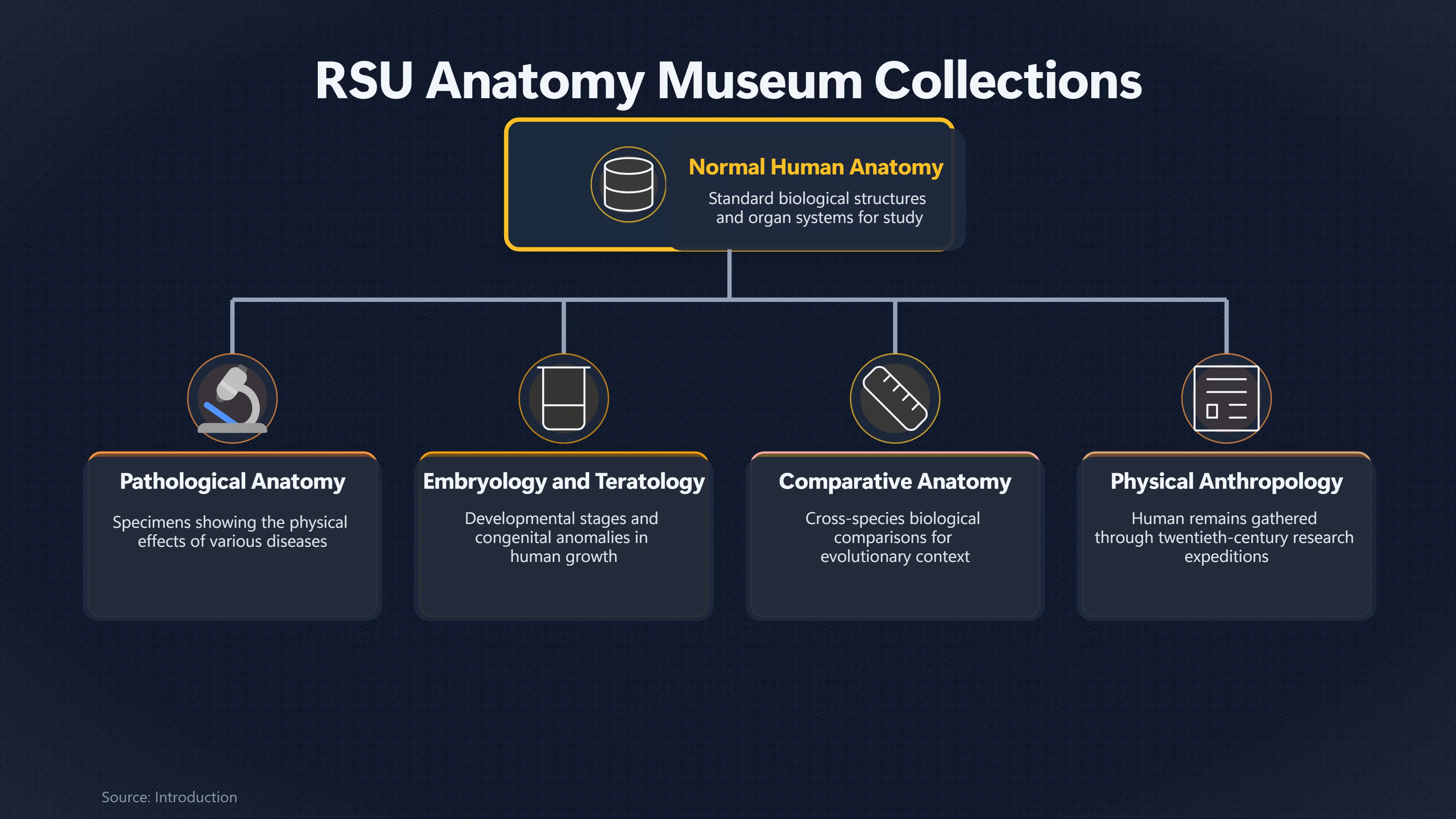
Its holdings include several thousand specimens covering:
- normal human anatomy;
- pathological anatomy showing the effects of disease;
- embryology;
- congenital anomalies (teratology);
- comparative anatomy;
- physical anthropology gathered through twentieth-century research expeditions.[am.rsu.lv]am.rsu.lvAbout the museum | RSUAbout the museum | RSU
One distinctive feature is the museum’s treatment of congenital anomalies. Instead of presenting these specimens as historical curiosities, exhibitions explain how developmental differences arise, what medicine has learned about them and why such collections were once essential for medical education before advanced imaging became widely available. Visitors encounter preserved embryos and foetuses alongside explanations that place them within scientific rather than sensational narratives.[am.rsu.lv]am.rsu.lvAbout the museum | RSUAbout the museum | RSU
The museum also documents its own history. Historical photographs, teaching slides and records show how anatomical collections were created, catalogued and used by generations of medical students, revealing that the museum is as much about the evolution of medical education as it is about anatomy itself.[am.rsu.lv]am.rsu.lvAbout the museum | RSUAbout the museum | RSU

Medicine, pharmacy and folk healing
The experience broadens considerably at the Pauls Stradiņš Medicine History Museum. Rather than focusing solely on preserved anatomy, it traces changing ideas about health, disease and treatment across centuries. Its collections span scientific instruments, surgical equipment, historical reconstructions and displays illustrating how medicine developed alongside changing political and cultural conditions. The museum now contains more than 200,000 objects, although only a small proportion can be exhibited at any one time.[mvm.lv]mvm.lvPauls Stradiņš Medicine History MuseumPauls Stradiņš Medicine History Museum
An especially interesting feature is the way Latvia’s medical history is connected with older traditions of healing. Earlier exhibitions explored prehistoric and folk medicine, while more recent interpretations place greater emphasis on ethnic medicine and the historical relationship between scientific medicine and local healing practices. This approach acknowledges that professional medicine and traditional remedies often existed side by side rather than replacing one another overnight.[mvm.lv]mvm.lvPauls Stradiņš Medicine History MuseumPauls Stradiņš Medicine History Museum
The nearby Pharmacy Museum complements this perspective by reconstructing historic pharmacies and laboratories, displaying pharmaceutical tools, medicinal containers and preparations that illustrate how medicines were compounded before industrial production became standard. Visitors can see how herbal knowledge, chemistry and practical pharmacy gradually merged into modern medical practice, showing that the history of medicine includes both laboratory science and long traditions of household and folk remedies.[mvm.lv]mvm.lvPauls Stradiņš Medicine History MuseumPauls Stradiņš Medicine History Museum
Ethics, education and the limits of spectacle
What distinguishes Latvia’s medical museums from many famous anatomy collections elsewhere in Europe is their explicit attention to ethics. The exhibitions repeatedly remind visitors that the specimens represent real human beings whose bodies contributed to medical knowledge.
Rather than hiding difficult material, the museums prepare visitors for it. The RSU Anatomy Museum advises that displays of embryology and congenital anomalies may be disturbing, particularly in the basement galleries, and recommends that younger visitors attend with adults. This framing encourages informed choice instead of surprise.[am.rsu.lv]am.rsu.lvVisit the museum | RSUVisit the museum | RSU
Modern interpretation also reflects changing attitudes towards collecting. Historical anatomy museums often acquired specimens according to standards that would no longer be considered ethically acceptable. Contemporary curators therefore present the collections within discussions of consent, historical context, scientific value and museum responsibility instead of treating preserved bodies simply as unusual objects.[RSU]science.rsu.lvAnatomy Museum: a historical collection with a contemporary approachRSU Anatomy Museum: a historical collection with a contemporary approach - RSUJanuary 1, 2021…
This marks a significant shift from older displays that celebrated rarity or abnormality. Today, congenital differences and pathological specimens are interpreted primarily as evidence for understanding human development and disease rather than as spectacles.
What visitors should expect
Visitors expecting a horror attraction are often surprised by the atmosphere. The museums are quiet, carefully curated and intellectually demanding rather than sensational. Multimedia interpretation, historical context and scientific explanation encourage slow observation rather than shock.
Even so, some exhibits remain emotionally powerful. Preserved embryos, skeletal remains and severe pathological specimens confront visitors with illness, mortality and biological variation in ways that photographs or textbooks rarely can. The impact comes from recognising that every preparation once belonged to a living person.
For many travellers interested in unusual museums, this balance is precisely what makes Latvia distinctive. Rather than exploiting medical oddities for entertainment, Riga’s collections demonstrate how museums can preserve difficult material with dignity while still satisfying curiosity. They occupy a rare position between scientific archive, historical museum and reflective public space, making them some of the country’s most memorable contributions to Europe’s landscape of unusual collections.
Amazon book picks
Further Reading
Books and field guides related to Why Latvia's Medical Museums Feel So Unsettling. Use these as the next step if you want deeper reading beyond the article.
The Body: A Guide for Occupants
AN INSTANT NEW YORK TIMES BESTSELLER • A BEST BOOK OF THE YEAR BY THE WASHINGTON POST • LONGLISTED FOR THE PEN E.O. WILSON LITERARY SCIEN...
Stiff: The Curious Lives of Human Cadavers
A look inside the world of forensics examines the use of human cadavers in a wide range of endeavors, including research into new surgica...
The Emperor of All Maladies
"This edition includes a new interview with the author"--P. [4] of cover.
The History of Medicine: A Very Short Introduction
Against the backdrop of unprecedented concern for the future of health care, this i Very Short Introduction/i surveys the history of medi...
eBay marketplace picks
Marketplace Samples
Live-tested eBay searches with available results related to this page.
Selected fromscience decor oneBay.co.uk.
Endnotes
1.
Source: am.rsu.lv
Title: About the museum | RSU
Link:https://am.rsu.lv/en/about-museum
2.
Source: mvm.lv
Title: Pauls Stradiņš Medicine History Museum
Link:https://mvm.lv/en/about-the-museum/exhibition-history
3.
Source: latvia.travel
Title: Travel The RSU Anatomy Museum | latvia.travel
Link:https://www.latvia.travel/en/sight/rsu-anatomy-museum
Source snippet
The RSU Anatomy Museum | latvia.travel...
4.
Source: science.rsu.lv
Title: Anatomy Museum: a historical collection with a contemporary approach
Link:https://science.rsu.lv/en/publications/rsu-anatomy-museum-a-historical-collection-with-a-contemporary-ap/
Source snippet
RSU Anatomy Museum: a historical collection with a contemporary approach - RSUJanuary 1, 2021...
Published: January 1, 2021
5.
Source: rsu.lv
Title: A year of growth for the RSU Anatomy Museum
Link:https://www.rsu.lv/en/news/year-growth-rsu-anatomy-museum
Source snippet
A year of growth for the RSU Anatomy Museum...
6.
Source: am.rsu.lv
Title: Visit the museum | RSU
Link:https://am.rsu.lv/en/visit
7.
Source: mvm.lv
Title: Pauls Stradiņš Medicine History Museum
Link:https://www.mvm.lv/en/about-the-museum/museum-history
9.
Source: rsu.lv
Title: Institute of the History of Medicine | RSU
Link:https://www.rsu.lv/en/institute-history-medicine
Source snippet
Institute of the History of Medicine | RSU...
10.
Source: science.rsu.lv
Title: lv Recent acquisition of unique anatomical objects at RSU Anatomy museum
Link:https://science.rsu.lv/en/activities/recent-acquisition-of-unique-anatomical-objects-at-rsu-anatomy-mu/
Source snippet
(Speaker) * Institute of the History of Medicine Activity: Talk or presentation types › Oral presentation DESCR...
11.
Source: science.rsu.lv
Title: lv Donation of the anatomical collection for RSU
Link:https://science.rsu.lv/en/activities/donation-of-the-anatomical-collection-for-rsu/
Source snippet
(Advisor) * Lībiete, I. (Consultant) * Institute of the History of Medicine * RSU Museum Activity: Consultancy types › Consultancy DESCR...
12.
Source: rsu.lv
Title: The New RSU Anatomy Museum is Now Fully Open!
Link:https://www.rsu.lv/en/news/new-rsu-anatomy-museum-now-fully-open
13.
Source: rsu.lv
Link:https://www.rsu.lv/en/historical-collection-teaching-and-scientific-aids
14.
Source: rsu.lv
Title: RS U History Museum | RSURSU HISTORY MUSEUM Learn all about the history of RSU
Link:https://www.rsu.lv/en/rsu-history-museum
15.
Source: rsu.lv
Link:https://www.rsu.lv/en/about-us/museums-and-exhibitions
16.
Source: latvia.travel
Link:https://www.latvia.travel/lv/apskates-vieta/rsu-anatomijas-muzejs
17.
Source: mvm.lv
Link:https://www.mvm.lv/en/easy-to-read
18.
Source: mvm.lv
Link:https://www.mvm.lv/en
19.
Source: mvm.lv
Link:https://mvm.lv/en/plan-your-visit/visit
20.
Source: muzeji.lv
Title: rsu anatomy museum
Link:https://muzeji.lv/en/museum-catalogue/museum/rsu-anatomy-museum
21.
Source: liveriga.com
Link:https://www.liveriga.com/en/1156-pauls-stradins-museum-of-the-history-of-medicine/
Additional References
22.
Source: rosa.uniroma1.it
Link:https://rosa.uniroma1.it/rosa01/medicina_nei_secoli/article/view/1626
23.
Source: riga-guide.com
Title: Pauls Stradins Museum of the History of Medicine | Riga Guide
Link:https://www.riga-guide.com/listing/medicine-museum/
24.
Source: muzeji.lv
Title: pauls stradins medical history museum
Link:https://muzeji.lv/en/museum-catalogue/museum/pauls-stradins-medical-history-museum
25.
Source: youtube.com
Link:https://www.youtube.com/watch?v=JC3Gt2ciDqE
26.
Source: youtube.com
Link:https://www.youtube.com/watch?v=XJ839Zr7jI4
27.
Source: youtube.com
Link:https://www.youtube.com/watch?v=p-yIaNANvQA
28.
Source: muzeji.lv
Title: rsu anatomijas muzejs
Link:https://muzeji.lv/lv/muzeji-latvija/museum/rsu-anatomijas-muzejs
29.
Source: pilsetas.lv
Title: farmacijas muzejs 2
Link:https://pilsetas.lv/en/objects/farmacijas-muzejs-2
30.
Source: farmacijasmuzejs.lv
Title: muzeja vesture
Link:https://www.farmacijasmuzejs.lv/muzeja-vesture/