Within Strange Greece
Inside Athens's Restricted Museums of Crime and Anatomy
Athens university collections preserve human remains, crime evidence and rare specimens, but access is often limited and academically controlled.
On this page
- What the criminology and anatomy collections contain
- Why these collections exist for teaching and research
- How public access differs from ordinary museums
Page outline Jump by section
Introduction
Athens is home to some of Greece’s most unusual scientific collections, but they are very different from commercial “museum of horrors” attractions. Hidden within the Medical School of the National and Kapodistrian University of Athens are teaching collections that preserve human remains, forensic evidence, pathological specimens and historical criminal artefacts for education and research rather than entertainment. Many visitors never see them because access is carefully controlled, reflecting both ethical responsibilities and their continuing role in medical training.[NKUA]en.uoa.grNKUACriminology Museum | National and Kapodistrian University of AthensNKUACriminology Museum | National and Kapodistrian University of Athens

These collections occupy an unusual position between museum, laboratory and archive. They preserve the history of forensic medicine in Greece while continuing to support students of medicine, law, forensic anthropology and toxicology. For anyone interested in Greece’s stranger heritage, they represent one of the country’s most authentic—but least accessible—collections of medical and criminal history.
What the criminology and anatomy collections contain
The best-known institution is the Criminology Museum at the National and Kapodistrian University of Athens. Founded in 1932 by forensic medicine professor Ioannis Georgiadis, it developed from decades of collecting evidence used in real criminal investigations. Rather than recreating famous crimes, the museum preserves the physical material that helped investigators understand them.[NKUA]en.uoa.grNKUACriminology Museum | National and Kapodistrian University of AthensNKUACriminology Museum | National and Kapodistrian University of Athens
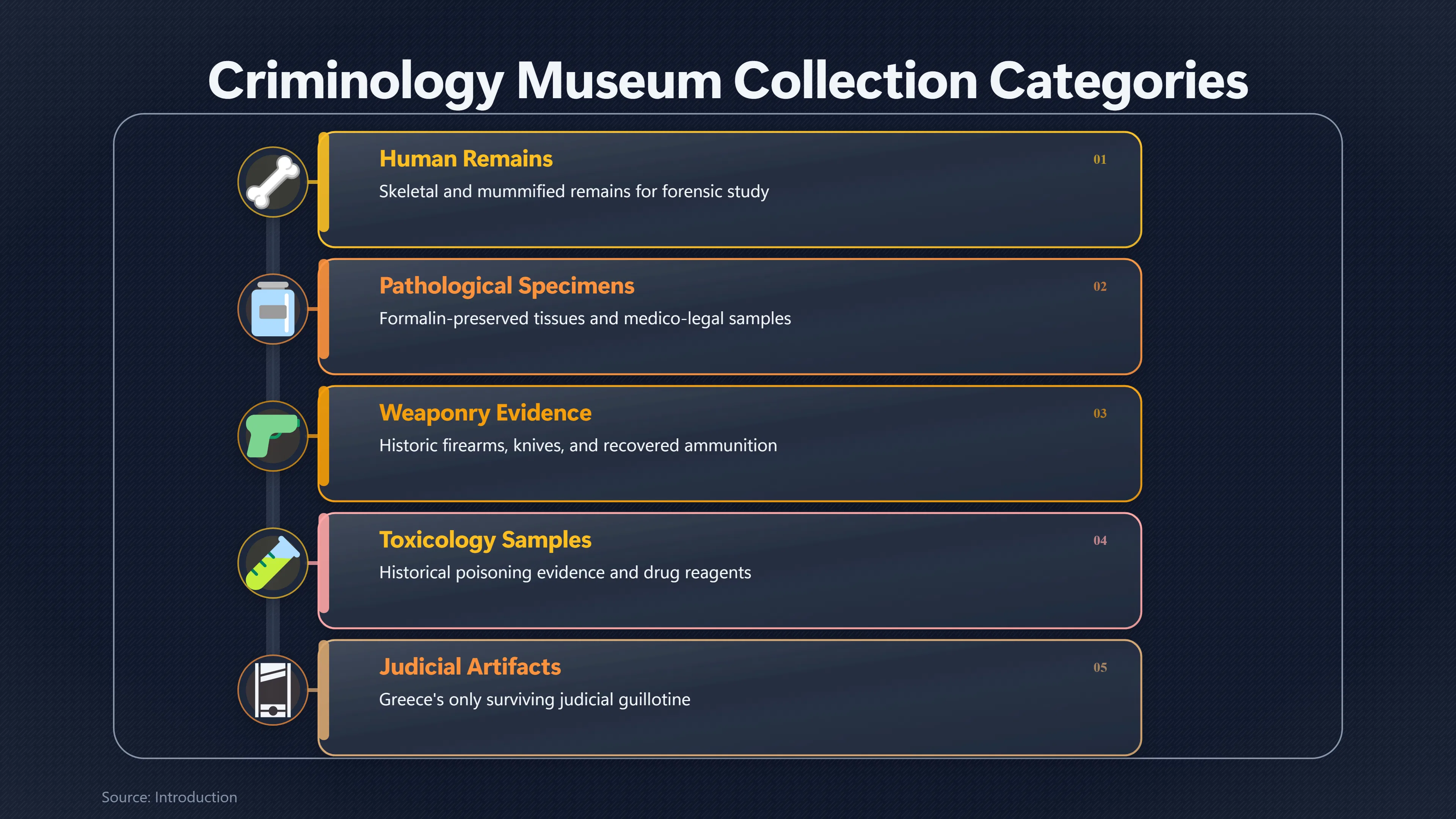
Its approximately 1,500 objects are organised into several teaching collections, including:
- Human skeletal and mummified remains.
- Formalin-preserved pathological and medico-legal specimens.
- Embalmed heads of notorious early twentieth-century Greek outlaws.
- Historic tattooed skin preparations collected during autopsies.
- Wax models demonstrating injuries from homicide, suicide and accidents.
- Crime scene photographs, police records and early forensic identification documents.
- Historic firearms, knives, ammunition and bullets recovered during autopsies.
- Toxicology collections containing historical poisoning evidence, drug samples and laboratory reagents.
- Objects associated with folk magic and ritual practices, preserved as evidence rather than as occult artefacts.
- Greece’s only surviving judicial guillotine, retained because of its importance in the country’s legal history rather than for sensational display.[NKUA]en.uoa.grNKUACriminology Museum | National and Kapodistrian University of AthensNKUACriminology Museum | National and Kapodistrian University of Athens
Nearby, the university’s Anatomical Museum “Georgios Papanikolaou” presents a different type of restricted collection. Established in the nineteenth century, it contains more than 800 anatomical preparations assembled for teaching generations of medical students. These include normal and abnormal skeletons, preserved organs, injected vascular specimens, comparative animal anatomy and historic teaching models made from wax, plaster and wood. Particularly notable are skeletons showing rare skeletal disorders, extensive brain collections and preserved specimens illustrating congenital abnormalities.[NKUA]en.uoa.grOpen source on uoa.gr.
Closely related is the university’s Pathology Museum, centred on the nineteenth-century Rokitansky Collection. Its holdings include over 2,500 pathological specimens, with around 1,000 on display for specialist audiences. The collection preserves surgically removed organs, autopsy material and more than one hundred foetal specimens demonstrating congenital conditions, making it one of Greece’s most significant historical pathology collections.[NKUA]en.uoa.grNKUAPathology MuseumRokitanski Collection | National and Kapodistrian University of Athens…
Why these collections exist for teaching and research
Although their contents can appear macabre, these collections were never assembled simply because they were unusual. Their primary purpose has always been practical education.
Forensic medicine depends heavily on recognising injury patterns, disease processes and the physical effects of violence. Before widespread digital imaging, preserved specimens allowed students to study conditions they might never otherwise encounter. Wax models reproduced complex injuries with remarkable accuracy, while preserved tissues demonstrated the real appearance of disease and trauma. Even today, many of these historical preparations remain valuable because they document conditions that are now uncommon or illustrate the development of forensic practice.[NKUA]en.uoa.grNKUACriminology Museum | National and Kapodistrian University of AthensNKUACriminology Museum | National and Kapodistrian University of Athens
The criminology collections also chart the evolution of criminal investigation in Greece. Historic police files, anthropometric identification cards based on the Bertillon system, toxicological evidence and recovered weapons reveal how forensic science gradually replaced confession, witness testimony and circumstantial evidence as the foundation of criminal investigation.[NKUA]en.uoa.grNKUACriminology Museum | National and Kapodistrian University of AthensNKUACriminology Museum | National and Kapodistrian University of Athens
The museums therefore function as historical archives as much as scientific collections. Researchers studying legal history, forensic anthropology, toxicology, pathology or the history of medicine continue to use them as reference material rather than simply as preserved curiosities.[uoa.gr]en.uoa.grNKUACriminology Museum | National and Kapodistrian University of AthensNKUACriminology Museum | National and Kapodistrian University of Athens
How public access differs from ordinary museums
One of the most distinctive features of Athens’s forensic collections is that they are not designed as conventional visitor attractions.
The Criminology Museum explicitly states that, because of the nature of its exhibits, access is controlled. The collection primarily serves medical students, law students, police academy trainees and researchers. Public visits are limited and generally require advance arrangement or special permission, reflecting both ethical considerations surrounding human remains and the museum’s continuing academic role.[uoa.gr]en.uoa.grNKUACriminology Museum | National and Kapodistrian University of AthensNKUACriminology Museum | National and Kapodistrian University of Athens
The Anatomical Museum follows a similar model. Although it has broadened educational outreach and can accommodate some organised visits, entry normally requires prior permission through the university rather than the purchase of a standard museum ticket.[eStories]estories.uoa.gre Stories Anatomical Museum | e Stories.uoa.gre Stories Anatomical Museum | e Stories.uoa.gr
This restricted access differs sharply from commercial medical museums found elsewhere in Europe. Athens’s collections remain embedded within working university departments, where teaching, research and ethical stewardship take priority over tourism. Their presentation is correspondingly clinical, with specimens interpreted as educational material rather than spectacles.
Why these museums matter in Greece’s curiosity landscape
Within Greece’s wider landscape of unusual collections, the Athens university museums demonstrate that some of the country’s strangest heritage survives not in purpose-built curiosity museums but inside scientific institutions.
Their significance lies in the combination of authenticity and continuity. The specimens were collected through genuine medical practice, criminal investigation and university teaching over more than a century. Unlike reconstructed displays or theatrical exhibitions, they preserve the material history of forensic science itself.
For readers exploring Greece’s stranger cultural heritage, these collections illustrate an important distinction. The country’s most unsettling museums are often not designed to shock. Instead, they reveal how universities preserved difficult evidence—human remains, pathological specimens and criminal artefacts—as tools for understanding anatomy, disease, violence and justice. That educational purpose continues to shape both their interpretation and the carefully restricted way in which they are made available today.
Amazon book picks
Further Reading
Books and field guides related to Inside Athens's Restricted Museums of Crime and Anatomy. Use these as the next step if you want deeper reading beyond the article.
The Poisoner's Handbook
In early-twentieth-century New York, poisons offered an easy path to the perfect crime. Science had no place in the Tammany Hall-controll...
Forensics: What Bugs, Burns, Prints, Dna, and More Tell Us ab...
Crime writer Val McDermid takes readers behind the scenes of real forensic investigations: from bugs that reveal time of death to DNA tha...
Stiff: The Curious Lives of Human Cadavers
A look inside the world of forensics examines the use of human cadavers in a wide range of endeavors, including research into new surgica...
The Body: A Guide for Occupants
AN INSTANT NEW YORK TIMES BESTSELLER • A BEST BOOK OF THE YEAR BY THE WASHINGTON POST • LONGLISTED FOR THE PEN E.O. WILSON LITERARY SCIEN...
eBay marketplace picks
Marketplace Samples
Live-tested eBay searches with available results related to this page.
Selected frommedical collectible oneBay.co.uk.
Endnotes
1.
Source: en.uoa.gr
Title: NKUACriminology Museum | National and Kapodistrian University of Athens
Link:https://en.uoa.gr/about_us/museums/criminology_museum
2.
Source: en.uoa.gr
Link:https://en.uoa.gr/about_us/museums/anatomical_museum_/_collection_georgios_papanikolaou
3.
Source: en.uoa.gr
Title: NKUAPathology Museum
Link:https://en.uoa.gr/about_us/museums/pathology_museum_rokitanski_collection
Source snippet
Rokitanski Collection | National and Kapodistrian University of Athens...
4.
Source: uoa.gr
Link:https://www.uoa.gr/to_panepistimio/moyseia/egklimatologiko
5.
Source: estories.uoa.gr
Title: e Stories Criminology Museum | e Stories.uoa.gr
Link:https://estories.uoa.gr/en/cultural_heritage/museums/criminology-museum
6.
Source: estories.uoa.gr
Title: e Stories Anatomical Museum | e Stories.uoa.gr
Link:https://estories.uoa.gr/en/cultural_heritage/museums/anatomical-museum
Additional References
7.
Source: youtube.com
Title: Antikythera Mechanism, the oldest computer
Link:https://www.youtube.com/watch?v=sLe-QmZ-LDU
Source snippet
Forging the Network: International Industrial Conferences, 1957-1997 with Grigorios Antoniou...
8.
Source: youtube.com
Title: Myrtis: Face to Face with the Past
Link:https://www.youtube.com/watch?v=ZsJYw1kJC2w
Source snippet
Antikythera Mechanism, the oldest computer - Dr. Xenophon Moussas...
9.
Source: youtube.com
Link:https://www.youtube.com/watch?v=PMWTDV5XLjo
10.
Source: youtube.com
Title: King of the Mountains
Link:https://www.youtube.com/watch?v=LnvhitMyQtk
Source snippet
Bearing the Weight of History: The Secret of the Stone Women...
11.
Source: youtube.com
Title: Bearing the Weight of History: The Secret of the Stone Women
Link:https://www.youtube.com/watch?v=7MB7ZF9_5wk
Source snippet
Myrtis: Face to Face with the Past...