What Makes South Korea's Museums So Unusual?
South Korea’s strangest museums are less a single “weird museum” circuit than a patchwork of private collections, folklore archives, preserved prisons, border installations and highly commercial theme attractions. The most revealing sites are not necessarily the loudest.
Page outline Jump by section
Introduction
For visitors, the key distinction is between collections that preserve living or endangered traditions, historic places that use disturbing material to interpret state violence, and tourist-led attractions built around bodily humour, sex, animals or spectacle. South Korea has strong examples of all three. Credibility varies accordingly: some institutions are national or academic museums with catalogued research collections; others grew from one collector’s obsession; still others are entertainment businesses using museum language.[shamanismmuseum.org]shamanismmuseum.orgShamanism Museum샤머니즘박물관All of shamanic materials, data, relics, remains, and vestiges are tangible and intangible heritage which help people to understand Korea…
Where belief becomes a collection
The richest route into South Korea’s uncanny heritage runs through shamanism, household religion and folk imagery. These collections are unusual not because their objects were originally curiosities, but because items once used to negotiate illness, fortune, dangerous spirits and family welfare have been removed from rituals and placed in display cases.
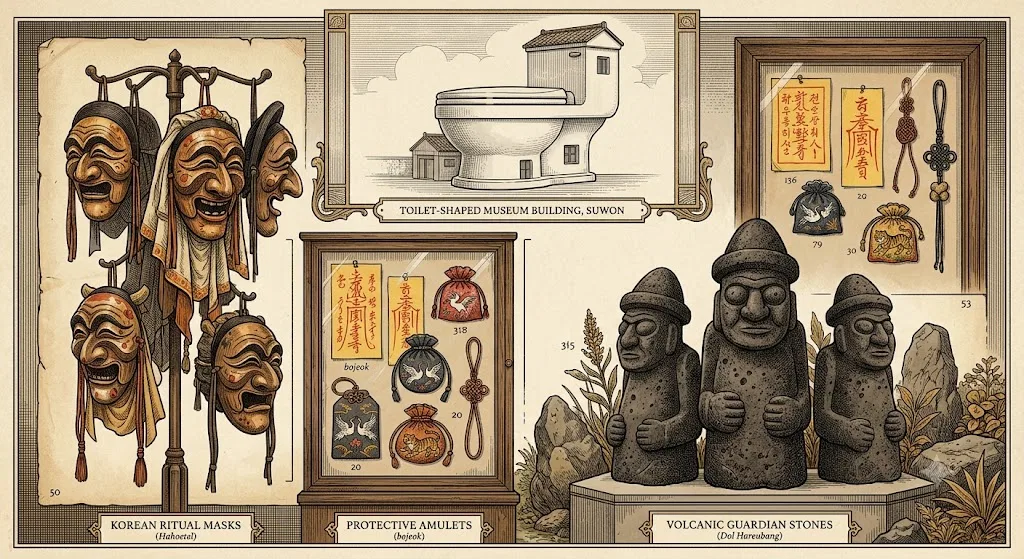
The Museum of Shamanism in Seoul describes itself as the country’s first museum devoted specifically to shamanism education and research. Its collection reportedly contains about 30,000 items, including spirit paintings, ritual costumes, bells, mirrors, fans, knives, spears, divination equipment, amulets and elaborate paper decorations. This is closer to a specialist archive than a supernatural theme park. Many objects were made to be worn, sounded, burned, carried or arranged during ceremonies, so their museum presentation inevitably preserves the material while only partly conveying the performance and relationships that gave it meaning.[Shamanism Museum]shamanismmuseum.orgShamanism Museum샤머니즘박물관All of shamanic materials, data, relics, remains, and vestiges are tangible and intangible heritage which help people to understand Korea…
The National Folk Museum of Korea provides a broader and more institutional setting. Its exhibitions place religious belief among domestic work, agriculture, family customs and village life rather than isolating it as “the occult”. A particularly important collection came from the folklorist Kim Taegon, whose decades of fieldwork documented shamanic rites that were changing or disappearing. More than 31,000 associated items—including spirit paintings, costumes, ritual equipment, photographs and films—were donated to the museum in 2012. The combination of objects and field documentation gives researchers far more context than an attractive but unexplained cabinet of ritual implements would provide.[VISITKOREA - Imagine Your Korea]english.visitkorea.or.krImagine Your KoreaNational Folk Museum of Korea (국립민속박물관)Located inside Gyeongbokgung Palace, the National Folk Museum of Korea presents…
This institutional framing matters. Korean shamanism is not presented simply as a primitive survival or a collection of ghost stories. It is treated as a system through which people have sought practical help by communicating with spirits, addressing concerns such as health, misfortune, family conflict and safety. Historical boundaries are also blurred: the National Museum of Korea notes that the mountain spirit associated with shamanic tradition was absorbed into Korean Buddhist practice and can appear in shrines or paintings at mountain temples. A visitor looking for strange religious collections therefore encounters overlap rather than a tidy division between folk religion and formal Buddhism.[Korea Herald]koreaherald.comSince the seaside residents…Read more…
Amulets, tigers and private obsession
The Gahoe Museum in Seoul offers a more intimate version of the same territory. Opened in 2002 and housed in a traditional building, it grew from a private collection of folk paintings, religious amulets and related objects. Displays include images associated with ordinary hopes and anxieties, as well as roof tiles shaped like human faces or goblin-like beings. Rather than presenting a single doctrine, the collection shows how protection, prosperity and good fortune could be expressed through pictures and objects placed in homes.[Visit Seoul]english.visitseoul.netOpen source on visitseoul.net.
Its folk paintings are particularly useful because apparently playful animals and plants often carry practical symbolic weight. Tigers may function as protective figures, birds may suggest harmony, and flowers can communicate prosperity or status. The meaning does not rest on identifying one symbol alone: arrangement, pairing and visual context change the reading. This makes the museum more than a gallery of charming “naïve” art. It preserves a visual language through which households could express wishes, warnings and social aspirations.[arXiv]arxiv.orgOpen source on arxiv.org.
The Gahoe Museum also illustrates a recurring feature of South Korea’s curiosity culture: the collector-founder. Such museums can preserve material overlooked by larger institutions and allow visitors to see dense, highly personal selections. Their weakness is that interpretation may depend heavily on the founder’s interests, labelling standards or availability of guided explanation. They are often most rewarding when approached as curated personal archives rather than comprehensive authorities on an entire tradition.
The Owl Museum in Seoul pushes the private-collection model towards pure accumulation. Official tourism information describes a compact museum devoted to owl-themed art, crafts, household objects and accessories, while secondary descriptions portray a former private home crowded with cases of owl objects gathered by its owners. Sources differ over its current operating status, with an official tourism listing providing hours while a commercial listing describes it as temporarily closed. That uncertainty is a useful warning: very small private museums can change hours, relocate or suspend admission more quickly than major public institutions, so same-day verification is sensible.[or.kr]english.visitkorea.or.krOpen source on or.kr.
Jeju turns landscape into mythology
Jeju Island has one of South Korea’s densest concentrations of eccentric visitor attractions, but Jeju Stone Park stands apart because its strangeness grows from local geology and belief rather than an imported novelty concept. The complex includes a stone museum, cultural exhibition spaces, reconstructed houses and extensive outdoor displays. Its organising idea is that volcanic stone is simultaneously building material, landscape, craft resource and mythic presence.[VISITKOREA - Imagine Your Korea]english.visitkorea.or.krOpen source on or.kr.
The park links lava formations and carved stones to Jeju’s creation traditions, guardian figures and local ways of living in a harsh volcanic environment. This makes it difficult to classify. It is part museum, part sculpture landscape, part folklore installation and part regional identity project. Objects that might look like geological specimens in a natural-history museum are instead interpreted alongside stories, domestic architecture and protective traditions.
For visitors interested in monsters or supernatural folklore, the important point is that Jeju’s guardian stones are not presented as evidence that legendary beings literally existed. Their value lies in showing how unusual forms in the landscape become culturally meaningful. A weathered rock can acquire a face, a story or a protective association because generations of viewers interpret it through shared tradition. The result is more credible and more interesting than a display that simply labels an ambiguous stone as paranormal.
Jeju’s museum landscape also demonstrates how local identity can be commercialised. The island contains branded character gardens, teddy-bear displays, optical-illusion attractions and adult-themed venues alongside heritage institutions. Their concentration reflects Jeju’s position as a major domestic holiday and honeymoon destination, where museums compete not only as educational establishments but as weatherproof leisure stops and photograph-friendly experiences.[Condé Nast Traveler]cntraveler.comOpen source on cntraveler.com.
Bodies, toilets and commercial candour
Haewoojae in Suwon—often called Mr Toilet House—is perhaps South Korea’s clearest example of bodily humour becoming civic heritage. The original building was designed in the shape of a toilet and later became a museum and cultural centre devoted to sanitation. Official tourism material describes it as the world’s only toilet-shaped museum. Its subject may sound frivolous, but the exhibits connect toilets with hygiene, urban infrastructure and changing social attitudes towards waste.[VISITKOREA - Imagine Your Korea]english.visitkorea.or.krImagine Your KoreaHaewoojae Museum (Mr. Toilet House) (해우재)- VISITKOREAHaewoojae Museum is the world's only toilet-shaped museum…. 463…
Its unusualness therefore works on two levels. The architecture delivers an immediate visual joke, while the museum attempts to turn an embarrassing subject into public education. It is family-oriented, civic and deliberately playful rather than an archive of medical oddities. Visitors expecting a cabinet of grotesque specimens will instead find a sanitation museum using humour to reduce discomfort around a basic human activity.
Jeju’s Museum of Sex and Health takes a more openly commercial approach to another subject often excluded from conventional museums. Its own publicity emphasises erotic art and sexual cultures from around the world, while Jeju’s tourism service describes indoor galleries and an outdoor sculpture park intended to treat sex as a healthy subject rather than something hidden. Reports of the visitor experience suggest a mixture of anatomy, sex education, cross-cultural material, erotic art and conspicuous novelty displays.[or.kr]sexmuseum.or.krOpen source on or.kr.
The museum should not be confused with an academic medical collection. Its claims to exceptional size are promotional and difficult to verify, and its presentation combines education with adult entertainment. Even so, it has cultural relevance. Jeju has long been associated with honeymoon tourism, and the museum turns that history into a visitor product that is simultaneously informative, comic and provocative. Its value lies less in scholarly comprehensiveness than in showing how a relatively conservative public culture packages sexuality for tourism.[Condé Nast Traveler]cntraveler.comOpen source on cntraveler.com.
For a more conventional account of the body, Seoul National University Hospital’s Museum of Medicine and Yonsei University’s Dongeun Medical Museum trace the arrival and development of modern medicine in Korea through equipment, institutional records and hospital history. Neither is primarily a horror attraction. Their oddity lies in obsolete instruments, changing diagnostic practices and the material remains of medicine before today’s technologies. They are academic collections and should be read as histories of institutions and professional practice rather than displays designed to shock.[VISITKOREA - Imagine Your Korea]english.visitkorea.or.krOpen source on or.kr.
Prisons and border relics
Some of South Korea’s most unsettling collections preserve real sites of confinement and military division. Seodaemun Prison History Hall in Seoul occupies part of a prison complex opened under Japanese colonial rule in 1908. It held numerous Korean independence activists, and surviving cells, prison buildings and the execution site now form a memorial museum. Seven buildings were preserved for their historical importance, with several prison blocks and the execution area protected as a historic site.[VISITKOREA - Imagine Your Korea]english.visitkorea.or.krImagine Your KoreaSeodaemun Prison History Museum (서대문형무소역사관)Of the many buildings, only seven were preserved for their historical signif…
What visitors encounter is not a crime museum in the entertainment sense. The prison is interpreted primarily through colonial repression, resistance and the suffering of detainees. Reconstructed interrogation and torture displays can be graphic, but they sit within a national memorial narrative rather than a collection of sensational murder cases. The preserved architecture—narrow cells, surveillance arrangements and execution facilities—often communicates more powerfully than replica instruments because it places violence within the machinery of a functioning institution.[Korea.net]korea.netOpen source on korea.net.
That framing also requires care. Memorial museums select whose experiences are foregrounded and how political violence is narrated. Seodaemun is authoritative as a protected historic location, but individual reconstructions should still be distinguished from surviving original fabric. Visitors should expect commemoration and civic education, not an emotionally neutral account of penal history.
Farther north, the DMZ Museum at Goseong addresses the division of the Korean peninsula, military confrontation and hopes for reunification. It belongs to a wider border landscape of observatories, abandoned stations, barriers, military equipment and infiltration tunnels. These sites are unusually difficult to separate into museum and reality: the artefacts are displayed beside a border that remains militarised, and visitor access can be shaped by security restrictions.[dmzmuseum.com]dmzmuseum.comOpen source on dmzmuseum.com.
The tunnels open on some DMZ routes are especially powerful examples of an object becoming an environment. Visitors do not merely look at a tunnel section in a case; they enter a constrained underground space interpreted as evidence of planned infiltration. Yet border tourism can compress complex history into dramatic symbols—barbed wire, lookout points and tunnels—so a dedicated museum is useful for supplying chronology, documents and civilian context. Conditions and permitted itineraries can change, making official checks more important here than at an ordinary museum.[Condé Nast Traveler]cntraveler.comCondé Nast Traveler How to Visit Korea's Demilitarized Zone the Right WayCondé Nast Traveler How to Visit Korea's Demilitarized Zone the Right Way
What counts as authentic?
South Korea’s unusual collections sit on a spectrum rather than dividing neatly into “real museums” and tourist traps.
Research and national collections usually provide the strongest documentation. The National Folk Museum and university medical museums preserve catalogued material, institutional archives and field records. Their displays may be less theatrical, but objects are more likely to be connected to provenance, historical context and specialist research.[NFM]nfm.go.krSpecial ExhibitionThis special exhibition that presents shamanism relics collected by Namgang (pen name) Kim Taegon. He was the folklo…
Private museums can be highly valuable when they preserve neglected everyday material. Gahoe’s amulets and folk paintings reveal beliefs that may not dominate national art narratives. Small collections, however, can be dependent on one person’s interpretation and may have irregular public access.[Visit Seoul]english.visitseoul.netOpen source on visitseoul.net.
Historic-site museums derive authority from place. Seodaemun Prison and the DMZ landscape contain authentic structures and terrain, although reconstructions, multimedia and national narratives shape how visitors understand them. Authentic walls do not automatically create a complete interpretation.[VISITKOREA - Imagine Your Korea]english.visitkorea.or.krImagine Your KoreaSeodaemun Prison History Museum (서대문형무소역사관)Of the many buildings, only seven were preserved for their historical signif…
Commercial attractions prioritise entertainment, photography and memorable branding. A toilet-shaped museum can still explain sanitation, and an adult attraction can include legitimate health information, but promotional superlatives should not be treated as curatorial evidence. The useful question is not whether commercialisation makes a collection “fake”, but whether the attraction clearly distinguishes education, art, folklore, humour and marketing.[or.kr]english.visitkorea.or.krImagine Your KoreaHaewoojae Museum (Mr. Toilet House) (해우재)- VISITKOREAHaewoojae Museum is the world's only toilet-shaped museum…. 463…
South Korea’s history of tiny themed museums also shows why old travel lists age badly. The once-publicised Museum of Chicken Art in Seoul was built around thousands of chicken images and objects, but reports indicate that its former Seoul location closed or changed use, with inconsistent claims about later relocation. It remains a fascinating example of collector-led eccentricity, but it should not be presented as a reliably visitable Seoul attraction without current confirmation.[latimes.com]latimes.comLos Angeles Times Seoul museum holds an interesting brood in its fowlLos Angeles Times Seoul museum holds an interesting brood in its fowl
The best route through South Korea’s strange collections
For the clearest introduction to South Korea’s curiosity culture, Seoul offers the strongest combination: the National Folk Museum for broad context, the Gahoe Museum for intimate protective imagery, the Museum of Shamanism for specialist ritual material, Seodaemun Prison for difficult modern history and a university medical museum for obsolete scientific objects.
Jeju provides a different experience. Jeju Stone Park is the most substantial choice for understanding how geology, folklore and regional identity merge. The island’s sex, character and illusion museums then show how aggressively unusual themes can be transformed into leisure products. Suwon’s Haewoojae works well as a separate case in which civic education adopts the architecture and humour of a novelty attraction.
The most rewarding visits are those that preserve ambiguity without confusing it with poor evidence. A spirit painting can be historically authentic without proving the existence of spirits. A volcanic stone can carry genuine mythic meaning without being an archaeological anomaly. A prison reconstruction can communicate documented brutality without every displayed scene being an untouched survival. South Korea’s unusual museums matter because they show how a modern, technologically confident country continues to collect older systems of protection, memory, taboo and fear—sometimes with scholarly care, sometimes with commercial exuberance, and often with both at once.
Amazon book picks
Further Reading
Books and field guides related to What Makes South Korea's Museums So Unusual?. Use these as the next step if you want deeper reading beyond the article.
The Invention of Tradition
Rating: 4.5/5 from 16 Google Books ratings
This book explores examples of this process of invention and addresses the complex interaction of past and present in a fascinating study...
The Birth of Korean Cool: How One Nation Is Conquering the Wo...
How did a really unhip country suddenly become cool? How could a nation that once banned miniskirts, long hair on men and rock 'n' roll c...
Korean Folk Tales: Imps, Ghosts and Fairies
This classic collection of Korean folk and fairy tales is of cultural enormous importance for Koreans and Westerners alike. First publish...
eBay marketplace picks
Marketplace Samples
Live-tested eBay searches with available results related to this page.
Selected fromKorean culture poster oneBay.co.uk.
Endnotes
1.
Source: nfm.go.kr
Link:https://www.nfm.go.kr/user/bbs/english/17/469/bbsDataView/7560.do
Source snippet
Special ExhibitionThis special exhibition that presents shamanism relics collected by Namgang (pen name) Kim Taegon. He was the folklo...
2.
Source: english.visitkorea.or.kr
Link:https://english.visitkorea.or.kr/svc/contents/contentsView.do?menuSn=351&vcontsId=111259
Source snippet
Imagine Your KoreaSeodaemun Prison History Museum (서대문형무소역사관)Of the many buildings, only seven were preserved for their historical signif...
3.
Source: english.visitkorea.or.kr
Link:https://english.visitkorea.or.kr/svc/contents/contentsView.do?menuSn=351&vcontsId=72851
Source snippet
Imagine Your KoreaHaewoojae Museum (Mr. Toilet House) (해우재)- VISITKOREAHaewoojae Museum is the world's only toilet-shaped museum.... 463...
4.
Source: english.visitkorea.or.kr
Link:https://english.visitkorea.or.kr/svc/whereToGo/locIntrdn/rgnContentsView.do?vcontsId=110875
Source snippet
Imagine Your KoreaNational Folk Museum of Korea (국립민속박물관)Located inside Gyeongbokgung Palace, the National Folk Museum of Korea presents...
5.
Source: english.visitkorea.or.kr
Link:https://english.visitkorea.or.kr/svc/contents/contentsView.do?vcontsId=97786
6.
Source: arxiv.org
Link:https://arxiv.org/abs/2606.09855
7.
Source: english.visitkorea.or.kr
Link:https://english.visitkorea.or.kr/svc/contents/contentsView.do?vcontsId=109376
8.
Source: korea.net
Link:https://www.korea.net/NewsFocus/Culture/view?articleId=126624
9.
Source: trip.com
Title: owl museum 94600
Link:https://www.trip.com/travel-guide/attraction/seoul/owl-museum-94600/
10.
Source: english.visitkorea.or.kr
Link:https://english.visitkorea.or.kr/svc/whereToGo/locIntrdn/rgnContentsView.do?vcontsId=76736
11.
Source: english.visitkorea.or.kr
Link:https://english.visitkorea.or.kr/svc/contents/contentsView.do?vcontsId=72851
12.
Source: english.visitkorea.or.kr
Link:https://english.visitkorea.or.kr/svc/contents/contentsView.do?vcontsId=193521
13.
Source: korea.net
Link:https://www.korea.net/NewsFocus/HonoraryReporters/view?articleId=229598&pageIndex=1
14.
Source: dmzmuseum.com
Link:https://www.dmzmuseum.com/
15.
Source: dmzmuseum.com
Title: 인사말 | DMZ 박물관 > 박물관소개 > 인사말DMZ가 갖는 역사적인 의미, 이후 지속되었던 군사충돌, 그 동안 민간인의 손길이 닿지 않은
Link:https://www.dmzmuseum.com/museum/introduce
16.
Source: english.visitkorea.or.kr
Link:https://english.visitkorea.or.kr/svc/contents/contentsView.do?menuSn=351&vcontsId=71062
17.
Source: tripadvisor.com
Title: Seoul Museum of Chicken Art
Link:https://www.tripadvisor.com/Attraction_Review-g294197-d2369055-Reviews-Seoul_Museum_of_Chicken_Art-Seoul.html
18.
Source: tripadvisor.com
Title: Museum of Sex and Health
Link:https://www.tripadvisor.com/Attraction_Review-g297892-d2203355-Reviews-Museum_of_Sex_and_Health-Seogwipo_Jeju_Island.html
19.
Source: tripadvisor.com
Title: Owl Museum
Link:https://www.tripadvisor.com/Attraction_Review-g294197-d2369065-Reviews-Owl_Museum-Seoul.html
20.
Source: tripadvisor.com
Link:https://www.tripadvisor.com/Attraction_Review-g294197-d1440196-Reviews-Seodaemun_Prison_History_Hall-Seoul.html
21.
Source: dmzmuseum.com
Link:https://www.dmzmuseum.com/museum/information/practical
22.
Source: dmzmuseum.com
Link:https://www.dmzmuseum.com/museum/information
23.
Source: dmzmuseum.com
Link:https://www.dmzmuseum.com/museum/information/practical/guide
26.
Source: dmzmuseum.com
Link:https://dmzmuseum.com/museum
27.
Source: dmzmuseum.com
Link:https://dmzmuseum.com/museum/introduce/location
28.
Source: dmzmuseum.com
Link:https://www.dmzmuseum.com/museum/information/reservation
30.
Source: trip.com
Title: seoul 234 142776881
Link:https://www.trip.com/moments/detail/seoul-234-142776881/
31.
Source: trip.com
Title: Museum of Sex and Health
Link:https://www.trip.com/travel-guide/attraction/seogwipo/museum-of-sex-and-health-94694/
32.
Source: shamanismmuseum.org
Title: Shamanism Museum샤머니즘박물관
Link:https://www.shamanismmuseum.org/sub07/sub01.php
Source snippet
All of shamanic materials, data, relics, remains, and vestiges are tangible and intangible heritage which help people to understand Korea...
33.
Source: koreaherald.com
Link:https://www.koreaherald.com/article/16282
Source snippet
Since the seaside residents...Read more...
34.
Source: english.visitseoul.net
Link:https://english.visitseoul.net/attractions/gahoe-museum-en_/18972
35.
Source: m.visitjeju.net
Link:https://m.visitjeju.net/en/detail/view?contentsid=CONT_000000000500547&menuId=DOM_000001817000000004
36.
Source: cntraveler.com
Link:https://www.cntraveler.com/story/south-korea-jeju-island-microcosm-of-k-culture
37.
Source: sexmuseum.or.kr
Link:https://www.sexmuseum.or.kr/
38.
Source: visitjeju.net
Link:https://www.visitjeju.net/s/1000000000500039
39.
Source: cntraveler.com
Title: Condé Nast Traveler How to Visit Korea’s Demilitarized Zone the Right Way
Link:https://www.cntraveler.com/story/how-to-visit-koreas-demilitarized-zone-the-right-way
40.
Source: latimes.com
Title: Los Angeles Times Seoul museum holds an interesting brood in its fowl
Link:https://www.latimes.com/archives/la-xpm-2009-oct-19-fg-korea-chicken-art19-story.html
41.
Source: english.visitseoul.net
Link:https://english.visitseoul.net/attractions/Museum-of-Medicine/ENP000846
42.
Source: english.visitseoul.net
Link:https://english.visitseoul.net/attractions/gahoe-museum-en/ENP018912
43.
Source: visitjeju.net
Title: Visit Jeju
Link:https://www.visitjeju.net/en/themtour/view?contentsid=CONT_000000000500547
44.
Source: visitjeju.net
Title: Visit Jeju
Link:https://www.visitjeju.net/my/detail/view?contentsid=CONT_000000000500547
45.
Source: visitjeju.net
Title: Visit Jeju
Link:https://visitjeju.net/en/detail/view?contentsid=CONT_000000000500547
47.
Source: nfm.go.kr
Title: National Folk Museum of Korea
Link:https://www.nfm.go.kr/user/bbs/english/17/469/bbsDataView/7560.do?page=1
48.
Source: english.visitseoul.net
Link:https://english.visitseoul.net/attractions/Museum-of-Korean-Medical-History-at-Kyung-Hee-University/ENP006886
49.
Source: english.visitkorea.or.kr
Link:https://english.visitkorea.or.kr/svc/contents/contentsView.do?vcontsId=76736
50.
Source: english.visitkorea.or.kr
Link:https://english.visitkorea.or.kr/svc/whereToGo/locIntrdn/rgnContentsView.do?vcontsId=97786
51.
Source: english.visitkorea.or.kr
Link:https://english.visitkorea.or.kr/svc/main/index.do
52.
Source: jaapan.de
Title: Museum of Chicken Art in Seoul
Link:https://jaapan.de/museum-of-chicken-art-in-seoul/
53.
Source: tripadvisor.co.uk
Title: SEOU L SPIRITUAL EXPERIENCE
Link:https://www.tripadvisor.co.uk/Attraction_Review-g294197-d33116782-Reviews-Seoul_Spiritual_Experience-Seoul.html
54.
Source: m.visitjeju.net
Link:https://m.visitjeju.net/en/themtour/view?contentsid=CONT_000000000500547
56.
Source: ddm.go.kr
Link:https://www.ddm.go.kr/eng/contents.do?key=3775
57.
Source: kidsfuninseoul.wordpress.com
Title: seodaemun prison
Link:https://kidsfuninseoul.wordpress.com/2014/08/23/seodaemun-prison/
58.
Source: ktriptips.com
Link:https://www.ktriptips.com/eng/culture/268155
59.
Source: nfm.go.kr
Title: National Folk Museum of Korea
Link:https://www.nfm.go.kr/english/subIndex/436.do
60.
Source: nfm.go.kr
Link:https://www.nfm.go.kr/user/bbs/english/17/469/bbsDataView/23209.do?page=1
61.
Source: mindtrip.ai
Link:https://mindtrip.ai/attraction/seoul-south-korea/owl-museum/at-V5BdKUpF
62.
Source: sexmuseum.or.kr
Link:https://www.sexmuseum.or.kr/english
Additional References
63.
Source: museum.go.kr
Link:https://www.museum.go.kr/ENG/contents/E0403000000.do?relicId=2424&schM=relic_represent_view
Source snippet
국립중앙박물관NATIONAL MUSEUM OF KOREA>Collection>HighlightsAn important deity in traditional Korean shamanism is Sansin (山神), the Mountain Spir...
64.
Source: youtube.com
Title: Discover Korea’s Traditions at the National Folk Museum of Korea
Link:https://www.youtube.com/watch?v=6HnM023F95U
Source snippet
Seodaemun Prison History Hall Seoul 🇰🇷 South Korea, Seoul: Seodaemun Independence Park & Prison History Hall Autumn Walking Tour - 4K Wal...
65.
Source: youtube.com
Title: Korean Shamanism (Mugyo): Gods, Rituals & Myths (Korean History)
Link:https://www.youtube.com/watch?v=vcxDzJxNqUw
Source snippet
Seodaemun Prison History Hall in Seoul, South Korea...
66.
Source: youtube.com
Title: Seodaemun Prison History Hall in Seoul, South Korea
Link:https://www.youtube.com/watch?v=FfDl1G1CMQA
Source snippet
JEJU Stone Park Full Tour Explore History, Legends & Scenic Spots...
67.
Source: atlasobscura.com
Link:https://www.atlasobscura.com/things-to-do/south-korea/museums
68.
Source: viator.com
Link:https://www.viator.com/en-GB/blog/Weird-and-Wonderful-Museums-Around-the-World/l98622
69.
Source: rcseng.ac.uk
Link:https://rcseng.ac.uk/museums-and-archives/anatomy-and-pathology-museum/
70.
Source: ft.com
Link:https://www.ft.com/content/e7be0c0f-d894-4964-b944-fee4c9f53545
71.
Source: gotoseoul.com
Link:https://www.gotoseoul.com/culture/CulturalFacilities/detail/?idx=562503
72.
Source: ontrip.kr
Link:https://ontrip.kr/en/travel-guides/details/562503