Within Jamaica Curiosities
Jamaica's Lost Animals and Rare Specimens
Jamaica's natural history collections preserve extinct species and rare specimens that reveal lost parts of the island's biodiversity.
On this page
- Extinct Jamaican species in collections
- Scientific specimens and conservation stories
- Returning important specimens to Jamaica
Page outline Jump by section
Introduction
Jamaica’s natural history collections preserve a record of animals and plants that can no longer be seen alive on the island. The most important collection for this story is the Natural History Museum of Jamaica (NHMJ) in Kingston, which holds thousands of biological specimens, including examples of extinct Jamaican species such as the Jamaican giant galliwasp, the Jamaican petrel and Sloane’s urania moth. These objects are not curiosities in the traditional “cabinet of wonders” sense; they are scientific evidence of lost ecosystems, changing landscapes and the consequences of human activity.[Natural History Museum of Jamaica]nhmj-ioj.org.jmNatural History Museum of Jamaica -Our CollectionsNatural History Museum of JamaicaApril 24, 2025…
For visitors interested in unusual collections, Jamaica’s extinct species specimens offer a different kind of mystery: not mythical creatures, but real animals that disappeared. A preserved lizard in a jar, a rare insect specimen or an old bird skin can reveal more about the island’s past than a legend because each specimen carries information about habitat, extinction and conservation.[Natural History Museum of Jamaica]nhmj-ioj.org.jmNatural History Museum of Jamaica -Peek In CollectionNatural History Museum of JamaicaApril 8, 2025…
Extinct Jamaican species in collections
The Jamaican giant galliwasp: a lost island reptile
One of Jamaica’s most remarkable extinct animals is the Jamaican giant galliwasp (Celestus occiduus), a large secretive lizard that once lived in Jamaican forests and wetlands. The species has not been confirmed alive since the 19th century and is generally considered extinct or possibly extinct. Its disappearance is linked to habitat loss and introduced predators, including mongooses that were brought to Jamaica during the colonial period.[Wikipedia]WikipediaJamaican giant galliwaspJamaican giant galliwasp
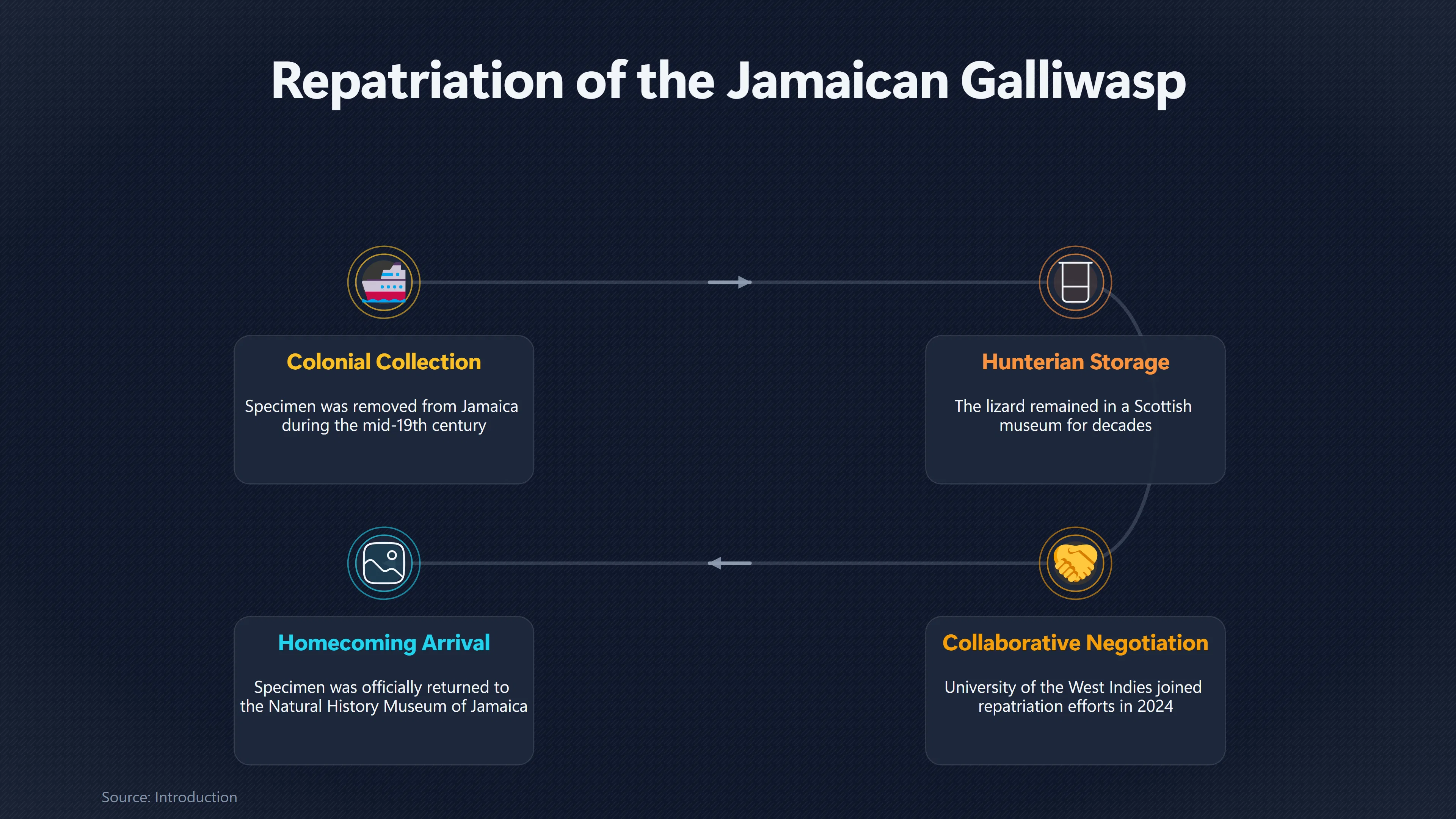
The galliwasp is especially significant because surviving specimens became the only physical evidence of an animal that vanished from Jamaica’s landscapes. Natural history collections around the world hold examples, but recent efforts have focused on reconnecting these specimens with their country of origin. In 2024, a preserved galliwasp specimen held by the University of Glasgow’s Hunterian Museum was returned to Jamaica through collaboration involving the University of the West Indies and Jamaican institutions, where it was deposited with the Natural History Museum of Jamaica.[Museums Galleries Scotland]museumsgalleriesscotland.org.ukMuseums Galleries Scotland Return of the GalliwaspMuseums Galleries ScotlandReturn of the Galliwasp - Museums Galleries Scotland…
This return was not simply about moving an old specimen from one museum to another. It highlighted a wider question in natural history: who should hold important biological heritage, especially when specimens were collected during colonial periods and removed from their original regions? The galliwasp became both a scientific object and a symbol of Jamaica reclaiming part of its natural history record.[The Times]thetimes.co.ukThe reptile, which vanished due to habitat destruction and introduced predators, was collected in the mid-19th century and has been part…
Sloane’s urania: the vanished Jamaican moth
Another striking specimen in Jamaican collections is Sloane’s urania (Urania sloanus), a large day-flying moth once found only in Jamaica. Unlike many moths, which are associated with darkness and camouflage, this species was known for its bright colours and unusual appearance. It was recorded as disappearing in the late 19th century, with habitat destruction and the loss of its food plants considered major factors in its decline.[Extinction]extinction.photoSloane's UraniaSloane's Urania - Extinction…
The NHMJ’s zoological collections include a specimen of this extinct moth, preserving a physical link to a species that existed for centuries but could not survive the transformation of parts of the Jamaican landscape.[Natural History Museum of Jamaica]nhmj-ioj.org.jmNatural History Museum of Jamaica -Peek In CollectionNatural History Museum of JamaicaApril 8, 2025… Its story demonstrates why museum specimens matter: even when an animal disappears, collections allow scientists to study its appearance, distribution and ecological relationships.
The Jamaican petrel and the problem of disappearing island species
The Jamaican petrel (Pterodroma caribbaea) is another extinct species represented in discussions of Jamaica’s lost biodiversity. A seabird once associated with Jamaica’s mountainous regions, it became rare as habitats changed and threats increased. The species is now considered extinct, although historical records and specimens remain important for understanding its former range and biology. The NHMJ identifies the Jamaican petrel among extinct species represented within its zoological holdings.[Natural History Museum of Jamaica]nhmj-ioj.org.jmNatural History Museum of Jamaica -Our CollectionsNatural History Museum of JamaicaApril 24, 2025…
Island species are particularly vulnerable because they often evolve in isolation. Jamaica’s wildlife includes many endemic species — animals found nowhere else — meaning that when one disappears, a unique part of global biodiversity is lost.[Natural History Museum of Jamaica]nhmj-ioj.org.jmNatural History Museum of Jamaica -Do You KnowNatural History Museum of JamaicaApril 8, 2025…
Scientific specimens and conservation stories
The Natural History Museum of Jamaica is not only a display space; it functions as a national scientific archive. Its collections include more than 110,000 animal specimens covering insects, spiders, molluscs, crustaceans, amphibians, fish, reptiles, birds and mammals, alongside a botanical collection of more than 130,000 plant specimens.[Natural History Museum of Jamaica]nhmj-ioj.org.jmNatural History Museum of Jamaica -ZoologyNatural History Museum of JamaicaAugust 12, 2024…
For extinction research, these collections work like historical records. A preserved specimen can show where a species lived, what it looked like, and sometimes how populations changed over time. Scientists can compare older museum material with living relatives to investigate evolution, disease, habitat change and conservation priorities.
The collections also help prevent future losses. Jamaica remains home to many rare species, including endemic birds, frogs and reptiles. By documenting existing wildlife, museums create a baseline against which future declines can be measured.[Natural History Museum of Jamaica]nhmj-ioj.org.jmNatural History Museum of Jamaica -Do You KnowNatural History Museum of JamaicaApril 8, 2025…
A particularly important lesson from Jamaica’s extinct species is that extinction is often gradual rather than dramatic. The galliwasp did not vanish in a single event; the urania moth declined as habitats changed; the Jamaican petrel disappeared after long-term pressures. Museum specimens preserve the final chapters of these stories, allowing researchers and the public to understand how environmental changes affect island ecosystems.[Extinction]extinction.photoSloane's UraniaSloane's Urania - Extinction…
Returning important specimens to Jamaica
Why repatriation matters for natural history
The return of the Jamaican giant galliwasp specimen showed that natural history collections are increasingly part of conversations about heritage and ownership. Unlike art objects or archaeological artefacts, biological specimens are often collected for scientific study, but their histories can still reflect unequal relationships between colonial powers and Caribbean territories.[The Times]thetimes.co.ukThe reptile, which vanished due to habitat destruction and introduced predators, was collected in the mid-19th century and has been part…
Returning specimens does not mean removing them from science. Instead, modern museum partnerships often aim to improve access, research cooperation and local stewardship. A specimen held in Jamaica can support education, conservation awareness and future research while still being part of wider international scientific networks.
A changing role for Jamaican collections
The Natural History Museum of Jamaica represents a shift from the old idea of museums as places where rare objects are simply stored. Today, extinct species collections are tools for understanding environmental change. The preserved remains of lost animals are warnings as much as they are exhibits.
For visitors, these collections offer an unusual kind of encounter: a chance to stand before evidence of creatures that once shared Jamaica’s forests, wetlands and skies. The fascination comes not from the impossible, but from the reality that a small preserved specimen can hold the story of an entire vanished world.[Natural History Museum of Jamaica]nhmj-ioj.org.jmNatural History Museum of Jamaica -Our CollectionsNatural History Museum of JamaicaApril 24, 2025…
Amazon book picks
Further Reading
Books and field guides related to Jamaica's Lost Animals and Rare Specimens. Use these as the next step if you want deeper reading beyond the article.
The Diversity of Life
View a collection of videos on Professor Wilson entitled "On the Relation of Science and the Humanities" "In the Amazon Basin the greates...
The Sixth Extinction: An Unnatural History
"Over the last half billion years, there have been five major mass extinctions, when the diversity of life on Earth suddenly and dramatic...
The Song of the Dodo: Island Biogeography in an Age of Extinc...
First published 1996. Subjects: Biogeography, Island ecology, Endangered species, Ecology, Écologie des îles.
The Invention of Nature: Alexander von Humboldt's New World
NATIONAL BESTSELLER • The acclaimed author of Founding Gardeners reveals the forgotten life of Alexander von Humboldt, the visionary Germ...
eBay marketplace picks
Marketplace Samples
Live-tested eBay searches with available results related to this page.
Selected fromwildlife art print oneBay.co.uk.



Endnotes
1.
Source: Wikipedia
Title: Jamaican giant galliwasp
Link:https://en.wikipedia.org/wiki/Jamaican_giant_galliwasp
2.
Source: extinction.photo
Title: Sloane’s Urania
Link:https://www.extinction.photo/species/sloanes-urania/
Source snippet
Sloane's Urania - Extinction...
3.
Source: hunterian.blog
Title: Repatriation and New Beginnings | The Hunterian Blog
Link:https://hunterian.blog/repatriation-and-new-beginnings/
4.
Source: youtube.com
Title: News Bite: Jamaican giant galliwasp specimen on display at UWI Museum
Link:https://www.youtube.com/watch?v=xWcrlIs6g4Q
Source snippet
NATURAL HISTORY MUSEUM OF JAMAICA...
5.
Source: youtube.com
Title: NATURAL HISTORY MUSEUM OF JAMAICA
Link:https://www.youtube.com/watch?v=0kb3a90ypFM
Source snippet
Jamaican Folklore and Natural History Series...
6.
Source: nhmj-ioj.org.jm
Title: Natural History Museum of Jamaica -Our Collections
Link:https://nhmj-ioj.org.jm/our-collections/
Source snippet
Natural History Museum of JamaicaApril 24, 2025...
Published: April 24, 2025
7.
Source: nhmj-ioj.org.jm
Title: Natural History Museum of Jamaica -Home
Link:https://nhmj-ioj.org.jm/
Source snippet
Natural History Museum of Jamaica...
8.
Source: nhmj-ioj.org.jm
Title: Natural History Museum of Jamaica -Peek In Collection
Link:https://nhmj-ioj.org.jm/zoology/peek-in-collection/
Source snippet
Natural History Museum of JamaicaApril 8, 2025...
Published: April 8, 2025
9.
Source: museumsgalleriesscotland.org.uk
Title: Museums Galleries Scotland Return of the Galliwasp
Link:https://www.museumsgalleriesscotland.org.uk/sector-story/return-of-the-galliwasp/
Source snippet
Museums Galleries ScotlandReturn of the Galliwasp - Museums Galleries Scotland...
10.
Source: thetimes.co.uk
Link:https://www.thetimes.co.uk/article/reparation-deal-sends-museums-extinct-lizard-home-to-jamaica-jr830r0n9
Source snippet
The reptile, which vanished due to habitat destruction and introduced predators, was collected in the mid-19th century and has been part...
11.
Source: nhmj-ioj.org.jm
Title: Natural History Museum of Jamaica -Do You Know
Link:https://nhmj-ioj.org.jm/do-you-know/
Source snippet
Natural History Museum of JamaicaApril 8, 2025...
Published: April 8, 2025
12.
Source: nhmj-ioj.org.jm
Title: Natural History Museum of Jamaica -Zoology
Link:https://nhmj-ioj.org.jm/zoology/
Source snippet
Natural History Museum of JamaicaAugust 12, 2024...
Published: August 12, 2024
13.
Source: nhmj-ioj.org.jm
Title: Natural History Museum of Jamaica -Botany
Link:https://nhmj-ioj.org.jm/botany/
Source snippet
Natural History Museum of Jamaica...
14.
Source: jamaica-gleaner.com
Link:https://jamaica-gleaner.com/article/news/20250917/natural-history-museum-jamaicas-state-art-exhibition-gallery-opened
15.
Source: nhmj-ioj.org.jm
Link:https://nhmj-ioj.org.jm/our-collections-2/
16.
Source: nhmj-ioj.org.jm
Title: Ongoing Projects
Link:https://nhmj-ioj.org.jm/ongoing-projects-2/
17.
Source: nhmj-ioj.org.jm
Title: What We Do
Link:https://nhmj-ioj.org.jm/what-we-do/
18.
Source: nhmj-ioj.org.jm
Link:https://nhmj-ioj.org.jm/exhibitions/
19.
Source: gla.ac.uk
Title: University of Glasgow
Link:https://www.gla.ac.uk/colleges/arts/aboutus/news/artsarchive/2024/headline_1065608_en.html
20.
Source: gla.ac.uk
Title: University of Glasgow
Link:https://www.gla.ac.uk/hunterian/about/news/press-releases/headline_1065685_en.html
21.
Source: gla.ac.uk
Title: University of Glasgow
Link:https://www.gla.ac.uk/hunterian/about/news/headline_1066689_en.html
22.
Source: nhm.ac.uk
Link:https://www.nhm.ac.uk/our-science/services/collections.html
23.
Source: nhm.ac.uk
Link:https://www.nhm.ac.uk/our-science/collections.html/
24.
Source: recentlyextinctspecies.com
Title: urania sloanus
Link:https://recentlyextinctspecies.com/lepidoptera-butterflies-moths/urania-sloanus
Additional References
25.
Source: youtube.com
Title: Natural history repatriations: how and why to do it
Link:https://www.youtube.com/watch?v=N8R3Nw5SY6Y
Source snippet
News Bite: Jamaican giant galliwasp specimen on display at UWI Museum...
26.
Source: researchgate.net
Link:https://www.researchgate.net/publication/282568005_Urania_sloanus_Cramer_1779_an_extinct_species_in_the_collection_of_the_Upper_Silesian_Museum_Muzeum_Gornoslaskie_Bytom_Poland_Lepidoptera_Uraniidae
27.
Source: researchgate.net
Link:https://www.researchgate.net/publication/338580671_Urania_sloanus_Cramer_1779_Lepidoptera_Uraniidae_an_Enigmatic_Extinct_Species_in_Polish_Museum_Collections
28.
Source: nhm.ac.uk
Link:https://www.nhm.ac.uk/our-science/services/collections/palaeontology/fossil-birds.html
29.
Source: nhm.ac.uk
Link:https://www.nhm.ac.uk/our-science/services/collections/zoology/herpetology.html
30.
Source: lntreasures.com
Link:https://lntreasures.com/jamaicar.html
31.
Source: nhm.ac.uk
Link:https://www.nhm.ac.uk/our-science/services/collections/palaeontology.html
32.
Source: instituteofjamaica.org.jm
Link:https://instituteofjamaica.org.jm/plan-your-visit/
33.
Source: repo.uni.opole.pl
Link:https://repo.uni.opole.pl/info/article/UO6e21cdea09bb468ba3313ca50c6ed1d1/Publication%2B%25E2%2580%2593%2BUrania%2Bsloanus%2B%2528Cramer%252C%2B1779%2529%252C%2Ban%2Bextinct%2Bspecies%2Bin%2Bthe%2Bcollection%2Bof%2Bthe%2BUpper%2BSilesian%2BMuseum%2B%2528Muzeum%2BG%25C3%25B3rno%25C5%259Bl%25C4%2585skie%2529%252C%2BBytom%252C%2BPoland%2B%2528Lepidoptera%253A%2BUraniidae%2529%2B%25E2%2580%2593%2BOpole%2BUniversity?cid=151602&lang=en&pn=1&ps=20&r=publication
34.
Source: nhm.ac.uk
Link:https://www.nhm.ac.uk/our-science/study/postgraduate/phd-opportunities/projects/reconstructing-the-trophic-ecology-of-caribbean-mammals.html