Within Congo Curiosities
Were Kongo Nail Figures Really Witchcraft Objects?
Nail-studded Kongo figures were instruments of healing, justice and protection, not simply frightening objects of witchcraft.
On this page
- How power figures were activated and used
- Why nails, mirrors and animal forms mattered
- How museums and markets distort their meaning
Page outline Jump by section
Introduction
Kongo power figures are among the most striking objects associated with the Democratic Republic of the Congo, yet they are also among the most misunderstood. Their dramatic appearance—wooden figures studded with iron nails or blades, often with mirrors set into the abdomen—has encouraged generations of visitors, collectors and popular media to describe them simply as “witchcraft objects”. That label is misleading. These sculptures were not created as horror props or idols of evil. Instead, many served as public instruments of justice, healing, protection, oath-taking and conflict resolution within Kongo communities, with their power understood to come from ritual specialists, sacred substances and social agreements rather than from the carved wood alone. Modern museums increasingly interpret them in this broader cultural context, challenging sensational colonial-era descriptions that reduced them to exotic curiosities.[metmuseum.org]metmuseum.orgThe Metropolitan Museum of Art Power Figure: Male (Nkisi NkondiThe Metropolitan Museum of ArtPower Figure: Male (Nkisi Nkondi) - Kongo peoples - The Metropolitan Museum of Art…
Were Kongo Nail Figures Really Witchcraft Objects?
The short answer is no—at least not in the simple sense suggested by the word “witchcraft”. Many Kongo communities distinguished between harmful spiritual aggression and the legitimate use of ritual knowledge to restore order, uncover hidden wrongdoing or protect individuals and communities. Power figures belonged to the latter sphere.
The best-known examples are often called nkisi nkondi, sometimes translated as “hunter” or “hunter of wrongdoers”. They were commissioned for specific purposes and activated by trained ritual specialists rather than functioning as magical objects on their own. Their role could include settling disputes, witnessing agreements, identifying thieves, protecting settlements, healing illness or enforcing justice when ordinary social mechanisms failed.[metmuseum.org]metmuseum.orgThe Metropolitan Museum of Art Power Figure: Male (Nkisi NkondiThe Metropolitan Museum of ArtPower Figure: Male (Nkisi Nkondi) - Kongo peoples - The Metropolitan Museum of Art…
This distinction matters because colonial observers frequently used the broad label “fetish” to describe almost every unfamiliar African ritual object. That vocabulary encouraged European audiences to imagine irrational superstition while overlooking the legal, political and therapeutic roles these figures played within Kongo society. Contemporary museums increasingly avoid that language or explain its historical baggage.[British Museum]britishmuseum.orgBritish Museumfigure | British MuseumBritish Museumfigure | British Museum
How Power Figures Were Activated and Used
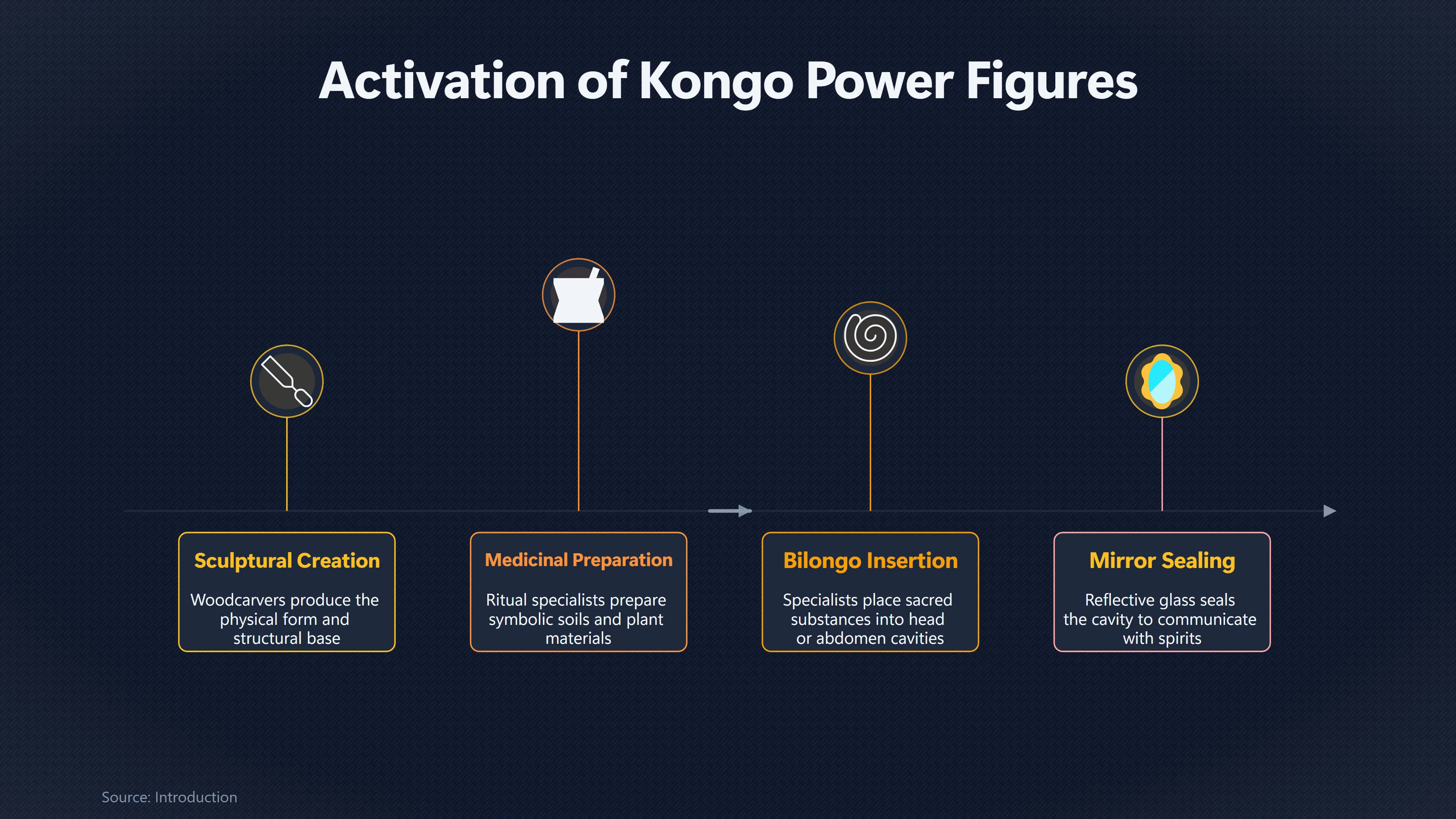
A power figure became effective only after collaboration between a woodcarver and a ritual specialist, often known as a nganga. The sculptor produced the physical form, but the ritual expert transformed it into a functioning ritual object through carefully prepared medicinal and symbolic materials.
These materials, often called bilongo, were placed inside cavities in the figure’s head or abdomen. They could include selected soils, plant materials, minerals, shells or animal substances chosen for symbolic and ritual reasons rather than random decoration. Mirrors or pieces of reflective glass frequently sealed the abdominal cavity. Rather than serving as ornament, the reflective surface represented communication with the spirit world and the ability to detect hidden dangers or concealed wrongdoing.[metmuseum.org]metmuseum.orgThe Metropolitan Museum of Art Power Figure: Male (NkisiThe Metropolitan Museum of ArtPower Figure: Male (Nkisi) - Kongo peoples - The Metropolitan Museum of Art…
The figure therefore acted less like an idol receiving worship than as a carefully prepared container through which spiritual forces could be directed towards specific community concerns.
Why Nails, Mirrors and Animal Forms Mattered
The dense covering of iron nails is the feature that most often leads modern viewers to assume violence or torture. In reality, the nails usually recorded moments of ritual activation.
Each blade or nail commonly marked an oath, agreement, request or judgement. Driving metal into the figure could activate its power in response to a dispute or formal promise. In some traditions, people participating in the agreement touched or licked the blade before it was driven into the figure, sealing the commitment. More serious disputes might be represented by larger or more forcefully inserted blades. The figure therefore became a physical archive of social obligations accumulated over many years.[smarthistory.org]smarthistory.org– Power Figure (Nkisi Nkondi), Kongo peoplesSmarthistory – Power Figure (Nkisi Nkondi), Kongo peoples…
Mirrors carried equally important symbolism. Rather than allowing the figure to “see” in a literal sense, reflective surfaces represented the boundary between the visible world and the world of spirits. Through this symbolic window, hidden truths could be revealed and supernatural assistance invoked against deception or injustice.[Smarthistory]smarthistory.org– Power Figure (Nkisi Nkondi), Kongo peoplesSmarthistory – Power Figure (Nkisi Nkondi), Kongo peoples…
Not every power object was human-shaped. Dogs appeared frequently because they were associated with tracking what could not easily be found, making them appropriate symbols for uncovering concealed crimes or pursuing invisible threats. Animal imagery therefore reflected function rather than decoration or fantasy.[British Museum]britishmuseum.orgBritish Museumfigure | British MuseumBritish Museumfigure | British Museum
Why Museums and Markets Distort Their Meaning
The popular image of a nail-covered “voodoo doll” owes far more to colonial collecting and the international art market than to Kongo religious practice.
During the late nineteenth and early twentieth centuries, European administrators, missionaries and collectors often removed these figures from their ritual settings. Once separated from the communities and specialists who maintained them, they were displayed as examples of “primitive fetishism” or evidence of supposed African superstition. Context about legal mediation, healing or community governance was frequently omitted.[British Museum]britishmuseum.orgBritish Museumfigure | British MuseumBritish Museumfigure | British Museum
Commercial art markets reinforced this misunderstanding because dramatic objects with hundreds of nails proved visually compelling. Auction catalogues and popular books often emphasised mystery, curses or “dark magic”, making the sculptures easier to sell but harder to understand historically.
Many museums have since revised their interpretation. Institutions such as the Metropolitan Museum of Art, the British Museum and educational organisations including Smarthistory and Khan Academy now explain that these figures emerged through collaboration between artists and ritual specialists and were embedded within systems of law, medicine, religion and community responsibility rather than existing as generic objects of witchcraft.[metmuseum.org]metmuseum.orgThe Metropolitan Museum of Art Power Figure: Male (Nkisi NkondiThe Metropolitan Museum of ArtPower Figure: Male (Nkisi Nkondi) - Kongo peoples - The Metropolitan Museum of Art…

Seeing Kongo Power Figures in DR Congo Today
Visitors to museums in the Democratic Republic of the Congo are increasingly encouraged to view power figures as part of the country’s cultural and historical heritage rather than as frightening curiosities. National museum displays place them alongside masks, royal sculpture and other ritual objects, presenting them within broader narratives about Kongo belief systems, political authority and artistic traditions.
Outside the country, many of the finest surviving examples remain in European and North American museums because of colonial collecting. This history has become part of the story the objects now tell. Questions about provenance, interpretation and the return of cultural heritage accompany discussions of their original ritual function.
For anyone interested in the DR Congo’s unusual collections, Kongo power figures are compelling not because they confirm myths of African witchcraft, but because they demonstrate how spectacular objects can be misunderstood when removed from their cultural setting. Their nails, mirrors and medicines were never merely theatrical. They formed part of a sophisticated system through which communities sought justice, protection and healing, making these figures as much records of social relationships as works of sculpture.[britishmuseum.org]britishmuseum.orgBritish Museumfigure | British MuseumBritish Museumfigure | British Museum
Amazon book picks
Further Reading
Books and field guides related to Were Kongo Nail Figures Really Witchcraft Objects?. Use these as the next step if you want deeper reading beyond the article.
Kongo: Power and Majesty
A fascinating account of the effects of turbulent history on one of Africa’s most storied kingdoms, Kongo: Power and Majesty presents ove...
African Art in Motion: Icon and Act
National Gallery of Art, Washington, Apr. 28 - Aug. 18, 1974

Religion and Society in Central Africa: The BaKongo of Lower...
First published 1986. Subjects: Kongo (African people), Religion, Religion and sociology.
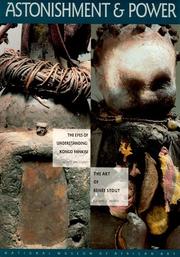
Astonishment and Power: Kongo Minkisi and the Art of Renée Stout
First published 1993. Subjects: History, Influence, Exhibitions, Rites and ceremonies, Kongo (African people).
eBay marketplace picks
Marketplace Samples
Example marketplace items related to this page. Use the search link to explore similar finds on eBay.
Selected fromCongo mask replica oneBay.co.uk.
Current eBay listing
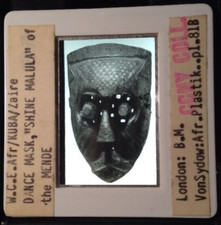
Kuba Congo-Dance Mask "Shine Malula" African Tribal Art 35mm Slide
Current eBay listing
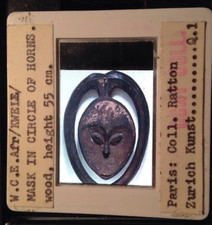
Kwele Congo-mask In Horn Circle- African Tribal Art 35mm Slide
Endnotes
1.
Source: metmuseum.org
Title: The Metropolitan Museum of Art Power Figure: Male (Nkisi Nkondi)
Link:https://www.metmuseum.org/art/collection/search/312221
Source snippet
The Metropolitan Museum of ArtPower Figure: Male (Nkisi Nkondi) - Kongo peoples - The Metropolitan Museum of Art...
2.
Source: smarthistory.org
Title: – Power Figure (Nkisi Nkondi), Kongo peoples
Link:https://smarthistory.org/nkisi-nkondi-kongo-people/
Source snippet
Smarthistory – Power Figure (Nkisi Nkondi), Kongo peoples...
3.
Source: khanacademy.org
Title: Khan Academy Power Figure, Nkisi Nkondi, Kongo peoples (article) | Khan Academy
Link:https://www.khanacademy.org/humanities/art-africa/central-africa/democratic-republic-of-the-congo/a/nkisi-nkondi
4.
Source: britishmuseum.org
Title: British Museumfigure | British Museum
Link:https://www.britishmuseum.org/collection/object/E_Af1905
5.
Source: metmuseum.org
Title: The Metropolitan Museum of Art Power Figure: Male (Nkisi)
Link:https://www.metmuseum.org/art/collection/search/311035
Source snippet
The Metropolitan Museum of ArtPower Figure: Male (Nkisi) - Kongo peoples - The Metropolitan Museum of Art...
6.
Source: khanacademy.org
Title: Khan Academy Power Figure, Nkisi Nkondi, Kongo peoples (article) | Khan Academy
Link:https://www.khanacademy.org/humanities/art-africa/kongo/a/nkisi-nkondi
7.
Source: metmuseum.org
Title: Kongo artist
Link:https://www.metmuseum.org/art/collection/search/310982
8.
Source: metmuseum.org
Title: Kongo artist and nganga (ritual specialist)
Link:https://www.metmuseum.org/art/collection/search/312342?amp=&searchField=All
9.
Source: khanacademy.org
Link:https://www.khanacademy.org/humanities/art-africa/central-africa/democratic-republic-of-the-congo/v/power-figure-male-nkisi
10.
Source: britishmuseum.org
Link:https://www.britishmuseum.org/collection/object/E_Af1949
11.
Source: britishmuseum.org
Link:https://www.britishmuseum.org/collection/object/E_Af1979
12.
Source: britishmuseum.org
Link:https://www.britishmuseum.org/collection/object/E_Af1905
Additional References
13.
Source: commons.wikimedia.org
Title: Other resolution: 427 × 800 pixels. Original file (427 × 800 pixels, file size
Link:https://commons.wikimedia.org/wiki/File%3AWLA_metmuseum_Kongo_Power_Figure_Nkisi_NKondi.jpg
Source snippet
wikimedia.orgFile:WLA metmuseum Kongo Power Figure Nkisi NKondi.jpg - Wikimedia CommonsFebruary 17, 2009 — FILE:WLA METMUSEUM KONGO POWER...
Published: February 17, 2009
14.
Source: commons.wikimedia.org
Title: Other resolutions: 250 × 333 pixels | 500 × 667 pixels | 960 × 1,280 pix
Link:https://commons.wikimedia.org/wiki/File%3AWLA_metmuseum_Kongo_Power_Figure_Nkisi_NKondi_Mangaaka.jpg
Source snippet
wikimedia.orgFile:WLA metmuseum Kongo Power Figure Nkisi NKondi Mangaaka.jpg - Wikimedia CommonsFebruary 14, 2009 — FILE:WLA METMUSEUM KO...
Published: February 14, 2009
15.
Source: rowtonsmuseum.co.uk
Title: Nkisi Nkondi Power Figure
Link:https://rowtonsmuseum.co.uk/collection/nkisi-nkondi-power-figure/
Source snippet
Rowtons' MuseumJanuary 5, 2024 — NKISI NKONDI POWER FIGURE search again * © ROWTONS’ MUSEUM OF THE PARANORMAL AND SPIRITUALITY (IMAGE) DE...
Published: January 5, 2024
16.
Source: youtube.com
Title: The Art of Examination: Role of the Doctor and the Nkisi Nkondi
Link:https://www.youtube.com/watch?v=xY5IK9KV6v4
Source snippet
Kongo "Power and Majesty" exhibition at Metropolitan Museum of Art, NY...
17.
Source: youtube.com
Title: Kongo “Power and Majesty” exhibition at Metropolitan Museum of Art, NY
Link:https://www.youtube.com/watch?v=F0Hx74tsjx0
Source snippet
Inside the Catalogue—"Kongo: Power and Majesty"...
18.
Source: youtube.com
Title: Inside the Catalogue—”Kongo: Power and Majesty”
Link:https://www.youtube.com/watch?v=kgD55AUw2Uc
Source snippet
Nkisi Nkondi Power Figure – Meaningful Materials (78)...
19.
Source: etymology.life
Link:https://www.etymology.life/word/nkisi
20.
Source: brooklynmuseum.org
Link:https://www.brooklynmuseum.org/objects/71253
21.
Source: uen.pressbooks.pub
Link:https://uen.pressbooks.pub/arth2720/chapter/kongo-power-figures/
22.
Source: youtube.com
Title: Power Figure: Male (Nkisi)
Link:https://www.youtube.com/watch?v=H9iy5TTALBQ
Source snippet
The Art of Examination: Role of the Doctor and the Nkisi Nkondi...