Where Burundi Keeps Its Strangest Cultural Treasures
Burundi does not have a large circuit of specialist oddity museums, occult galleries or commercial cabinets of curiosity.
Page outline Jump by section
Introduction
The most important point for curious travellers is that Burundi’s strangeness is rarely presented as spectacle for its own sake. Objects associated with healing, kingship, sacred places or supernatural belief generally sit inside broader ethnographic displays. Royal drums are not treated as quaint musical props but as symbols of political and spiritual authority. Even the country’s most eccentric visitor attraction, the Musée Vivant, is closer to a modest reptile park and craft village than a conventional museum. Evidence is sometimes thin and visitor information changes, so expectations should remain realistic.
The National Museum’s compact cabinet of Burundian life
The National Museum of Gitega is the clearest starting point for anyone interested in Burundi’s unusual material culture. Founded in 1955 during Belgian colonial rule, it occupies a relatively small colonial-era building. Burundi’s tourism authority describes a site of about 500 square metres, with only 168 square metres devoted to exhibition space. Its publicly displayed holdings number 416 objects and 96 photographs, while a reserve room contains roughly 800 additional objects.[tourisme.gov.bi]tourisme.gov.biCreated in 1955, the National Museum of Gitega has a collection of ethnographic and archaeological art objects.Currently, there are 416 o…
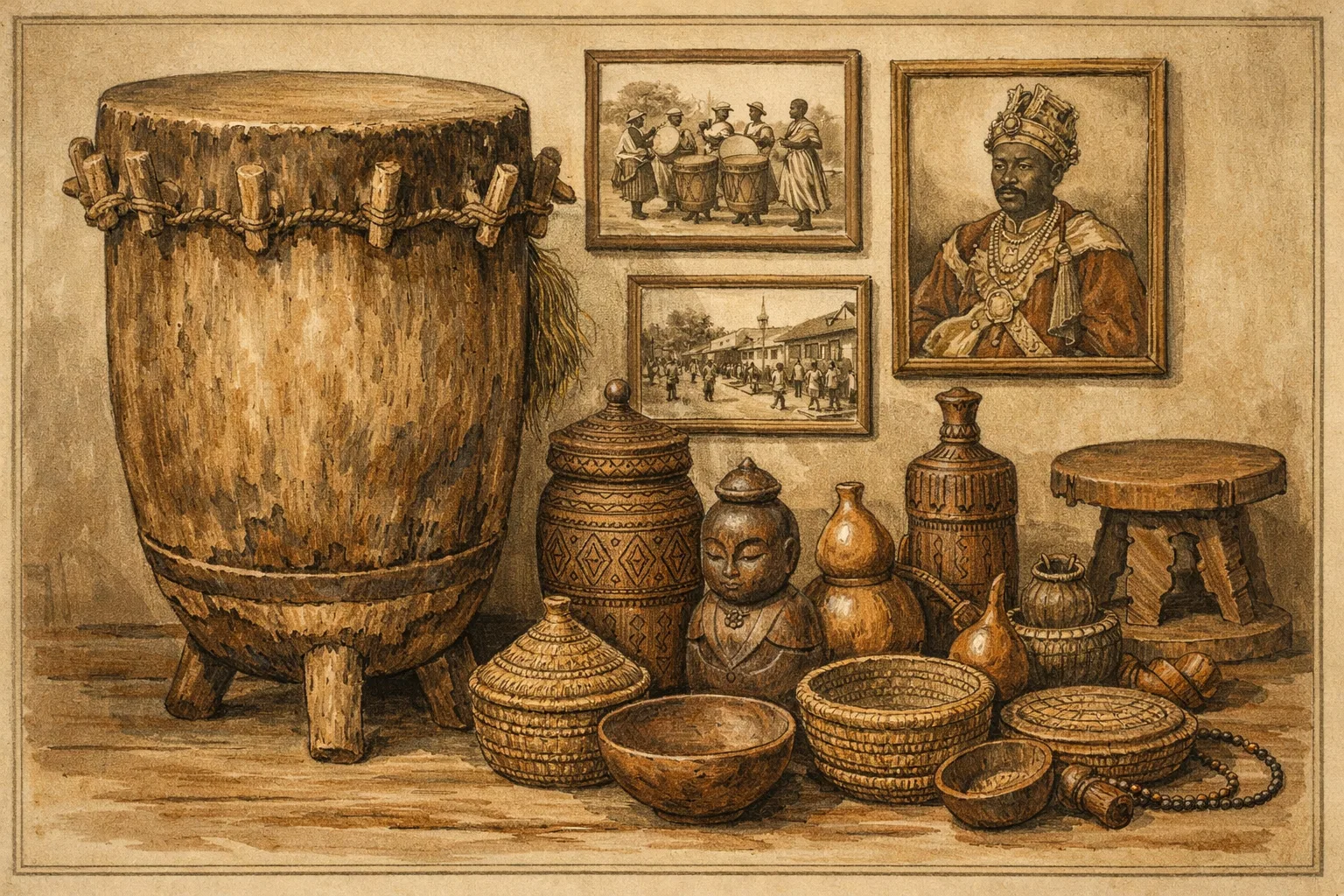
That modest scale gives the museum the atmosphere of a condensed ethnographic cabinet rather than a grand national gallery. Visitors encounter objects from domestic, agricultural, ceremonial and royal life in close succession: pottery, jewellery, weapons, tools, musical instruments, clothing and objects connected with the former monarchy. Older visitor descriptions also mention cow-horn snuffboxes, bark clothing and medicinal equipment, alongside photographs of royal dignitaries and early urban scenes.[lonelyplanet.com]lonelyplanet.comLonely PlanetMusée National de Gitega | Burundi, Africa | AttractionsThe one-room hall has a dusty collection of traditional household it…
The collection is unusual less because any single object is sensational than because it preserves a world in which practical, political and spiritual functions overlap. A drum may be a musical instrument, an emblem of state authority and a sacred object. A medicinal implement may belong simultaneously to healthcare, ritual and local systems of explanation. Weapons and royal possessions also carry meanings that cannot be understood simply as military antiques or decorative art.
Several travel and reference sources state that the museum contains “witchcraft tools” or “witchcraft implements”. That description should be handled cautiously. It is repeated widely, but detailed object-level cataloguing is difficult to find online, and the term can flatten very different practices—healing, divination, protective ritual and accusations of harmful magic—into a single exotic label.[visiterleburundi.com]visiterleburundi.comNational Museumof GitegaVisiter le BurundiGitega National Museum is located in Burundi and was established in 1955 in a large city called Gitega just a few kilom…
For visitors interested in occult or magical collections, the best approach is therefore not to expect a dedicated witchcraft exhibition. Instead, look for objects whose meanings sit between religion, medicine and social custom, and ask a guide how the museum identifies them. The quality of that interpretation may depend heavily on the available staff and labels.
A museum struggling to preserve its own collection
The National Museum is valuable partly because Burundi has so few formal public museums, but its physical limitations are also part of the visitor experience. The national tourism authority acknowledges that objects and photographs have been displayed in exposed conditions, creating risks of falls and breakage. Local reporting in 2023 likewise described the institution as failing to meet international museum standards.[tourisme.gov.bi]tourisme.gov.biCreated in 1955, the National Museum of Gitega has a collection of ethnographic and archaeological art objects.Currently, there are 416 o…
These difficulties are not merely cosmetic. Weak environmental control, limited display furniture and sparse interpretation affect how convincingly a collection can establish provenance and distinguish ceremonial fact from folklore or outdated colonial classification. A mysterious-looking object without a detailed label may attract attention, but it also becomes easier for visitors or tour operators to project dramatic meanings onto it.
An important preservation effort came in 2015, when a catalogue of the museum’s holdings was published with support from the German embassy. The book gave the institution a more durable record of objects that might otherwise remain poorly documented or vulnerable to deterioration.[Wikipedia]WikipediaNational Museum of GitegaNational Museum of Gitega
This makes Gitega an intriguing but imperfect curiosity museum. Its appeal lies in proximity to rare objects and photographs, not in elaborate staging. Readers accustomed to polished European ethnographic museums may find the room sparse or dusty; others may value the directness of a small collection that has not been heavily theatricalised.
Gishora, where the collection is still performed
About seven kilometres from central Gitega, the Royal Residence of Gishora offers a very different model of preservation. Rather than separating historic objects from their original cultural setting, the site reconstructs a royal compound and maintains Burundi’s celebrated tradition of ceremonial drumming. The national tourism authority describes Gishora as a sanctuary where visitors can see a recreated royal architectural complex and attend performances.[tourisme.gov.bi]tourisme.gov.biOpen source on tourisme.gov.bi.
The drums are the site’s central “collection”, but they are not museum pieces in the ordinary sense. Burundi’s ritual dance of the royal drum was inscribed on UNESCO’s Representative List of the Intangible Cultural Heritage of Humanity in 2014. The performance combines synchronised drumming, dance, heroic poetry and traditional song.[ICH UNESCO]ich.unesco.orgOpen source on unesco.org.
Historically, the drum belonged to the symbolic machinery of monarchy. It communicated authority, marked major ceremonies and carried sacred associations. At Gishora, the forecourt includes a sanctuary connected with the royal drums, while the wider compound represents spaces once associated with the king, royal family, attendants and ritual activity. UNESCO’s current description presents the place as a sacred royal landscape and as living testimony to the hereditary ritual specialists who maintain the drumming tradition.[UNESCO World Heritage Centre]whc.unesco.orgWorld Heritage Centre Résidence Royale de GishoraWorld Heritage Centre Résidence Royale de Gishora
For travellers drawn to reliquaries, ritual objects or sacred music collections, Gishora is arguably Burundi’s most compelling site. Its power comes from the fact that the objects are activated. Visitors do not merely inspect drums behind glass; they encounter a controlled public performance in which sound, movement, costume and architecture create meaning together.
That does not mean the experience is untouched by tourism. Performances are staged for visitors and national ceremonies, and the reconstructed royal setting inevitably turns history into a curated presentation. Yet calling it merely a tourist show would miss the continuing social importance of the tradition. UNESCO recognises the practice precisely because it remains a living form of cultural expression rather than a discontinued court ritual.[ICH UNESCO]ich.unesco.orgOpen source on unesco.org.
Sacred landscapes beyond the museum walls
Burundi’s curiosity culture also survives in landscapes where royal memory is attached to trees, groves, springs and former court sites. These places do not usually contain ticketed collections, but they preserve physical traces that function much like an open-air archive.
UNESCO’s account of the sacred natural landscapes of Muramvya, Mpotsa and Nkiko-Mugamba describes former royal capitals marked by groves and particular tree species. Royal compounds historically contained residences, ritual areas, granaries, cattle spaces and homes for court personnel. The surviving vegetation can therefore act as evidence of otherwise vanished political and ceremonial geography.[UNESCO World Heritage Centre]whc.unesco.orgOpen source on unesco.org.
The tourist and cultural village of Rubumba similarly connects surviving sacred groves with royal succession rites. Burundi’s tourism authority describes the area as a place associated with mourning, investiture processions, drumming, praise poetry and the planting of venerated trees linked to successive kings.[tourisme.gov.bi]tourisme.gov.biOpen source on tourisme.gov.bi.
These sites matter because they complicate the Western assumption that a collection must consist of portable objects owned by an institution. In Burundi, a grove, reconstructed court or sequence of ceremonial spaces may preserve memory more effectively than a glass display case. Their “uncanny” quality comes not from ghost stories or manufactured mystery, but from the survival of sacred geography beneath ordinary-looking vegetation and hills.
Interpretation can be difficult without a knowledgeable guide. Physical remains may be subtle, and online descriptions sometimes blend historic practice, national symbolism and tourism promotion. Visitors should distinguish between a documented royal association and any additional supernatural claim supplied informally on site.
Bujumbura’s museum-zoo hybrid
The Musée Vivant in Bujumbura is Burundi’s most obviously eccentric visitor attraction. Opened in 1977, it combines elements of a zoo, reptile house, aquarium, open-air cultural museum, botanical park and craft market. The site has historically displayed crocodiles, snakes, fish, birds and several mammals, while artisans work or sell objects nearby and a reconstructed traditional homestead provides a cultural component.[bujumbura.org]bujumbura.orgMusée Vivant — Burundi's Living MuseumThe Musée Vivant is best known locally for its reptiles. Expect enclosures of Nile crocodi…
For many visitors, the reptiles are the memorable element. Crocodile pools and snake enclosures create the atmosphere of an old-fashioned natural-history attraction in which live specimens replace preserved animals in cases. The proximity of workshops and reconstructed architecture makes the site feel more like a collection of experiences than a single coherent museum.
That hybridity is precisely what makes the Musée Vivant interesting. It reflects an older idea of the “living museum”, where wildlife, plants, architecture and crafts are assembled to represent the country as a miniature cultural and natural world. Instead of carefully separated departments, visitors move from animal enclosure to hut, tree, workshop and souvenir stall.
The attraction should not, however, be romanticised. Local reporting documented a severe decline in visitor numbers after Burundi’s 2015 political crisis, difficulty replacing animals when they died, and a reduction in the number of species on display. A 2018 report recorded an average of about ten visitors per day and described the museum as being in danger of disappearing without greater support.[IWACU]iwacu-burundi.orgmusee vivant on the verge of disappearingmusee vivant on the verge of disappearing
Animal welfare is the main practical concern. Historical reports describe visitors holding snakes, interacting closely with chimpanzees and even sitting on a crocodile, practices that would be unacceptable in many modern accredited zoos. More recent independent visitor guidance continues to warn that enclosures may be basic and that people uncomfortable with captive-animal attractions may prefer to see wildlife in a protected natural setting.[IWACU]iwacu-burundi.orgmusee vivant on the verge of disappearingmusee vivant on the verge of disappearing
The Musée Vivant is therefore best understood as a culturally revealing institution rather than an uncomplicated family attraction. It shows how natural history, spectacle, craft production and tourism have been bundled together in an under-resourced museum environment. Visitors may find it fascinating, troubling or both.

What Burundi does not appear to have
There is no strong evidence for a currently operating Burundian museum devoted entirely to UFOs, cryptids, ghosts, crime, torture, medical abnormalities, mummies, automata or elaborate hoaxes. Nor is there a well-documented commercial museum of magic comparable with specialist witchcraft institutions elsewhere.
Claims about “witchcraft collections” generally lead back to the National Museum of Gitega, where such objects appear to form a small part of a broader ethnographic collection. This distinction matters. Repeating the phrase without context risks turning Burundian religious and medical traditions into an exotic sideshow.
A Geological Museum of Burundi is named in some museum lists, but readily available current public information about its location, access, holdings and operating status is extremely limited. It should not be treated as a reliably visitable attraction without local confirmation.[Wikipedia]WikipediaList of museums in BurundiList of museums in Burundi
The shortage of specialist museums is itself informative. Burundi’s formal museum sector is small, and much of the country’s distinctive heritage remains embedded in performance, royal landscapes, community memory and collections with limited cataloguing. The result is not a conventional “weird museum” trail but a more fragmented map of unusual objects and practices.
Colonial collections outside Burundi
Part of Burundi’s material and visual history is preserved overseas, especially in Belgium. The AfricaMuseum in Tervuren holds vast collections relating to Belgium’s former colonies, including Burundi: ethnographic objects, natural-history specimens, maps, musical instruments, films, archives and historic photographs. Its broader photographic holdings include about 170,000 images concerning Rwanda, Burundi and the Democratic Republic of the Congo, while its film archive contains hundreds of works from the colonial period.[Royal Museum for Central Africa]africamuseum.beRoyal Museum for Central Africa Collections ManagementRoyal Museum for Central Africa Collections Management
These holdings form an enormous external cabinet of Burundi’s colonial-era past, but their provenance and interpretation require scrutiny. Objects, recordings and photographs collected under colonial conditions may preserve knowledge unavailable elsewhere while also reflecting unequal power, selective documentation and categories imposed by foreign researchers or administrators.
The contrast with Gitega is striking. Burundi’s national museum displays a few hundred objects in limited space, while a former colonial institution in Belgium manages millions of specimens and extensive Central African archives. This imbalance helps explain why debates about digitisation, access, provenance and restitution matter to Burundi’s museum landscape even when they are not visible to the ordinary visitor.[tourisme.gov.bi]tourisme.gov.biCreated in 1955, the National Museum of Gitega has a collection of ethnographic and archaeological art objects.Currently, there are 416 o…
For researchers interested in unusual religious instruments, old field recordings, ritual photography or natural-history specimens, overseas archives may contain richer documentation than Burundi’s public galleries. Yet those collections should be read alongside Burundian interpretation rather than treated as neutral records.
What visitors can realistically expect
A curiosity-focused journey through Burundi is likely to revolve around Gitega and Bujumbura rather than a nationwide chain of museums.
At the National Museum of Gitega, expect a small, traditional display with royal objects, domestic tools, weapons, musical instruments, photographs and items connected with medicine or ritual. Labels and conservation standards may be uneven, so a guide can make a substantial difference.
At Gishora, expect performance and reconstructed royal space rather than a conventional object exhibition. The most important “artefact” is the continuing relationship between drums, hereditary performers, ceremony and national identity.
At the Musée Vivant, expect an idiosyncratic mixture of reptiles, other live animals, crafts and traditional architecture. Conditions and the range of animals may change, and welfare-conscious visitors should make an informed decision before entering.
At sacred royal landscapes, expect subtle traces rather than spectacular ruins. Trees, groves and remembered boundaries may carry more significance than surviving buildings.
Opening hours, admission charges, animal collections and performance arrangements are not consistently documented online. Local confirmation through accommodation providers, tourism offices or guides is advisable, particularly outside major holidays and organised tours.

Why Burundi’s strange collections matter
Burundi’s unusual heritage does not fit neatly into familiar categories such as folklore museum, occult museum or natural-history gallery. Its strongest sites occupy the boundaries between those forms. A national museum preserves ritual and royal objects in an ethnographic framework. A drum sanctuary treats music as sacred political heritage. A city attraction combines live reptiles with craft workshops and reconstructed housing. Former royal capitals survive partly as groves and remembered landscapes.
This gives Burundi a small but distinctive curiosity culture. The most memorable encounters are not sensational mysteries but objects whose meanings remain unsettled for outsiders: a medicinal implement that may also be ritual, a drum that is simultaneously instrument and emblem of sovereignty, or a stand of trees that marks a vanished royal court.
The limitations are equally important. Collections are underfunded, interpretation can be sparse, and promotional sources sometimes repeat dramatic claims without explaining individual objects. The responsible visitor should remain curious while resisting easy labels. In Burundi, the richest strange-history experiences often appear when the boundary between museum object, living tradition and sacred place begins to dissolve.
Amazon book picks
Further Reading
Books and field guides related to Where Burundi Keeps Its Strangest Cultural Treasures. Use these as the next step if you want deeper reading beyond the article.
A History of Zimbabwe
The first single-volume history of Zimbabwe with detailed coverage from pre-colonial times to the present, this book examines Zimbabwe's...
A History of African Archaeology
First published 1990. Subjects: History, Antiquities, Archaeology, Archéologie, Antiquités.
eBay marketplace picks
Marketplace Samples
Live-tested eBay searches with available results related to this page.
Selected fromAfrican archaeology decor oneBay.co.uk.
Endnotes
1.
Source: tourisme.gov.bi
Link:https://tourisme.gov.bi/en/monuments-and-museums/
Source snippet
Created in 1955, the National Museum of Gitega has a collection of ethnographic and archaeological art objects.Currently, there are 416 o...
2.
Source: ich.unesco.org
Link:https://ich.unesco.org/en/RL/ritual-dance-of-the-royal-drum-00989
3.
Source: bujumbura.org
Link:https://bujumbura.org/attractions/musee-vivant/
Source snippet
Musée Vivant — Burundi's Living MuseumThe Musée Vivant is best known locally for its reptiles. Expect enclosures of Nile crocodi...
4.
Source: Wikipedia
Title: National Museum of Gitega
Link:https://en.wikipedia.org/wiki/National_Museum_of_Gitega
5.
Source: iwacu-burundi.org
Link:https://www.iwacu-burundi.org/un-livre-pour-immortaliser-la-richesse-du-musee-national-de-gitega/
6.
Source: tourisme.gov.bi
Link:https://tourisme.gov.bi/en/cultural-tourism/
7.
Source: whc.unesco.org
Title: World Heritage Centre Résidence Royale de Gishora
Link:https://whc.unesco.org/en/tentativelists/6927/
9.
Source: whc.unesco.org
Link:https://whc.unesco.org/en/tentativelists/5143/
10.
Source: Wikipedia
Title: Living Museum of Bujumbura
Link:https://en.wikipedia.org/wiki/Living_Museum_of_Bujumbura
11.
Source: Wikipedia
Title: List of museums in Burundi
Link:https://en.wikipedia.org/wiki/List_of_museums_in_Burundi
12.
Source: africamuseum.be
Title: Royal Museum for Central Africa Collections Management
Link:https://www.africamuseum.be/en/research/discover/collections_management
13.
Source: whc.unesco.org
Link:https://whc.unesco.org/en/tentativelists/action%3Dlisttentative%26order%3Dstates%26state%3Dbi
14.
Source: ich.unesco.org
Title: 26785 EN.docx
Link:https://ich.unesco.org/doc/src/26785-EN.docx
15.
Source: whc.unesco.org
Link:https://whc.unesco.org/en/statesparties/bi/
16.
Source: whc.unesco.org
Link:https://whc.unesco.org/en/tentativelists/action%3Dlisttentative%26order%3Dstates
18.
Source: whc.unesco.org
Link:https://whc.unesco.org/en/search/?category=Tentative+Lists&criteria=ES
19.
Source: whc.unesco.org
Link:https://whc.unesco.org/en/search/?category=Tentative+Lists&criteria=120&maxrows=106
20.
Source: whc.unesco.org
Link:https://whc.unesco.org/en/search/?category=Tentative+Lists&criteria=MAKEMUR.COM+cu%C3%A1nto+cuesta+sacar+a+mi+marido+de+la+c%C3%A1rcel&maxrows=200
21.
Source: whc.unesco.org
Link:https://whc.unesco.org/en/search/?category=Tentative+Lists&criteria=PROBLEMGO.com+bribe+judge+to+get+my+son+released&maxrows=200
22.
Source: whc.unesco.org
Link:https://whc.unesco.org/en/search/?category=Tentative+Lists&criteria=eneba+credit+fc+Visitez+le+site+Buyfc26coins.com++Site+unanimement+approuv%C3%A9+pour+les+FC+coins.KGSI&maxrows=200
23.
Source: Wikipedia
Title: Museum of Witchcraft and Magic
Link:https://en.wikipedia.org/wiki/Museum_of_Witchcraft_and_Magic
24.
Source: Wikipedia
Title: Royal Museum for Central Africa
Link:https://en.wikipedia.org/wiki/Royal_Museum_for_Central_Africa
25.
Source: tourisme.gov.bi
Link:https://tourisme.gov.bi/en/cultural-heritage/
26.
Source: tourisme.gov.bi
Link:https://tourisme.gov.bi/monuments-et-musees/
27.
Source: tourisme.gov.bi
Link:https://tourisme.gov.bi/patrimoine-culturel/
28.
Source: africa.com
Title: museums of burundi
Link:https://africa.com/museums/museums-of-burundi
29.
Source: africa.com
Link:https://africa.com/museums-of-burundi
30.
Source: africa.com
Link:https://africa.com/tag/national-museum-of-gitega/
31.
Source: africamuseum.be
Link:https://www.africamuseum.be/en/discover/origin_collections
32.
Source: lonelyplanet.com
Link:https://www.lonelyplanet.com/points-of-interest/musee-national-de-gitega/1503844
Source snippet
Lonely PlanetMusée National de Gitega | Burundi, Africa | AttractionsThe one-room hall has a dusty collection of traditional household it...
33.
Source: visiterleburundi.com
Title: National Museumof Gitega
Link:https://visiterleburundi.com/NationalMuseumofGitega.html
Source snippet
Visiter le BurundiGitega National Museum is located in Burundi and was established in 1955 in a large city called Gitega just a few kilom...
34.
Source: nationsencyclopedia.com
Title: Nations Encyclopedia Libraries and museums
Link:https://www.nationsencyclopedia.com/Africa/Burundi-LIBRARIES-AND-MUSEUMS.html
Source snippet
The National Museum in Gitega (founded in 1955) houses a collection of musical instruments, weapons, witchcraft implements, and a sizeabl...
35.
Source: iwacu-burundi.org
Title: musee vivant on the verge of disappearing
Link:https://www.iwacu-burundi.org/englishnews/musee-vivant-on-the-verge-of-disappearing/
36.
Source: iwacu-burundi.org
Link:https://www.iwacu-burundi.org/au-coeur-du-pays-commune-gitega-entre-resilience-citoyenne-et-defis-persistants-du-developpement/
37.
Source: iwacu-burundi.org
Title: comment page 1
Link:https://www.iwacu-burundi.org/moise-niyoyandemye-des-larmes-de-crocodile/comment-page-1/
38.
Source: iwacu-burundi.org
Link:https://www.iwacu-burundi.org/concours-national-editions-2016-et-2017-faible-taux-de-reussite-malheur-aux-directeurs/
39.
Source: iwacu-burundi.org
Title: que la sacralite de notre tambour soit respectee
Link:https://www.iwacu-burundi.org/que-la-sacralite-de-notre-tambour-soit-respectee/
40.
Source: iwacu-burundi.org
Title: report du proces en appel des putschistes
Link:https://www.iwacu-burundi.org/report-du-proces-en-appel-des-putschistes/
41.
Source: iwacu-burundi.org
Title: lamerican corner de gitega souffle ses deux bougies
Link:https://www.iwacu-burundi.org/lamerican-corner-de-gitega-souffle-ses-deux-bougies/
42.
Source: iwacu-burundi.org
Title: comment page 1
Link:https://www.iwacu-burundi.org/gitega-une-opposition-bien-muselee/comment-page-1/
43.
Source: iwacu-burundi.org
Link:https://www.iwacu-burundi.org/2015/01/29/
44.
Source: iwacu-burundi.org
Title: elections 2015 la politique de lautriche
Link:https://www.iwacu-burundi.org/elections-2015-la-politique-de-lautriche/
45.
Source: iwacu-burundi.org
Title: etats generaux de la justice la parcem exige la publication du rapport
Link:https://www.iwacu-burundi.org/etats-generaux-de-la-justice-la-parcem-exige-la-publication-du-rapport/
46.
Source: facebook.com
Link:https://www.facebook.com/groups/992045138136536/posts/1842832663057775/
47.
Source: tripadvisor.com
Title: National Museum of Gitega
Link:https://www.tripadvisor.com/Attraction_Review-g4471914-d12473039-Reviews-National_Museum_of_Gitega-Gitega_Gitega_Province.html
48.
Source: roadsofadventuresafaris.com
Title: National Museum of Gitega
Link:https://www.roadsofadventuresafaris.com/blogs/national-museum-of-gitega
49.
Source: synthesys.info
Link:https://www.synthesys.info/tafs/be-taf/royal-museum-central-africa.html
50.
Source: iwacu-burundi.org
Link:https://www.iwacu-burundi.org/journaliste/redaction-iwacu/page/114/
51.
Source: doseeafrica.com
Link:https://doseeafrica.com/tabs/?country=burundi&dkWqrd=6&type=country
52.
Source: tripadvisor.de
Title: National Museum of Gitega
Link:https://www.tripadvisor.de/Attraction_Review-g4471914-d12473039-Reviews-National_Museum_of_Gitega-Gitega_Gitega_Province.html
Additional References
53.
Source: onemoreadventuresafaris.com
Title: One More Adventure Safaris Gitega National Museum
Link:https://www.onemoreadventuresafaris.com/gitega-national-museum/
Source snippet
One More Adventure SafarisGitega National Museum - One More Adventure SafarisGitega National Museum was established in 1955 and is locate...
54.
Source: youtube.com
Title: Burundi’s timeless drumming tradition thrives through generations
Link:https://www.youtube.com/watch?v=TIM9-SUB1_Q
Source snippet
Musée Vivant de Bujumbura. The National Museum of Burundi...
55.
Source: youtube.com
Title: We visit the Living Museum Zoo “Musee Vivant” of Bujumbura, Burundi
Link:https://www.youtube.com/watch?v=2_QW2PvzouM
Source snippet
Burundi's Capital - Things to do in and around Gitega...
56.
Source: youtube.com
Title: Burundi’s Capital
Link:https://www.youtube.com/watch?v=dugI0kDZoxM
Source snippet
Burundi's timeless drumming tradition thrives through generations...
57.
Source: youtube.com
Title: Musée Vivant de Bujumbura. The National Museum of Burundi
Link:https://www.youtube.com/watch?v=eMl06cOxbtw
Source snippet
Gishora Drum Sanctuary (Full version), Burundi...
58.
Source: academia.edu
Link:https://www.academia.edu/67135890/Restitution_of_Museum_Objects_and_Human_Remains
59.
Source: researchgate.net
Link:https://www.researchgate.net/publication/315329883_%27Sacred%27_sites_artefacts_and_museum_collections_Pagan_engagements_with_archaeology_in_Britain
60.
Source: africanarchaeology.org
Link:https://www.africanarchaeology.org/burundi-1
61.
Source: instagram.com
Link:https://www.instagram.com/reel/DBUTeGnSNro/
62.
Source: rcrcconference.org
Link:https://rcrcconference.org/app/uploads/2025/09/CD_2015_10_Cultural-heritage-background-report-EN.pdf