Within Curious Iceland
When Does an Obsession Become a Museum?
From preserved anatomy to prophecy, Iceland shows how personal collections and local legends can become lasting public attractions.
On this page
- How private collecting grows into a public institution
- The Phallological Museum's anatomy and playful folklore
- Prophecy, performance and other local curiosity collections
Page outline Jump by section
Introduction
Some of Iceland’s most memorable museums did not begin as government projects or national collections. They started with one person pursuing an unusual fascination that other institutions ignored. Over time, these private interests attracted enough public curiosity to become museums in their own right. In Iceland, where small communities have often depended on dedicated local enthusiasts to preserve stories and artefacts, the boundary between hobby and heritage can be surprisingly thin.
These museums are not simply collections of odd objects. They show how private collecting can preserve overlooked aspects of Icelandic culture, from comparative anatomy and folklore to prophecy, performance and local memory. Their appeal lies as much in the personality of their founders as in the collections themselves.
When does an obsession become a museum?
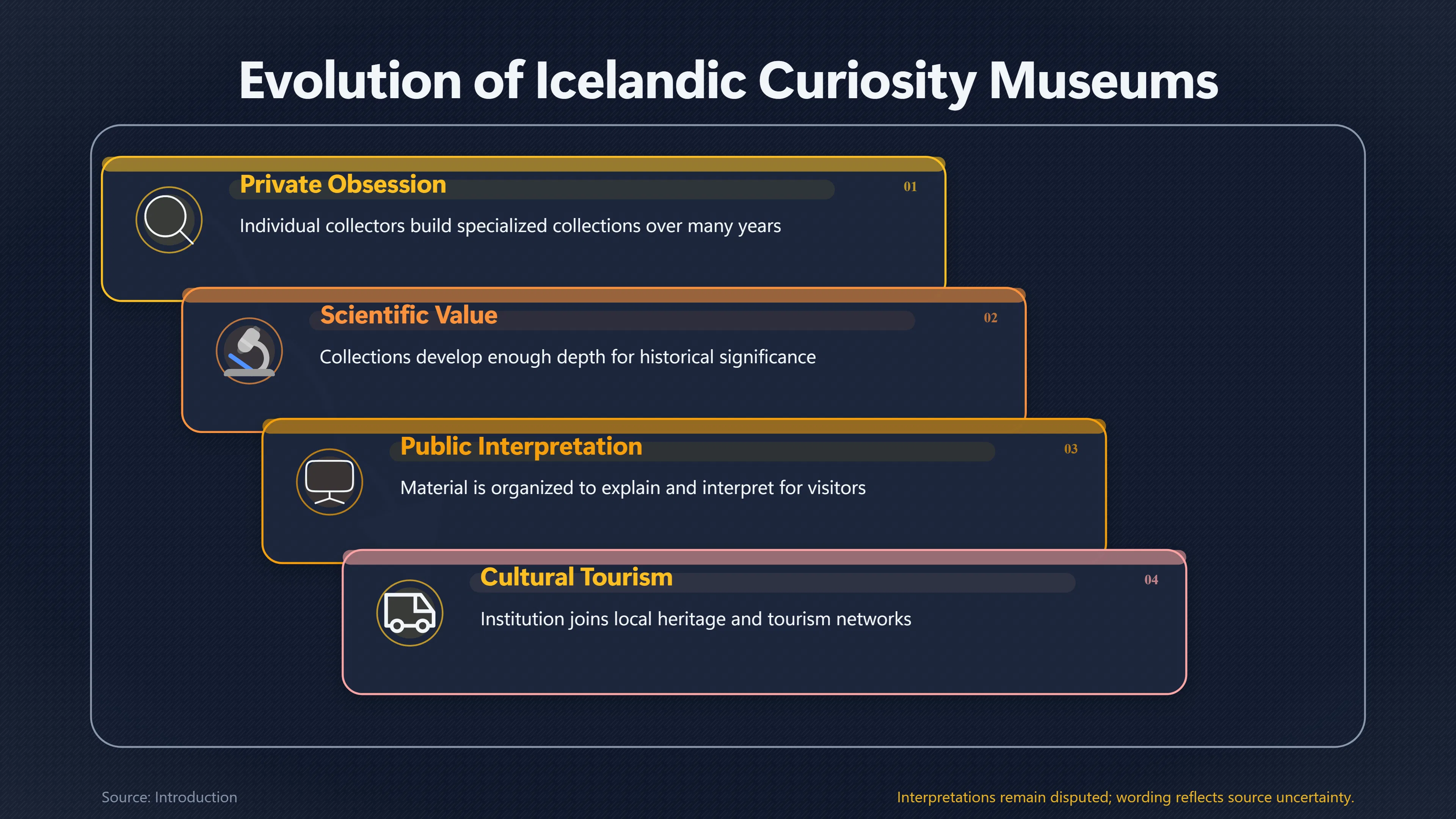
A private collection becomes a museum when it changes purpose. Instead of satisfying its creator’s curiosity alone, it begins to interpret, organise and explain its material for visitors. In Iceland, this transition has often happened outside the country’s largest cultural institutions, allowing subjects that might once have seemed too eccentric or specialised to find a permanent public audience.
Several characteristics appear repeatedly:
- A single collector spends years building a specialised collection.
- The collection develops enough depth that it becomes historically or scientifically valuable.
- Displays are organised with interpretation rather than simple accumulation.
- Visitors arrive because the collection offers something unavailable elsewhere.
- The institution gradually becomes part of Iceland’s cultural tourism as well as its local heritage.
Rather than replacing conventional museums, these institutions complement them by preserving subjects that would otherwise remain scattered in private homes or disappear altogether.
How private collecting grows into a public institution
Iceland’s relatively small population has encouraged an unusually direct relationship between individual enthusiasts and cultural preservation. A determined collector can assemble nationally significant material without needing a large institution behind them, particularly when the subject falls outside mainstream museum priorities.
This creates museums with distinctive personalities. Visitors are often encountering not only unusual objects but also the intellectual journey of the founder. The displays reveal how interests developed over decades, what the collector considered important and how apparently trivial objects gained cultural meaning.
Many Icelandic curiosity museums therefore occupy a space between scholarship and storytelling. They usually present genuine collections while also acknowledging folklore, humour or local tradition. The strongest examples make clear distinctions between documented evidence and imaginative interpretation rather than blurring the two.

The Phallological Museum: anatomy, science and playful folklore
The clearest example is the Icelandic Phallological Museum in Reykjavík. What is now an internationally recognised attraction began in 1974 as an accidental joke. Teacher and headmaster Sigurður Hjartarson received a dried bull’s penis from colleagues, prompting a collecting hobby that gradually expanded through donations from farmers, slaughterhouses, fishermen and whaling stations. His ambition eventually became remarkably systematic: to obtain specimens from every Icelandic mammal.[Icelandic Phallological Museum]phallus.isIcelandic Phallological Museum HistoryIcelandic Phallological MuseumHistory - The Icelandic Phallological Museum…
The museum opened to the public in 1997 with just over sixty specimens. Since then it has expanded several times, moved between Reykjavík and Húsavík before returning to the capital, and remains an independent family-run institution under the founder’s son, Hjörtur Gísli Sigurðsson. The collection now includes hundreds of preserved specimens representing mammals from Iceland and abroad.[phallus.is]phallus.isIcelandic Phallological Museum HistoryIcelandic Phallological MuseumHistory - The Icelandic Phallological Museum…
What makes the museum especially interesting within Iceland’s curiosity culture is its combination of scientific collecting and cultural playfulness.
The biological collection is treated seriously, with preserved anatomical specimens arranged for comparative study rather than shock value. Alongside these sit artistic works, historical objects and references to Icelandic folklore, including invisible specimens supposedly belonging to elves, trolls and other legendary beings. These folklore displays are presented as cultural artefacts reflecting Icelandic traditions rather than evidence that such creatures exist.[Icelandic Phallological Museum]phallus.isIcelandic Phallological Museum The Icelandic Phallological MuseumIcelandic Phallological Museum The Icelandic Phallological Museum
This balance illustrates an important pattern found across several Icelandic curiosity museums. Scientific material and folklore are allowed to coexist, provided visitors understand which belongs to documented biology and which belongs to cultural imagination.
Prophecy, performance and other local curiosity collections
Not every private obsession centres on physical specimens. Some Icelandic collections preserve unusual people, performances or systems of belief that larger museums have historically overlooked.
Collections associated with local prophets, fortune tellers and celebrated seers illustrate how personal reputation can become part of regional heritage. Rather than asking visitors to accept supernatural claims as fact, these exhibitions typically explore how prophetic figures influenced local communities, attracted followers and became woven into Icelandic cultural memory. Their significance lies as much in social history as in questions about paranormal belief.
Elsewhere, museums devoted to niche artistic practices, performers or everyday material culture follow the same pattern. Individual enthusiasts recognise that apparently ordinary objects—whether posters, handwritten notes, costumes or specialised tools—gain historical importance when preserved together with their stories. Without the determination of private collectors, many such materials would simply disappear.
These institutions therefore broaden the definition of heritage. They preserve not only nationally celebrated events but also local passions, eccentric personalities and subjects that conventional museums once considered too narrow or unconventional.
Why these museums matter
Private museums occupy an important place in Iceland’s wider landscape of strange collections because they demonstrate that cultural heritage is not created solely by governments or universities. Individual curiosity can produce collections that become internationally recognised attractions while remaining rooted in local communities.
They also encourage visitors to think critically about authenticity. A preserved whale specimen, a reconstructed folklore object and a display explaining prophetic traditions each require different standards of evidence. Iceland’s better curiosity museums generally make those distinctions visible, allowing visitors to enjoy humour, folklore and unusual collecting without confusing legend with documented history.
Taken together, these museums reveal that an obsession becomes a museum not simply because it is unusual, but because someone has transformed years of private curiosity into a collection that helps the public understand a neglected corner of Icelandic culture.
Amazon book picks
Further Reading
Books and field guides related to When Does an Obsession Become a Museum?. Use these as the next step if you want deeper reading beyond the article.
Icelandic Magic
A practical guide to the magical systems of pre-Christian Iceland • Reveals spells and workings drawn directly from surviving magical boo...
Stuff: Compulsive Hoarding and the Meaning of Things
The New York Times bestseller. "Gripping . . . By turns fascinating and heartbreaking . . . Stuff invites readers to reevaluate their des...
Collected Short Stories of Bertolt Brecht
Everyone knows that Bertolt Brecht was one of the great 20th-century innovators in theatre - the literary-theatrical equivalent of a Pica...
eBay marketplace picks
Marketplace Samples
Live-tested eBay searches with available results related to this page.
Selected fromoddities collectible oneBay.co.uk.
Endnotes
1.
Source: phallus.is
Title: Icelandic Phallological Museum History
Link:https://www.phallus.is/history
Source snippet
Icelandic Phallological MuseumHistory - The Icelandic Phallological Museum...
2.
Source: visitreykjavik.is
Title: Visit Reykjavík The Icelandic Phallological Museum | Visit Reykjavík
Link:https://visitreykjavik.is/service/icelandic-phallological-museum
3.
Source: Wikipedia
Title: Icelandic Phallological Museum
Link:https://en.wikipedia.org/wiki/Icelandic_Phallological_Museum
4.
Source: phallus.is
Title: Icelandic Phallological Museum The Icelandic Phallological Museum
Link:https://www.phallus.is/
5.
Source: guidetoiceland.is
Title: Icelandic Phallological Museum Travel Guide | Guide to Iceland
Link:https://guidetoiceland.is/travel-iceland/drive/icelandic-phallological-museum
Source snippet
April 22, 2026 — ICELANDIC PHALLOLOGICAL MUSEUM TRAVEL GUIDE Last updated: Apr 22, 2026 8.8 5577 Google reviews Share attraction Share at...
Published: April 22, 2026
6.
Source: museumguide.is
Link:https://www.museumguide.is/icelandic-phallological-museum/
Source snippet
The Icelandic Phallological Museum - The Iceland Museum GuideDecember 7, 2016 — THE ICELANDIC PHALLOLOGICAL MUSEUM The Icelandic Phallolo...
Published: December 7, 2016
7.
Source: encyclopedia.pub
Link:https://encyclopedia.pub/entry/history/show/80398
8.
Source: kupi.com
Link:https://www.kupi.com/en/explore/iceland/reykjavik/icelandic-phallological-museum
Additional References
9.
Source: guidetoiceland.is
Link:https://guidetoiceland.is/connect-with-locals/michael-chapman/the-icelandic-phallological-museum
Source snippet
April 16, 2026 — INSIDE THE ICELANDIC PHALLOLOGICAL MUSEUM: REYKJAVIK'S STRANGEST COLLECTION Last updated: Apr 16, 2026 Image: Michael Ch...
Published: April 16, 2026
10.
Source: wonderfulmuseums.com
Link:https://www.wonderfulmuseums.com/museum/phallus-museum-iceland/
Source snippet
Wonderful MuseumsNovember 7, 2025 — PHALLUS MUSEUM ICELAND: UNVEILING THE WORLD’S MOST UNIQUE PHALLOLOGICAL COLLECTION IN REYKJAVIK By Fr...
Published: November 7, 2025
11.
Source: wonderfulmuseums.com
Title: Iceland Penis Museum: Unveiling the Phallological Marvels of Reykjavík
Link:https://www.wonderfulmuseums.com/museum/iceland-penis-museum/
Source snippet
Wonderful MuseumsAugust 16, 2025 — ICELAND PENIS MUSEUM: UNVEILING THE PHALLOLOGICAL MARVELS OF REYKJAVÍK By Frank Johnson /...
Published: August 16, 2025
12.
Source: youtube.com
Title: A Kendra Greene || The Museum of Whales You Will Never See
Link:https://www.youtube.com/watch?v=Iplb2OM9jA0
Source snippet
Skógar Museum with Þórður Tómasson as guide...
13.
Source: icelandtravel.is
Link:https://www.icelandtravel.is/attractions/phallological-museum/
14.
Source: youtube.com
Title: Skógar Museum with Þórður Tómasson as guide
Link:https://www.youtube.com/watch?v=sOZnop5pYPU
Source snippet
The Final Member Official Trailer (2014) - Documentary HD...
15.
Source: youtube.com
Title: Inside The World’s Only Penis Museum
Link:https://www.youtube.com/watch?v=lfeYFrXL9N4
Source snippet
Icelandic Gemstone Museums that you need to visit...
16.
Source: youtube.com
Link:https://www.youtube.com/watch?v=KexMwS-WGxY
Source snippet
Inside The World's Only Penis Museum...
17.
Source: youtube.com
Title: Icelandic Gemstone Museums that you need to visit!
Link:https://www.youtube.com/watch?v=bnkwzhjMT3U
18.
Source: whitecraneinstitute.org
Link:https://www.whitecraneinstitute.org/tdih_event/1997