Within Strange Nepal
What Is the Khumjung Yeti Scalp?
The alleged yeti scalp at Khumjung Monastery is a sacred community relic, a tested animal object and a global cryptid icon.
On this page
- The relic inside Khumjung Monastery
- Scientific testing and the serow explanation
- Belief, tourism and the modern yeti myth
Page outline Jump by section
Introduction
The Khumjung Yeti Scalp is one of Nepal’s most famous curiosity objects because it sits at the intersection of religion, folklore, tourism and science. Kept inside Khumjung Monastery in the Everest region rather than in a conventional museum, the dome-shaped, hair-covered relic is revered by many local people as part of the community’s heritage while also attracting trekkers intrigued by the legend of the Himalayan yeti. Scientific examination has repeatedly failed to support claims that it came from an unknown primate, yet the object has lost little of its cultural significance. Instead, it has become a rare example of how a sacred relic can simultaneously function as a religious artefact, a cryptozoological icon and a case study in the respectful testing of traditional beliefs.[The Guardian]theguardian.comThe GuardianFrom the archive: Yeti scalp (they say it's 240 years old) is here – by air | Nepal | The GuardianDecember 23, 1960…

What Is the Khumjung Yeti Scalp?
The object is housed in Khumjung Monastery, a Buddhist monastery in the Khumbu region of north-eastern Nepal, along one of the world’s best-known trekking routes towards Mount Everest. Visitors are typically shown the relic inside a protective case, often after making a small donation to the monastery. Unlike commercial cryptid attractions elsewhere in the world, the monastery does not exist to promote the existence of the yeti. The scalp is one element of a functioning religious institution whose primary purpose remains worship and community life.[Wikipedia]WikipediaOpen source on wikipedia.org.
Physically, the relic resembles a rounded cap covered in coarse brown hair. It lacks a skull or bone beneath the hide and has long appeared more like a carefully shaped piece of animal skin than the preserved head of an unknown creature. Nevertheless, for decades it was presented locally as the scalp of a yeti, the elusive mountain being known internationally as the “abominable snowman”. Its fame grew not because of local promotion but because mountaineers, journalists and explorers carried stories of it around the world during the mid-twentieth century.[Atlas Obscura]atlasobscura.comAtlas Obscura The Yeti Scalp of Khumjung in KhumjungAtlas Obscura The Yeti Scalp of Khumjung in Khumjung
The Relic Inside Khumjung Monastery
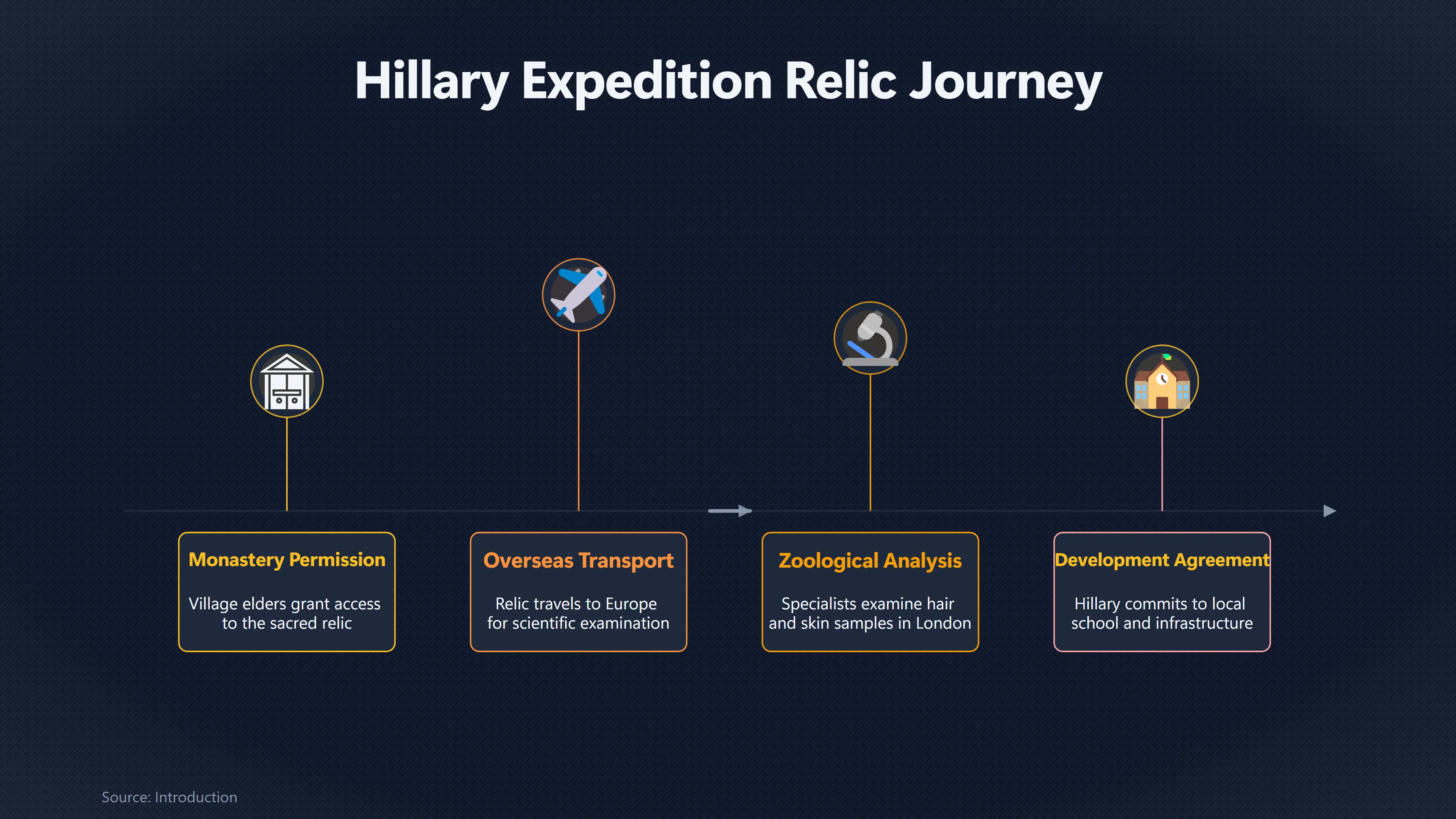
The scalp became internationally famous during Sir Edmund Hillary’s 1960–61 Silver Hut Expedition. Hillary and journalist Desmond Doig obtained permission from the monastery and village elders to take the relic abroad for scientific examination. This was not a straightforward removal. Contemporary reports emphasise that the village headman accompanied the relic, reflecting local concern that a sacred object should remain under community supervision while being examined overseas. Hillary himself stated that he was withholding judgement until zoologists completed their analyses, while the Khumjung representatives maintained their belief that the relic genuinely belonged to a yeti.[The Guardian]theguardian.comThe GuardianFrom the archive: Yeti scalp (they say it's 240 years old) is here – by air | Nepal | The GuardianDecember 23, 1960…
The agreement also had practical consequences for the village. Permission to examine the relic was tied to Hillary’s commitment to support local development, including the establishment of the Khumjung School through what became the Himalayan Trust. This episode illustrates that the scalp was never merely an object of scientific curiosity. It also became part of a broader relationship between Himalayan communities and international mountaineers, linking local heritage with education and long-term development.[Wikipedia]WikipediaHimalayan TrustHimalayan Trust
Scientific Testing and the Serow Explanation
The Khumjung relic is unusual because it has undergone serious scientific examination rather than remaining simply a matter of legend. Hair and skin samples were analysed by zoologists in London and elsewhere after Hillary transported the object to Europe. The best-known examinations concluded that the material did not belong to an unknown ape or human relative.
One influential assessment by zoologist Marca Burns found that the skin most closely resembled that of a Himalayan serow, a shaggy goat-antelope native to the region. Burns noted that it was not an exact match for every available specimen but concluded that it was probably made from the hide of an animal closely related to the serow rather than representing a previously unknown species. Other specialists likewise rejected the idea that the material came from a primate.[Wikipedia]WikipediaOpen source on wikipedia.org.
Importantly, the scientific conclusions were more cautious than many popular retellings suggest. Researchers did not simply declare the object “fake”. Instead, they identified it as a crafted object made from known animal material. That distinction matters because it recognises that the relic is an artefact with cultural value, even if it is not biological evidence for the existence of a yeti.[Wikipedia]WikipediaOpen source on wikipedia.org.
The Khumjung scalp has also become an example of how cryptozoological claims are evaluated. Rather than relying on eyewitness stories alone, investigators examined physical material, compared hair structure with known mammals and looked for anatomical features expected from genuine skin. The available evidence consistently points towards manufacture from an existing Himalayan animal rather than an unidentified species.[Wikipedia]WikipediaOpen source on wikipedia.org.
Belief, Tourism and the Modern Yeti Myth
Scientific conclusions have not ended public fascination with the Khumjung scalp because its importance extends beyond zoology. For many visitors, seeing the object is part of experiencing the folklore of the Everest region rather than searching for proof that yetis exist. The monastery presents a living cultural setting where local traditions and global popular culture intersect.
The relic also illustrates how beliefs can persist alongside scientific explanations without necessarily being in direct conflict. Local religious communities may value the object as part of inherited tradition, while many trekkers appreciate it as a tangible link to one of the twentieth century’s great exploration stories. The result is a form of heritage that operates on several levels at once: sacred object, historical curiosity and tourist attraction.[Atlas Obscura]atlasobscura.comAtlas Obscura The Yeti Scalp of Khumjung in KhumjungAtlas Obscura The Yeti Scalp of Khumjung in Khumjung
Modern cryptid enthusiasts sometimes continue to debate whether early tests were comprehensive enough or whether newer genetic methods might produce different answers. However, no published evidence has overturned the broad scientific consensus established after Hillary’s expedition. Instead, the scalp’s enduring appeal comes less from the possibility that it proves the existence of an unknown primate than from the way it captures a moment when Himalayan folklore, Western exploration and scientific investigation briefly converged.[Wikipedia]WikipediaOpen source on wikipedia.org.
Why the Khumjung Scalp Still Matters
Among Nepal’s unusual collections, the Khumjung Yeti Scalp occupies a distinctive position. It is not a museum specimen collected for research, nor is it a commercial exhibit designed purely for entertainment. It remains a community-held religious relic that achieved worldwide fame because explorers attempted to test its extraordinary claim.
That combination explains its lasting significance. Even though science strongly supports the view that the scalp is fashioned from the hide of a Himalayan serow rather than an unknown creature, the object continues to embody something more enduring than a solved mystery. It preserves a meeting point between faith, local identity, international exploration and one of the world’s most enduring cryptid legends.[Wikipedia]WikipediaOpen source on wikipedia.org.
Amazon book picks
Further Reading
Books and field guides related to What Is the Khumjung Yeti Scalp?. Use these as the next step if you want deeper reading beyond the article.
Abominable Science!
"A sharp analysis of the quest for unreal critters―cryptids, as they are called―and the people who pursue them . . . entertaining and tho...
The Snow Leopard
An account of the author's two-hundred-fifty-mile journey, on foot, from Kathmandu, Nepal, to the Crystal Mountain, in Tibet, in search o...
Myths and Symbols in Indian Art and Civilization
A landmark work that demystifies the rich tradition of Indian art, Myths and Symbols in Indian Art and Civilization analyzes key motifs f...
eBay marketplace picks
Marketplace Samples
Live-tested eBay searches with available results related to this page.
Selected fromCryptid collectibles oneBay.co.uk.
Endnotes
1.
Source: Wikipedia
Link:https://en.wikipedia.org/wiki/Yeti
2.
Source: Wikipedia
Link:https://en.wikipedia.org/wiki/Khumjung
3.
Source: Wikipedia
Title: Himalayan Trust
Link:https://en.wikipedia.org/wiki/Himalayan_Trust
4.
Source: theguardian.com
Link:https://www.theguardian.com/world/2009/dec/23/yeti-scalp-nepal-edmund-hillary
Source snippet
The GuardianFrom the archive: Yeti scalp (they say it's 240 years old) is here – by air | Nepal | The GuardianDecember 23, 1960...
Published: December 23, 1960
5.
Source: atlasobscura.com
Title: Atlas Obscura The Yeti Scalp of Khumjung in Khumjung
Link:https://www.atlasobscura.com/places/the-yeti-scalp-of-khumjung-khumjung-nepal
6.
Source: atlasobscura.com
Title: Objects of Intrigue: Yeti Scalp
Link:https://www.atlasobscura.com/articles/objects-of-intrigue-yeti-scalp
Source snippet
May 30, 2013 — OBJECTS OF INTRIGUE: YETI SCALP by Annetta Black May 30, 2013 Image: article-image YETI SCALP Brought to the Explorers Clu...
Published: May 30, 2013
7.
Source: cryptidarchives.fandom.com
Link:https://cryptidarchives.fandom.com/wiki/Yeti
Source snippet
Encyclopaedia of Cryptozoology | FandomKNOWN HOAXES YETI SCALPS During the 1950's, three alleged yeti scalps, at Pangboche, Khumjun...
Additional References
8.
Source: nationalgeographic.com
Title: Yeti Legends Are Based on These Real Animals, DNA Shows | National Geographic
Link:https://www.nationalgeographic.com/science/article/yeti-legends-real-animals-dna-bears-himalaya-science
Source snippet
November 29, 2017 — Image: a femur bone from the decayed body of a purported Yeti found in a cave in Tibet Image: a Himalayan brown bear...
Published: November 29, 2017
9.
Source: camaraethiopia.org.et
Title: H. Hodgson’s account of the Yeti in northern Nepal. His native guides spott
Link:https://www.camaraethiopia.org.et/rachel/wikip/wp/y/Yeti.htm
Source snippet
YetiEVENTS AND STUDIES 19TH CENTURY In 1832, the James Prinsep's Journal of the Asiatic Society of Bengal published trekker B...
10.
Source: esovitae.com
Title: The Yeti Legend: Folklore and Faith in the Himalayas
Link:https://esovitae.com/yeti-himalayan-legend/
Source snippet
June 5, 2026 — THE MONASTERY RELICS WERE SACRED CHARMS LONG BEFORE THEY WERE LAB SAMPLES Two Khumbu monasteries, Pangboche and Khumjung...
Published: June 5, 2026
11.
Source: unexplainedsightings.com
Title: Yeti: Footprints & Folklore | Unexplained Sightings
Link:https://unexplainedsightings.com/yeti-himalayan-mystery/
Source snippet
By 1951 he had completed multiple Himalayan expeditions and was regarded as one of the most experienced high-altitude mountaineers of his...
12.
Source: youtube.com
Link:https://www.youtube.com/watch?v=WbgmsStBkzY
Source snippet
The $600 Dinosaur Tail That Proved Warm-Blooded Dinosaurs...
13.
Source: youtube.com
Title: Illicit Fossils: The Ethical Dilemma in Protecting the World’s Natural History
Link:https://www.youtube.com/watch?v=PnssaLktiXw
Source snippet
A tale of two papers: ethics of Burmese amber...
14.
Source: tsemrinpoche.com
Title: He wrote ab
Link:https://www.tsemrinpoche.com/tsem-tulku-rinpoche/yeti-bigfoot-sasquatch/sir-edmund-hillarys-yeti.html
Source snippet
Sir Edmund Hillary’s Yeti | Tsem RinpocheNovember 2, 2017 — THE ABOMINABLE SNOWMAN The term ‘abominable snowman’ was coined in 1921, the...
Published: November 2, 2017
15.
Source: tmcnet.com
Link:https://www.tmcnet.com/usubmit/-hillarys-abortive-hunt-yeti-left-sherpa-myth-undisturbed-/2006/jan/1287442.htm
Source snippet
January 15, 2006 — HILLARY'S ABORTIVE HUNT FOR YETI LEFT SHERPA MYTH UNDISTURBED HILLARY'S ABORTIVE HUNT FOR YETI LEFT SHERPA MYTH UNDIST...
Published: January 15, 2006
16.
Source: newworldencyclopedia.org
Title: New World Encyclopedia Yeti
Link:https://www.newworldencyclopedia.org/entry/Yeti
Source snippet
Writing about a British expedition into the Himalayas, led...
17.
Source: youtube.com
Title: Episode 135: Burmese Amber Pt2
Link:https://www.youtube.com/watch?v=ABC736Ron80
Source snippet
Illicit Fossils: The Ethical Dilemma in Protecting the World's Natural History...