Where Does Lebanon Keep Its Strangest Treasures?
Lebanon does not have a single, famous “museum of the weird”.
Page outline Jump by section
Introduction
The strongest unusual museums in Lebanon fall into three overlapping groups. Some are carefully curated scientific or archaeological institutions, such as the Mim Museum and the National Museum’s funerary galleries. Others are personal creations built around one collector’s obsession, including Moussa Castle and the fossil displays of Byblos. A third group uses objects, ruins and reconstructed environments to shape contested memories of war. Visitors should therefore expect very different standards of interpretation, from academic displays to devotional collections, theatrical tableaux and partisan storytelling.
Where Lebanon’s strangest collections are found
Most of Lebanon’s distinctive collections are concentrated in Beirut and the mountainous corridor running north and south of the capital. Beirut contains the country’s most important archaeological and mineral displays, while Byblos, Jeita, Antelias, Deir el-Qamar and the Chouf mountains contain smaller private, religious and eccentric institutions.
The national picture is shaped by Lebanon’s unusual combination of deep archaeological history, strong private collecting traditions, numerous religious communities and repeated episodes of conflict. Objects are rarely presented as mere curiosities. Fossils can become commercial souvenirs, relics can remain active objects of pilgrimage, damaged buildings can serve as political testimony, and antiquities can symbolise both ancient continuity and modern survival.
Operating conditions can change quickly. Conflict has repeatedly forced museums to close, protect collections or suspend loans. In 2026, insecurity disrupted the transport of major Lebanese antiquities to an exhibition in Paris, leaving deliberately empty cases where objects judged too vulnerable to travel should have stood. Any journey involving southern Lebanon or a small privately run museum should therefore be checked directly rather than planned from an old travel listing.[Financial Times]ft.comAccording to the Lebanese cultural preservation organization Biladi, 24 heritage sites were either destroyed or damaged between September…
The National Museum’s underground world of death
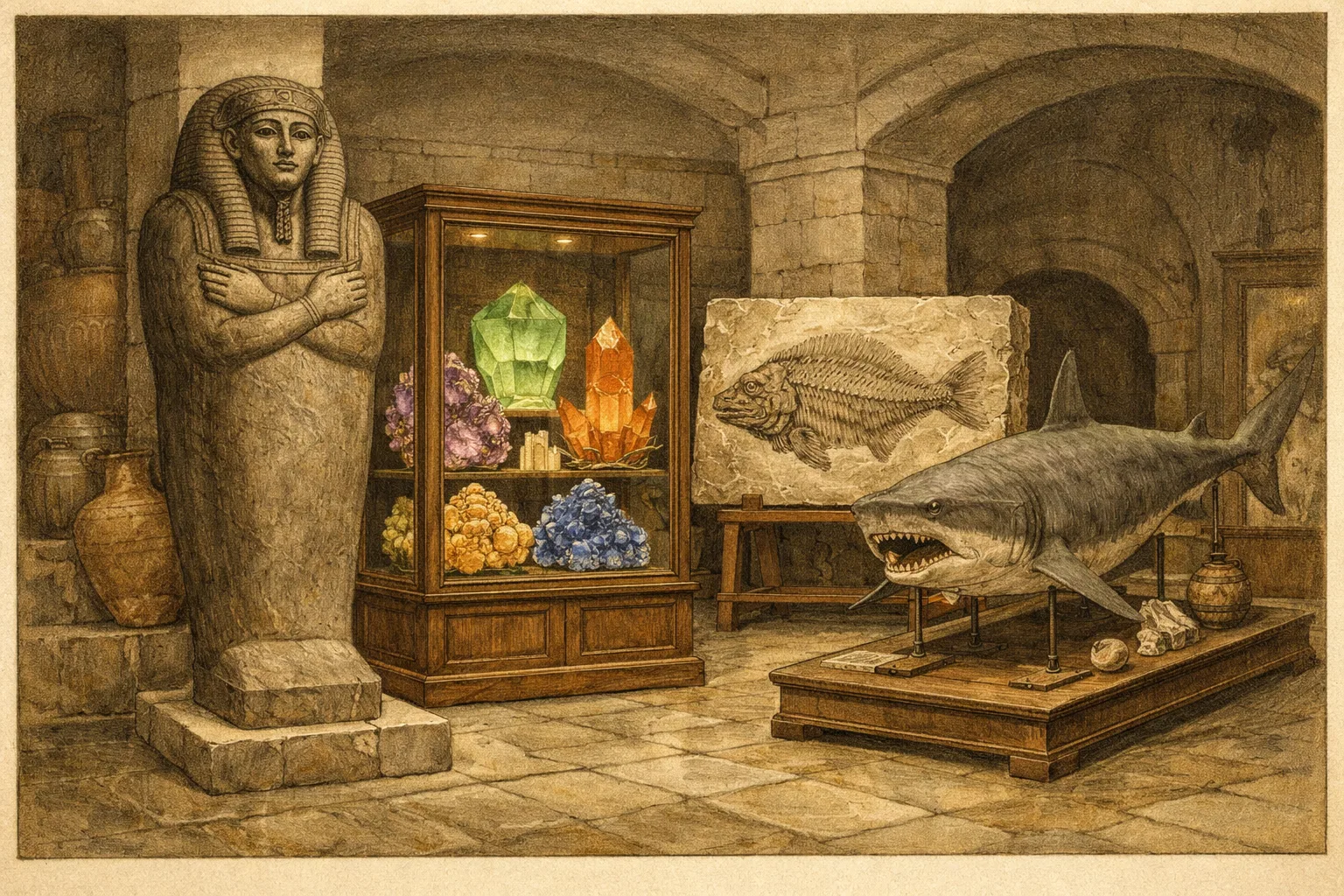
The National Museum of Beirut appears at first to be a conventional national archaeology museum. Its basement, however, is one of Lebanon’s most atmospheric and unusual public collections. Reopened in 2016, the underground galleries are devoted to burial customs from prehistory into the Ottoman period. Visitors encounter human-faced Phoenician sarcophagi, reconstructed tomb interiors, funerary jewellery, offerings and objects placed beside the dead.[Wikipedia]WikipediaNational Museum of BeirutNational Museum of Beirut
The most arresting exhibits are the naturally preserved medieval villagers discovered in a cave in the Qadisha Valley. Commonly known as the Maronite mummies, the remains belong to a community that lived in the late thirteenth century. Their preservation was environmental rather than the result of an Egyptian-style embalming process. Clothing and personal material survived alongside the bodies, making the group unusually valuable for understanding ordinary medieval life rather than royal burial.[Hürriyet Daily News]hurriyetdailynews.comlebanons national museum reveals long hidden treasures 105863Hürriyet Daily NewsLebanon's national museum reveals long-hidden treasures8 Nov 2016 — They include Phoenician stelae and rare medieval C…
The display is unusual without being sensationalist. These are human remains presented within a broad archaeological account of death, belief and commemoration. The galleries also include a reconstructed painted Roman tomb from Tyre and a striking row of anthropoid sarcophagi whose carved faces turn the burial container itself into a portrait of the deceased.[The New Yorker]newyorker.comThe National Museum, located on the dangerous Green Line, protected its ancient collection during the war by encasing artifacts in concre…
The building has acquired another layer of strange history. During the Lebanese Civil War, it stood on the line dividing Beirut and was occupied, shelled and used by fighters. Staff concealed smaller objects behind walls and encased large sculptures and mosaics in concrete. Some damage remains visible, so the museum is simultaneously a collection of ancient objects and an unintended monument to the twentieth-century struggle to keep those objects alive. In 2025, officials described the preserved scars as part of the museum’s message about resilience and coexistence.[Reuters]reuters.comOnce on civil war's frontline, Lebanon museum sees new lifeLocated on the former frontline dividing Beirut, the museum witnessed fierce fighting, with militants barricading inside and damaging anc…

Crystals, meteorites and stone fish
Mim Museum
The Mim Museum in Beirut is the clearest example of an elite private collection transformed into a polished public institution. Created from the collection assembled by Salim Eddé, it displays thousands of mineral specimens chosen as much for visual drama as for scientific importance. The cases contain crystals with improbable geometries, fluorescent minerals, rare metals, gemstones and meteorites, with the most exceptional pieces gathered in a treasure-room-style display.[MIM]mim.museumOpen source on mim.museum.
Mim’s strangeness comes from seeing natural objects that appear manufactured. Metallic growths resemble mechanical sculptures; coloured crystals look dyed or illuminated from within; and fluorescent specimens change appearance under ultraviolet light. The museum’s presentation is modern and educational, making it one of Lebanon’s most credible choices for visitors who want wonder without dubious claims.
A separate palaeontology section presents fossils from Lebanon, including marine creatures preserved in fine limestone. The museum has also staged a large thematic display of fossil fish. This link between minerals and fossils helps explain a wider Lebanese collecting tradition: local stone has preserved extraordinarily detailed traces of ancient marine life, and these fossils circulate through museums, family collections and commercial outlets.[MIM]mim.museumOpen source on mim.museum.
Memory of Time in Byblos
In the old souk of Byblos, Memory of Time combines a fossil museum, a family collecting story and a shop. Its specimens largely come from limestone deposits in the Byblos region, especially sites known for fish and other marine fossils. Displays include sharks, rays, eels, crustaceans and other creatures from seas that covered the area tens of millions of years ago.[memoryoftime.com]memoryoftime.comOpen source on memoryoftime.com.
This is not a conventional public museum separated from commerce. Visitors can examine fossils and also buy specimens. That makes it an important example of how Lebanese curiosity culture overlaps with the souvenir trade. The appeal is immediate: a recognisable fish or shrimp seems to float inside pale stone, turning deep geological time into an object that can be carried away.
The family behind the collection says it has gathered, exhibited and studied fossils from the region over many years. Even so, buyers should distinguish between a fossil’s scientific value, its authenticity and the legality or ethics of removing palaeontological material from its original context. The museum is most rewarding as an introduction to Lebanon’s fossil landscape rather than simply as a shop for ancient objects.[memoryoftime.com]memoryoftime.comOpen source on memoryoftime.com.
Preserved wildlife in Jeita
The Lebanese Marine and Wildlife Museum near Jeita is closer to an old-fashioned natural-history cabinet than to a contemporary zoo or conservation centre. Its densely packed collections reportedly contain thousands of preserved specimens representing marine animals, birds, mammals, reptiles, shells, minerals and fossils. Particularly memorable displays include sharks, dolphins, sea turtles, snakes and numerous bird species.[Wikipedia]WikipediaLebanese Marine and Wildlife MuseumLebanese Marine and Wildlife Museum
For some visitors, this density is the attraction. The museum offers the uncanny experience of seeing Lebanon’s living and vanished fauna gathered together in static form. Large sea creatures are especially striking because they are encountered out of water and at close range, reduced to biological specimens but still retaining their scale and physical presence.
Its stated purpose is environmental education and the documentation of Lebanese and Mediterranean wildlife. The presentation, however, belongs to a taxidermy-heavy tradition that may feel very different from a modern interactive science museum. Interpretation and conservation messaging should be judged separately from the spectacle of the specimens themselves. Public information about opening arrangements has also appeared uneven across travel platforms, so current access is worth confirming before making a special journey.[Wikipedia]WikipediaLebanese Marine and Wildlife MuseumLebanese Marine and Wildlife Museum
Moussa Castle: one man’s private world
Moussa Castle, near Beiteddine, is perhaps Lebanon’s purest outsider-built attraction. It was the lifelong project of Moussa Abdel Karim Al-Maamari, who constructed a fantasy castle and filled it with weapons, household objects, jewellery, tools and staged scenes of historic village life. The official visitor material presents the building as a dream realised in stone and highlights a large collection of arms and artefacts from different periods.[moussacastle.com.lb]moussacastle.com.lbMoussa CastleMoussa Castle
Inside, wax figures perform domestic work, farming, teaching and social rituals. Some scenes are linked to the builder’s memories, including representations of the school experience that helped inspire his determination to build a castle. This personal element separates Moussa Castle from a standard folklore museum. It is not simply a reconstruction of “traditional Lebanon”; it is one man’s autobiography converted into architecture, collecting and theatre.[Atlas Obscura]atlasobscura.comAtlas Obscura Moussa Castle in Tahouitet El GhadirAtlas Obscura Moussa Castle in Tahouitet El Ghadir
The armoury is substantial, but published totals vary widely and should not be repeated uncritically. The same caution applies to the age and provenance of individual pieces unless they are clearly labelled. Visitors are better approaching the site as an eccentric private creation than as an academically catalogued military museum.
Reactions to the interiors are divided. Admirers enjoy their handmade, theatrical character, while critics find the tableaux dusty, uneven or unintentionally comic. That tension is part of the appeal: Moussa Castle occupies the border between folk museum, personal monument, weapons collection, roadside attraction and three-dimensional memoir.
Lebanon’s uncanny wax and silicone figures
The Marie Baz Wax Museum in Deir el-Qamar occupies the historic Fakhreddine Palace and contains more than 40 figures representing personalities from Lebanese history. Its setting gives the display a curious double quality: reconstructed bodies of modern and historic figures stand within a much older palace, turning national history into a sequence of staged encounters.[destinationshouf.com]destinationshouf.commarie baz wax museummarie baz wax museum
The museum is intimate and old-fashioned rather than technologically elaborate. Its value lies less in perfect realism than in the attempt to create a physical cast of Lebanon’s political and cultural memory. Visitor reports suggest that attendance can be light, which may intensify the slightly uncanny experience of moving through rooms of silent historical personalities. Current opening arrangements should be verified, as small privately administered museums may not follow reliably published schedules.
North of Beirut, the Lebanese Hall of Fame developed a different variation on the wax-museum formula. Its figures were made from silicone rather than conventional wax, allowing some to move or speak through simple animatronic mechanisms. The cast included Lebanese and other Arab public figures, producing a peculiar mixture of celebrity display, political portrait gallery and mechanical theatre.[Atlas Obscura]atlasobscura.comAtlas Obscura Lebanese "Hall of Fame" Museum in Zouk MosbehAtlas Obscura Lebanese "Hall of Fame" Museum in Zouk Mosbeh
Evidence for the Hall of Fame’s present operation is much weaker than the evidence for its historic displays. Most detailed descriptions are older, and current visitor information is inconsistent. It should therefore be treated as a potentially historic or intermittently accessible attraction unless its status is confirmed locally.
Relics that remain sacred
The Cilicia Museum in Antelias is not a museum of curiosities in the commercial sense. It belongs to the Armenian Church’s Catholicosate of Cilicia and preserves manuscripts, ritual clothing, jewellery, coins, carved stones, reliquaries and other objects carried through displacement and institutional rebuilding.[armenianorthodoxchurch.org]armenianorthodoxchurch.orgOpen source on armenianorthodoxchurch.org.
Its unusual importance comes from the fact that many exhibits are not merely “religious antiques”. They belong to a living ecclesiastical tradition. Reliquaries and sacred objects can move between museum display and devotional use; in March 2026, relics from the collection were brought out for a pilgrimage event. This makes the museum part treasury, part archive, part memorial and part active religious institution.[The Middle East Council of Churches]mecc.orgOpen source on mecc.org.
The collection also records the transfer of Armenian religious and cultural memory into Lebanon after persecution and mass displacement. Visitors should therefore avoid approaching it as an exotic cabinet of holy objects. Its material splendour—embroidered vestments, metalwork, illuminated books and containers for relics—is inseparable from histories of survival, loss and continuity.[eKathimerini]ekathimerini.come Kathimerini Religious, artistic relics of Cilicia commemorate Armeniane Kathimerini Religious, artistic relics of Cilicia commemorate Armenian
Museums built from war
Lebanon’s most contested museum spaces are those that transform battlefields and ruined buildings into historical narratives. They are unusual not because their objects are inexplicable, but because the selection and arrangement of those objects are politically charged.
Beit Beirut occupies the bullet-scarred Barakat building, which stood on Beirut’s Civil War dividing line and was used by snipers. The preserved damage, sightlines and architectural wounds make the building itself the central exhibit. Rather than reconstructing war through neat glass cases, it asks visitors to move through a place physically altered by violence. Its exhibitions and level of regular public access have varied, so it functions more as a cultural venue and memory site than as a conventional museum with a fixed permanent display.[The New Yorker]newyorker.comThe National Museum, located on the dangerous Green Line, protected its ancient collection during the war by encasing artifacts in concre…
In southern Lebanon, the Mleeta site presents trenches, bunkers, captured or displayed military equipment and reconstructed positions associated with Hezbollah’s conflict with Israel. It opened in 2010 on terrain formerly used by fighters and is operated as a “resistance” landmark rather than a neutral national war museum. Its environment is deliberately immersive: the landscape, underground spaces and weaponry are used to turn a political narrative into a physical visitor experience.[Wikipedia]WikipediaTourist Landmark of the ResistanceTourist Landmark of the Resistance
Mleeta should be read critically. Supporters regard it as a memorial to resistance and occupation; critics describe it as propaganda that glorifies an armed movement. The objects may be genuine military material, but their arrangement does not provide a balanced history of Lebanon’s wars. It is a highly curated partisan site in which omissions matter as much as exhibits.
Travel to southern Lebanon also carries serious practical concerns. Continuing military activity, displacement and access restrictions have repeatedly affected the region, and conditions can change much faster than museum listings are updated. The site’s historical importance does not override the need for current official travel and security information.[Reuters]reuters.comOpen source on reuters.com.
What Lebanon’s curiosity culture reveals
Lebanon’s unusual collections rarely separate wonder from identity. Fossils connect the modern country to ancient seas. Mummies and tombs make ordinary medieval and ancient lives physically present. Armenian relics remain part of living worship. Wax figures give national history a human form, however theatrical. Weapons collections range from one man’s private obsession to organised political messaging.
The most credible institutions are generally clear about what their objects are and where they came from. Mim uses scientific classification and modern museum design; the National Museum places human remains and grave goods within archaeological context; and the Cilicia Museum explains sacred artefacts through institutional and community history. Private attractions such as Moussa Castle or Memory of Time are valuable for different reasons, but their personal or commercial character should remain visible rather than being mistaken for academic neutrality.
The country’s strangest museums are therefore not unified by monsters, magic or fabricated mysteries. Their common subject is preservation under pressure: bodies preserved by a cave climate, fish held in stone, wildlife fixed through taxidermy, relics carried across borders, antiquities sealed in concrete during war and damaged buildings prevented from disappearing. Lebanon’s distinctive contribution to the world of unusual museums is the way curiosity, survival and contested memory repeatedly occupy the same display case.
Amazon book picks
Further Reading
Books and field guides related to Where Does Lebanon Keep Its Strangest Treasures?. Use these as the next step if you want deeper reading beyond the article.
The Wisden Book of Test Cricket,
The Wisden Book of Test Cricket, first published in 1979, is well established as an invaluable and unique source of reference essential t...
The Museum Experience Revisited
The first book to take a "visitor's eye view" of the museum visit when it was first published in 1992, The Museum Experience revolutioniz...
A History of Lebanon
First published 1984. Subjects: History, Juvenile literature, Lebanon Civil War, 1975-1990, Lebanon, Civil War (Lebanon : 1975-1990) fast...
eBay marketplace picks
Marketplace Samples
Live-tested eBay searches with available results related to this page.
Selected fromLebanon collectible oneBay.co.uk.
Endnotes
1.
Source: Wikipedia
Title: National Museum of Beirut
Link:https://en.wikipedia.org/wiki/National_Museum_of_Beirut
2.
Source: reuters.com
Title: Once on civil war’s frontline, Lebanon museum sees new life
Link:https://www.reuters.com/world/middle-east/once-civil-wars-frontline-lebanon-museum-sees-new-life-2025-04-11/
Source snippet
Located on the former frontline dividing Beirut, the museum witnessed fierce fighting, with militants barricading inside and damaging anc...
3.
Source: mim.museum
Link:https://www.mim.museum/
4.
Source: memoryoftime.com
Link:https://www.memoryoftime.com/
5.
Source: Wikipedia
Title: Byblos Fossil Museum
Link:https://en.wikipedia.org/wiki/Byblos_Fossil_Museum
6.
Source: memoryoftime.com
Link:https://www.memoryoftime.com/discover-us/our-history
7.
Source: Wikipedia
Title: Lebanese Marine and Wildlife Museum
Link:https://en.wikipedia.org/wiki/Lebanese_Marine_and_Wildlife_Museum
8.
Source: moussacastle.com.lb
Title: Moussa Castle
Link:https://www.moussacastle.com.lb/
9.
Source: destinationshouf.com
Title: marie baz wax museum
Link:https://destinationshouf.com/attractions/details/marie-baz-wax-museum
10.
Source: armenianorthodoxchurch.org
Link:https://www.armenianorthodoxchurch.org/en/museums/cilicia-museum
11.
Source: ekathimerini.com
Title: e Kathimerini Religious, artistic relics of Cilicia commemorate Armenian
Link:https://www.ekathimerini.com/culture/10191/religious-artistic-relics-of-cilicia-commemorate-armenian-struggle/
12.
Source: Wikipedia
Title: Tourist Landmark of the Resistance
Link:https://en.wikipedia.org/wiki/Tourist_Landmark_of_the_Resistance
13.
Source: mleeta.com
Link:https://www.mleeta.com/newmleeta/english/article6.html
14.
Source: reuters.com
Link:https://www.reuters.com/video/watch/idRW691924032026RP1/
15.
Source: reuters.com
Title: nearly year after truce women south lebanon say war never ended 2025 10 22
Link:https://www.reuters.com/world/middle-east/nearly-year-after-truce-women-south-lebanon-say-war-never-ended-2025-10-22/
16.
Source: reuters.com
Title: planned visit by us envoy sparks protests southern lebanon 2025 08 27
Link:https://www.reuters.com/world/middle-east/planned-visit-by-us-envoy-sparks-protests-southern-lebanon-2025-08-27/
17.
Source: reuters.com
Title: devoted crowds throng hezbollahs lebanon theme park id USTRE67A2RF
Link:https://www.reuters.com/article/lifestyle/devoted-crowds-throng-hezbollahs-lebanon-theme-park-idUSTRE67A2RF/
18.
Source: Wikipedia
Title: Assi el Hadath Mummies
Link:https://en.wikipedia.org/wiki/Assi-el-Hadath_Mummies
19.
Source: Wikipedia
Title: MIM Museum
Link:https://en.wikipedia.org/wiki/MIM_Museum
20.
Source: beirut.com
Title: the worlds most thrilling private collection of minerals resides in beirut
Link:https://www.beirut.com/en/63921/the-worlds-most-thrilling-private-collection-of-minerals-resides-in-beirut/
21.
Source: ft.com
Link:https://www.ft.com/content/2715cb60-25e4-49eb-8707-38f70ddaee40
Source snippet
According to the Lebanese cultural preservation organization Biladi, 24 heritage sites were either destroyed or damaged between September...
22.
Source: newyorker.com
Link:https://www.newyorker.com/news/news-desk/beiruts-museums-to-war-and-memories
Source snippet
The National Museum, located on the dangerous Green Line, protected its ancient collection during the war by encasing artifacts in concre...
23.
Source: hurriyetdailynews.com
Title: lebanons national museum reveals long hidden treasures 105863
Link:https://www.hurriyetdailynews.com/lebanons-national-museum-reveals-long-hidden-treasures–105863
Source snippet
Hürriyet Daily NewsLebanon's national museum reveals long-hidden treasures8 Nov 2016 — They include Phoenician stelae and rare medieval C...
24.
Source: tripadvisor.com
Title: Memory of Time
Link:https://www.tripadvisor.com/Attraction_Review-g298264-d6948042-Reviews-Memory_of_Time-Byblos_Mount_Lebanon_Governorate.html
25.
Source: atlasobscura.com
Title: Atlas Obscura Moussa Castle in Tahouitet El Ghadir
Link:https://www.atlasobscura.com/places/castle-moussa
26.
Source: atlasobscura.com
Title: Atlas Obscura Lebanese “Hall of Fame” Museum in Zouk Mosbeh
Link:https://www.atlasobscura.com/places/lebanese-hall-of-fame-museum
27.
Source: mecc.org
Link:https://www.mecc.org/news-en/2026/3/24/his-holiness-catholicos-aram-i-brings-forth-relics-from-the-cilicia-museum-for-pilgrimage-day
28.
Source: tripadvisor.com
Title: Marie Baz Wax Museum
Link:https://www.tripadvisor.com/Attraction_Review-g6585473-d5788622-Reviews-Marie_Baz_Wax_Museum-Deir_el_Qamar_Mount_Lebanon_Governorate.html
29.
Source: tripadvisor.com
Title: Lebanese Marine and Wildlife Museum
Link:https://www.tripadvisor.com/Attraction_Review-g2624572-d8695806-Reviews-Lebanese_Marine_and_Wildlife_Museum-Jitta_Mount_Lebanon_Governorate.html
30.
Source: tripadvisor.com
Title: Mim Museum
Link:https://www.tripadvisor.com/Attraction_Review-g294005-d6649204-Reviews-Mim_Museum_Mineral_Museum-Beirut.html
31.
Source: tripadvisor.com
Title: Moussa Castle
Link:https://www.tripadvisor.com/Attraction_Review-g635942-d8569802-Reviews-Moussa_Castle-Beiteddine_Mount_Lebanon_Governorate.html
32.
Source: tripadvisor.com
Title: Hall of Fame
Link:https://www.tripadvisor.com/Attraction_Review-g3961257-d5562475-Reviews-Hall_of_Fame-Qornet_El_Hamra_Mount_Lebanon_Governorate.html
33.
Source: tripadvisor.com
Title: Marie Baz Wax Museum
Link:https://www.tripadvisor.com/Attraction_Review-g6585473-d5788622-Reviews-or10-Marie_Baz_Wax_Museum-Deir_el_Qamar_Mount_Lebanon_Governorate.html
34.
Source: facebook.com
Link:https://www.facebook.com/mimmuseum/
35.
Source: facebook.com
Link:https://www.facebook.com/memoire.dutemps/
36.
Source: youtube.com
Link:https://www.youtube.com/watch?v=2mGzgyC09r0
37.
Source: atlasobscura.com
Title: hezbollah museum of resistance
Link:https://www.atlasobscura.com/places/hezbollah-museum-of-resistance
38.
Source: evendo.com
Link:https://evendo.com/locations/lebanon/metn/attraction/lebanese-marine-and-wildlife-museum
39.
Source: reutersconnect.com
Link:https://www.reutersconnect.com/item/lebanese-cultural-authorities-warn-us-offensive-threatens-archaeological-heritage/dGFnOnJldXRlcnMuY29tLDIwMjY6bmV3c21sX09XRUZWQzcwMDE1OTcyNDYwMDE
Additional References
40.
Source: lemonde.fr
Link:https://www.lemonde.fr/en/culture/article/2026/03/19/at-the-arab-world-institute-an-exhibition-on-byblos-lebanon-s-millennia-old-city-loses-key-artwork-due-to-war_6751584_30.html
Source snippet
Due to ongoing conflict between Hezbollah and Israel, the war has deeply impacted Lebanon and disrupted the transportation of key artifac...
41.
Source: lebanonuntravelled.com
Link:https://lebanonuntravelled.com/beirut-national-museum-funerary-collection/
Source snippet
They were uncovered by a team of speologists...
42.
Source: youtube.com
Link:http://www.youtube.com/watch?v=F4lDp8JY0ZI
Source snippet
Lebanon’s Qasr Moussa: The story of the man who built his own castle...
43.
Source: youtube.com
Title: A new Chapter: The National Museum of Beirut
Link:http://www.youtube.com/watch?v=3nOU_q4Fe1w
Source snippet
Mim Museum Beirut minerals tour The MIM Mineral Museum 💎 Nature's Treasure in Beirut Lebanon متحف ميم للمعادن بيروت Arab Travel...
44.
Source: youtube.com
Title: Lebanese Fossils Museum/The story of fossilized fish in Lebanon
Link:http://www.youtube.com/watch?v=LzYyL6z5rdc
Source snippet
A new Chapter: The National Museum of Beirut...
45.
Source: youtube.com
Title: Byblos Fossil Museum, Lebanon
Link:http://www.youtube.com/watch?v=L1YpIBu4eOg
Source snippet
Lebanese Fossils Museum/The story of fossilized fish in Lebanon - 100 Million year-old fish fossils...
46.
Source: abcnews.com
Link:https://abcnews.com/International/Travel/hezbollahland-war-meets-tourism-lebanon/story?id=11173351
47.
Source: ashmolean.org
Link:https://www.ashmolean.org/ancient-middle-east-gallery
48.
Source: instagram.com
Link:https://www.instagram.com/reel/DaYQfPtIIjc/
49.
Source: jetlygo.com
Link:https://jetlygo.com/Lebanon/Byblos/things-to-do/attractions/id/byblos-fossil-museum