Within Turkmen Curiosities
The Bronze Age City Hidden in the Desert
Gonur-Depe reveals a Bronze Age civilisation through ritual objects, burials, and artefacts that challenge ideas of the desert as empty.
On this page
- Discoveries from the Margiana civilisation
- Ritual objects and unanswered questions
- Why Gonur Depe matters today
Page outline Jump by section
Introduction
Gonur-Depe is one of the most remarkable archaeological sites in Turkmenistan: a Bronze Age city that emerged from what many modern visitors imagine as an empty desert landscape. Located in the ancient delta of the Murghab River in the Karakum Desert, the settlement reveals a sophisticated society of the Margiana civilisation, part of the wider Bactria–Margiana Archaeological Complex (BMAC), which flourished roughly four thousand years ago. Its ruins, burials, ritual buildings, and finely crafted objects have turned Gonur-Depe into one of Central Asia’s most important archaeological “mysteries” — not because it proves lost legends, but because it challenges older assumptions about where complex urban societies could develop.[Cambridge University Press & Assessment]cambridge.orgCambridge University Press & AssessmentNew polychrome painting from Gonur Depe, Turkmenistan | Antiquity | Cambridge CoreAugust 4, 2020…
Unlike a conventional museum collection, Gonur-Depe is a place where the landscape itself acts as the archive. The remains of buildings, tombs, workshops, and ceremonial spaces preserve evidence of a society whose beliefs and daily life are still being reconstructed. The site is especially important within Turkmenistan’s unusual heritage landscape because many of its most fascinating “curiosities” are not supernatural objects but real archaeological discoveries whose meanings remain partly unresolved.[Cambridge University Press & Assessment]cambridge.orgCambridge University Press & AssessmentNew polychrome painting from Gonur Depe, Turkmenistan | Antiquity | Cambridge CoreAugust 4, 2020…
Discoveries from the Margiana civilisation
A desert city that changed ideas about the ancient world
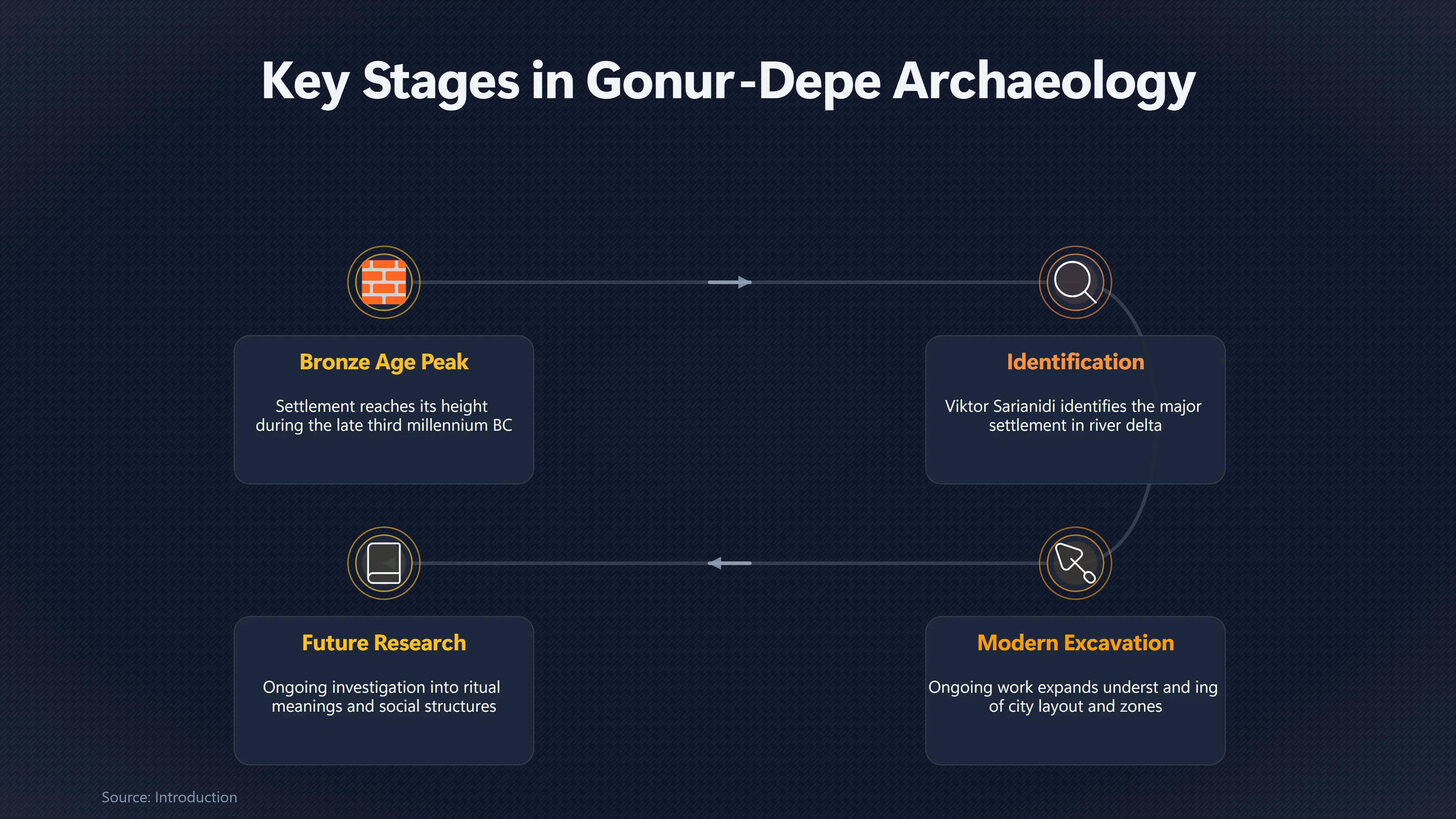
Gonur-Depe was identified in 1972 by archaeologist Viktor Sarianidi, whose excavations revealed a major Bronze Age settlement in the Murghab River delta. The site became a central reference point for understanding the BMAC, a network of Bronze Age communities spread across parts of modern Turkmenistan, Afghanistan, Uzbekistan, and neighbouring regions. Archaeologists date Gonur-Depe mainly to the late third and early second millennium BC, with the settlement reaching its peak during the Bronze Age.[Cambridge University Press & Assessment]cambridge.orgCambridge University Press & AssessmentNew polychrome painting from Gonur Depe, Turkmenistan | Antiquity | Cambridge CoreAugust 4, 2020…
The discovery was significant because it showed that complex urban life was not limited to the better-known civilisations of Mesopotamia, Egypt, or the Indus Valley. Gonur-Depe contained planned architecture, defensive walls, specialised craft production areas, and evidence of social organisation on a large scale. The site is part of a wider group of Bronze Age centres in the ancient Merv oasis, including other settlements recognised as important archaeological remains of the region.[UNESCO World Heritage Centre]whc.unesco.orgWorld Heritage Centre State Historical and Cultural Park “Ancient Merv”UNESCO World Heritage CentreState Historical and Cultural Park “Ancient Merv” - UNESCO World Heritage Centre…
For modern visitors, the most striking idea is the contrast between appearance and history. Today the surrounding Karakum landscape can seem harsh and isolated, yet during the Bronze Age the Murghab delta supported agricultural communities using water from changing river channels. Gonur-Depe demonstrates that deserts can preserve traces of highly organised societies rather than simply representing empty spaces between famous ancient centres.[Cambridge University Press & Assessment]cambridge.orgCambridge University Press & AssessmentNew polychrome painting from Gonur Depe, Turkmenistan | Antiquity | Cambridge CoreAugust 4, 2020…
What archaeologists found beneath the ruins
Excavations at Gonur-Depe uncovered a complex settlement with monumental mud-brick structures, residential areas, craft remains, and large burial zones. The site is generally divided into areas including the northern settlement and southern ritual or ceremonial zones, alongside extensive cemetery areas. Continued archaeological work has expanded understanding of the city’s layout and its relationship with smaller surrounding settlements.[Archaeological Institute]iaw.unibe.chArchaeological Institute Forschung: Archäologische Forschungen in Gonur DepeArchaeological InstituteForschung: Archäologische Forschungen in Gonur Depe - Institut für Archäologische Wissenschaften…
Among the most memorable discoveries are objects made from gold, silver, bronze, stone, and ceramics. These include jewellery, seals, vessels, ornaments, and small artistic objects that reveal skilled craftsmanship and long-distance connections. Finds from Gonur-Depe have helped researchers study how Bronze Age communities exchanged materials, technologies, and artistic ideas across Central Asia and beyond.[Cambridge University Press & Assessment]cambridge.orgCambridge University Press & AssessmentNew polychrome painting from Gonur Depe, Turkmenistan | Antiquity | Cambridge CoreAugust 4, 2020…
The site also offers clues about social differences. Richly equipped burials suggest that some individuals held higher status, while specialised ritual spaces indicate that religious activity was organised rather than purely informal. However, archaeologists continue to debate exactly how the society was structured and how closely its institutions resembled those of later urban civilisations.[ResearchGate]researchgate.netResearchGate(PDF) Evidence of Funeral Rituals from the Bactria–Margiana Archaeological Complex in Turkmenistan:: The Case of Gonur DepeMa…

Ritual objects and unanswered questions
The mystery of Bronze Age beliefs
Gonur-Depe is particularly fascinating because many discoveries appear connected with ritual activity. Archaeologists have identified ceremonial buildings, unusual installations, decorated objects, and burial practices that suggest complex beliefs about death, identity, and sacred practices. Some researchers have explored possible links between Gonur’s ritual traditions and later religious ideas in the region, but direct connections remain debated rather than proven.[ResearchGate]researchgate.netResearchGate(PDF) Evidence of Funeral Rituals from the Bactria–Margiana Archaeological Complex in Turkmenistan:: The Case of Gonur DepeMa…
One reason Gonur-Depe attracts attention is the difficulty of interpreting objects without written explanations. A beautifully made vessel or symbol may reveal advanced craftsmanship, but its original meaning can remain uncertain. Archaeologists must compare architecture, burial customs, repeated patterns of objects, and evidence from other Bronze Age cultures rather than relying on assumptions about ancient beliefs.[ResearchGate]researchgate.netResearchGate(PDF) Evidence of Funeral Rituals from the Bactria–Margiana Archaeological Complex in Turkmenistan:: The Case of Gonur DepeMa…
The site has sometimes been described through dramatic ideas about forgotten religions or mysterious ancient knowledge. The stronger archaeological picture is more grounded: Gonur-Depe represents a sophisticated society whose rituals were important, but whose exact worldview is still being reconstructed from incomplete evidence. This uncertainty is part of what makes the site valuable for research.[Cambridge University Press & Assessment]cambridge.orgCambridge University Press & AssessmentNew polychrome painting from Gonur Depe, Turkmenistan | Antiquity | Cambridge CoreAugust 4, 2020…
The unanswered questions that keep Gonur-Depe important
Several major questions remain open:
- Who exactly were the people of Margiana? Archaeologists can study their buildings, objects, and burial practices, but their own name for themselves and the language they spoke are not securely known.[BiblioIranica]biblioiranica.infoLanguage of the Bactria-Margiana Archaeological Complex – Bibliographia IranicaDecember 10, 2020…
- How were ritual spaces used? Finds suggest organised ceremonies, but interpretations of specific practices remain debated.[ResearchGate]researchgate.netResearchGate(PDF) Evidence of Funeral Rituals from the Bactria–Margiana Archaeological Complex in Turkmenistan:: The Case of Gonur DepeMa…
- Why was Gonur-Depe eventually abandoned? Changes in the Murghab River system and wider environmental shifts are considered important factors, although the decline of the settlement involved broader social and economic changes as well.[BiblioIranica]biblioiranica.infoLanguage of the Bactria-Margiana Archaeological Complex – Bibliographia IranicaDecember 10, 2020…
These unanswered questions are not weaknesses of the site; they are what make Gonur-Depe a living archaeological investigation rather than a closed historical story.
Why Gonur-Depe matters today
Gonur-Depe has become one of Turkmenistan’s strongest examples of archaeology as a form of cultural curiosity. It does not fit the traditional image of a strange museum filled with unexplained objects, yet it offers something similar: a collection of real discoveries that invite visitors to reconsider what is known about the ancient world. The “mystery” comes from the distance between modern observers and a civilisation that left behind impressive material evidence but few direct explanations.[Cambridge University Press & Assessment]cambridge.orgCambridge University Press & AssessmentNew polychrome painting from Gonur Depe, Turkmenistan | Antiquity | Cambridge CoreAugust 4, 2020…
The site also changes how Central Asia is viewed in ancient history. Instead of being treated only as a crossroads between larger neighbouring civilisations, the region appears as a place where complex societies developed in their own right. Gonur-Depe provides evidence of urban planning, skilled production, ritual traditions, and connections across a wide geographic area during the Bronze Age.[Cambridge University Press & Assessment]cambridge.orgCambridge University Press & AssessmentNew polychrome painting from Gonur Depe, Turkmenistan | Antiquity | Cambridge CoreAugust 4, 2020…
For Turkmenistan’s heritage landscape, Gonur-Depe represents one of the clearest examples of how archaeology can create a “cabinet of ancient mysteries” without relying on myths. The ruins, artefacts, and unanswered questions show a civilisation that was real, advanced, and still only partly understood.[iDAI Publications]publications.dainst.orgOpen source on dainst.org.
Today, Gonur-Depe remains primarily an archaeological research site rather than a conventional visitor attraction or standalone museum. Its importance lies in the evidence preserved in the ground: a Bronze Age city that reveals how much history can survive in places once assumed to be silent.[Archaeological Institute]iaw.unibe.chArchaeological Institute Forschung: Archäologische Forschungen in Gonur DepeArchaeological InstituteForschung: Archäologische Forschungen in Gonur Depe - Institut für Archäologische Wissenschaften…
Amazon book picks
Further Reading
Books and field guides related to The Bronze Age City Hidden in the Desert. Use these as the next step if you want deeper reading beyond the article.
The Horse, the Wheel, and Language
Roughly half the world's population speaks languages derived from a shared linguistic source known as Proto-Indo-European. But who were t...
The Silk Roads: A New History of the World
The No. 1 Sunday Times and international bestseller - a major reassessment of world history in light of the economic and political renais...
The Oxford Handbook of the Bronze Age Aegean
The Greek Bronze Age, roughly 3000 to 1000 BCE, witnessed the flourishing of the Minoan and Mycenean civilizations, the earliest expansio...
In Search of Zarathustra: Across Iran and Central Asia to Fin...
Long before the first Hebrew temple, before the birth of Christ or the mission of Muhammad, there lived in Persia a prophet to whom we ow...
eBay marketplace picks
Marketplace Samples
Live-tested eBay searches with available results related to this page.
Selected fromancient history poster oneBay.co.uk.
Endnotes
1.
Source: cambridge.org
Link:https://www.cambridge.org/core/journals/antiquity/article/new-polychrome-painting-from-gonur-depe-turkmenistan/11646E3B962E256200499E215AAAEAF8
Source snippet
Cambridge University Press & AssessmentNew polychrome painting from Gonur Depe, Turkmenistan | Antiquity | Cambridge CoreAugust 4, 2020...
Published: August 4, 2020
2.
Source: whc.unesco.org
Title: World Heritage Centre State Historical and Cultural Park “Ancient Merv”
Link:https://whc.unesco.org/en/list/886/
Source snippet
UNESCO World Heritage CentreState Historical and Cultural Park “Ancient Merv” - UNESCO World Heritage Centre...
3.
Source: researchgate.net
Link:https://www.researchgate.net/publication/331603061_Evidence_of_Funeral_Rituals_from_the_Bactria-Margiana_Archaeological_Complex_in_Turkmenistan_The_Case_of_Gonur_Depe
Source snippet
ResearchGate(PDF) Evidence of Funeral Rituals from the Bactria–Margiana Archaeological Complex in Turkmenistan:: The Case of Gonur DepeMa...
4.
Source: biblioiranica.info
Link:https://www.biblioiranica.info/language-of-the-bactria-margiana-archaeological-complex/
Source snippet
Language of the Bactria-Margiana Archaeological Complex – Bibliographia IranicaDecember 10, 2020...
Published: December 10, 2020
5.
Source: researchgate.net
Title: (PDF) New polychrome painting from Gonur Depe, Turkmenistan
Link:https://www.researchgate.net/publication/343419615_New_polychrome_painting_from_Gonur_Depe_Turkmenistan
6.
Source: margiana.su
Link:https://margiana.su/viktor-ivanovich-sarianidi/
7.
Source: researchgate.net
Title: 272487631 Animal Burials and Cult of them in Margiana
Link:https://www.researchgate.net/publication/272487631_Animal_Burials_and_Cult_of_them_in_Margiana
8.
Source: publications.dainst.org
Link:https://publications.dainst.org/journals/efb/article/view/1677
9.
Source: iaw.unibe.ch
Title: Archaeological Institute Forschung: Archäologische Forschungen in Gonur Depe
Link:https://www.iaw.unibe.ch/forschung/vorderasiatische_archaeologie/archaeologische_forschungen_in_gonur_depe/index_ger.html
Source snippet
Archaeological InstituteForschung: Archäologische Forschungen in Gonur Depe - Institut für Archäologische Wissenschaften...
10.
Source: ebrary.net
Link:https://ebrary.net/265015/sociology/margiana
11.
Source: iaw.unibe.ch
Title: ch Forschung: Stadtentwicklung und Landnutzung in Gonur Depe, Turkmenistan
Link:https://www.iaw.unibe.ch/forschung/vorderasiatische_archaeologie/stadtentwicklung_und_landnutzung_in_gonur_depe_turkmenistan/index_ger.html
Additional References
12.
Source: turkmenistan.gov.tm
Title: The autumn excavation season at Gonur-depe presented new unique finds
Link:https://turkmenistan.gov.tm/en/post/89109/autumn-excavation-season-gonur-depe-presented-new-unique-finds
Source snippet
November 1, 2024 — THE AUTUMN EXCAVATION SEASON AT GONUR-DEPE PRESENTED NEW UNIQUE FINDS 01.11.2024 Image: view-icon 8366 Image: The autu...
Published: November 1, 2024
13.
Source: youtube.com
Title: Gonur Tepe Mysterious City in Turkmenistan
Link:https://www.youtube.com/watch?v=fNf5RSj3VrU
Source snippet
Gonur Depe Turkmenistan archaeology BMAC ancient city mysteries Gonur Depe: Secrets of the Lost Bronze Age City Hidden in the Desert Ever...
14.
Source: youtube.com
Link:https://www.youtube.com/watch?v=G7FulSmkCW8
Source snippet
Gonur Tepe Mysterious City in Turkmenistan...
15.
Source: pages.vassar.edu
Title: College Pages» Gonur Depe Central Asia Sites
Link:https://pages.vassar.edu/central-asia-sites/2017/05/10/gonur-depe/
Source snippet
Vassar College Pages» Gonur Depe Central Asia Sites...
16.
Source: frontiersin.org
Link:https://www.frontiersin.org/journals/earth-science/articles/10.3389/feart.2023.1224873/full
17.
Source: sciencedirect.com
Link:https://www.sciencedirect.com/science/article/pii/S2352226716301131
18.
Source: ebrary.net
Link:https://ebrary.net/265060/sociology/
19.
Source: journals.ed.ac.uk
Link:https://journals.ed.ac.uk/lithicstudies/article/view/4490
20.
Source: youtube.com
Title: The Oxus Civilization/BMAC: a recent overview
Link:https://www.youtube.com/watch?v=vGlnBnzzoKM
Source snippet
Types of burials and funeral rituals in the Bronze Age Margiana (by the data from Gonur depe)...
21.
Source: turkmenistan.gov.tm
Title: Unique mosaic panels of the Bronze Age are exposed in the Museum of Fine Arts
Link:https://turkmenistan.gov.tm/en/post/8849/unique-mosaic-panels-of-the-bronze-age-are-exposed-in-the-museum-of-fine-arts