Within Unusual Eritrea
What Makes Eritrea's National Museum So Unusual?
Asmara's National Museum links million-year-old human fossils with rock art, archaeology, colonial objects and revolutionary memory.
On this page
- The Buia fossils and early human history
- Rock art, archaeology and ancient Red Sea objects
- Colonial rule, independence and national memory
Page outline Jump by section
Introduction
Eritrea’s National Museum in Asmara is unusual because it allows visitors to move across almost the entire span of human history in a single building. Rather than beginning with kingdoms or written records, the museum starts with evidence from around one million years ago, including fossils from the Buia site in the Danakil Depression. These finds place Eritrea within one of the world’s most important regions for understanding early human evolution. Alongside the fossil collections are prehistoric stone tools, rock art, archaeological discoveries from the Red Sea coast, and later galleries covering colonial rule and the struggle for independence. The result is a museum where deep geological time, archaeology and modern national history are presented as parts of one continuous story rather than separate subjects.[si.edu]humanorigins.si.eduHuman Origins Buia UA 31 | The Smithsonian Institution's Human Origins ProgramHuman Origins Buia UA 31 | The Smithsonian Institution's Human Origins Program
What Makes Eritrea’s National Museum So Unusual?
Many national museums concentrate on historical artefacts, art or ethnography. Eritrea’s National Museum instead combines palaeontology, archaeology, ethnography and political history, giving equal prominence to fossils that predate humanity’s oldest civilisations by hundreds of thousands of years.
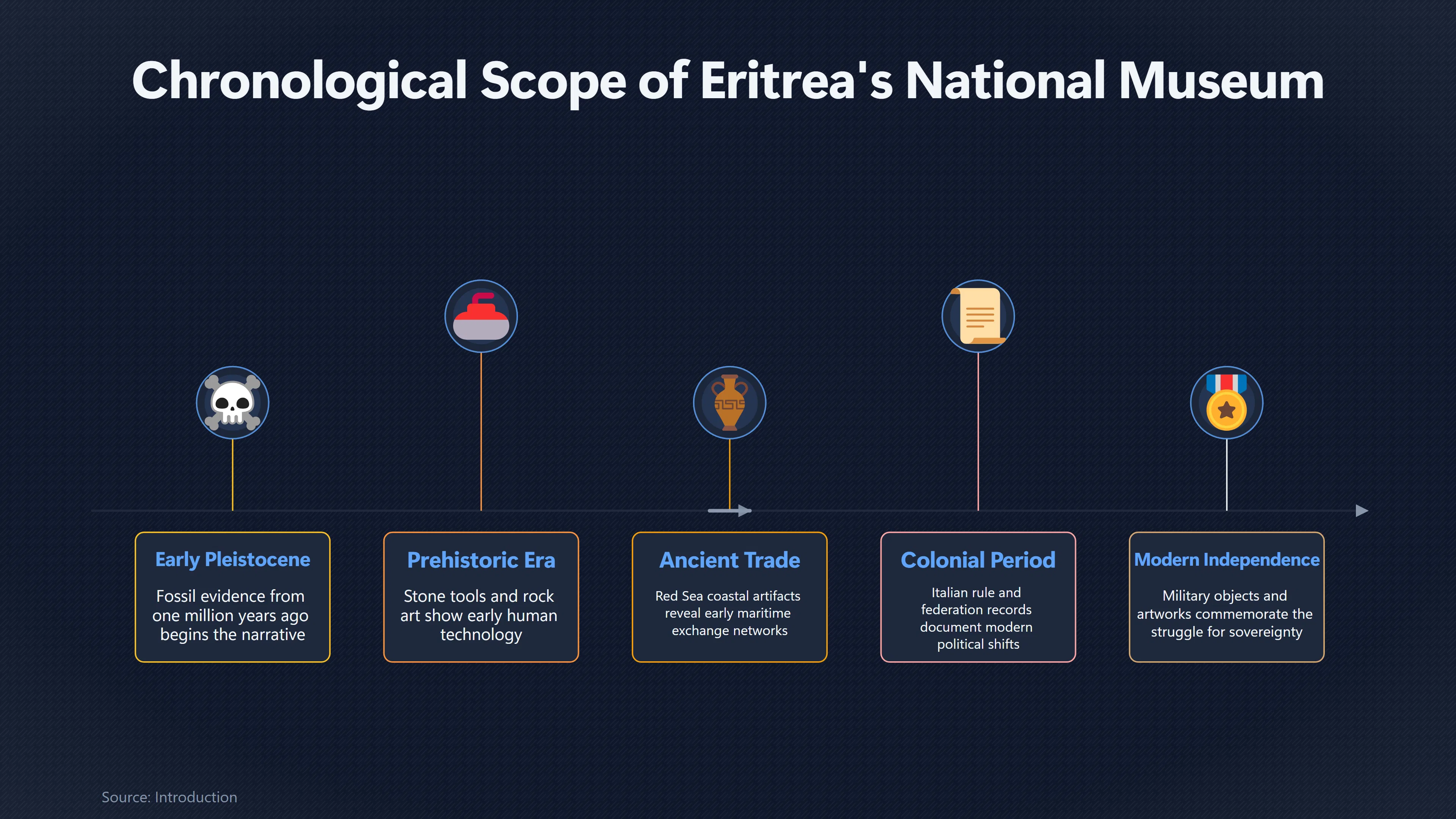
That broad chronological range makes the museum distinctive within the country’s cultural landscape. Visitors can encounter fossil evidence from the Early Pleistocene before progressing through prehistoric technology, ancient Red Sea trade, medieval heritage, colonial material and twentieth-century independence history. Rather than presenting fossils as isolated scientific specimens, the museum places them within a longer narrative about how the Eritrean landscape has changed over immense stretches of time. Research partnerships with Eritrean and international scientists have also given the museum an important role as a research repository as well as a public exhibition space.[wikipedia.org]WikipediaBuya, EritreaBuya, Eritrea
The Buia Fossils and Early Human History
The museum’s most remarkable collection comes from Buia in the Danakil Depression, where Eritrean and Italian research teams uncovered one of Africa’s most significant Early Pleistocene human fossil sites.
The best-known specimen is the cranium known as Buia UA 31, generally attributed to Homo erectus or a closely related African form of early Homo. Dating to roughly one million years ago, the skull occupies a crucial position in the fossil record between earlier African human ancestors and later populations that eventually gave rise to modern humans. Studies of its braincase suggest a combination of archaic and more advanced anatomical features, illustrating that human evolution was not a simple linear progression.[Human Origins]humanorigins.si.eduHuman Origins Buia UA 31 | The Smithsonian Institution's Human Origins ProgramHuman Origins Buia UA 31 | The Smithsonian Institution's Human Origins Program
Research has continued long after the skull’s discovery. A partial pelvis from the same area, dated to approximately 1.07–0.99 million years ago, revealed surprisingly modern-looking pelvic anatomy despite belonging to an early African member of the genus Homo. This finding challenged older assumptions that modern human pelvic structure evolved much later, showing instead that important aspects of human anatomy may have appeared earlier and with greater variation than previously thought.[nih.gov]pubmed.ncbi.nlm.nih.govPub Med A partial Homo pelvis from the Early Pleistocene of EritreaA partial Homo pelvis from the Early Pleistocene of Eritrea - PubMed…
The museum therefore displays fossils that are scientifically significant not because they are rare curiosities, but because they continue to influence international debates about early human evolution. Visitors are seeing evidence that remains part of active palaeoanthropological research rather than simply closed historical discoveries.[PubMed]pubmed.ncbi.nlm.nih.govPub Med A partial Homo pelvis from the Early Pleistocene of EritreaA partial Homo pelvis from the Early Pleistocene of Eritrea - PubMed…
More Than Human Fossils
The Buia discoveries extend well beyond hominin remains. Excavations have recovered stone tools together with fossils of mammals, crocodiles, turtles, monitor lizards and pythons.
These associated fossils allow researchers to reconstruct an environment very different from today’s harsh Danakil landscape. Around one million years ago the region contained lakes, rivers and wetlands capable of supporting large animals and early humans. The museum’s collections therefore preserve evidence not only of ancient people but also of the ecosystems in which they lived, making the deep-time galleries as much about environmental change as about human origins.[Riviste UNIMI]riviste.unimi.itITALIANA DI PALEONTOLOGIA E STRATIGRAFIADecember 31, 2004…
Rock Art, Archaeology and Ancient Red Sea Objects
After the fossil collections, the museum shifts into Eritrea’s archaeological record, showing how human activity became increasingly visible through tools, rock art and material culture.
Rock engravings and prehistoric artefacts demonstrate that the region remained inhabited long after the age represented by the Buia fossils. Stone tools chart changing technologies across thousands of years, while archaeological collections illustrate how communities adapted to shifting climates and landscapes. These galleries help bridge the enormous chronological gap between fossil humans and later historical societies.
The museum also preserves material connected with Eritrea’s Red Sea coast, including archaeological finds linked to ancient maritime exchange. Artefacts from early settlements and trading networks illustrate the country’s role in long-distance connections between northeast Africa, Arabia and the wider Indian Ocean world. Together with the fossil collections, these objects show that Eritrea’s importance extends from the earliest chapters of human evolution to the development of international commerce in antiquity.[Wikipedia]WikipediaBuya, EritreaBuya, Eritrea
Colonial Rule, Independence and National Memory
One of the museum’s defining features is the way it continues the historical narrative without breaking chronology. Instead of ending with archaeology, visitors move into galleries devoted to Italian colonial rule, the federation with Ethiopia, the independence struggle and the creation of the modern Eritrean state.
This arrangement creates an unusual experience. A journey that begins with million-year-old fossils eventually reaches photographs, military objects, documents and artworks connected with events still remembered by living generations. The museum therefore functions simultaneously as a natural history museum, archaeological museum and national history museum.
From a visitor’s perspective, this combination explains why the National Museum occupies such a distinctive place in Eritrea’s heritage. It is less a cabinet of curiosities than a chronological walk through the country’s entire known past, linking geological time, prehistoric life, ancient civilisations and modern political memory under one roof.[Wikipedia]WikipediaBuya, EritreaBuya, Eritrea
Why the Museum Matters Within Eritrea’s Curiosity Landscape
For travellers interested in unusual collections, the National Museum’s appeal lies in its evidence rather than sensationalism. Eritrea has few museums devoted to cryptids, occult traditions or eccentric collecting. Instead, its greatest curiosity is that one of the country’s principal public museums preserves direct evidence from one of the defining periods of human evolution.
The Buia fossils transform the museum from a conventional national collection into a place where visitors encounter discoveries that continue to shape international scientific understanding. Combined with rock art, archaeological finds from the Red Sea region and galleries devoted to more recent history, the museum offers one of the widest chronological journeys available in any museum in the Horn of Africa.[si.edu]humanorigins.si.eduHuman Origins Buia UA 31 | The Smithsonian Institution's Human Origins ProgramHuman Origins Buia UA 31 | The Smithsonian Institution's Human Origins Program
Amazon book picks
Further Reading
Books and field guides related to What Makes Eritrea's National Museum So Unusual?. Use these as the next step if you want deeper reading beyond the article.
The Archaeology of Ancient Eritrea
This is a collection of essays exploring the contradicting paradigms of oppression and liberation in Ethiopia.
Ancient Ethiopia: Aksum, Its Antecedents and Successors
During the first seven centuries AD there arose at Aksum in the highlands of northern Ethiopia, a unique African culture which has been d...
Against All Odds: A Chronicle of the Eritrean Revolution
A Chronicle of the Eritrean Revolution
eBay marketplace picks
Marketplace Samples
Live-tested eBay searches with available results related to this page.
Selected fromnatural history poster oneBay.co.uk.
Endnotes
1.
Source: Wikipedia
Title: Buya, Eritrea
Link:https://en.wikipedia.org/wiki/Buya%2C_Eritrea
2.
Source: sciencedirect.com
Title: ScienceDirect A partial Homo pelvis from the Early Pleistocene of Eritrea
Link:https://www.sciencedirect.com/science/article/pii/S0047248418300757
Source snippet
A partial Homo pelvis from the Early Pleistocene of Eritrea - ScienceDirect...
3.
Source: riviste.unimi.it
Link:https://riviste.unimi.it/index.php/RIPS/article/view/5764
Source snippet
ITALIANA DI PALEONTOLOGIA E STRATIGRAFIADecember 31, 2004...
Published: December 31, 2004
4.
Source: riviste.unimi.it
Link:https://riviste.unimi.it/index.php/RIPS/article/view/5761
Source snippet
A DI PALEONTOLOGIA E STRATIGRAFIA...
5.
Source: sciencedirect.com
Link:https://www.sciencedirect.com/science/article/abs/pii/S004724841400102X
6.
Source: sciencedirect.com
Link:https://www.sciencedirect.com/science/article/abs/pii/S0047248410001600
7.
Source: riviste.unimi.it
Link:https://riviste.unimi.it/index.php/RIPS/article/view/5768
8.
Source: youtube.com
Title: Eritrea: Discovery of Ancient Human Remains in BUYA-UA31
Link:https://www.youtube.com/watch?v=mGfvTf8IiXI
Source snippet
Homo erectus | The Out of Africa Series...
9.
Source: youtube.com
Title: Homo erectus | The Out of Africa Series
Link:https://www.youtube.com/watch?v=LKqy3IrLz2I
Source snippet
Glimpse into the Antiquity of Eritrea - 'Adulite Civilization'...
10.
Source: humanorigins.si.edu
Title: Human Origins Buia UA 31 | The Smithsonian Institution’s Human Origins Program
Link:https://humanorigins.si.edu/evidence/human-fossils/fossils/buia-ua-31
11.
Source: pubmed.ncbi.nlm.nih.gov
Link:https://pubmed.ncbi.nlm.nih.gov/27040007/
Source snippet
The endocast of the one-million-year-old human cranium from Buia (UA 31), Danakil Eritrea - PubMed...
12.
Source: pubmed.ncbi.nlm.nih.gov
Title: Pub Med A partial Homo pelvis from the Early Pleistocene of Eritrea
Link:https://pubmed.ncbi.nlm.nih.gov/30017175/
Source snippet
A partial Homo pelvis from the Early Pleistocene of Eritrea - PubMed...
13.
Source: nationalmuseum.gov.ph
Link:https://www.nationalmuseum.gov.ph/our-collections/archaeology/
14.
Source: nationalmuseum.co.za
Link:https://nationalmuseum.co.za/palaeontology/
Additional References
15.
Source: ucl.ac.uk
Link:https://www.ucl.ac.uk/human-evolution/news/2018/nov/partial-homo-pelvis-early-pleistocene-eritrea
Source snippet
University College LondonA partial Homo pelvis from the Early Pleistocene of Eritrea | Human Evolution @ UCL - UCL – University College L...
16.
Source: statemediamonitor.com
Title: Eritrean News Agency (ERINA) – State Media Monitor
Link:https://statemediamonitor.com/2026/04/eritrean-news-agency-erina/
Source snippet
April 27, 2026 — ERITREAN NEWS AGENCY (ERINA) April 27, 2026April 29, 2026 QUICK FACTS Eritrean News Agency (ERINA) Country Eritrea Opera...
Published: April 27, 2026
17.
Source: youtube.com
Title: Glimpse into the Antiquity of Eritrea
Link:https://www.youtube.com/watch?v=X2LlvlHCMV0
Source snippet
You Won't Believe What's Inside the National Museum of Ethiopia (The Home of Lucy)...
18.
Source: nature.com
Link:https://www.nature.com/articles/30954
19.
Source: unesco.org
Title: As family member
Link:https://www.unesco.org/en/articles/eritrea-strengthens-national-capacity-safeguard-its-living-heritage
Source snippet
Eritrea strengthens national capacity to safeguard its living heritage3 days ago — ERITREA STRENGTHENS NATIONAL CAPACITY TO SAFEGUARD ITS...
20.
Source: esteri.it
Link:https://www.esteri.it/en/sala_stampa/archivionotizie/approfondimenti/2016/06/asmara-prime-orme-di-homo-erectus-2/
21.
Source: shabait.com
Link:https://shabait.com/2026/01/13/highlights-of-local-media-interview-with-president-isaias-afwerki/
22.
Source: museu.ms
Link:https://museu.ms/exhibition/details/6742
23.
Source: shabait.com
Link:https://shabait.com/2026/01/24/president-isaias-afwerkis-interview-with-local-media-outlets-third-and-final-part/
24.
Source: ittihaas.com
Link:https://ittihaas.com/api/apps/685bf8c05cf93a74890518d0/functions/newsSharePage?newsId=69e412e914c614825d468383&slug=preserving-the-nations-identity-a-new-vision-for-the-national-museum-of-eritrea