Within Kenya Curiosities
Kenya's Sacred Forests Beyond Museums
The Kaya Forests show how sacred places can preserve history through community belief and responsibility.
On this page
- The history of the Kaya settlements
- Community guardianship and sacred traditions
- Heritage beyond glass cases
Page outline Jump by section
Introduction
Kenya’s Sacred Mijikenda Kaya Forests are a rare example of heritage that is not stored behind glass, catalogued in a building, or reduced to a collection of objects. They are living cultural landscapes where forests, ancestral sites, historic settlements, rituals and community authority remain connected. The “collection” is the place itself: a network of sacred forests and former fortified villages along Kenya’s coast that continue to be protected through Mijikenda traditions and guardianship systems.[National Museums of Kenya]museums.or.keOpen source on or.ke.
For visitors interested in unusual heritage, the Kaya Forests offer a different kind of curiosity from conventional museums. They show how belief can preserve archaeology, how spiritual rules can shape environmental conservation, and how a community can remain the primary guardian of its own history. Recognised both as a UNESCO World Heritage Site and as intangible cultural heritage requiring safeguarding, the Kayas sit at the meeting point of archaeology, folklore, conservation and living memory.[Intangible Cultural Heritage]ich.unesco.orgIntangible Cultural HeritageTraditions and practices associated with the Kayas in the sacred forests of the Mijikenda - UNESCO Intangible…
The history of the Kaya settlements
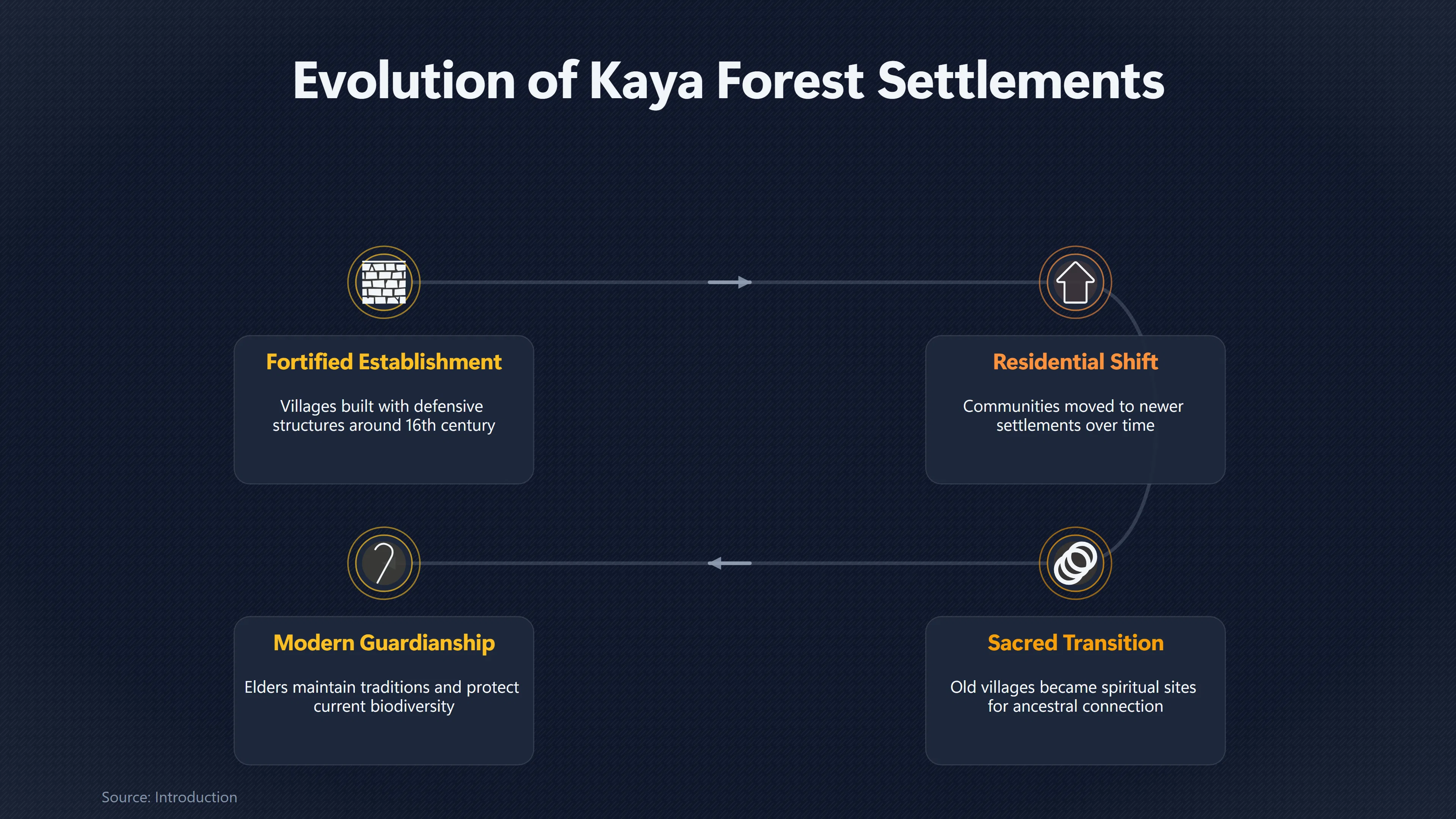
The Kaya Forests are associated with the Mijikenda, a group of nine related communities whose historic settlements developed along Kenya’s coastal region. The word kaya refers to the fortified settlements that were established from around the 16th century. These villages were protected by forest surroundings and defensive structures, but over time many ceased to function as ordinary places of residence.[UNESCO World Heritage Centre]whc.unesco.orgWorld Heritage Centre Sacred Mijikenda Kaya ForestsUNESCO World Heritage CentreSacred Mijikenda Kaya Forests - UNESCO World Heritage Centre…
Rather than becoming abandoned ruins, many Kayas changed meaning. As communities moved to newer settlements, the forests and the remains of the old villages became sacred places connected with ancestors. The landscape shifted from being mainly domestic space to a spiritual and cultural one, with restrictions placed on access and resource use. UNESCO notes that these restrictions helped sustain forest biodiversity because certain areas were protected from ordinary extraction.[National Museums of Kenya]museums.or.keOpen source on or.ke.
The unusual feature of the Kayas is therefore not simply that they are old. Many archaeological sites around the world preserve traces of past societies, but the Kayas continue to function as places of identity and ceremony. The ruins, trees, burial areas and sacred groves are interpreted through continuing cultural practices rather than only through archaeological study.[UNESCO World Heritage Centre]unesco.orgWorld Heritage Centre Sacred Mijikenda Kaya ForestsUNESCO World Heritage CentreSacred Mijikenda Kaya Forests - UNESCO World Heritage Centre
The UNESCO World Heritage designation covers a group of forest sites spread across roughly 200 kilometres of Kenya’s coast, representing numerous surviving Kaya locations. These sites include forests containing remains of fortified settlements and areas considered ancestral homes by Mijikenda communities.[UNESCO World Heritage Centre]whc.unesco.orgWorld Heritage Centre Sacred Mijikenda Kaya ForestsUNESCO World Heritage CentreSacred Mijikenda Kaya Forests - UNESCO World Heritage Centre…
Community guardianship and sacred traditions
The guardianship system behind the Kaya Forests is what makes them different from a conventional heritage attraction. Protection is not based only on government ownership, fencing or scientific conservation methods. Traditional authority remains central, especially through councils of elders who act as custodians of the Kayas and the cultural practices associated with them.[Intangible Cultural Heritage]ich.unesco.orgIntangible Cultural HeritageTraditions and practices associated with the Kayas in the sacred forests of the Mijikenda - UNESCO Intangible…
These elders help regulate how sacred areas are approached and used. The forests are linked with ceremonies and social practices including prayers, oath-taking, burial traditions, reconciliation practices, initiations, naming ceremonies and other community events. Such activities are not historical performances recreated for tourists; they are part of a continuing cultural system.[Intangible Cultural Heritage]ich.unesco.orgIntangible Cultural HeritageTraditions and practices associated with the Kayas in the sacred forests of the Mijikenda - UNESCO Intangible…
This creates an important difference between a museum object and a living heritage site. A museum usually separates an object from everyday life so that it can be preserved and interpreted. The Kaya Forests preserve meaning by keeping relationships active: between elders and younger generations, between people and ancestral places, and between cultural rules and the natural environment.[Intangible Cultural Heritage]ich.unesco.orgIntangible Cultural HeritageDecision of the Intergovernmental Committee: 4.COM 14.06 - UNESCO Intangible Cultural Heritage…
The conservation value of this approach is also significant. Traditional restrictions on cutting trees, disturbing sacred areas or using resources without permission have helped protect fragments of coastal forest that might otherwise have disappeared. The National Museums of Kenya describes the Kayas as important cultural and natural heritage areas, with councils of elders working alongside heritage authorities in their management.[National Museums of Kenya]museums.or.keNational Museums of Kenya Kaya Kauma Project – National Museums of KenyaNational Museums of Kenya Kaya Kauma Project – National Museums of Kenya
However, this guardianship model faces pressures. UNESCO has identified risks including changing lifestyles, movement away from traditional settlements, pressure on land, and declining transmission of traditional knowledge. The challenge is not only protecting trees or archaeological remains; it is maintaining the social systems that give those places their meaning.[Intangible Cultural Heritage]ich.unesco.orgIntangible Cultural HeritageDecision of the Intergovernmental Committee: 4.COM 14.06 - UNESCO Intangible Cultural Heritage…

Heritage beyond glass cases
The Kaya Forests represent a different idea of what a “collection” can be. In a project about unusual museums and curious collections, they matter because they preserve something that cannot easily be removed, displayed or owned as an isolated object. The heritage lies in a relationship between landscape, memory and community responsibility.
This makes the Kayas comparable to other forms of living heritage where the most important “artefact” is not a physical object but a practice. A carved object, ritual item or archaeological fragment can be placed in a gallery, but the Kaya Forests demonstrate that the surrounding knowledge, rules and beliefs may be equally important.[Intangible Cultural Heritage]ich.unesco.orgIntangible Cultural HeritageTraditions and practices associated with the Kayas in the sacred forests of the Mijikenda - UNESCO Intangible…
The forests also complicate the usual distinction between nature and culture. They are protected landscapes, but their ecological survival is closely tied to cultural beliefs. The forest is not preserved simply because it is rare woodland; it is preserved because it is meaningful. UNESCO identifies this connection between sacred practice and biodiversity conservation as one of the key reasons for the Kayas’ international importance.[National Museums of Kenya]museums.or.keOpen source on or.ke.
For visitors, the experience is therefore different from entering a standard museum. Access may depend on local guidance and respect for restrictions because some areas are sacred rather than tourist exhibits. The purpose is not to display a mysterious forest as an attraction, but to understand why a community has protected it for generations.[National Museums of Kenya]museums.or.keOpen source on or.ke.
Why the Kaya Forests matter in Kenya’s curiosity landscape
Kenya’s unusual heritage is often associated with fossils, archaeological discoveries and natural history collections, but the Kaya Forests add another dimension: a heritage site where belief itself has become a conservation mechanism. They show that the country’s most intriguing cultural “collections” are not always objects gathered by museums; sometimes they are places preserved by communities.
Their importance also raises wider questions about who has the right to interpret heritage. The Kayas have attracted international recognition through UNESCO, academic research and conservation programmes, but their meaning remains rooted in Mijikenda communities. The strongest interpretation of the site comes not from treating it as a forgotten ruin, but from recognising it as a living place with its own guardians, rules and responsibilities.[Intangible Cultural Heritage]ich.unesco.orgIntangible Cultural HeritageTraditions and practices associated with the Kayas in the sacred forests of the Mijikenda - UNESCO Intangible…
In that sense, the Sacred Mijikenda Kaya Forests are one of Kenya’s most distinctive examples of heritage beyond museums: a preserved landscape where history survives not because it has been frozen in time, but because people continue to care for it.

Amazon book picks
Further Reading
Books and field guides related to Kenya's Sacred Forests Beyond Museums. Use these as the next step if you want deeper reading beyond the article.
The Forest Unseen
A biologist reveals the secret world hidden in a single square meter of old-growth forest—a finalist for the Pulitzer Prize and the Pen/E...
Braiding Sweetgrass
'A hymn of love to the world ... A journey that is every bit as mythic as it is scientific, as sacred as it is historical, as clever as i...
The Human Past Essentials
The most authoritative world prehistory book on the market is now available in a new, thoroughly up-to-date essentials version. Partnerin...
eBay marketplace picks
Marketplace Samples
Live-tested eBay searches with available results related to this page.
Selected fromAfrican heritage decor oneBay.co.uk.

Endnotes
1.
Source: whc.unesco.org
Title: World Heritage Centre Sacred Mijikenda Kaya Forests
Link:https://whc.unesco.org/en/list/1231/
Source snippet
UNESCO World Heritage CentreSacred Mijikenda Kaya Forests - UNESCO World Heritage Centre...
2.
Source: ich.unesco.org
Link:https://ich.unesco.org/en/RL/traditions-and-practices-associated-with-the-kayas-in-the-sacred-forests-of-the-mijikenda-00313
Source snippet
Intangible Cultural HeritageTraditions and practices associated with the Kayas in the sacred forests of the Mijikenda - UNESCO Intangible...
4.
Source: whc.unesco.org
Title: World Heritage Centre UNESCO World Heritage Centre
Link:https://whc.unesco.org/en/decisions/4265
Source snippet
UNESCO World Heritage CentreUNESCO World Heritage Centre - Decision - 32 COM 8B.50...
5.
Source: ich.unesco.org
Link:https://ich.unesco.org/en/Decisions/4.COM/14.06
Source snippet
Intangible Cultural HeritageDecision of the Intergovernmental Committee: 4.COM 14.06 - UNESCO Intangible Cultural Heritage...
6.
Source: ich.unesco.org
Link:https://ich.unesco.org/en/USL/traditions-and-practices-associated-with-the-kayas-in-the-sacred-forests-of-the-mijikenda-00313
7.
Source: whc.unesco.org
Link:https://whc.unesco.org/en/decisions/1319/
8.
Source: whc.unesco.org
Link:https://whc.unesco.org/en/list/1231/documents/
9.
Source: whc.unesco.org
Link:https://whc.unesco.org/en/list/1231/maps/
10.
Source: whc.unesco.org
Link:https://whc.unesco.org/fr/list/1231/
11.
Source: ich.unesco.org
Link:https://ich.unesco.org/en/USL/traditions-and-practices-associat-%20ed-with-the-kayas-in-the-sacred-forests-of-the-mijikenda-00313
12.
Source: ich.unesco.org
Title: individual case study 00988
Link:https://ich.unesco.org/en/individual-case-study-00988?id=00020
13.
Source: ich.unesco.org
Title: kenya KE
Link:https://ich.unesco.org/en/state/kenya-KE?cp=KE&info=periodic-reporting&topic=en-state
14.
Source: ich.unesco.org
Link:https://ich.unesco.org/en/assistances/traditions-and-practices-associated-with-the-kayas-in-the-sacred-forests-of-the-mijikenda-00326
15.
Source: ar.unesco.org
Link:https://ar.unesco.org/silkroad/node/3485
16.
Source: museums.or.ke
Link:https://museums.or.ke/sacred-mijikenda-kaya-forests/
17.
Source: museums.or.ke
Title: National Museums of Kenya Kaya Kauma Project – National Museums of Kenya
Link:https://museums.or.ke/kaya-kauma-project/
18.
Source: worldheritageexplorer.org
Link:https://www.worldheritageexplorer.org/sites/sacred_mijikenda_kaya_forests.html
Source snippet
ber: 1231 World Heritage since: 2008 Category: Cultural Heritage WHE Type: Religious Sites & Sacred Architecture Transbounda...
19.
Source: sportsheritage.go.ke
Title: Mijikenda Kaya Forests
Link:https://sportsheritage.go.ke/mijikenda-kaya-forests/
20.
Source: kenya-delegation-unesco.org
Title: Sacred Mijikenda Kaya Forests
Link:https://kenya-delegation-unesco.org/unesco-world-heritage-sites-in-kenya/sacred-mijikenda-kaya-forests/
Additional References
21.
Source: youtube.com
Link:https://www.youtube.com/watch?v=vwM1RV_j2Q4
Source snippet
Exploring the Sacred Mijikenda Kaya Forests of Kenya...
22.
Source: youtube.com
Title: Meet the Kaya Forest Community
Link:https://www.youtube.com/watch?v=X9vXyWtWj2A
Source snippet
Sacred Mijikenda Kaya Forests Kenya UNESCO heritage Traditions and practices associated to the Kayas in the sacred forests of the Mijiken...
23.
Source: youtube.com
Title: Establishing a biocultural heritage territory to protect Kenya’s Kaya Forests
Link:https://www.youtube.com/watch?v=rzvstpEMWTU
Source snippet
Kaya elders decry wanton destruction of their shrines...
24.
Source: youtube.com
Title: Exploring the Sacred Mijikenda Kaya Forests of Kenya
Link:https://www.youtube.com/watch?v=0XdcSopSbJ0
Source snippet
Establishing a biocultural heritage territory to protect Kenya’s Kaya Forests...
25.
Source: link.springer.com
Link:https://link.springer.com/chapter/10.1007/978
Source snippet
Ecological Connectivity in a Kaya Forest Landscape Through Biocultural Heritage Territory (BCHT) Management Model | Springer Nature LinkO...
26.
Source: tdb.maeasam.org
Link:https://tdb.maeasam.org/report/b5d883a6-0325-403e-808a-373f05331769
Source snippet
Resource ReportJuly 16, 2026 — for more documentation, visit arches.readthedocs.io Site - Sacred Mijikenda Kaya Forests Report Date: July...
Published: July 16, 2026
27.
Source: researchgate.net
Link:https://www.researchgate.net/publication/250015359_The_Contribution_of_Ecotourism_to_the_Conservation_of_Natural_Sacred_Sites_A_Case_Study_from_Coastal_Kenya
28.
Source: africabib.org
Link:https://www.africabib.org/rec.php?RID=K00002797
29.
Source: iied.org
Link:https://www.iied.org/21556iied
30.
Source: iied.org
Link:https://www.iied.org/establishing-biocultural-heritage-territory-protect-kenyas-kaya-forests