Within Guinea Bissau Curiosities
How Photographs Helped Rebuild Bissau's Lost Museum
Bissau's ethnographic museum was reconstructed through surviving objects, contact sheets and memories after civil-war destruction.
On this page
- The museum before the civil war
- What survived in the contact sheets
- Reopening, access and incomplete recovery
Page outline Jump by section
Introduction
Guinea-Bissau’s National Ethnographic Museum is unusual not because it houses spectacular curiosities, but because much of its modern identity was rebuilt from fragments of its own lost archive. After the 1998–99 civil war devastated the museum, destroying or dispersing collections and thousands of photographs, researchers, museum staff and curators reconstructed its history using surviving contact sheets, damaged objects and the memories of the people who had created the institution. The result is a museum that documents not only the country’s cultural diversity but also the destruction and recovery of cultural memory itself. Rather than treating photographs as simple illustrations, the reconstruction project turned them into primary evidence, allowing lost exhibitions, collecting expeditions and forgotten objects to be identified decades after the original museum had effectively disappeared.[le.ac.uk]journals.le.ac.ukUniversity of Leicester Open JournalsThe Lives and Deaths of an Ethnographic Museum: History, Violence and Curatorial Collaborations in G…
How Photographs Helped Rebuild Bissau’s Lost Museum
The National Ethnographic Museum opened in 1988 as Guinea-Bissau’s principal museum devoted to the country’s many ethnic communities. It collected textiles, tools, ceremonial objects, domestic artefacts and masks, but it also displayed photographs showing these objects being used in everyday life, festivals and religious ceremonies. This emphasis on context distinguished it from museums that present objects as isolated works of art. Instead, visitors could see how material culture functioned within living communities.[Oxford University]ox.ac.ukOxford University Blow-up in Bissau | University of OxfordOxford University Blow-up in Bissau | University of Oxford
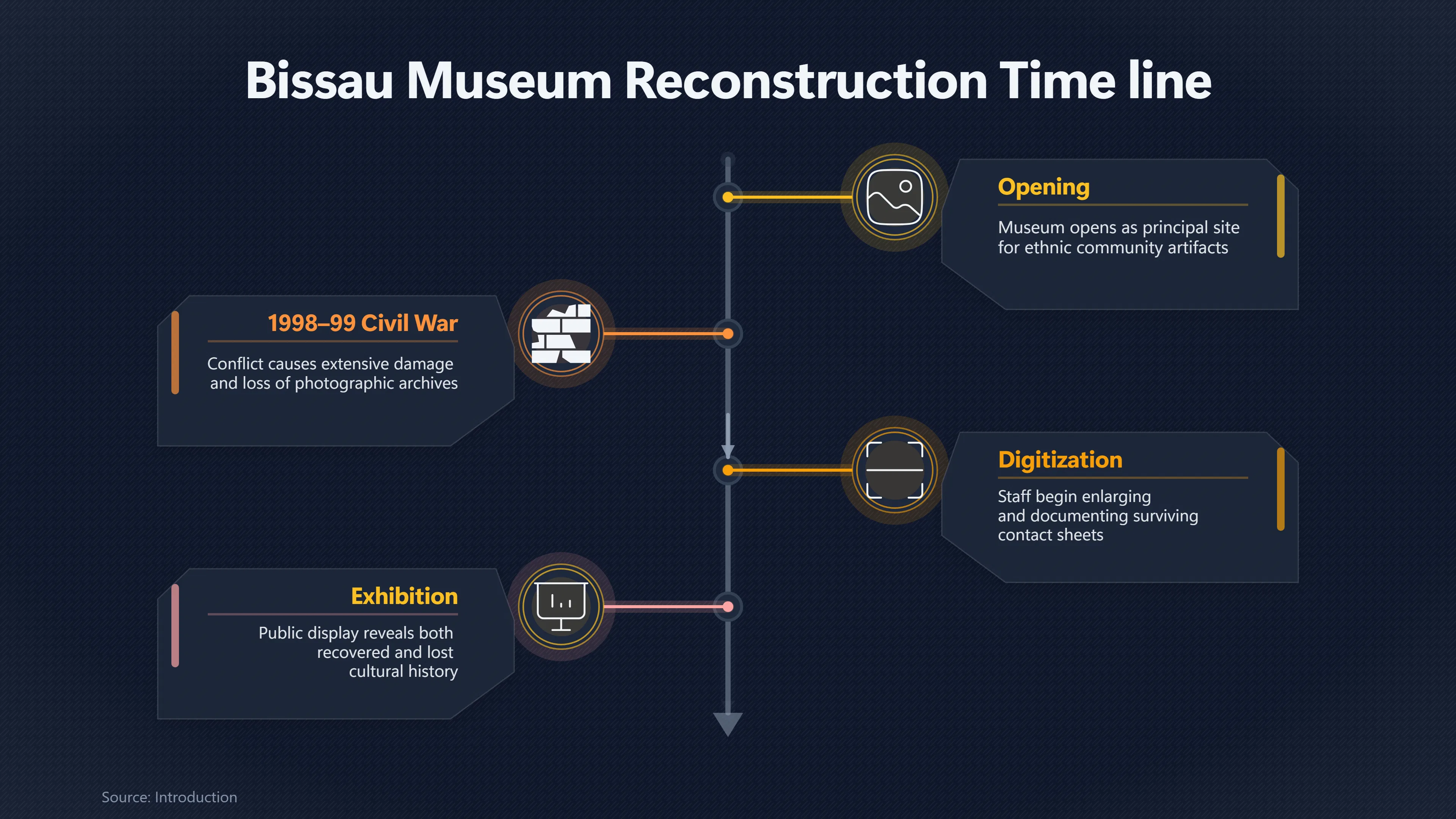
Everything changed during the civil war of 1998–99. The museum building was occupied by Senegalese troops supporting the government, while fighting in Bissau caused extensive damage. Much of the collection was destroyed, dispersed or left in poor condition, and the museum’s photographic archive—thousands of negatives and prints documenting fieldwork carried out since the mid-1980s—was largely lost. By the early 2000s the institution had effectively ceased to exist as a functioning national museum.[ox.ac.uk]ox.ac.ukOxford University Blow-up in Bissau | University of OxfordOxford University Blow-up in Bissau | University of Oxford
What survived was unexpectedly modest: several hundred contact sheets, a small number of damaged artefacts and the recollections of former museum staff. Those fragments became the foundation for rebuilding both the museum’s collections and its institutional history.[Anthropology & Museum Ethnography]anthro.web.ox.ac.ukpology & Museum EthnographyBlow-up in Bissau: Images and Memories of a National Ethnographic Museum in Bissau | School of Anthropol…
The Museum Before the Civil War
The museum emerged during Guinea-Bissau’s first decades of independence, when cultural institutions were expected to strengthen national identity while recognising the country’s remarkable linguistic and cultural diversity. Museum staff travelled across the country documenting everyday life, religious practices, craftsmanship and local traditions.
Importantly, the museum’s collecting policy was often more restrained than outsiders might expect. Researchers involved in documenting its history note that fieldworkers frequently chose not to remove certain sacred ritual objects from communities. Instead, they photographed ceremonies, recorded information and collected only items whose transfer had been negotiated. This means the photographic archive preserved aspects of cultural life that were never fully represented by the physical collection alone.[University of Leicester Open Journals]journals.le.ac.ukUniversity of Leicester Open JournalsThe Lives and Deaths of an Ethnographic Museum: History, Violence and Curatorial Collaborations in G…
Because photographs accompanied many displays, the archive recorded not just individual artefacts but also exhibition design, field expeditions, museum staff, donors and community collaborations. After the war, those images became essential evidence for reconstructing all of these relationships.
What Survived in the Contact Sheets
The most remarkable survivors were approximately 400–450 contact-print sheets. Contact sheets are proof pages made directly from photographic negatives, allowing photographers to review every frame before producing larger prints. Normally they are temporary working material. In Guinea-Bissau they became the principal surviving visual archive after the negatives themselves were destroyed.[ox.ac.uk]anthro.web.ox.ac.ukpology & Museum EthnographyBlow-up in Bissau: Images and Memories of a National Ethnographic Museum in Bissau | School of Anthropol…
Beginning in 2012, museum director Albano Mendes collaborated with anthropologist Ramon Sarró and curator Ana Temudo to digitise, enlarge and document these fragile sheets. Enlarging the tiny images made it possible to identify:
- objects that had disappeared;
- former exhibitions inside the museum;
- fieldwork carried out during the 1980s;
- museum staff and community collaborators;
- places where collecting expeditions had taken place;
- aspects of Guinea-Bissau’s cultural heritage that no longer survived in the museum itself.[ox.ac.uk]anthro.web.ox.ac.ukpology & Museum EthnographyBlow-up in Bissau: Images and Memories of a National Ethnographic Museum in Bissau | School of Anthropol…
Researchers also relied on interviews with former employees and visitors, comparing memories against the photographs to identify people, dates and locations. In this sense the museum was reconstructed through a combination of visual evidence and oral history rather than by recovering the original collection alone.[University of Leicester Open Journals]journals.le.ac.ukUniversity of Leicester Open JournalsThe Lives and Deaths of an Ethnographic Museum: History, Violence and Curatorial Collaborations in G…
Reopening, Access and Incomplete Recovery
The reconstruction project became publicly visible through the exhibition The National Ethnographic Museum of Bissau: 30 Years of History, opened in September 2017. Instead of pretending the losses had never happened, the exhibition displayed enlarged versions of the contact-sheet images alongside surviving artefacts, telling visitors both what had once existed and what had been lost. According to the researchers involved, the exhibition attracted official attention and helped secure renewed political support for reopening the museum.[ox.ac.uk]anthro.web.ox.ac.ukpology & Museum EthnographyBlow-up in Bissau: Images and Memories of a National Ethnographic Museum in Bissau | School of Anthropol…
The museum therefore reopened not as a perfect reconstruction but as a visibly incomplete institution. Many original artefacts remain missing, and the photographic archive itself survives only in fragmentary form. That incompleteness is now part of the museum’s identity rather than something hidden from visitors.[University of Leicester Open Journals]journals.le.ac.ukUniversity of Leicester Open JournalsThe Lives and Deaths of an Ethnographic Museum: History, Violence and Curatorial Collaborations in G…
Practical information for visitors remains less predictable than at larger national museums elsewhere. Opening arrangements and staffing have varied over time, reflecting Guinea-Bissau’s limited cultural funding and the continuing challenges of maintaining museum infrastructure. Travellers should therefore expect a small institution whose greatest significance lies in its history rather than in the scale of its displays.[Oxford University]ox.ac.ukOxford University Blow-up in Bissau | University of OxfordOxford University Blow-up in Bissau | University of Oxford

Why This Museum Matters in Guinea-Bissau’s Curiosity Landscape
Within Guinea-Bissau’s unusual heritage sites, the National Ethnographic Museum stands apart because its most extraordinary collection is, in effect, a collection of evidence about its own destruction. The damaged contact sheets preserve vanished exhibitions, lost objects and forgotten museum practices while demonstrating how photographs can become historical artefacts in their own right.
That gives the museum a dual role. It remains an ethnographic museum documenting the country’s diverse cultures, but it is also a case study in cultural resilience. Visitors encounter not only masks, textiles and everyday objects but also the story of how a nation’s museum was painstakingly rebuilt from proof sheets that were never intended to survive. Few museums illustrate so clearly how fragile cultural memory can be—and how much can sometimes be recovered from what appears to be little more than photographic scraps.[le.ac.uk]journals.le.ac.ukUniversity of Leicester Open JournalsThe Lives and Deaths of an Ethnographic Museum: History, Violence and Curatorial Collaborations in G…
Amazon book picks
Further Reading
Books and field guides related to How Photographs Helped Rebuild Bissau's Lost Museum. Use these as the next step if you want deeper reading beyond the article.
The Past Is a Foreign Country
A completely updated new edition of David Lowenthal's classic account of how we reshape the past to serve present needs.
The Archive and the Repertoire: Performing Cultural Memory in...
An interdisciplinary study about the centrality of performance in Latin American culture and politics.

The Social Life of Things: Commodities in Cultural Perspective
First published 1986. Subjects: Social aspects, Commerce, Economic anthropology, History, Commodity exchanges.
eBay marketplace picks
Marketplace Samples
Live-tested eBay searches with available results related to this page.
Selected fromAfrican photo print oneBay.co.uk.

Endnotes
1.
Source: journals.le.ac.uk
Link:https://journals.le.ac.uk/index.php/mas/article/view/3825
Source snippet
University of Leicester Open JournalsThe Lives and Deaths of an Ethnographic Museum: History, Violence and Curatorial Collaborations in G...
2.
Source: anthro.web.ox.ac.uk
Link:https://anthro.web.ox.ac.uk/blow-up-in-bissau-images-and-memories-of-a-national-ethnographic-museum-in-bissau
Source snippet
pology & Museum EthnographyBlow-up in Bissau: Images and Memories of a National Ethnographic Museum in Bissau | School of Anthropol...
3.
Source: ox.ac.uk
Title: Oxford University Blow-up in Bissau | University of Oxford
Link:https://www.ox.ac.uk/research/research-impact/blow-bissau
4.
Source: prm.ox.ac.uk
Link:https://www.prm.ox.ac.uk/node/819581
5.
Source: prm.ox.ac.uk
Title: PRM Oxford BLOW-UP
Link:https://www.prm.ox.ac.uk/files/blow-upinbissaubookletpdf
Source snippet
IN BISSAU PHOTOGRAPHY AND MUSEUM REVIVAL...
Additional References
6.
Source: researchgate.net
Link:https://www.researchgate.net/publication/355824512_The_Lives_and_Deaths_of_an_Ethnographic_Museum_History_Violence_and_Curatorial_Collaborations_in_Guinea-Bissau
Source snippet
November 1, 2021 — THE LIVES AND DEATHS OF AN ETHNOGRAPHIC MUSEUM: HISTORY, VIOLENCE AND CURATORIAL COLLABORATIONS IN GUINEA-BISSAU * Nov...
Published: November 1, 2021
7.
Source: instituto-camoes.pt
Title: bissau exposicao e reabertura do museu etnografico nacional 30 anos de historia
Link:https://www.instituto-camoes.pt/activity/o-que-fazemos/cultura-portuguesa/agenda/bissau-exposicao-e-reabertura-do-museu-etnografico-nacional-30-anos-de-historia
Source snippet
Bissau: Exposição e reabertura do Museu Etnográfico Nacional – 30 Anos de História - Camões - Instituto da Cooperação e da LínguaSeptembe...
8.
Source: journals.openedition.org
Title: O grupo de trabalho que viajou pelo país e reuniu o núcleo de artefac
Link:https://journals.openedition.org/midas/2376
Source snippet
Mendes, Ramon Sarró e Ana Temudo – O Museu Etnográfico Nacional da Guiné-Bissau: Imagens para uma HistóriaDecember 15, 2020 — 3 Um outro...
Published: December 15, 2020
9.
Source: youtube.com
Title: Brazilian 3D scans could help rebuild part of heritage lost in the fire
Link:https://www.youtube.com/watch?v=NDuUjzi3jUU
Source snippet
Brazil’s National Museum tries to recover one year after devastating fire...
10.
Source: youtube.com
Title: Brazil’s National Museum tries to recover one year after devastating fire
Link:https://www.youtube.com/watch?v=fXiAIQC8mOs
Source snippet
3D digital reconstructions bring back ancient Arab cities...
11.
Source: youtube.com
Title: Rekrei: A public platform for digitally preserving lost heritage
Link:https://www.youtube.com/watch?v=wSCtrq_JMFM
Source snippet
Brazilian 3D scans could help rebuild part of heritage lost in the fire...
12.
Source: youtube.com
Title: Reco VR: Mosul, a collective reconstruction
Link:https://www.youtube.com/watch?v=0EazGA673fk
Source snippet
Rekrei: A public platform for digitally preserving lost heritage...
13.
Source: apantropologia.org
Link:https://apantropologia.org/o-museu-etnografico-nacional-de-bissau-30-anos-de-historia/
14.
Source: mendeley.com
Link:https://www.mendeley.com/catalogue/0eca9bb4-85c0-3ecd-a0fa-6e0778fb17ae/
15.
Source: anthro.ox.ac.uk
Link:https://www.anthro.ox.ac.uk/blow-up-in-bissau-images-and-memories-of-a-national-ethnographic-museum-in-bissau