What Makes India's Museums So Unexpected?
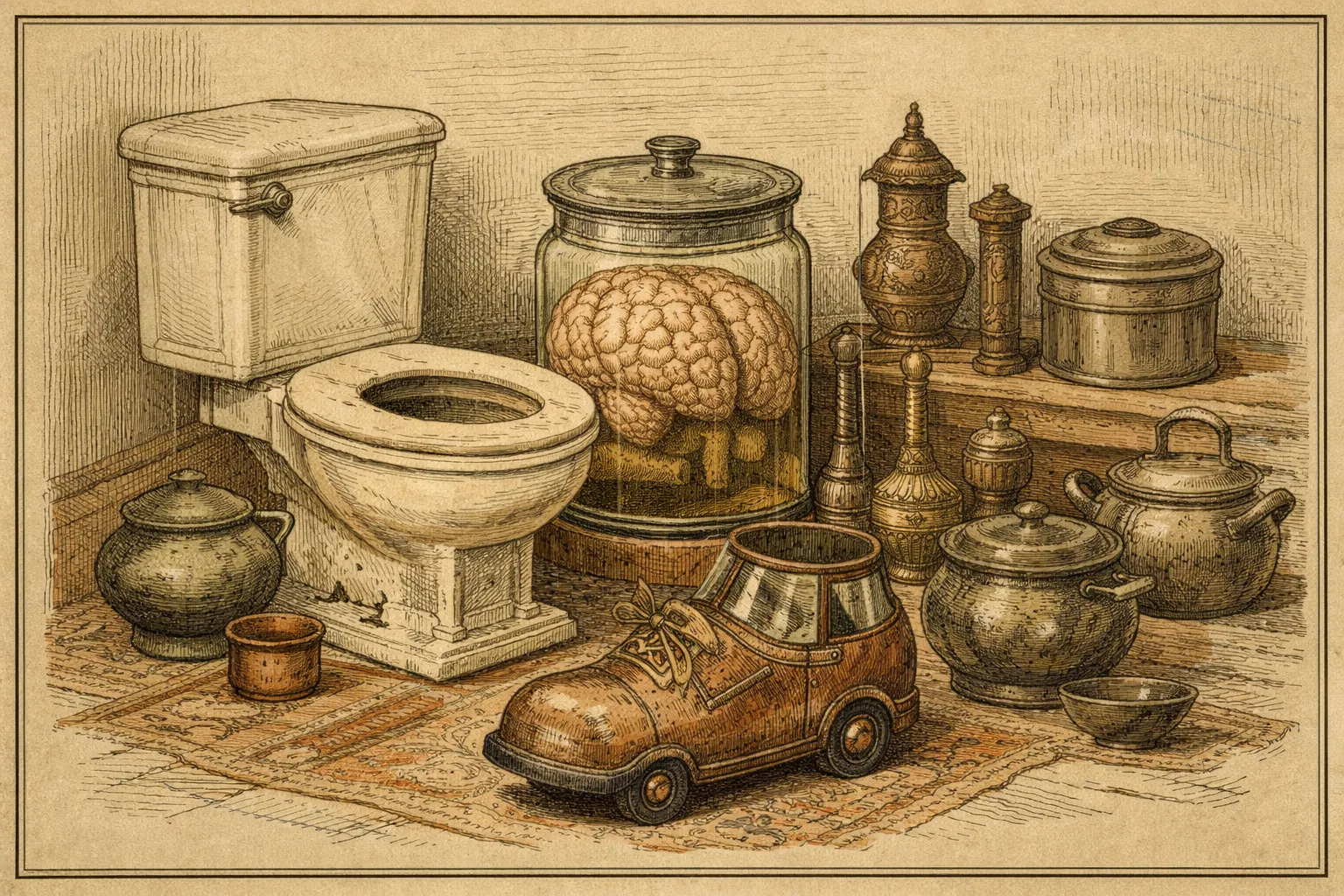
India’s strangest museums are rarely strange for strangeness’s sake. A museum of toilets in Delhi is really about sanitation and social reform. A collection of preserved brains in Bengaluru teaches neuroscience and public health. A village museum in Assam turns traditions of magic, healing and folklore into local heritage.
Page outline Jump by section
Introduction
India’s strangest museums are rarely strange for strangeness’s sake. A museum of toilets in Delhi is really about sanitation and social reform. A collection of preserved brains in Bengaluru teaches neuroscience and public health. A village museum in Assam turns traditions of magic, healing and folklore into local heritage. Elsewhere, Egyptian mummies, prison cells, ritual masks, antique cooking vessels and vehicles shaped like shoes or hamburgers reveal how unusually broad the idea of a museum can become.
There is no single national circuit of “weird museums”. India’s curiosity culture is scattered among government institutions, universities, charitable organisations, private collectors, restaurants, historic prisons and community museums. Some collections are carefully researched; others blend scholarship with tourism, family memory, religious belief or local legend. The most rewarding visits therefore involve more than finding an eccentric object. They ask who collected it, what purpose the display serves and where documented history ends and storytelling begins.
The strongest unusual museums to visit
Several Indian collections stand out because their subjects are genuinely distinctive, their public status is reasonably clear and their exhibits offer more than novelty.
Sulabh International Museum of Toilets, Delhi. Perhaps India’s best-known unconventional museum, Sulabh traces toilets and sanitation from the ancient world to modern engineering. Its displays include privies, chamber pots, bidets, water closets, diagrams, replicas and material about changing toilet etiquette, laws and waste systems. Although humorous objects attract attention, the museum belongs to a sanitation and social-reform organisation, so its central message concerns public health, dignity and access rather than bathroom comedy.[sulabhtoiletmuseum.org]sulabhtoiletmuseum.orgAbout | SulabhmuseumSulabh International Museum of ToiletsThe Museum has a rare collection of facts, pictures and objects detailing the historic evolution of…
Visitors should expect a relatively compact, information-heavy collection rather than a vast hall filled with thousands of historic lavatories. An assessment published by the National Museum of Australia described it as primarily a sequence of images, graphics and photographs supported by a modest number of physical objects and models. That distinction matters because travel coverage sometimes markets it as a cabinet of bizarre plumbing, while its real value lies in connecting bodily necessity to technology, caste, labour, urban planning and sanitation policy.[recollections.nma.gov.au]recollections.nma.gov.ausulabh international museum toiletsSulabh International Museum of Toilets, New DelhiEstablished in 1970. Sulabh's museum is essentially a series of images, drawings, graphi…
NIMHANS Brain Museum, Bengaluru. The museum associated with the National Institute of Mental Health and Neurosciences displays preserved human brains affected by injuries, infections, tumours, vascular disease and degenerative conditions. It is an educational medical collection rather than a horror attraction, with guided visits intended to improve public understanding of neuroscience. The institution describes it as open to students, children and the general public, though access is structured around tours rather than casual all-day admission.[thenimhansbrainbank.in]thenimhansbrainbank.inMuseum | The NIMHANS Brain BankBrain Museum is the only one-of-its kind in India Once experience for visitors: guided tour available Open…
The unusual impact comes from seeing real human tissue rather than models. Reports have also described demonstrations in which visitors can handle a prepared specimen under supervision, but such details and tour arrangements should be confirmed directly before travelling. The collection belongs to a research and teaching environment, and the specimens represent diseases and individual lives, not anonymous “oddities”. That ethical distinction is important whenever museums exhibit human remains.[Atlas Obscura]atlasobscura.comnimhans brain museumAtlas ObscuraVisitors Can Touch Human Brains at This Indian…September 21, 2018 — 21 Sept 2018 — Visitors to India's only Brain Museum…
Mayong Central Museum and Emporium, Assam. Mayong has long been promoted as a village associated with magic, charms, divination and traditional healing. Assam Tourism identifies the museum as a place to see archaeological objects and books connected with healing traditions and black magic; it also notes that demonstrations may be arranged locally.[assamtourism.gov.in]assamtourism.gov.inOpen source on assamtourism.gov.in.
This is one of India’s clearest examples of folklore becoming a visitor attraction. The displays reportedly include manuscripts, ritual implements, weapons and healing materials, but the collection must be read cautiously. Mayong’s reputation is built from oral traditions, regional identity, tourism promotion and fragmentary historical evidence. A responsible visitor should not treat every supernatural story as a verified description of past events, nor assume that ritual medicine and stage demonstrations represent one continuous, unchanged tradition. The museum is most valuable as evidence of how a community remembers, performs and commercialises its reputation for magic.[assamtourism.gov.in]assamtourism.gov.inOpen source on assamtourism.gov.in.
Vechaar Utensils Museum, Ahmedabad. Situated within the Vishalla restaurant complex, Vechaar transforms everyday domestic objects into a surprisingly rich private museum. Gujarat Tourism describes a collection of urns, jugs, spittoons, pots, locks and other household implements arranged along a rustic gallery. It was founded in 1981 from the restaurant founder’s collection and developed with anthropological input.[gujrattourism]gujarattourism.comveechar cultural and heritage museum for utensilsveechar cultural and heritage museum for utensils
Its strangeness lies less in grotesque objects than in obsessive specificity. Once hundreds of vessels, nutcrackers, storage boxes, lamps and cooking tools are assembled together, ordinary domestic life begins to look like an enormous field of forgotten technologies. The museum also preserves forms that are disappearing as metalwork, cooking practices and household economies change. Because it is attached to a commercial hospitality venue, it combines cultural preservation with a deliberately atmospheric visitor experience.[gujrattourism]gujarattourism.comveechar cultural and heritage museum for utensilsveechar cultural and heritage museum for utensils
Sudha Cars Museum, Hyderabad. This private collection displays working novelty vehicles built in the shapes of familiar objects, including shoes, cameras, sports equipment, food and household items. Guinness World Records reported in 2024 that the museum held 57 such vehicles, created by designer and builder Kanyaboyina Sudhakar.[Guinness World Records]guinnessworldrecords.comdiscover the most bizarre car museum in the worlddiscover the most bizarre car museum in the world
Unlike museums that preserve historic artefacts, Sudha Cars is closer to an exhibition of mechanical folk art and personal invention. The vehicles are deliberately comic, but they also demonstrate metal fabrication, improvised engineering and the collector’s sustained commitment to one eccentric idea. It is among India’s most openly entertainment-led curiosity museums: private, accessible and designed around visual surprise rather than academic interpretation.
Mummies, brains and the uneasy display of bodies
India’s unusual collections include several displays of human remains, but they differ sharply in origin and purpose. The Egyptian Gallery at the Indian Museum in Kolkata contains an Egyptian mummy and a mummified hand. The museum presents these within an archaeological collection, alongside material intended to explain ancient Egyptian funerary culture.[indianmuseumkolkata.org]indianmuseumkolkata.orgOpen source on indianmuseumkolkata.org.
The mummy is one of the Indian Museum’s most popular exhibits, together with fossils, dinosaur eggs and large zoological specimens. Its presence also reflects the global collecting practices of nineteenth-century museums, when Egyptian bodies and funerary objects were transported internationally and displayed as scientific or archaeological specimens. The Indian Museum itself developed within that colonial museum tradition, making the mummy both an ancient person and an artefact in the history of institutional collecting.[indianmuseumkolkata.org]indianmuseumkolkata.orgOpen source on indianmuseumkolkata.org.
An Egyptian mummy at the Telangana State Archaeology Museum in Hyderabad illustrates a different problem: preservation. Reporting in July 2025 described visible deterioration and a need for substantial conservation work, despite earlier gallery renovation. The case shows why the existence of an extraordinary object does not necessarily mean that it is securely funded, well interpreted or displayed under ideal conditions.[The Times of India]timesofindia.indiatimes.comOpen source on indiatimes.com.
Medical displays such as the NIMHANS brains raise related questions. Human tissue can teach visitors about disease in a way that illustrations cannot, but it also requires careful consent, respectful language and clear educational framing. International museum practice increasingly treats human remains as a sensitive category rather than merely another form of specimen. Visitors should therefore judge these galleries not by how shocking they are, but by whether they explain provenance, medical purpose and the dignity owed to the dead.[Museums Association]museumsassociation.orgperspectives on human remainsperspectives on human remains
Where folklore becomes a collection
India’s folklore museums often provide the country’s closest equivalent to collections of monsters, spirits, witchcraft and supernatural belief. They may not contain “proof” of uncanny beings, but they preserve the masks, costumes, ritual objects, stories and performance traditions through which such beings acquire cultural form.
The Folklore Museum at the University of Mysore was established as an academic collection of Karnataka’s folk arts and crafts. Its significance lies in bringing together material that might otherwise remain dispersed among performers, villages and private households. As a university museum, it is more closely connected to documentation and scholarship than most tourist-led collections.[Wikipedia]WikipediaFolklore Museum (MysuruFolklore Museum (Mysuru
In Kochi, the privately run Kerala Folklore Museum is known for densely arranged architecture, sculpture, masks, ritual art and performance-related objects. Such a collection can be visually overwhelming, and labels may not always answer every question about date, locality or ritual use. Nevertheless, its masks and carved figures offer an immediate route into traditions in which gods, demons, ancestors and legendary characters are made physically present through costume and performance.
The Loktak Folklore Museum on Thanga Island in Manipur represents a more local model. Its collection is tied to the communities, fishing practices, beliefs, medicines and oral literature surrounding Loktak Lake. Rather than presenting folklore as a national category, it connects stories and objects to one ecological landscape.[Wikipedia]WikipediaLoktak Folklore MuseumLoktak Folklore Museum
These museums are important because supernatural traditions are easily distorted when separated from performance and community life. A ritual mask is not simply a frightening face; its meaning depends on who wears it, during which ceremony, before which audience and under what religious authority. The best folklore interpretation restores those connections instead of reducing sacred or ceremonial objects to decorative curiosities.
Prisons, punishment and national memory
Not every strange museum depends on bizarre objects. Historic prisons can be among the most unsettling collections because the building itself is the main exhibit.
The Cellular Jail in the Andaman and Nicobar Islands was constructed by British colonial authorities around a system of individual cells and surveillance. Indian political prisoners were exiled there and subjected to isolation and harsh treatment. It is now a National Memorial with museum, photographic and art displays, while a sound-and-light presentation turns the site’s history into an evening visitor experience.[andamannicobar.gov.in]tourism.andamannicobar.gov.inOpen source on andamannicobar.gov.in.
The site occupies an awkward position between memorial, patriotic destination and tourist attraction. Its surviving cells and architecture communicate confinement more directly than conventional display cases can. At the same time, theatrical narration and heroic national framing can simplify the diversity of prisoners, political movements and experiences associated with the jail.
A thoughtful visit should therefore separate three layers: the documented function of the prison, the individual histories of those confined there and the later construction of the jail as a national symbol. The official presentation understandably centres resistance to colonial rule, but the physical site also raises wider questions about surveillance, forced labour, transportation and the use of remote territory as an instrument of punishment.
Older museums with cabinets of curiosity inside them
Some of India’s most unusual exhibits are hidden within otherwise conventional institutions. The Indian Museum in Kolkata is the clearest example. Alongside archaeology and art are an Egyptian mummy, fossils, zoological specimens, dinosaur eggs and monumental skeletal displays. Its appeal resembles an old encyclopaedic cabinet: many branches of knowledge gathered under one roof, sometimes with the atmosphere of an earlier age of collecting.[indianmuseumkolkata.org]indianmuseumkolkata.orgOpen source on indianmuseumkolkata.org.
Natural-history and medical museums can contain malformed specimens, preserved animals, skeletons and pathological material, although access is often restricted because many belong to universities or teaching hospitals. Public information may be limited, opening arrangements may depend on staff availability and some collections are intended primarily for students. They should not automatically be treated as tourist attractions simply because older travel articles mention them.
The same caution applies to archaeological stores and small regional museums. A striking object may be real, misidentified, poorly labelled or detached from its excavation history. Claims about impossible artefacts, giants, miraculous relics or lost civilisations should be checked against institutional catalogues and archaeological research. An object’s mystery often reflects incomplete documentation rather than a genuine anomaly.
How credible are the displays?
India’s unusual museums range from national institutions to one-person collections, so standards of documentation vary considerably. A useful credibility test is to ask four questions.
- Who runs the collection? A government museum, university laboratory, charitable foundation, private business and village heritage centre will have different goals and resources.
- Are objects labelled with provenance? Dates, places of origin, makers, donors and collection histories allow claims to be checked.
- Is belief distinguished from evidence? Folklore museums can present magical traditions responsibly without claiming that supernatural events have been scientifically proved.
- What is the visitor experience designed to achieve? Education, devotion, commemoration, entertainment and commercial promotion can overlap, but they should not be confused.
Sulabh, for example, uses an eccentric subject to advocate sanitation reform. NIMHANS uses visually confronting specimens to teach neuroscience. Mayong preserves and markets a supernatural reputation whose historical basis is partly oral and contested. Sudha Cars celebrates an individual maker’s imagination. Cellular Jail uses a preserved site to support national remembrance. Each is credible in a different way, provided its claims are judged according to its actual purpose.
Planning an unusual-museum journey
India’s curiosity collections are geographically dispersed, and several maintain limited or changeable opening arrangements. Official museum or tourism pages should be checked shortly before visiting, especially for university museums, medical institutions and small private collections.
Delhi offers the most straightforward single stop in the Sulabh museum, while Bengaluru combines the NIMHANS collection with larger scientific and cultural institutions. Ahmedabad’s Vechaar Museum works well for visitors interested in design, crafts and overlooked domestic technologies. Hyderabad offers the playful Sudha Cars collection as well as an Egyptian mummy whose conservation condition has attracted concern. Kolkata’s Indian Museum is the best choice for an old-fashioned mixture of mummies, fossils, skeletons, archaeology and natural history.
Mayong requires more interpretive care and more travel planning. Its appeal lies not only in the museum but in the relationship between the village, its stories and Assam’s tourism economy. The Cellular Jail is more solemn and historically substantial, and should be approached as a memorial rather than an eccentric photo opportunity.
Visitors should also be prepared for uneven display quality. Smaller museums may have dense cases, limited English labelling, uncertain photography rules or no sophisticated digital guide. That does not make them worthless. In many cases, their idiosyncratic arrangement is part of what reveals the collector’s priorities. It does, however, mean that confident claims heard from guides or repeated online should sometimes be treated as local interpretation rather than settled fact.
Why India’s curiosity culture matters
India’s unusual museums show that collecting is not confined to royal treasure, fine art or national archaeology. Toilets can tell a history of public health. Cooking pots can preserve lost skills and domestic labour. Brains can make disease visible. Masks can hold relationships between performance, belief and community. A novelty car can become both sculpture and functioning machine. A prison cell can preserve political memory more powerfully than a ceremonial monument.
They also reveal tensions within museum culture. Private enthusiasm can rescue objects that official institutions overlook, but may produce weak documentation. Tourism can sustain a folklore collection while encouraging exaggerated legends. Medical and archaeological specimens can educate while raising ethical questions. National memorials can preserve suffering while compressing complex lives into a single heroic story.
The best of India’s strange collections do not merely display unusual things. They expose the systems that decide what deserves to survive: scholarship, devotion, family collecting, political memory, social reform, commercial entertainment and local pride. Their oddness is therefore not peripheral to Indian history. It is one of the clearest ways to see how the country classifies the sacred, the shameful, the ordinary, the wondrous and the difficult to explain.
Amazon book picks
Further Reading
Books and field guides related to What Makes India's Museums So Unexpected?. Use these as the next step if you want deeper reading beyond the article.
India: A History
The most authoritative and highly regarded single-volume history of India - from ancient time to the modern day. Five millennia of the su...
The Wonder That Was India
A. L. Basham’s The Wonder That Was India is a brilliant early history of one of the world’s oldest civilisations. When it was first publi...
The Idea of India
This Long Essay Makes An Eloquent And Persuasive Argument For Nehru'S Idea Of Nationhood In India. At A Time When The Relevance Of Nehru'...
The Oxford India Companion to Sociology and Social Anthropology
Contributed articles on sociology and cultural history in Indian context.
eBay marketplace picks
Marketplace Samples
Live-tested eBay searches with available results related to this page.
Selected fromIndian art print oneBay.co.uk.

Current eBay listing
Native American Indian Headdress Canvas Picture Print Wall Art Decor
Current eBay listing
Indian woman art Framed Wall Art Poster Canvas Print Picture
Endnotes
1.
Source: sulabhtoiletmuseum.org
Title: About | Sulabhmuseum
Link:https://www.sulabhtoiletmuseum.org/about
Source snippet
Sulabh International Museum of ToiletsThe Museum has a rare collection of facts, pictures and objects detailing the historic evolution of...
2.
Source: recollections.nma.gov.au
Title: sulabh international museum toilets
Link:https://recollections.nma.gov.au/issues/volume_9_number_1/commentary/sulabh-international-museum-toilets
Source snippet
Sulabh International Museum of Toilets, New DelhiEstablished in 1970. Sulabh's museum is essentially a series of images, drawings, graphi...
3.
Source: time.com
Link:https://time.com/101851/weirdest-museums-in-the-world/
Source snippet
1. **Icelandic Phallological Museum** in Reykjavik, focusing on penises from various species. 2. **Museum of Bad Art (MOBA)** in Massachu...
4.
Source: thenimhansbrainbank.in
Link:https://thenimhansbrainbank.in/museum/
Source snippet
Museum | The NIMHANS Brain BankBrain Museum is the only one-of-its kind in India Once experience for visitors: guided tour available Open...
5.
Source: assamtourism.gov.in
Link:https://assamtourism.gov.in/Mayong1.php
6.
Source: ndtv.com
Link:https://www.ndtv.com/lifestyle/how-a-tiny-village-in-assam-became-indias-black-magic-capital-complete-with-a-museum-9529390
7.
Source: indianmuseumkolkata.org
Link:https://indianmuseumkolkata.org/gallery/egypt-gallery/
8.
Source: Wikipedia
Title: Folklore Museum (Mysuru)
Link:https://en.wikipedia.org/wiki/Folklore_Museum_%28Mysuru%29
9.
Source: Wikipedia
Title: Loktak Folklore Museum
Link:https://en.wikipedia.org/wiki/Loktak_Folklore_Museum
10.
Source: tourism.andamannicobar.gov.in
Link:https://tourism.andamannicobar.gov.in/museums_details.php?data=3FrijLjZQnTDeT1B68Z1BNb31UPYTtkjlaIbLgKfgchL7VILE_uvVVM
11.
Source: pib.gov.in
Title: Print Release.aspx
Link:https://www.pib.gov.in/newsite/PrintRelease.aspx?relid=214531
12.
Source: incredibleindia.gov.in
Link:https://www.incredibleindia.gov.in/en/andaman-and-nicobar-islands/sri-vijaya-puram/cellular-jail
13.
Source: culture.gov.in
Link:https://culture.gov.in/files/inline-documents/Directory_of_Indian_Museums_080620231.pdf
14.
Source: bsi.gov.in
Title: Final Report Documentation of Exhibit Botanical Gallery ISIM
Link:https://bsi.gov.in/uploads/userfiles/file/miscellaneous/Final%20Report%20Documentation%20of%20Exhibit%20Botanical%20Gallery%20ISIM.pdf
15.
Source: indiaingreece.gov.in
Title: Konstantinos Kalaitzis
Link:https://www.indiaingreece.gov.in/content/THE%20CELLULAR%20%20JAIL%27%27%20%20OR%20%20%20KALA%20PANI%20%20%20%20%20%20%20%28Article%20in%20English%20by%20Konstantinos%20Kalaitzis.pdf
16.
Source: pib.gov.in
Title: Press Release Detail.aspx
Link:https://www.pib.gov.in/PressReleaseDetail.aspx?PRID=2189915&lang=1®=6
17.
Source: tourism.andamannicobar.gov.in
Title: andamannicobar.gov.in Show Details & Pricing
Link:https://tourism.andamannicobar.gov.in/etourist/show-details
18.
Source: tourism.andamannicobar.gov.in
Title: andamannicobar.gov.ine-Tourist Portal
Link:https://tourism.andamannicobar.gov.in/etourist/
19.
Source: tourism.andamannicobar.gov.in
Title: 1762838283 Museums
Link:https://tourism.andamannicobar.gov.in/userpages/admin/docuploads/1762838283_Museums.pdf
20.
Source: niti.gov.in
Link:https://niti.gov.in/node/2250
21.
Source: master-tourism.digifootprint.gov.in
Title: digifootprint.gov.in India, the incredible
Link:https://master-tourism.digifootprint.gov.in/static/uploads/2025/07/a7720ca5f98221c4be071b932d2186e4.pdf
22.
Source: archaeology.karnataka.gov.in
Link:https://archaeology.karnataka.gov.in/2/%E0%B2%87%E0%B2%B2%E0%B2%BE%E0%B2%96%E0%B3%86%E0%B2%AF%20%E0%B2%AA%E0%B2%B0%E0%B2%BF%E0%B2%9A%E0%B2%AF/en
23.
Source: incredibleindia.gov.in
Link:https://www.incredibleindia.gov.in/en
24.
Source: prod.incredibleindia.gov.in
Link:https://prod.incredibleindia.gov.in/content/incredible-india-v2/en/destinations/andaman-and-nicobar/cellular-jail.html
25.
Source: Wikipedia
Title: Sulabh International Museum of Toilets
Link:https://en.wikipedia.org/wiki/Sulabh_International_Museum_of_Toilets
26.
Source: Wikipedia
Title: Indian Museum
Link:https://en.wikipedia.org/wiki/Indian_Museum
27.
Source: services.india.gov.in
Title: india.gov.in Cellular Jail | Travel & Tourism | Explore India
Link:https://services.india.gov.in/explore-india/travel-and-tourism/details/cellular-jail-351181462189937
28.
Source: eoibudapest.gov.in
Title: Amrit Sep Oct 2014
Link:https://www.eoibudapest.gov.in/content/Amrit%20Sep-Oct%202014.pdf
29.
Source: utsav.gov.in
Link:https://utsav.gov.in/public/event-category/art-culture
30.
Source: mea.gov.in
Link:https://www.mea.gov.in/Uploads/PublicationDocs/203_apr-2002.pdf
31.
Source: doncaster.gov.uk
Link:https://www.doncaster.gov.uk/Documents/DocumentView/Stream/Media/Default/CultureLeisureTourism/Documents/World_Cultures.pdf
32.
Source: directortourism.assam.gov.in
Link:https://directortourism.assam.gov.in/portlet-sub-innerpage/rural-charm
33.
Source: indiacinehub.gov.in
Link:https://indiacinehub.gov.in/location/cellular-jail-port-blair
34.
Source: atlasobscura.com
Title: nimhans brain museum
Link:https://www.atlasobscura.com/articles/nimhans-brain-museum
Source snippet
Atlas ObscuraVisitors Can Touch Human Brains at This Indian...September 21, 2018 — 21 Sept 2018 — Visitors to India's only Brain Museum...
Published: September 21, 2018
35.
Source: gujarattourism.com
Title: veechar cultural and heritage museum for utensils
Link:https://gujarattourism.com/central-zone/ahmedabad/veechar-cultural-and-heritage-museum-for-utensils.html
36.
Source: museu.ms
Link:https://museu.ms/museum/details/17193
37.
Source: guinnessworldrecords.com
Title: discover the most bizarre car museum in the world
Link:https://www.guinnessworldrecords.com/news/2024/9/discover-the-most-bizarre-car-museum-in-the-world
38.
Source: timesofindia.indiatimes.com
Link:https://timesofindia.indiatimes.com/city/kolkata/museum-makes-entry-free-for-school-groups-to-ignite-kids-love-for-history/articleshow/122371872.cms
39.
Source: timesofindia.indiatimes.com
Link:https://timesofindia.indiatimes.com/city/hyderabad/in-dire-straits-at-telangana-archaeology-museum-2100-year-old-egyptian-mummy-cries-out-for-help/articleshow/122304815.cms
40.
Source: museumsassociation.org
Title: perspectives on human remains
Link:https://www.museumsassociation.org/museums-journal/features/2024/06/perspectives-on-human-remains/
41.
Source: atlasobscura.com
Link:https://www.atlasobscura.com/things-to-do/india/museums
42.
Source: youtube.com
Link:https://www.youtube.com/watch?v=tbq_d4VjuLE&vl=en
43.
Source: tripadvisor.com
Title: Brain Museum
Link:https://www.tripadvisor.com/Attraction_Review-g297628-d12238343-Reviews-Brain_Museum-Bengaluru_Bangalore_District_Karnataka.html
44.
Source: tripadvisor.com
Title: Sulabh International Museum Of Toilets
Link:https://www.tripadvisor.com/Attraction_Review-g304551-d609898-Reviews-Sulabh_International_Museum_Of_Toilets-New_Delhi_National_Capital_Territory_of_Del.html
45.
Source: google.com
Title: Vechaar Utensils Museum
Link:https://www.google.com/maps/search/Vechaar%2BUtensils%2BMuseum%2C%2BAhmedabad%2C%2BIndia
46.
Source: tripadvisor.in
Title: Egyptian Mummy
Link:https://www.tripadvisor.in/ShowUserReviews-g304558-d311670-r346082347-Indian_Museum_Jadu_Ghar-Kolkata_Calcutta_Kolkata_District_West_Bengal.html
47.
Source: timesofindia.indiatimes.com
Link:https://timesofindia.indiatimes.com/world/strangest-museums-in-the-world-know-their-entry-fees-and-timings/articleshow/111754662.cms
Additional References
48.
Source: shop.museumsofindia.org
Link:https://shop.museumsofindia.org/node/237
Source snippet
Museum of IndiaNIMHANS Brain MuseumCollected over the past 35 years, the museum exhibits brains affected by various head injuries, cerebr...
49.
Source: youtube.com
Link:https://www.youtube.com/watch?v=-eN_aKvP43E
Source snippet
Sudha Cars Museum Hyderabad, World's Largest Wacky Cars...
50.
Source: cntraveller.in
Title: the 11 weirdest museums in the world
Link:https://www.cntraveller.in/story/the-11-weirdest-museums-in-the-world/
Source snippet
Toilets, loos, commodes...call them what you will, this museum showcases them all. museum in Delhi...
51.
Source: youtube.com
Title: Sudha Cars Museum Hyderabad, World’s Largest Wacky Cars
Link:https://www.youtube.com/watch?v=yhmOllN5KfY
Source snippet
Vechaar Utensil Museum Ahmedabad | India's Only Museum of Its Kind...
52.
Source: youtube.com
Title: Bengaluru’s Brain Museum will blow your mind
Link:https://www.youtube.com/watch?v=ITVl1chQnE4
Source snippet
Assam के Mayong Village के Black Magic video का राज़ खुला, Kala Jadu की सच्ची कहानी...
53.
Source: instagram.com
Link:https://www.instagram.com/p/DBQ9a6KTN-W/
54.
Source: facebook.com
Link:https://www.facebook.com/groups/restitutionmatters/posts/3435033919979629/
55.
Source: facebook.com
Link:https://www.facebook.com/DrSudhakarK.Official/posts/bangalore-hosts-the-only-brain-museum-in-the-country-at-nimhans-that-exhibits-mo/563509651824965/
56.
Source: instagram.com
Link:https://www.instagram.com/p/DVS-64ZEwr9/
57.
Source: facebook.com
Link:https://www.facebook.com/theuntoldtrails/videos/black-magic-capital-of-india-follow-for-more-interesting-offbeat-travel-finds-ma/1362152488839903/