Within Tanzania Curiosities
Why Tanzania's Ancient Footprints Still Astonish
Fossils, stone tools and ancient footprints make northern Tanzania one of the world's most remarkable public archives of human origins.
On this page
- Olduvai fossils and prehistoric tools
- The Laetoli footprint trackway
- What visitors see and what remains protected
Page outline Jump by section
Introduction
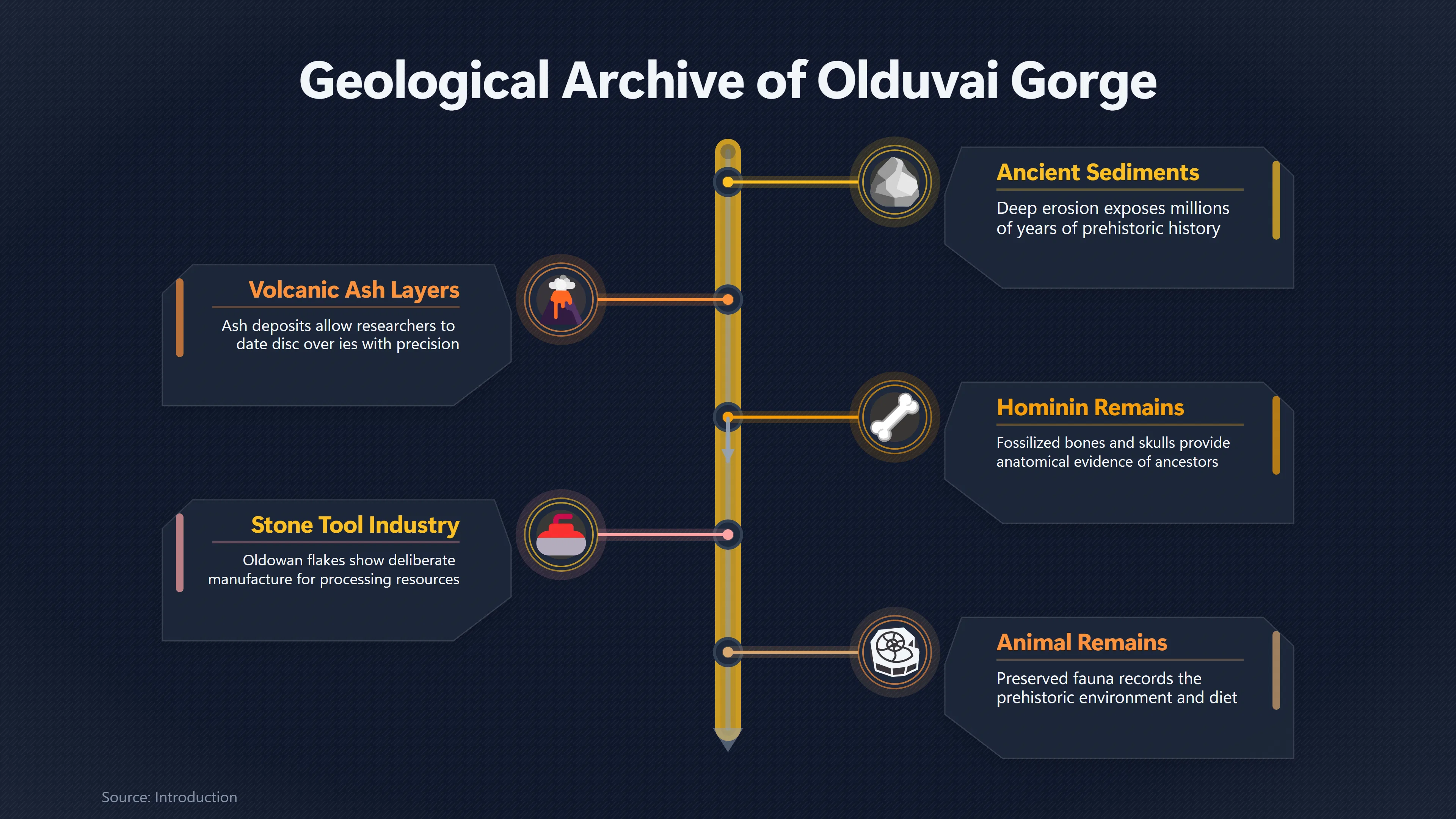
Northern Tanzania contains one of the world’s greatest archives of human origins, not because of a single spectacular fossil but because two nearby sites preserve complementary kinds of evidence. At Olduvai Gorge, layers of ancient sediments have yielded fossil hominins, stone tools and animal remains spanning almost two million years of prehistory. At nearby Laetoli, fossilised footprints record a fleeting moment when early human ancestors walked across wet volcanic ash around 3.6 million years ago. Together they allow visitors to move beyond reconstructed skeletons and imagine living individuals making tools, travelling across landscapes and leaving traces that survived for millions of years. Rather than presenting mystery for its own sake, these sites demonstrate how careful excavation, geology and conservation have transformed fragments of bone, stone and footprints into one of the strongest bodies of evidence for early human evolution.[Getty]getty.eduHominid Trackway at Laetoli | Getty ProjectsHominid Trackway at Laetoli | Getty Projects…
Olduvai fossils and prehistoric tools
Olduvai Gorge is often described as an open-air archive rather than simply an archaeological site. Deep erosion has exposed a sequence of volcanic ash layers and sediments, allowing researchers to date discoveries with unusual precision. Each layer captures different environments and different stages in the story of early humans, making the gorge one of the world’s most important reference sites for human evolution.
Excavations led by Louis and Mary Leakey, followed by generations of international researchers, recovered fossils representing several hominin species alongside abundant animal bones and some of the earliest widely accepted stone tools. These discoveries demonstrated that eastern Africa was central to understanding early human origins and helped establish the Oldowan stone-tool industry, named after Olduvai itself. Simple flakes and pebble tools reveal deliberate manufacture rather than accidental breakage, showing that early hominins were selecting suitable rocks and producing sharp cutting edges for processing meat, plants and other resources. The archaeological record also preserves evidence of changing technology through time as later, more sophisticated tool traditions appeared.[Getty]getty.eduHominid Trackway at Laetoli | Getty ProjectsHominid Trackway at Laetoli | Getty Projects…
What makes Olduvai especially unusual within Tanzania’s landscape of museums and heritage sites is that visitors are not looking at isolated curiosities. Fossils, stone tools, volcanic ash deposits and ancient animal remains all reinforce one another. A fossil jaw or skull fragment gains meaning because it can be linked to the tools nearby, the surrounding fauna and the geological layer in which it was found. This combination creates an unusually complete picture of prehistoric life rather than a collection of disconnected artefacts.
The Laetoli footprint trackway
If Olduvai provides the physical remains of ancient hominins, Laetoli captures an instant of behaviour.
Around 3.6 million years ago, several early hominins crossed damp volcanic ash shortly after an eruption. Another ashfall buried the surface before wind or rain could erase the impressions. Millions of years later, Mary Leakey’s team uncovered a trackway almost 27 metres long containing roughly seventy footprints, now regarded as the oldest known hominin footprint trail.[Human Origins]humanorigins.si.eduOpen source on si.edu.
The scientific importance lies in what the footprints reveal. Unlike bones, which require anatomical interpretation, footprints record movement directly. The Laetoli prints show:
- A heel-first stride followed by push-off from the toes, closely resembling modern human walking.
- A big toe aligned with the others rather than projecting sideways like that of living apes.
- Clear evidence of habitual upright walking rather than occasional bipedal movement.
- Several individuals moving across the same surface, offering rare clues about social behaviour as well as anatomy.[Human Origins]humanorigins.si.eduOpen source on si.edu.
Most researchers attribute the trackway to Australopithecus afarensis, the same early hominin species known from fossils found in eastern Africa, although continuing research refines ideas about exactly how these individuals walked and whether additional trackways at Laetoli may represent more than one hominin form. The broad conclusion, however, has remained remarkably stable: by 3.6 million years ago, upright walking was already well established.[Human Origins]humanorigins.si.eduOpen source on si.edu.
For many visitors, the emotional impact exceeds that of skeletal fossils. A footprint feels personal. Instead of imagining an extinct ancestor from reconstructed bones, people see the literal impression of a foot pressing into soft ash millions of years before recorded history.
Why the original evidence is protected
One of the most common misconceptions is that visitors can walk alongside the original footprints. In reality, the authentic trackway is deliberately kept buried.
After excavation in the late 1970s, researchers recognised that exposure created new risks. Weathering, erosion, vegetation and growing tree roots threatened the fragile volcanic tuff preserving the prints. During the 1990s, the Getty Conservation Institute worked with Tanzanian authorities to document the trackway in detail, remove damaging roots, stabilise vulnerable areas and rebury the footprints beneath carefully designed protective layers. Reburial was judged the safest long-term conservation strategy because leaving the prints permanently exposed would almost certainly accelerate their deterioration.[Getty]getty.eduHominid Trackway at Laetoli | Getty ProjectsHominid Trackway at Laetoli | Getty Projects…
This conservation approach explains why casts and replicas play such an important role. High-quality reproductions allow visitors and researchers to study the footprints closely while reducing pressure on the irreplaceable originals.
What visitors see and what remains protected
Most visitors experience these discoveries through the Olduvai Gorge Museum and the surrounding archaeological landscape rather than at active excavation trenches.
Museum displays typically include:
- Casts of significant hominin fossils.
- Replicas of the Laetoli footprints.
- Original stone tools and archaeological finds recovered from Olduvai.[humanorigins.si.edu]humanorigins.si.eduearly stone age toolsearly stone age tools
- Reconstructions showing how the ancient landscape and its inhabitants may have appeared.
- Explanations of excavation methods, dating techniques and ongoing research.[Getty]getty.eduHominid Trackway at Laetoli | Getty ProjectsHominid Trackway at Laetoli | Getty Projects…
Meanwhile, the original Laetoli footprint surface remains protected within the wider conservation area and is generally accessible only for authorised scientific work. This balance between public interpretation and strict preservation reflects an important principle in archaeological heritage management: the most valuable evidence is often best protected by limiting direct access.
Why these sites matter within Tanzania’s curiosity heritage
Within Tanzania’s landscape of unusual museums and heritage sites, Olduvai and Laetoli occupy a distinctive place because their extraordinary appeal comes from verified scientific evidence rather than folklore, mystery or spectacle.
The artefacts and footprints are unquestionably remarkable, yet their significance lies in careful interpretation rather than sensational claims. Fossils, stone tools and footprints are linked through geology, dating methods and decades of international research, allowing visitors to follow the reasoning behind scientific conclusions instead of simply accepting dramatic assertions.[Getty]getty.eduHominid Trackway at Laetoli | Getty ProjectsHominid Trackway at Laetoli | Getty Projects…
That combination of deep time and tangible human presence makes Olduvai and Laetoli unlike almost any other visitor destination. A chipped stone tool, a fragment of skull and a trail of footprints become connected pieces of the same story: evidence that some of humanity’s earliest ancestors lived, travelled and adapted in what is now northern Tanzania, leaving behind traces that continue to shape our understanding of where humans came from.
Amazon book picks
Further Reading
Books and field guides related to Why Tanzania's Ancient Footprints Still Astonish. Use these as the next step if you want deeper reading beyond the article.
The Human Story
In this concise and entertaining history, James C. Davis recounts the development of humanity, from the Stone Age to modern life. From th...
The Human Past: World Prehistory and the Development of Human...
First published 2005. Subjects: Social life and customs, Prehistoric peoples, Economic conditions, Human evolution, Hunting and gathering...
Origins: Fourteen Billion Years of Cosmic Evolution
“Who can ask for better cosmic tour guides?” —Michio Kaku Our true origins are not only human, or even terrestrial, but in fact cosmic. D...
Lucy, the Beginnings of Humankind
Describes the discovery of the oldest, most complete skeleton of any erect walking human ancestor ever found in 1974 in Ethiopia.
eBay marketplace picks
Marketplace Samples
Live-tested eBay searches with available results related to this page.
Selected fromprehistoric poster oneBay.co.uk.


Endnotes
1.
Source: getty.edu
Title: Hominid Trackway at Laetoli | Getty Projects
Link:https://www.getty.edu/projects/hominid-trackway-laetoli/
Source snippet
Hominid Trackway at Laetoli | Getty Projects...
2.
Source: getty.edu
Title: Conservation Program | Getty Projects
Link:https://www.getty.edu/projects/hominid-trackway-laetoli/conservation-program/
Source snippet
Conservation Program | Getty Projects...
3.
Source: archive.vn
Link:https://archive.vn/2026.01.14-041743/https%3A/www.britannica.com/biography/Mary-Douglas-Leakey
Source snippet
December 5, 2025 — OLDUVAI GORGE archaeological site, Tanzania Also known as: “Cradle of Mankind”, Olduwai Gorge account_circle Britannic...
Published: December 5, 2025
4.
Source: getty.edu
Link:https://www.getty.edu/conservation/publications_resources/pdf_publications/laetoli_condition_records.html
5.
Source: getty.edu
Link:https://www.getty.edu/projects/hominid-trackway-laetoli/project-origins/
6.
Source: getty.edu
Link:https://www.getty.edu/projects/hominid-trackway-laetoli/evaluation-trackway-condition/
7.
Source: getty.edu
Link:https://www.getty.edu/conservation/publications_resources/pdf_publications/laetoli_project_field_report_1995.html
8.
Source: getty.edu
Title: The Laetoli Conservation Project: A Visual
Link:https://www.getty.edu/conservation/publications_resources/pdf_publications/laetoli_visual_summary.html
9.
Source: getty.edu
Link:https://www.getty.edu/conservation/publications_resources/pdf_publications/laetoli_project_field_report_1996-98.html
10.
Source: youtube.com
Title: Animated Life – Mary Leakey | HHMI Bio Interactive Video
Link:https://www.youtube.com/watch?v=IEZh-gZgvrY
Source snippet
Mary Leakey | The History and Meaning of the Discoveries in Olduvai Gorge...
11.
Source: youtube.com
Title: Mary Leakey | The History and Meaning of the Discoveries in Olduvai Gorge
Link:https://www.youtube.com/watch?v=EQNI0428-ns
Source snippet
3 Things That Surprised Me at the Tanzania National Museum...
12.
Source: humanorigins.si.edu
Link:https://humanorigins.si.edu/evidence/behavior/footprints/laetoli-footprint-trails
13.
Source: humanorigins.si.edu
Link:https://humanorigins.si.edu/evidence/behavior/footprints
14.
Source: humanorigins.si.edu
Title: early stone age tools
Link:https://humanorigins.si.edu/evidence/behavior/stone-tools/early-stone-age-tools
15.
Source: humanorigins.si.edu
Link:https://humanorigins.si.edu/evidence/human-fossils/fossils/oh-8
Additional References
16.
Source: nature.com
Link:https://www.nature.com/articles/s41586-021-04187-7
Source snippet
December 1, 2021 — Footprint evidence of early hominin locomotor diversity at Laetoli, Tanzania Download PDF Download PDF * Article * Ope...
Published: December 1, 2021
17.
Source: visittanzania.org
Title: From Africa they spread out to populate the rest
Link:https://www.visittanzania.org/destinations-in-tanzania/olduvai-gorge-laetoli/
Source snippet
Olduvai Gorge & Laetoli - Visit Tanzania – Land of the KilimajaroApril 17, 2014 — OLDUVAI GORGE & LAETOLI Image Over the last thirty year...
Published: April 17, 2014
18.
Source: smithsonianmag.com
Title: Louis Leakey: The Father of Hominid Hunting
Link:https://www.smithsonianmag.com/science-nature/louis-leakey-the-father-of-hominid-hunting-119543967/
Source snippet
June 13, 2012 — LOUIS LEAKEY: THE FATHER OF HOMINID HUNTING LOUIS LEAKEY POPULARIZED THE STUDY OF HUMAN EVOLUTION AND SPARKED THE SEARCH...
Published: June 13, 2012
19.
Source: youtube.com
Title: 3 Things That Surprised Me at the Tanzania National Museum!
Link:https://www.youtube.com/watch?v=a0QWy0ujbPU
Source snippet
Olduvai Gorge Tanzania: Exploring the Cradle of Humankind | 4K Virtual Documentary Virtual Travel Videos | In Case You're Wondering · 7.6...
20.
Source: youtube.com
Link:https://www.youtube.com/watch?v=oreAMNEd-Gc
Source snippet
Foot Prints without Feet: Laetoli Foot Prints, Tanzania Africa...
21.
Source: youtube.com
Title: Foot Prints without Feet: Laetoli Foot Prints, Tanzania Africa
Link:https://www.youtube.com/watch?v=rvaZx2nSo6E
Source snippet
Animated Life -- Mary Leakey | HHMI BioInteractive Video...
22.
Source: whc.unesco.org
Link:https://whc.unesco.org/en/news/641
Source snippet
Heritage Committee inscribes Ngorongoro Conservation Area (Tanzania) as Cultural World Heritage Site - UNESCO World Heritage CentreJuly 3...
23.
Source: ncaa.go.tz
Link:https://www.ncaa.go.tz/about-ncaa/
24.
Source: ncaa.go.tz
Link:https://www.ncaa.go.tz/archeological-features/
25.
Source: smithsonianmag.com
Link:https://www.smithsonianmag.com/history/the-old-man-of-olduvai-gorge-69246530/