Where Somalia Keeps Its Strangest Cultural Treasures
Somalia does not currently have a well-documented circuit of witchcraft museums, cryptid exhibitions or commercial cabinets of curiosity.
Page outline Jump by section
Introduction
For curious travellers, the central story is therefore not a parade of eccentric attractions. It is the struggle to preserve objects, images and voices after war scattered collections and weakened cultural institutions. Some places are formally public; others function intermittently, require local arrangements or sit in politically contested territory. The most memorable “museum” experience may be an archaeological landscape or a working archive rather than a conventional gallery.[UNESCO]unesco.orgfederal republic somalia reopens its national museum mogadishuFederal Republic of Somalia reopens its National Museum…On 1 July 2020, the nation celebrated the reopening of its National Muse…
Is there a strange-museum scene in Somalia?
There is no credible evidence of a dedicated Somali museum of witchcraft, monsters, UFOs, medical oddities, crime or paranormal phenomena. That absence matters. Somalia’s museum sector has spent much of the modern period trying to recover basic national collections rather than developing highly specialised attractions.
The National Museum in Mogadishu closed after the state collapsed in 1991. Its buildings were damaged and its collections were pillaged; staff were killed, displaced or dispersed. Restoration began in 2019, and the museum formally reopened on 1 July 2020, almost three decades after its closure. UNESCO presented the reopening as part of a broader effort to restore Somalia’s National Library, National Theatre and other cultural institutions.[UNESCO]unesco.orgfederal republic somalia reopens its national museum mogadishuFederal Republic of Somalia reopens its National Museum…On 1 July 2020, the nation celebrated the reopening of its National Muse…
Reopening, however, did not instantly recreate a fully functioning national museum. UNESCO’s subsequent work concentrated on basic museum management, staff training, policy and rebuilding collections. A 2025 Associated Press report described the National Museum and neighbouring National Theatre as largely inactive, with access to the heavily guarded government district requiring significant advance security arrangements. The fairest description is therefore that the museum exists and has hosted exhibitions, but should not be treated as a reliably open, walk-in tourist attraction without current local confirmation.[unesco.org]unesco.orgsomalia seeks strengthen management its newly rehabilitated national museumSomalia seeks to strengthen management of its newly…27 Nov 2020 — Following the reopening of Somalia National Museum on 1 July 2…
What makes the museum unusual is not a bizarre theme but its condition as a reconstructed institution with an enormous gap at its centre. Earlier museum displays covered archaeology, ethnography, anti-colonial resistance, weaponry and regional history. The reopened institution has had to rebuild from surviving, recovered and newly contributed material, including pottery, traditional objects, weapons, coins and contemporary art. Visitors are not simply looking at Somalia’s past; they are seeing an attempt to reconstruct public memory after the original collection was violently dispersed.[UNESCO Digital Library]unesdoc.unesco.orgOpen source on unesco.org.
Laas Geel: the open-air collection that outshines the museums
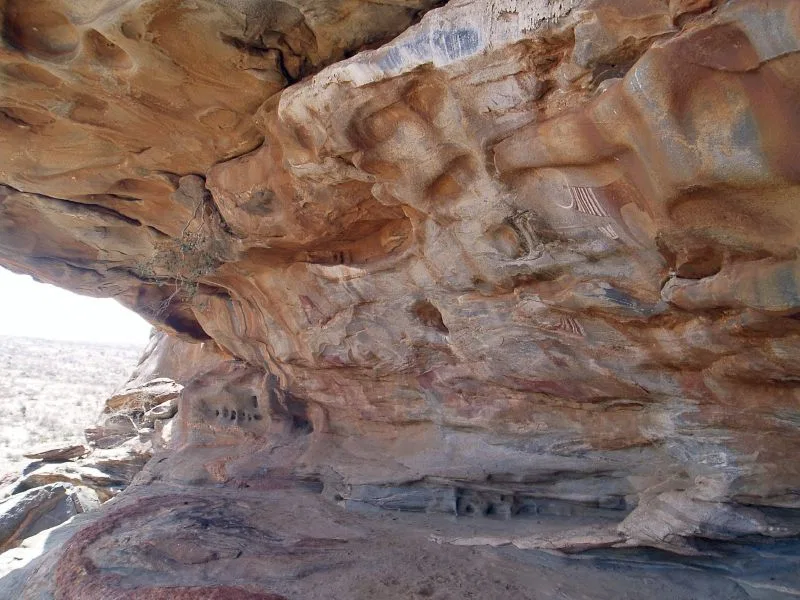
The most extraordinary visitor-facing heritage collection associated with Somalia is not housed in a building. Laas Geel is a group of painted rock shelters near Hargeisa containing vivid images of cattle, people and other animals. The paintings are notable for their strong colours, stylised human figures and elaborately decorated cattle, some shown with unusually shaped necks, ceremonial markings or human attendants.
A French archaeological mission documented the site internationally in 2002. Excavation and study have allowed researchers to place the paintings within the prehistoric development of cattle-keeping communities in the Horn of Africa. The British Museum’s African rock-art project notes that the site can be dated more securely than many comparable rock-art locations and that its distinctive style initially had few close regional parallels.[Archéologie]archeologie.culture.gouv.frOpen source on gouv.fr.
Laas Geel is unusual because it behaves like both archaeological site and natural gallery. The rock overhangs form exhibition chambers, while the paintings remain in the landscape for which they were created. There are no glass cases separating the viewer from the images, and no modern curator can fully explain what the scenes meant to their makers. Interpretations involving cattle wealth, ritual display, fertility or social identity are plausible, but the paintings are not a coded prehistoric documentary whose precise message has been deciphered.
The site lies in Somaliland, which has governed itself separately since 1991 but remains the subject of an unresolved sovereignty dispute. International bodies have continued to affirm Somalia’s territorial integrity, while Somaliland maintains its claim to independence. For a country-level Somalia project, Laas Geel belongs within the cultural landscape, but its present-day administration and travel arrangements are controlled from Hargeisa rather than Mogadishu.[Archéologie]archeologie.culture.gouv.frOpen source on gouv.fr.
For unusual-museum enthusiasts, Laas Geel offers something that a conventional ethnographic display cannot: an intact prehistoric visual world dominated by cattle. Yet it should be approached as vulnerable archaeology, not as an adventure prop. The fascination lies in the paintings themselves and in how little certainty survives about the beliefs behind them.
Hargeisa’s small museums and rescued collections
Hargeisa has developed a modest network of cultural organisations partly in response to the destruction of older institutions. The former Hargeisa Provincial Museum, built in an unusual circular design during the 1970s, once held an important ethnographic collection. It was bombed during the conflict of 1988 and subsequently became a ruin, while its collection disappeared. The building is a stark example of a museum becoming an artefact of destruction in its own right.[VISIT HORN AFRICA]visithornafrica.comwhat to see do in hargeisawhat to see do in hargeisa
The privately developed Saryan Museum is one of the city’s best-known replacement spaces. Published descriptions indicate that it combines a chronological photographic account of Somaliland’s history with a compact assortment of cultural and archaeological objects. Reported displays have included Stone Age tools, traditional clothing, weapons, agricultural equipment, jewellery, historical photographs and material relating to war and political separation. It is closer to a community history museum than a polished national institution, and detailed independent cataloguing of its holdings remains limited.[Mysite]queenofshebainternational.orgMysite Saryan Museum, The Home of the Arts, Culture and Heritage of SomalilandMysite Saryan Museum, The Home of the Arts, Culture and Heritage of Somaliland
That informality is part of its interest. Saryan reflects a museum culture built from what could be found, donated, photographed or remembered after established collections had vanished. Its displays combine deep prehistory with living memory, domestic material and political narrative. Visitors should expect an earnest local collection rather than neutral, comprehensive coverage of every disputed event.
The Hargeysa Cultural Centre offers a different model. Established in 2014, it functions as a library, archive, gallery and cultural venue. Its publicly described holdings include manuscripts, maps, music cassettes, historical documents, archaeological information, artworks and temporary displays. It also supports research and programmes around Somali literature, language, music and performance.[hargeysaculturalcenter.org]hargeysaculturalcenter.orgabout usabout us
For a reader interested in eccentric archives, the cassette collection may be especially evocative. In a culture where poetry, song and oral performance carry major historical and social importance, ageing recordings can hold material that has no equivalent in a cabinet of objects. A tape of a poet, singer or political broadcast may be simultaneously an artwork, historical document and fragile technological relic.
Protective amulets and the missing museum of belief
Somalia has no publicly documented museum devoted to magic or supernatural belief, yet Somali protective objects appear in international museum collections. The Smithsonian’s National Museum of African Art, for example, catalogues Somali silver amulet containers made to hold folded written texts. Its records explain that specialists wrote Qur’anic verses on paper, which was enclosed in protective jewellery intended to promote health and wellbeing.[National Museum of African Art]africa.si.eduOpen source on si.edu.
Other surviving examples incorporate written formulas, geometric arrangements or animal imagery. A Smithsonian object record describes designs including magic squares and a winged horse, alongside Arabic inscriptions, while noting that written amulets could be folded into leather pouches or placed in silver containers worn as necklaces or armlets. Such objects occupy a delicate interpretive boundary: they may combine orthodox religious text, popular healing practice, craftsmanship and beliefs about protection without fitting neatly into a Western category such as “occult”.[National Museum of African Art]africa.si.eduOpen source on si.edu.
A responsible exhibition would therefore avoid presenting them merely as spooky charms. Their unusual quality comes from the way writing becomes a concealed physical presence. The wearer may never open the container or read its contents; protection is carried on the body through the authority of the text, the maker and the object’s material form.
The fact that some of the clearest catalogue information is found in Washington, London and other foreign collections reveals another feature of Somali curiosity culture: many objects are more accessible abroad than in the country where they originated. Colonial collecting, later conflict and the collapse of museum systems removed material from its original setting. Modern diaspora museums are beginning to challenge older labels by adding family knowledge, community memory and explanations of use.[The Guardian]theguardian.comOpen source on theguardian.com.
These overseas objects should not be mistaken for evidence of a secret Somali witchcraft museum. They are fragments of religious, medical and domestic life whose original meanings can be flattened when classified only as ethnographic curiosities.

Archives where voices matter more than objects
Somalia’s oral traditions make sound archives unusually important. Poetry is not merely a literary sideline: it has historically been used to preserve genealogy, comment on politics, settle disputes, praise communities and communicate social values. Cultural destruction therefore involves more than broken buildings. It can also mean the loss of recordings, scripts, broadcasting logs and the memories needed to identify anonymous voices.
Radio Mogadishu’s archive is one of the country’s most significant endangered collections. In July 2026, Al Jazeera reported on efforts to digitise its deteriorating holdings, preserving decades of broadcasts from Somalia’s principal public radio service. The collection is effectively an audio museum of public life, containing material that may survive nowhere else.[Al Jazeera]aljazeera.comAl Jazeera Somalia races to save Radio Mogadishu’s fading archiveAl Jazeera Somalia races to save Radio Mogadishu’s fading archive
The archive has a different kind of uncanniness from a room of unusual objects. Magnetic tape decays invisibly; labels become detached; speakers die before they can identify performers; obsolete machines make recordings unreadable. A reel that appears physically intact may already be losing its signal. Preservation requires not only digitisation but reliable descriptions of who is speaking, when a performance occurred and why it mattered.
Somalia’s “nation of poets” reputation also complicates the usual museum hierarchy. An old camel bell or carved headrest is clearly collectable, but a remembered poem may have carried more historical information than either. Contemporary poets still gather at the National Theatre and perform through radio and community networks, although institutions face severe funding and security constraints.[AP News]apnews.comPerforming in the National Theater—a venue once targeted by a suicide bomber—Barre and others emphasize peace, citizenship, and cultural…
For an offbeat heritage visitor, this means that a poetry event, archive presentation or cultural-centre programme may provide a richer encounter with Somali history than a static display case.
Looting, lost provenance and doubtful objects
The greatest mystery surrounding Somali collections is not a legendary creature or archaeological anomaly. It is the fate of thousands of objects removed from museums and sites during decades of conflict.
UNESCO states that the National Museum’s collections were pillaged after 1991. Cultural-heritage research has also documented illicit digging, destruction of sites and the emptying of both Mogadishu and Hargeisa museums. Once an object is stripped from its excavation layer, museum register or community history, much of its evidential value disappears even if the object itself survives.[unesco.org]unesco.orgActivities supported by the Heritage Emergency Fund in…17 Oct 2025 — These cultural institutions ran until 1991 but were once ag…
This creates fertile conditions for false claims. Coins, pottery, weapons and supposed antiquities offered without documentation may be genuine, misidentified, recently made or imported from elsewhere. A dramatic story about treasure from an ancient Somali sultanate is not provenance. Credibility depends on a recorded discovery location, lawful custody, specialist examination and comparison with securely documented material.
The old museum system itself was shaped by colonial collecting and interpretation. The original Mogadishu museum opened under Italian rule, and later national institutions inherited buildings, classifications and object histories from that period. Contemporary curators therefore face two reconstruction tasks: recovering what was lost and reconsidering how surviving objects were named, acquired and explained.[wikipedia.org]WikipediaNational Museum of SomaliaNational Museum of Somalia
This is why community archives and diaspora museums matter. They can reconnect objects with remembered use, correct demeaning or vague catalogue terms and record who donated an item. Their knowledge is not automatically infallible, but it can restore context that an old accession card never captured.

What can visitors realistically expect?
Somalia’s unusual heritage should be approached as a set of fragile, unevenly accessible collections rather than a dependable museum itinerary.
In Mogadishu, the National Museum is the key institution, but its activity and public access have varied. Security conditions, government-zone restrictions and limited programming mean that advance verification through trusted local contacts is essential. A formal reopening date should not be confused with guaranteed daily admission.[UNESCO]unesco.orgfederal republic somalia reopens its national museum mogadishuFederal Republic of Somalia reopens its National Museum…On 1 July 2020, the nation celebrated the reopening of its National Muse…
In Hargeisa, the Saryan Museum and Hargeysa Cultural Centre offer more intimate encounters with photographs, manuscripts, archaeological material, art and recordings. Their scale, opening arrangements and exhibition content may change, so visitors should confirm details directly rather than relying on old travel listings.[hargeysaculturalcenter.org]hargeysaculturalcenter.orgabout usabout us
At Laas Geel, the landscape and paintings are the collection. Access normally depends on locally arranged transport and permissions, and the site’s archaeological vulnerability calls for strict respect for barriers, guides and conservation rules. Nothing should be touched, wetted to intensify colour or removed.
The deeper expectation should be intellectual rather than commercial. Somalia offers few polished “weird tourism” attractions, but it presents a powerful study in how curiosity survives without stable museum infrastructure. Painted cattle endure under stone shelters; protective texts survive inside silver cases overseas; songs persist on ageing tape; replacement museums assemble histories from photographs and donated household objects.
Why Somalia matters in the history of unusual collections
Somalia expands the meaning of a cabinet of curiosity. Here, the cabinet may be empty because it was looted, distributed across foreign museums, rebuilt by a private collector or replaced by a digital archive. The unusual collection is often defined as much by absence as by survival.
Laas Geel shows how a spectacular prehistoric gallery can remain outside the international heritage mainstream despite exceptional artistic quality. Somali amulets demonstrate how devotional, medicinal and protective meanings overlap in objects too easily reduced to “magic”. The National Museum shows how reopening a building is only the beginning of restoring a collection. Radio Mogadishu’s tapes show that an archive can be lost even when nothing is visibly stolen.[britishmuseum.org]africanrockart.britishmuseum.orgOpen source on britishmuseum.org.
Somalia is therefore not a destination for sensational displays of the paranormal. Its real curiosity culture lies in prehistoric images, scattered objects, concealed texts and endangered voices—and in the continuing argument over who has the authority, resources and security to preserve them.
Amazon book picks
Further Reading
Books and field guides related to Where Somalia Keeps Its Strangest Cultural Treasures. Use these as the next step if you want deeper reading beyond the article.
The Scramble For Africa
In 1880 the continent of Africa was largely unexplored by Europeans. Less than thirty years later, only Liberia and Ethiopia remained unc...
The Fortunes of Africa
"Africa has been coveted for its riches ever since the era of the Pharaohs. In past centuries, it was the lure of gold, ivory, and slaves...
Lost Islamic History
Islam has been one of the most powerful religious, social, and political forces in history. Over the last 1400 years, from origins in Ara...
African Art
First published 1981. Subjects: Black Sculpture, Exhibitions, Private collections, Sculpture, Sculpture, Black.
eBay marketplace picks
Marketplace Samples
Live-tested eBay searches with available results related to this page.
Selected fromSomalia art oneBay.co.uk.

Endnotes
1.
Source: unesco.org
Title: federal republic somalia reopens its national museum mogadishu
Link:https://www.unesco.org/en/articles/federal-republic-somalia-reopens-its-national-museum-mogadishu
Source snippet
Federal Republic of Somalia reopens its National Museum...On 1 July 2020, the nation celebrated the reopening of its National Muse...
Published: July 2020
2.
Source: unesco.org
Link:https://www.unesco.org/en/node/195122
Source snippet
Activities supported by the Heritage Emergency Fund in...17 Oct 2025 — These cultural institutions ran until 1991 but were once ag...
3.
Source: unesco.org
Title: heritage emergency fund supports revival somalia national museum
Link:https://www.unesco.org/en/articles/unesco-heritage-emergency-fund-supports-revival-somalia-national-museum
Source snippet
UNESCO Heritage Emergency Fund supports revival of the...Official reopening of Somalia National Museum on 1 July 2020 ©Photo court...
Published: July 2020
4.
Source: unesco.org
Title: somalia seeks strengthen management its newly rehabilitated national museum
Link:https://www.unesco.org/en/articles/somalia-seeks-strengthen-management-its-newly-rehabilitated-national-museum
Source snippet
Somalia seeks to strengthen management of its newly...27 Nov 2020 — Following the reopening of Somalia National Museum on 1 July 2...
5.
Source: unesdoc.unesco.org
Link:https://unesdoc.unesco.org/ark%3A/48223/pf0000078773
6.
Source: unesdoc.unesco.org
Link:https://unesdoc.unesco.org/ark%3A/48223/pf0000036191
7.
Source: Wikipedia
Title: National Museum of Somalia
Link:https://en.wikipedia.org/wiki/National_Museum_of_Somalia
8.
Source: visithornafrica.com
Title: what to see do in hargeisa
Link:https://visithornafrica.com/what-to-see-do-in-hargeisa/
9.
Source: hargeysaculturalcenter.org
Title: about us
Link:https://www.hargeysaculturalcenter.org/about-us/
10.
Source: hargeysaculturalcenter.org
Link:https://www.hargeysaculturalcenter.org/the-art-gallery/
11.
Source: unesco.org
Title: Protecting Somalia’s documentary heritage: UNESCO supports Somali
Link:https://www.unesco.org/en/articles/protecting-somalias-documentary-heritage-unesco-supports-somali-memory-institutions-develop?hub=66969
12.
Source: whc.unesco.org
Link:https://whc.unesco.org/en/tentativelists/6812/
13.
Source: whc.unesco.org
Link:https://whc.unesco.org/fr/listesindicatives/6812/
14.
Source: whc.unesco.org
Link:https://whc.unesco.org/en/news/2206
15.
Source: whc.unesco.org
Link:https://whc.unesco.org/fr/actualites/2207
16.
Source: whc.unesco.org
Link:https://whc.unesco.org/en/statesparties/so
18.
Source: somaliland.com
Link:https://www.somaliland.com/travel/travel-guide-and-things-to-do-in-somaliland-maria-del-mar-vidal/
19.
Source: whc.unesco.org
Link:https://whc.unesco.org/en/documents/209149
20.
Source: whc.unesco.org
Link:https://whc.unesco.org/en/documents/155359
21.
Source: whc.unesco.org
Link:https://whc.unesco.org/en/documents/155362
22.
Source: whc.unesco.org
Link:https://whc.unesco.org/en/documents/165933
23.
Source: whc.unesco.org
Link:https://whc.unesco.org/en/list/1382/
24.
Source: whc.unesco.org
Link:https://whc.unesco.org/en/documents/142026
25.
Source: whc.unesco.org
Link:https://whc.unesco.org/en/activities/160/
26.
Source: Wikipedia
Link:https://en.wikipedia.org/wiki/Somalia
27.
Source: Wikipedia
Title: Museum of Witchcraft and Magic
Link:https://en.wikipedia.org/wiki/Museum_of_Witchcraft_and_Magic
28.
Source: ich.unesco.org
Title: somalia SO
Link:https://ich.unesco.org/en/state/somalia-SO
29.
Source: whc.unesco.org
Link:https://whc.unesco.org/en/statesparties/so/Laws
30.
Source: whc.unesco.org
Link:https://whc.unesco.org/en/list/179/
31.
Source: whc.unesco.org
Link:https://whc.unesco.org/en/rocktart/
33.
Source: unesco.org
Title: Post-conflict rehabilitation of the National Museum
Link:https://www.unesco.org/en/culture-emergencies/heritage-emergency-fund/post-conflict-rehabilitation-national-museum
34.
Source: unesdoc.unesco.org
Link:https://unesdoc.unesco.org/ark%3A/48223/pf0000229187
35.
Source: whc.unesco.org
Link:https://whc.unesco.org/en/list/352/
37.
Source: unesco.org
Link:https://www.unesco.org/en/alula/documentary-heritage?hub=158596
38.
Source: hargeysaculturalcenter.org
Link:https://www.hargeysaculturalcenter.org/
39.
Source: hargeysaculturalcenter.org
Link:https://www.hargeysaculturalcenter.org/the-library/
40.
Source: hargeysaculturalcenter.org
Link:https://www.hargeysaculturalcenter.org/about-us/visitcontact/
41.
Source: aljazeera.com
Title: Al Jazeera Somalia races to save Radio Mogadishu’s fading archive
Link:https://www.aljazeera.com/news/2026/7/19/somalia-races-to-save-radio-mogadishus-fading-archive
42.
Source: somalia.un.org
Link:https://somalia.un.org/en/102866-somalia-seeks-strengthen-management-its-newly-rehabilitated-national-museum
Source snippet
The United Nations in SomaliaSomalia seeks to strengthen management of its newly...27 Nov 2020 — UNESCO and the Government of Somalia wi...
43.
Source: apnews.com
Link:https://apnews.com/article/10b56e338a1a268d05d77d2bc51f0298
Source snippet
Performing in the National Theater—a venue once targeted by a suicide bomber—Barre and others emphasize peace, citizenship, and cultural...
44.
Source: archeologie.culture.gouv.fr
Link:https://archeologie.culture.gouv.fr/en/laas-geel-african-lascaux
45.
Source: africanrockart.britishmuseum.org
Link:https://africanrockart.britishmuseum.org/country/somalia-somaliland/laas-geel/
46.
Source: somalilandsun.com
Title: somaliland cultural heritage management study report
Link:https://somalilandsun.com/somaliland-cultural-heritage-management-study-report/
47.
Source: queenofshebainternational.org
Title: Mysite Saryan Museum, The Home of the Arts, Culture and Heritage of Somaliland
Link:https://www.queenofshebainternational.org/post/saryan-museum-the-home-of-the-arts-culture-and-heritage-of-somaliland
48.
Source: africa.si.edu
Link:https://africa.si.edu/collection/object/nmafa
49.
Source: africa.si.edu
Link:https://africa.si.edu/collection/object/nmafa
50.
Source: theguardian.com
Link:https://www.theguardian.com/artanddesign/2025/sep/02/artefacts-london-museum-preserving-somali-culture-house
51.
Source: jstor.org
Link:https://www.jstor.org/stable/41486763
52.
Source: digitallibrary.un.org
Link:https://digitallibrary.un.org/record/4097845
53.
Source: unsom.unmissions.org
Link:https://unsom.unmissions.org/en/node/53226
54.
Source: main.un.org
Link:https://main.un.org/securitycouncil/en/content/somalia
55.
Source: archeologie.culture.gouv.fr
Link:https://archeologie.culture.gouv.fr/monde/fr/laas-geel-le-lascaux-africain
56.
Source: archeologie.culture.gouv.fr
Link:https://archeologie.culture.gouv.fr/fr/laas-geel-le-lascaux-africain
57.
Source: archeologie.culture.gouv.fr
Link:https://archeologie.culture.gouv.fr/lascaux/en/plan-site
58.
Source: jstor.org
Link:https://www.jstor.org/stable/2796794
59.
Source: hrw.org
Link:https://www.hrw.org/africa/somalia
60.
Source: britishmuseum.org
Link:https://www.britishmuseum.org/collection/search?keyword=witch
61.
Source: britishmuseum.org
Link:https://www.britishmuseum.org/collection/object/C
62.
Source: britishmuseum.org
Link:https://www.britishmuseum.org/collection/object/C
63.
Source: britishmuseum.org
Link:https://www.britishmuseum.org/collection/object/C
64.
Source: britishmuseum.org
Link:https://www.britishmuseum.org/collection/object/C
65.
Source: britishmuseum.org
Link:https://www.britishmuseum.org/collection/object/C
66.
Source: britishmuseum.org
Link:https://www.britishmuseum.org/collection/term/x84852
67.
Source: africa.si.edu
Link:https://africa.si.edu/collection
68.
Source: americanhistory.si.edu
Link:https://americanhistory.si.edu/about/departments/work-and-industry/national-numismatic-collection/collection
69.
Source: tripadvisor.com
Title: Saryan Museum
Link:https://www.tripadvisor.com/Attraction_Review-g482880-d13338619-Reviews-Saryan_Museum-Hargeysa_Somaliland.html
70.
Source: freedomhouse.org
Link:https://freedomhouse.org/country/somalia
71.
Source: nationalmuseum.md
Link:https://www.nationalmuseum.md/en/
Additional References
72.
Source: youtube.com
Link:https://www.youtube.com/watch?v=QbZDLOSJepU
Source snippet
What Ancient Somali Cave Paintings in Sanaag Reveal | Karin-Heegan Documentary...
73.
Source: youtube.com
Title: Focus on Somalia: Radio Mogadishu Archive Digitization
Link:https://www.youtube.com/watch?v=SBX3VtPXsSU
Source snippet
These 5000-Year-Old Cave Paintings Are Not Even On The UNESCO List - Laas Geel...
74.
Source: youtube.com
Title: Somalia’s National Museum Hosts First Post-War Exhibit
Link:https://www.youtube.com/watch?v=zn5Pa07LbYc
Source snippet
Focus on Somalia: Radio Mogadishu Archive Digitization...
75.
Source: ryedalefolkmuseum.co.uk
Link:https://www.ryedalefolkmuseum.co.uk/a-hovel-fit-for-a-witch/
76.
Source: dppa.dfs.un.org
Link:https://dppa.dfs.un.org/en/mtg-sc-10084-asg-khiari-29-dec-2025
77.
Source: somalia.gov.so
Link:https://www.somalia.gov.so/about-somalia
78.
Source: nms.ac.uk
Link:https://www.nms.ac.uk/collections/departments/global-arts-cultures-design/the-mediterranean-africa-americas-and-oceania/africa-americas-and-oceania
79.
Source: academia.edu
Link:https://www.academia.edu/22688442/Al_Spirit_Possession_The_Caucasus_Central_Asia_Iran_and_Afghanistan
80.
Source: instagram.com
Link:https://www.instagram.com/p/DWoZ6OjgooZ/
81.
Source: iccrom.org
Link:https://www.iccrom.org/sites/default/files/publications/2019-11/iccrom_ics08_culturalheritageandlaw_en.pdf