Within Unusual Mali
What Mali's Museum Objects Cannot Fully Explain
Bamako's national collection reveals why masks, terracottas and ritual objects lose meaning when separated from ceremony and context.
On this page
- Masks beyond the display case
- Terracottas, looting and lost context
- Sacred knowledge and public interpretation
Page outline Jump by section
Introduction
The National Museum of Mali in Bamako is the country’s principal public collection of archaeological and ethnographic heritage, but its most important lesson is not simply what it displays. It is what those displays cannot fully communicate. Masks that once danced through funerals or initiation ceremonies, terracotta figures excavated from ancient settlements, and ritual objects associated with secret societies all lose part of their meaning when separated from the people, performances and beliefs that originally gave them life. The museum therefore asks visitors to look beyond the object itself. Rather than treating unusual artefacts as mysterious curiosities, it encourages an understanding of how archaeology, living tradition, conservation and ethical interpretation intersect in Mali’s cultural heritage.[smarthistory.org]smarthistory.org– Cultural heritage at risk: MaliSmarthistory – Cultural heritage at risk: MaliJanuary 12, 2018…
Masks beyond the display case
A museum display often encourages visitors to study a mask as a carved work of art. In Mali, however, the wooden mask was frequently only one element of a much larger performance.
Many ceremonial masks originally functioned alongside complete fibre costumes, music, dance, spoken formulas and carefully regulated social roles. In communities such as the Dogon, the carved face was meaningful because it was activated through performance, especially during collective funerary ceremonies intended to guide the deceased into the world of the ancestors. Outside that ceremonial setting, much of the object’s original purpose becomes invisible.[Smarthistory]smarthistory.org– Mask (Kanaga) (Dogon peoplesSmarthistory – Mask (Kanaga) (Dogon peoples)…
This is one reason museums increasingly avoid presenting masks simply as aesthetic masterpieces. Modern interpretation stresses that:
- the carving alone was rarely the complete ceremonial object;
- performers often belonged to initiation societies with restricted knowledge;
- movements, sound and costume were as important as the carved wood;
- some meanings remain intentionally undisclosed because they belong to living cultural traditions rather than public scholarship.[UNESCO Intangible Cultural Heritage]ich.unesco.orgIntangible Cultural Heritage Coming forth of the masks and puppets in MarkalaUNESCO Intangible Cultural HeritageComing forth of the masks and puppets in Markala - UNESCO Intangible Cultural Heritage…
The National Museum therefore faces a balancing act. It seeks to educate visitors while respecting the fact that certain ritual knowledge was never intended for complete public explanation. Some absences in gallery labels reflect cultural ethics rather than missing research.
UNESCO’s recognition of the “Coming forth of the masks and puppets in Markala” illustrates this broader point. The international designation protects a living cultural practice—not merely the surviving masks—because the ritual, music, community participation and transmission of knowledge together constitute the heritage. A museum can preserve the physical object, but not entirely recreate the social world that gave it meaning.[UNESCO Intangible Cultural Heritage]ich.unesco.orgIntangible Cultural Heritage Coming forth of the masks and puppets in MarkalaUNESCO Intangible Cultural HeritageComing forth of the masks and puppets in Markala - UNESCO Intangible Cultural Heritage…
Terracottas, looting and lost context
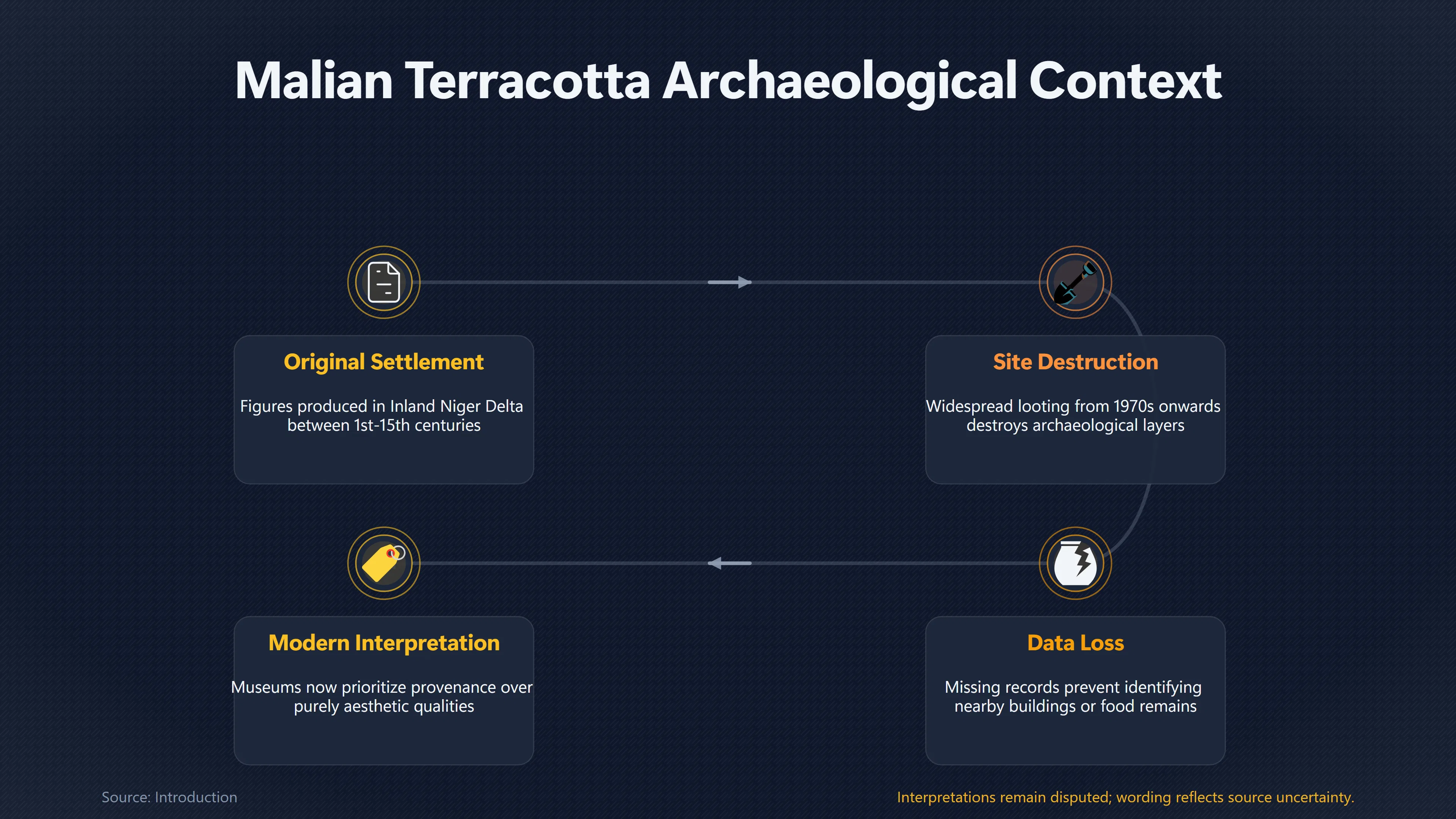
The museum’s famous terracotta sculptures raise a different problem. Their mystery often results not from ancient secrecy but from modern destruction.
Ancient settlements across the Inland Niger Delta produced sophisticated terracotta figures between roughly the first and fifteenth centuries. Many depict seated individuals, horse riders, animals or human figures with distinctive body markings. They are visually striking, but archaeologists value something even more than the sculptures themselves: knowing exactly where they were found.
During the twentieth century, especially from the 1970s onwards, widespread looting devastated archaeological sites across central Mali. Economic hardship combined with growing international demand for African antiquities encouraged organised digging, destroying layers of evidence that could have explained how objects were used, buried or associated with buildings and other artefacts. Estimates suggest that a very high proportion of archaeological sites in parts of the Niger Valley have been disturbed.[Smarthistory]smarthistory.org– Cultural heritage at risk: MaliSmarthistory – Cultural heritage at risk: MaliJanuary 12, 2018…
For visitors, this changes how the museum should be read.
A terracotta figure with secure archaeological provenance can reveal information about:
- the settlement where it was discovered;
- nearby buildings or burials;
- associated pottery, tools or food remains;
- approximate date;
- patterns of trade and social organisation.
A visually similar figure lacking excavation records may remain beautiful but cannot answer many of these historical questions. The missing context becomes part of the story.
This explains why museums increasingly discuss provenance alongside artistic qualities. The object’s history after excavation—whether legally recovered, looted or repatriated—affects how confidently historians can interpret it. Recent returns of Malian terracottas from overseas collections have reflected growing recognition that archaeological context matters as much as possession.[Smarthistory]smarthistory.org– Cultural heritage at risk: MaliSmarthistory – Cultural heritage at risk: MaliJanuary 12, 2018…
Sacred knowledge and public interpretation
One misconception visitors sometimes bring is that museums contain complete explanations of every object. The National Museum of Mali demonstrates why this is rarely possible.
Many ritual objects were associated with initiation societies whose teachings were transmitted orally to selected members rather than written down. Some ceremonies involved concepts of spiritual protection, social responsibility or moral education that communities continue to regard as restricted knowledge.
Museum curators therefore face several practical questions:
- How much should be explained? Public education should not violate living cultural boundaries.
- How should older terminology be handled? Labels increasingly avoid outdated descriptions such as “fetish”, replacing them with explanations rooted in local cultural practice.
- How can objects remain meaningful without sensationalism? Interpretation increasingly emphasises social function, history and community use instead of presenting ritual artefacts as exotic mysteries.
This approach reflects wider changes in museum practice around the world. Rather than claiming absolute authority over interpretation, curators increasingly acknowledge that descendant communities remain essential partners in explaining their own heritage.
Why the hidden meanings matter
The National Museum’s most unusual exhibits are therefore not unusual because they are supernatural or inexplicable. They are unusual because they demonstrate how much cultural knowledge cannot be captured inside a display case.
A carved mask once depended upon movement, costume and community participation. A terracotta figure depended upon archaeological context that may have been destroyed decades ago. A ritual object may have meanings deliberately withheld from public display because they remain part of living traditions.
For visitors interested in Mali’s stranger heritage, this makes the museum more thought-provoking than a conventional cabinet of curiosities. Its collections reveal not only remarkable objects but also the limits of what museums can preserve. Wood, clay and metal survive. Performance, memory, initiation and lived belief survive only imperfectly through interpretation, making every gallery as much an exploration of missing context as of the artefacts themselves.
Amazon book picks
Further Reading
Books and field guides related to What Mali's Museum Objects Cannot Fully Explain. Use these as the next step if you want deeper reading beyond the article.
The Hidden Treasures of Timbuktu
For centuries, camel caravans made epic journeys across the Sahara to reach the markets of the legendary city of Timbuktu, where they tra...
The Predicament of Culture
The Predicament of Culture is a critical ethnography of the West in its changing relations with other societies. Analyzing cultural pract...
The Anthropology of Art
This anthology provides a single-volume overview of the essential theoretical debates in the anthropology of art. Drawing together signif...
African Archaeology: A Critical Introduction
A landmark introduction to the archaeology of Africa that challenges misconceptions & claims about Africa’s past and teaches students how...
eBay marketplace picks
Marketplace Samples
Live-tested eBay searches with available results related to this page.
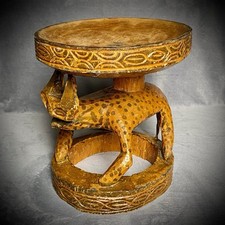
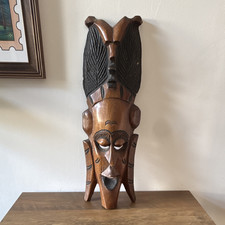
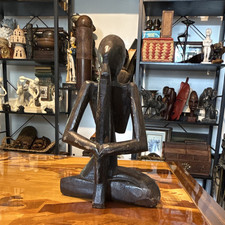
Selected fromAfrican sculpture decor oneBay.co.uk.
Endnotes
1.
Source: smarthistory.org
Title: – Cultural heritage at risk: Mali
Link:https://smarthistory.org/cultural-heritage-risk-mali/
Source snippet
Smarthistory – Cultural heritage at risk: MaliJanuary 12, 2018...
Published: January 12, 2018
2.
Source: ich.unesco.org
Title: Intangible Cultural Heritage Coming forth of the masks and puppets in Markala
Link:https://ich.unesco.org/en/RL/coming-forth-of-the-masks-and-puppets-in-markala-01004
Source snippet
UNESCO Intangible Cultural HeritageComing forth of the masks and puppets in Markala - UNESCO Intangible Cultural Heritage...
3.
Source: smarthistory.org
Title: – Mask (Kanaga) (Dogon peoples)
Link:https://smarthistory.org/mask-kanaga/
Source snippet
Smarthistory – Mask (Kanaga) (Dogon peoples)...
4.
Source: ich.unesco.org
Title: Intangible Cultural Heritage Mali
Link:https://ich.unesco.org/en/state/mali-ML
Source snippet
UNESCO Intangible Cultural HeritageMALI LATEST NEWS AND EVENTS 3 October 2023 THREE NEW INTERNATIONAL ASSISTANCE PROJECTS IN AFRICA SUPPO...
Published: October 2023
5.
Source: smarthistory.org
Title: The availability of dynamite and bulldozers in the modern era h
Link:https://smarthistory.org/arches-intro/
Source snippet
ARCHES, an introductionSeptember 2, 2017 — LOOTING AND THE LOSS OF THE ARCHEOLOGICAL RECORD The work of the archaeologist...
Published: September 2, 2017
6.
Source: unesco.org
Link:https://www.unesco.org/en/legal-affairs/convention-means-prohibiting-and-preventing-illicit-import-export-and-transfer-ownership-cultural?hub=68184
Source snippet
Legal AffairsNovember 14, 1970 — Convention CONVENTION ON THE MEANS OF PROHIBITING AND PREVENTING THE ILLICIT IMPORT, EXPORT AND TRANSFER...
Published: November 14, 1970
7.
Source: ich.unesco.org
Link:https://ich.unesco.org/en/Decisions/7.COM/11.20
Source snippet
of the Intergovernmental Committee: 7.COM 11.20 - UNESCO Intangible Cultural HeritageDECISION OF THE INTERGOVERNMENTAL COMMITTEE: 7.COM 1...
8.
Source: ich.unesco.org
Title: mali ML
Link:https://ich.unesco.org/en/state/mali-ML?info=elements-on-the-lists
Source snippet
UNESCO Intangible Cultural HeritageMALI ELEMENTS ON THE LISTS ELEMENTS ON THE LISTS OF INTANGIBLE CULTURAL HERITAGE 2024 --- Representati...
9.
Source: ich.unesco.org
Title: la aparicion de mascaras y marionetas de markala 01004
Link:https://ich.unesco.org/es/RL/la-aparicion-de-mascaras-y-marionetas-de-markala-01004
Source snippet
aparición de máscaras y marionetas de Markala - UNESCO Patrimonio cultural inmaterialLA APARICIÓN DE MÁSCARAS Y MARIONETAS DE MARKALA EXP...
Additional References
10.
Source: mfa.org
Link:https://www.mfa.org/press-release/malian-antiquities-return
Source snippet
MFA Boston Transfers Two Djenné Antiquities to the Republic of Mali | Museum of Fine Arts BostonFebruary 8, 2022 — BOSTON (February 8, 20...
Published: February 8, 2022
11.
Source: youtube.com
Title: Spectacular Dogon Masquerade
Link:https://www.youtube.com/watch?v=SDRMJox28y8
Source snippet
Inside The Dogon Ritual Mask Dance SECRET Revealed...
12.
Source: youtube.com
Title: African Masks
Link:https://www.youtube.com/watch?v=brVwiUl5-qY
Source snippet
The Tribal Eye - Behind The Mask (Part 1 of 7)...
13.
Source: youtube.com
Title: Inside The Dogon Ritual Mask Dance SECRET Revealed
Link:https://www.youtube.com/watch?v=YQC34k653v0
Source snippet
African Masks - Dogon Dama...
14.
Source: youtube.com
Title: Mali museum struggles to save artifacts
Link:https://www.youtube.com/watch?v=t4wR4YuRbyI
Source snippet
Spectacular Dogon Masquerade...
15.
Source: youtube.com
Title: The Tribal Eye
Link:https://www.youtube.com/watch?v=Uz96thYaD0c
16.
Source: africa.si.edu
Link:https://africa.si.edu/collection/object/nmafa
17.
Source: africa.si.edu
Link:https://africa.si.edu/collection/object/nmafa