Within Strange Finland
What Made Finnish Magic Objects Powerful?
Bear claws, healing stones and miniature coffins reveal how ordinary materials became powerful through ritual, memory and museum labels.
On this page
- From rural ritual tools to museum specimens
- How stories and handling created magical meaning
- Where the collections are kept and what visitors can see
Page outline Jump by section
Introduction
Finnish folk-magic objects are unusual not because they are elaborate ritual artefacts, but because many are surprisingly ordinary. A bear claw, a smooth pebble, a twisted tree branch or a small pouch filled with seemingly random items could all be regarded as powerful if they had the right history, had been handled in the correct way or were linked to a respected healer. Today, these objects survive mainly in museum collections rather than in active ritual use, offering a rare glimpse into how everyday materials became part of a lived system of healing, protection and practical magic. Modern research has identified hundreds of such objects in Finnish museum collections, many gathered during the late nineteenth and early twentieth centuries when ethnographers feared rural traditions were disappearing.[Taylor & Francis Online]tandfonline.comTaylor & Francis OnlineThe Materiality of Finnish Folk Magic: Objects in the Collections of the National Museum of Finland: Material Reli…
Rather than proving supernatural beliefs, these collections document how people understood illness, luck, misfortune and protection before modern medicine and scientific explanations became dominant. They also show how museum catalogues have reshaped these objects, turning once-functional ritual tools into historical specimens whose meanings must now be reconstructed from folklore, archival notes and oral tradition.[Taylor & Francis Online]tandfonline.comTaylor & Francis OnlineThe Materiality of Finnish Folk Magic: Objects in the Collections of the National Museum of Finland: Material Reli…
From rural ritual tools to museum specimens
Most surviving Finnish folk-magic objects entered museums through collectors rather than through formal religious institutions. Researchers studying the National Museum of Finland, Tampere museum collections and the Museum Centre of Turku have shown that these collections contain hundreds of objects associated with healing, protection, fertility and counter-magic. They include animal remains, unusual stones, wooden figures, miniature coffins, magic pouches and naturally formed plant materials that were believed to possess special qualities.[Åbo Akademi]abo.fiOpen source on abo.fi.
Unlike ceremonial objects from organised religions, these items were usually personal possessions. Many belonged to local healers or ordinary households rather than professional ritual specialists. Some were carried for years, others were hidden beneath buildings, buried in fields or used only during particular ceremonies. Their value came from use rather than craftsmanship.
Examples frequently documented in museum collections include:
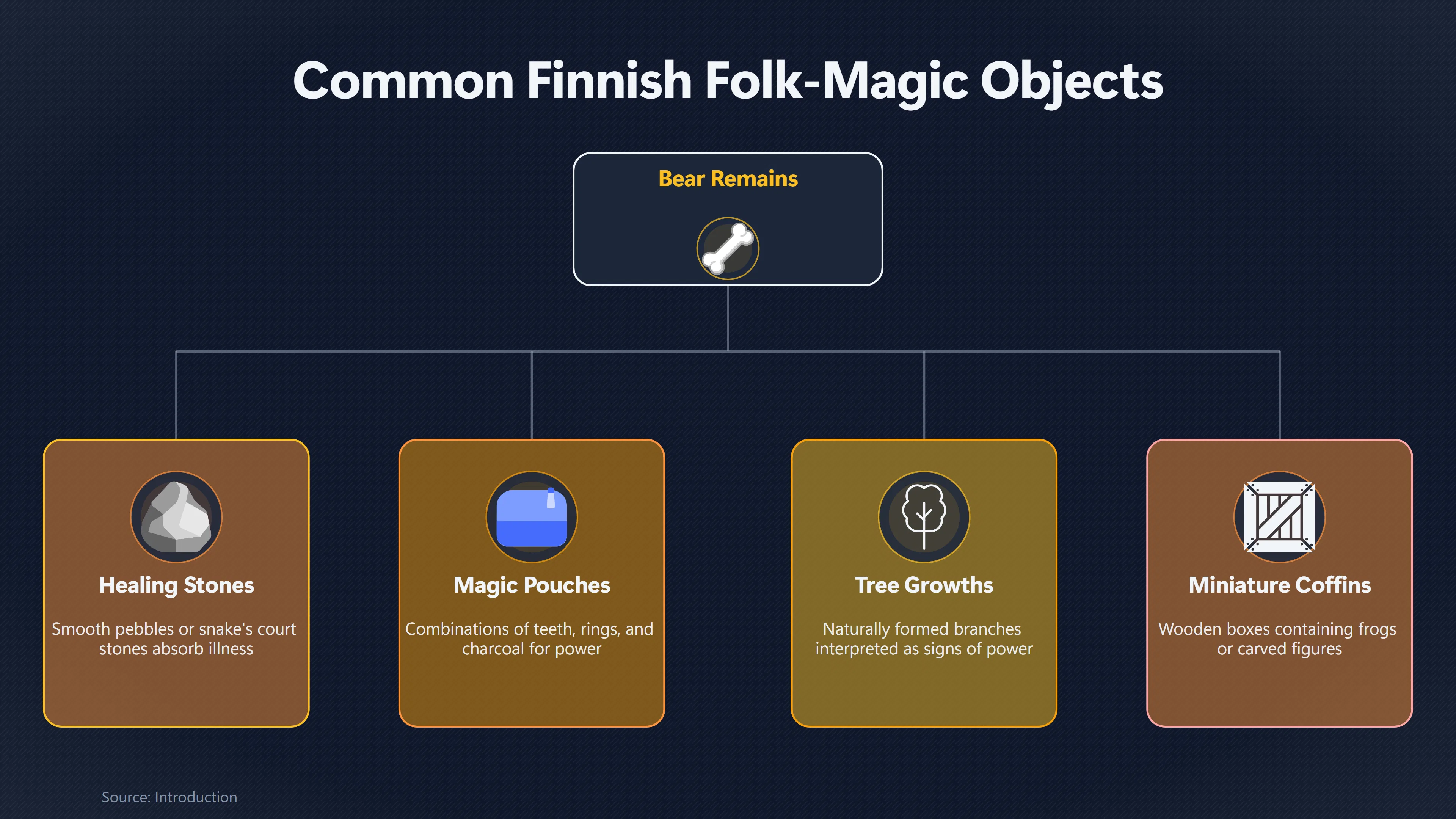
- Bear claws and bear teeth, carried as protective amulets or symbols of the bear’s respected strength and spiritual power.
- Healing stones, including unusually smooth pebbles or so-called “snake’s court stones”, believed to absorb illness or provide protection.
- Magic pouches, containing carefully selected combinations of teeth, rings, charcoal, shells, minerals or other materials whose power depended on their combination rather than any single ingredient.
- Circular tree growths, naturally formed branches or roots whose unusual shapes were interpreted as signs of extraordinary power.
- Miniature coffins, sometimes containing an impaled frog or carved wooden figure, used in aggressive or defensive magical practices intended to influence another person or remove harmful forces.[tandfonline.com]tandfonline.comTaylor & Francis OnlineThe Materiality of Finnish Folk Magic: Objects in the Collections of the National Museum of Finland: Material Reli…
Many of these objects appear visually unremarkable until accompanied by their recorded histories. Without those records, a museum visitor might mistake them for natural history specimens rather than evidence of a complex folk belief system.
How stories and handling created magical meaning
One of the most important findings from recent research is that Finnish magical objects were rarely considered powerful simply because of what they were made from. Their agency emerged through a combination of material, ritual, memory and narrative.
A bear claw, for example, drew meaning from the bear’s exceptional position within northern European belief. Bears were respected as spiritually significant animals long before the Christian period, and parts of the animal continued to carry symbolic authority in later rural traditions. Carrying a claw was therefore less about owning an animal part than maintaining a relationship with a respected natural power.[Archaeology of Folk Religion]archaeomagic.blogArchaeology of Folk Religion About – Archaeology of Folk ReligionArchaeology of Folk Religion About – Archaeology of Folk Religion
Healing stones illustrate another pattern. Some stones acquired reputations because of unusual shapes or colours, while others became effective only after being used repeatedly in particular healing rituals. Museum records occasionally preserve remarkably specific instructions—for example, that a stone should be pressed against an aching body part a prescribed number of times while following a traditional formula. Such details mattered as much as the object itself because the ritual completed its effectiveness.[Taylor & Francis Online]tandfonline.comTaylor & Francis OnlineThe Materiality of Finnish Folk Magic: Objects in the Collections of the National Museum of Finland: Material Reli…
Magic pouches demonstrate how combinations created meaning. Individual contents often appeared ordinary:
- broken pig teeth,
- metal rings,
- pieces of charcoal,
- shells,
- minerals,
- fragments of bone.
Together they formed portable collections whose effectiveness depended upon inherited knowledge about relationships between materials rather than on obvious symbolism visible to outsiders.[Archaeology of Folk Religion]archaeomagic.blogArchaeology of Folk Religion About – Archaeology of Folk ReligionArchaeology of Folk Religion About – Archaeology of Folk Religion
Researchers therefore argue that magical power existed within an “entanglement” of object, practitioner, ritual action and community belief rather than within the material alone. Once removed from those relationships and placed inside museum storage, much of that meaning becomes invisible without careful interpretation.[Taylor & Francis Online]tandfonline.comTaylor & Francis OnlineThe Materiality of Finnish Folk Magic: Objects in the Collections of the National Museum of Finland: Material Reli…
Why miniature coffins attract so much attention
Among the most striking Finnish folk-magic objects are miniature wooden coffins containing either an impaled frog or a carved wooden figure. These are frequently highlighted because they appear dramatically different from the rest of the collections, yet they actually represent only a small part of the surviving material.
Their appearance naturally attracts modern audiences, but scholars caution against treating them as representative of Finnish folk magic as a whole. The majority of surviving magical objects are far less theatrical. The coffins stand out because they were purpose-built ritual objects, making them easier for museum staff to identify and catalogue than ordinary household items whose magical use depended entirely on oral testimony.[Taylor & Francis Online]tandfonline.comTaylor & Francis OnlineThe Materiality of Finnish Folk Magic: Objects in the Collections of the National Museum of Finland: Material Reli…
This creates a subtle museum bias. Distinctive ritual artefacts are more likely to survive as recognised “magic objects”, while everyday items that once carried magical meanings may have entered collections simply as domestic tools, losing their ritual histories in the process.
Where the collections are kept and what visitors can see
Anyone hoping to visit a dedicated Finnish museum of witchcraft may be surprised. Finland’s magical objects are dispersed across ethnological collections rather than displayed together in a permanent national exhibition.
The largest body of material belongs to the ethnological collections of the National Museum of Finland, whose holdings document Finnish popular culture from the sixteenth century onwards. Only a small proportion of these approximately 90,000 ethnological objects is displayed at any one time, while many magical objects remain in storage or are accessible through research projects, digital catalogues and occasional exhibitions.[Suomen kansallismuseo]kansallismuseo.fiSuomen kansallismuseo Ethnological collectionsSuomen kansallismuseoEthnological collections - The National Museum of Finland…
The most important institutional collections for researchers include:
- the National Museum of Finland,[kansallismuseo.fi]kansallismuseo.fiSuomen kansallismuseo Ethnological collectionsSuomen kansallismuseoEthnological collections - The National Museum of Finland… * Tampere museum collections,[blogit.utu.fi]blogit.utu.fiSource details in endnotes.
- the Museum Centre of Turku.
Together they preserve the principal documented corpus of Finnish folk-magic objects currently available for scholarly study.[Åbo Akademi]abo.fiOpen source on abo.fi.
For visitors, this means expectations should be realistic. Rather than rooms filled with dramatic occult artefacts, Finnish museums generally present these objects within broader exhibitions on rural life, traditional healing, belief and everyday culture. Much of the most significant material remains behind the scenes for conservation and research.
What these objects reveal about Finnish curiosity culture
The greatest fascination of Finnish folk-magic collections lies in their ambiguity. They occupy a space between archaeology, folklore, ethnography and museum history rather than belonging entirely to any one field.
Modern scholarship increasingly avoids asking whether these objects “worked”. Instead, researchers examine how people assigned agency to materials, how stories transformed ordinary objects into powerful ones, and how museums themselves continue that process by deciding which objects deserve labels such as “magic”, “healing” or “ritual”.[Taylor & Francis Online]tandfonline.comTaylor & Francis OnlineThe Materiality of Finnish Folk Magic: Objects in the Collections of the National Museum of Finland: Material Reli…
This makes Finnish collections especially valuable within the country’s wider landscape of unusual museums and curious heritage. They preserve not only artefacts but also changing ideas about belief itself. A bear claw, a healing stone or a small pouch may appear ordinary in a display case, yet each carries evidence of how earlier communities understood health, danger, memory and the unseen forces they believed shaped everyday life.
Amazon book picks
Further Reading
Books and field guides related to What Made Finnish Magic Objects Powerful?. Use these as the next step if you want deeper reading beyond the article.
The Golden Bough
The work of Sir James G. Frazer (1854-1941) ranged widely across classics, cultural history, folklore and literary criticism as well as a...
The Kalevala: Epic of the Finnish People
Kalevala is the soaring epic poem of Finland's people, a work rich in magic and myth which tells the story of a nation through the ages f...
The Anthropology of Religion, Magic, and Witchcraft
This concise and accessible textbook introduces students to the anthropological study of religion. It examines religious expression from...
eBay marketplace picks
Marketplace Samples
Live-tested eBay searches with available results related to this page.
Selected fromNordic collectible oneBay.co.uk.

Endnotes
1.
Source: blogit.utu.fi
Link:https://blogit.utu.fi/kansanuskonarkeologia/magic-objects-in-finnish-museum-collections-archaeology-of-folk-religion/
2.
Source: kansallismuseo.fi
Title: Suomen kansallismuseo Ethnological collections
Link:https://www.kansallismuseo.fi/en/collections/kansatieteen-kokoelma
Source snippet
Suomen kansallismuseoEthnological collections - The National Museum of Finland...
3.
Source: tandfonline.com
Link:https://www.tandfonline.com/doi/full/10.1080/17432200.2018.1443893
Source snippet
Taylor & Francis OnlineThe Materiality of Finnish Folk Magic: Objects in the Collections of the National Museum of Finland: Material Reli...
4.
Source: abo.fi
Link:https://www.abo.fi/en/project/the-materiality-of-magic-in-finland-in-a-long-term-perspective-developing-the-archaeology-of-folk-religion/
5.
Source: archaeomagic.blog
Title: Archaeology of Folk Religion About – Archaeology of Folk Religion
Link:https://archaeomagic.blog/about/
6.
Source: tandfonline.com
Link:https://www.tandfonline.com/doi/abs/10.1080/17432200.2018.1443893
Source snippet
Taylor & Francis OnlineThe Materiality of Finnish Folk Magic: Objects in the Collections of the National Museum of Finland: Material Reli...
7.
Source: research.abo.fi
Link:https://research.abo.fi/en/projects/the-materiality-of-magic-in-finland-in-a-long-term-perspective-de/
Source snippet
Åbo Akademi UniversityThe Materiality of Magic in Finland in a Long-Term Perspective: Developing the Archaeology of Folk Religion - Åbo A...
8.
Source: archaeomagic.blog
Title: Archaeology of Folk Religion?
Link:https://archaeomagic.blog/2018/09/26/the-journey-begins/
Source snippet
Archaeology of Folk ReligionSeptember 26, 2018 — Research about material magic in Finland ARCHAEOLOGY OF FOLK RELIGION? Posted on 26.9...
Published: September 26, 2018
9.
Source: tandfonline.com
Link:https://www.tandfonline.com/doi/abs/10.1080/17432200.2018.1443893?needAccess=true
10.
Source: research.abo.fi
Link:https://research.abo.fi/fi/projects/the-materiality-of-magic-in-finland-in-a-long-term-perspective-de/
11.
Source: research.abo.fi
Title: fi Materiality of Magic in Estonian and Finnish Museums
Link:https://research.abo.fi/en/publications/materiality-of-magic-in-estonian-and-finnish-museums/
12.
Source: research.abo.fi
Title: fi Materiality of Magic in Estonian and Finnish Museums
Link:https://research.abo.fi/fi/publications/materiality-of-magic-in-estonian-and-finnish-museums/
13.
Source: research.abo.fi
Title: fi Materiality of Magic in Estonian and Finnish Museums
Link:https://research.abo.fi/sv/publications/materiality-of-magic-in-estonian-and-finnish-museums/
Additional References
14.
Source: researchgate.net
Title: (PDF) Materiality of Magic in Estonian and Finnish Museums
Link:https://www.researchgate.net/publication/369706658_Materiality_of_Magic_in_Estonian_and_Finnish_Museums
Source snippet
April 1, 2023 — Article PDF Available MATERIALITY OF MAGIC IN ESTONIAN AND FINNISH MUSEUMS * April 2023 * Folklore Electronic Journal of...
Published: April 1, 2023
15.
Source: youtube.com
Title: Healing powers and love potions
Link:http://www.youtube.com/watch?v=UUGkzZGY3DQ
Source snippet
Finnish Paganism | An Introduction into the Myth and Spirituality...
16.
Source: youtube.com
Title: FINNISH Folk Magic EXPERT Aili Marjatta Kerttula Reveals All!
Link:http://www.youtube.com/watch?v=3fR_O98Ry0Y
Source snippet
Healing powers and love potions - the re-use of Stone Age artefacts as magical objects...
17.
Source: youtube.com
Link:http://www.youtube.com/watch?v=ibEWt_znpC8
Source snippet
Snake's genesis-spell --- Finnish traditional magic words in early 1900s...
18.
Source: youtube.com
Title: The History of Paganism in Finland
Link:http://www.youtube.com/watch?v=WaBbAr-6ehQ
Source snippet
Finnish folk magic museum collection objects FINNISH Folk Magic EXPERT Aili Marjatta Kerttula Reveals All...
19.
Source: utupub.fi
Link:https://www.utupub.fi/items/befbee4a-6fea-490e-b829-fe9c122d7d86
20.
Source: eurekamag.com
Link:https://eurekamag.com/research/105/551/105551410.php
21.
Source: researchgate.net
Link:https://www.researchgate.net/publication/324615428_The_Materiality_of_Finnish_Folk_Magic_Objects_in_the_Collections_of_the_National_Museum_of_Finland
22.
Source: youtube.com
Link:http://www.youtube.com/watch?v=seWClM_wWvY
Source snippet
The History of Paganism in Finland...