Within Strange Ghana
Why Thousands of Clay Faces Rise at Nkyinkyim
Thousands of clay heads turn the history of enslavement into a living memorial rather than a conventional artefact display.
On this page
- The Ancestor Project and its expanding field of heads
- How symbolism differs from archaeological evidence
- What visitors experience across the museum grounds
Page outline Jump by section
Introduction
The most striking sight at Ghana’s Nkyinkyim Museum is not an ancient artefact or a reconstructed slave dungeon, but a vast and growing landscape of individually sculpted clay faces. Known as the Ancestor Project, this open-air installation transforms remembrance into a physical environment rather than a conventional exhibition. Thousands of heads emerge from earth and water, each standing for an African life disrupted or destroyed through enslavement, colonial violence or forced displacement. Rather than claiming to recreate identifiable historical individuals, the sculptures operate as symbolic ancestors, inviting reflection on historical trauma, continuity and healing. This approach makes Nkyinkyim one of Ghana’s most unusual cultural destinations: a place where contemporary art, memorial practice, education and ritual coexist in the same landscape.[Nkyinkyim Museum]nkyinkyimmuseum.orgNkyinkyim Museum About Us – Nkyinkyim MuseumNkyinkyim Museum About Us – Nkyinkyim Museum
Why thousands of clay faces rise at Nkyinkyim
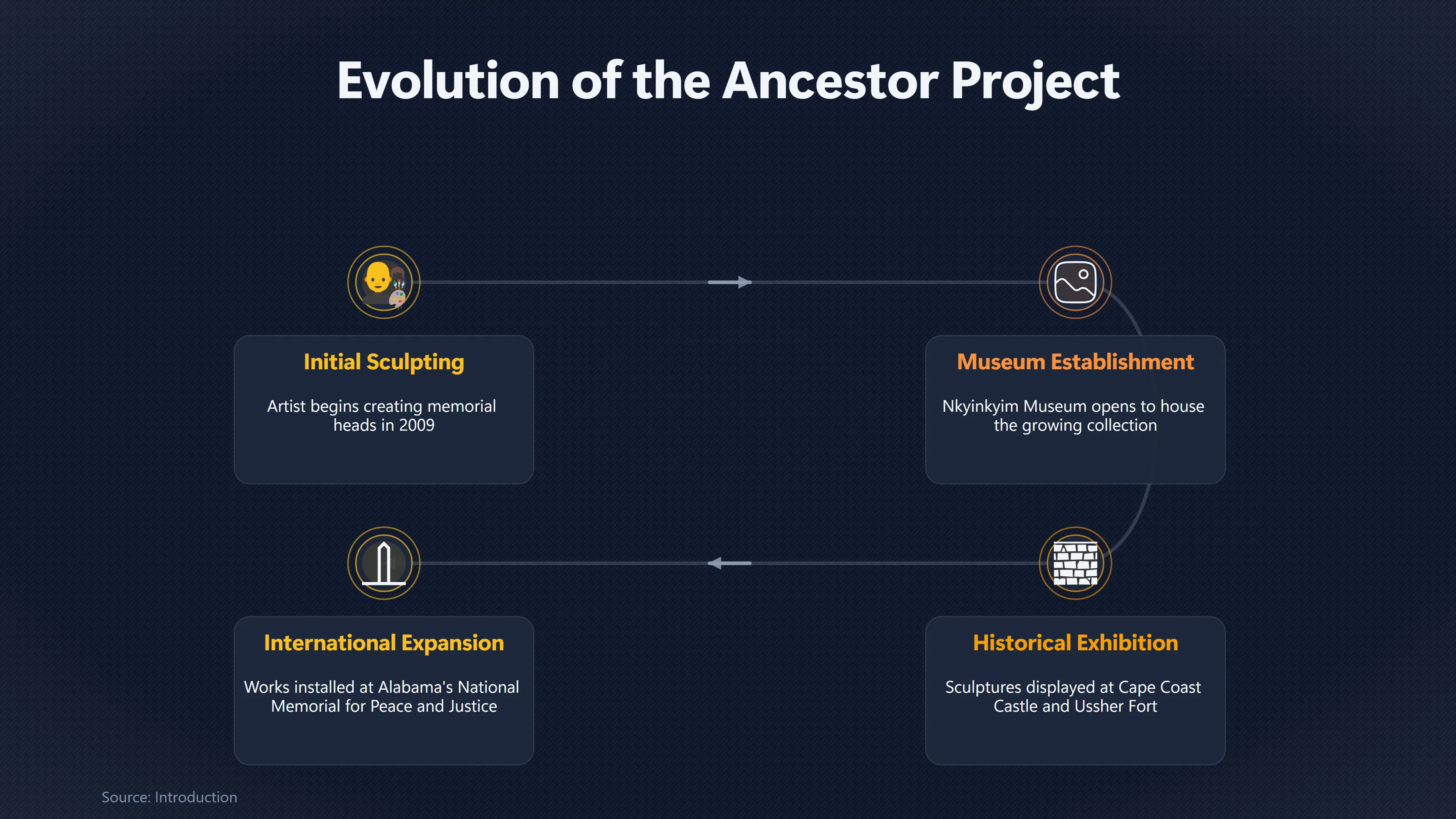
The installation was created by Ghanaian artist Kwame Akoto-Bamfo, who began sculpting memorial heads in 2009 before establishing the museum and its non-profit Ancestor Project. What began as a handful of sculptures has grown into an evolving field containing more than 3,500 clay heads, with a long-term ambition of reaching 11,111. The project is deliberately unfinished, reinforcing the idea that remembrance is an ongoing responsibility rather than a completed monument.[Nkyinkyim Museum]nkyinkyimmuseum.orgNkyinkyim Museum About Us – Nkyinkyim MuseumNkyinkyim Museum About Us – Nkyinkyim Museum
Every face is modelled individually. Some wear blindfolds, shackles or collars. Others bear marks of royalty, age or suffering. Hairstyles, expressions and physical features vary widely so that the installation avoids reducing millions of enslaved Africans to anonymous statistics. Instead, visitors encounter an imagined community of distinct human beings whose individuality was erased by the slave trade but restored symbolically through sculpture.[The Guardian]theguardian.comEstablished by artist Kwame Akoto-Bamfo in 2019, the museum aims to eventually showcase 11,111 heads, each representing an individual anc…
The museum describes this work as an archive of African history and heritage rather than a conventional sculpture garden. Tours are often led by trained cultural interpreters, known as griots, who explain the historical, philosophical and symbolic meanings embedded within the installation and wider museum landscape.[Nkyinkyim Museum]nkyinkyimmuseum.orgNkyinkyim Museum About Us – Nkyinkyim MuseumNkyinkyim Museum About Us – Nkyinkyim Museum
The Ancestor Project and its expanding field of heads
The clay heads are only one part of the Ancestor Project, but they are its emotional centre. The museum presents them as tools for restorative education and remembrance rather than decorative artworks. Educational programmes, workshops and commemorative events encourage visitors to think about how the transatlantic slave trade continues to shape identities, memory and conversations across Africa and the wider African diaspora.[Nkyinkyim Museum]nkyinkyimmuseum.orgNkyinkyim Museum About Us – Nkyinkyim MuseumNkyinkyim Museum About Us – Nkyinkyim Museum
The installation has itself followed a symbolic journey. Before finding its permanent home near Ada, groups of sculptures were exhibited at significant historical locations including the Kwame Nkrumah Mausoleum, Ussher Fort and Cape Coast Castle, places already associated with colonial rule and the history of enslavement. Some related sculptures were later installed at the National Memorial for Peace and Justice and the Legacy Museum in Montgomery, Alabama, linking Ghanaian remembrance with memorial landscapes in the United States.[Nkyinkyim Museum]nkyinkyimmuseum.orgNkyinkyim Museum About Us – Nkyinkyim MuseumNkyinkyim Museum About Us – Nkyinkyim Museum
Because the project continues to expand, repeat visitors may encounter new sculptures, altered arrangements and additional educational spaces. The museum therefore functions as a living memorial rather than a static collection.
How symbolism differs from archaeological evidence
One of the most important distinctions for visitors is that these heads are not archaeological reconstructions or portraits based on identified historical victims. They are contemporary memorial sculptures inspired by historical research, oral traditions and artistic interpretation. Their authority lies in symbolism and emotional truth rather than forensic identification.[Nkyinkyim Museum]nkyinkyimmuseum.orgNkyinkyim Museum About Us – Nkyinkyim MuseumNkyinkyim Museum About Us – Nkyinkyim Museum
This difference matters because the installation can easily be mistaken for an excavation site or a reconstruction of discovered remains. Instead:
- the sculptures represent collective ancestral memory rather than excavated individuals;
- facial expressions and physical details are artistic interpretations, not historical documentation;
- the installation seeks to communicate the scale and humanity of the slave trade through repetition, diversity and setting rather than through original artefacts.
Understanding this distinction helps explain why the work belongs equally to contemporary art, public history and memorial culture. It complements, rather than replaces, archaeological evidence or documentary collections relating to slavery.
What visitors experience across the museum grounds
The emotional effect of the installation comes partly from its setting. The heads are distributed through open ground, among trees and around water, creating changing perspectives as visitors walk through the landscape. Some appear partially submerged, while others emerge from the earth in dense clusters, encouraging slow movement rather than quick viewing.[The Guardian]theguardian.comEstablished by artist Kwame Akoto-Bamfo in 2019, the museum aims to eventually showcase 11,111 heads, each representing an individual anc…
The wider museum combines sculpture with traditional architecture, performance, storytelling, drumming and educational programmes. Museum staff describe the site as a place where tangible heritage, such as artworks, and intangible heritage, including ceremony and oral tradition, are experienced together.[Nkyinkyim Museum]nkyinkyimmuseum.orgOpen source on nkyinkyimmuseum.org.
Certain areas are treated as sacred rather than simply photographic attractions. During ancestor-veneration events, visitors are encouraged to observe respectful behaviour, with guidance covering dress, movement and conduct inside ceremonial spaces. This reinforces that the installation functions simultaneously as an artwork, a memorial and, for many participants, a place of spiritual reflection.[Nkyinkyim Museum]nkyinkyimmuseum.orgcelebrating our ancestors nkyinkyim museums 2024 ancestor veneration ceremonyNkyinkyim MuseumCelebrating Our Ancestors: Nkyinkyim Museum’s 2024 Ancestor Veneration Ceremony – Nkyinkyim Museum…
Why the memorial stands apart in Ghana’s curiosity landscape
Many unusual museums preserve rare objects from the past. Nkyinkyim reverses that pattern by creating new objects to remember people whose physical remains and personal histories were often erased. The clay heads are therefore unusual not because they are mysterious artefacts, but because they deliberately fill a historical absence.
Within Ghana’s broader landscape of museums, forts and memorial sites connected to the Atlantic slave trade, the installation offers something distinct. Rather than focusing on surviving chains, documents or architecture, it visualises the missing millions through contemporary sculpture. That makes the field of clay ancestors one of the country’s most memorable examples of how art can become both a public collection and a living memorial, encouraging visitors to move beyond historical facts towards reflection on memory, dignity and ancestral continuity.[Nkyinkyim Museum]nkyinkyimmuseum.orgNkyinkyim Museum About Us – Nkyinkyim MuseumNkyinkyim Museum About Us – Nkyinkyim Museum
Amazon book picks
Further Reading
Books and field guides related to Why Thousands of Clay Faces Rise at Nkyinkyim. Use these as the next step if you want deeper reading beyond the article.
The Slave Ship: A Human History
The slave ship was the instrument of history's greatest forced migration and a key to the origins and growth of global capitalism, yet mu...

Lose Your Mother: A Journey Along the Atlantic Slave Route
First published 2006. Subjects: Slave trade, Description and travel, Historic sites, Travel, Local History.
African Art in Detail
This book opens with the question, What is African art? The answer is a brilliantly colorful and detailed look at the myriad materials an...
eBay marketplace picks
Marketplace Samples
Live-tested eBay searches with available results related to this page.
Selected fromAfrican sculpture decor oneBay.co.uk.
Endnotes
1.
Source: nkyinkyimmuseum.org
Title: Nkyinkyim Museum About Us – Nkyinkyim Museum
Link:https://nkyinkyimmuseum.org/about-us/
2.
Source: theguardian.com
Link:https://www.theguardian.com/global-development/2025/mar/03/people-cry-get-angry-remembering-the-enslaved-in-ghanas-remarkable-sculpture-park
Source snippet
Established by artist Kwame Akoto-Bamfo in 2019, the museum aims to eventually showcase 11,111 heads, each representing an individual anc...
3.
Source: nkyinkyimmuseum.org
Title: celebrating our ancestors nkyinkyim museums 2024 ancestor veneration ceremony
Link:https://nkyinkyimmuseum.org/celebrating-our-ancestors-nkyinkyim-museums-2024-ancestor-veneration-ceremony/
Source snippet
Nkyinkyim MuseumCelebrating Our Ancestors: Nkyinkyim Museum’s 2024 Ancestor Veneration Ceremony – Nkyinkyim Museum...
4.
Source: nkyinkyimmuseum.org
Link:https://nkyinkyimmuseum.org/
5.
Source: theguardian.com
Title: Photograph: Joe Giddens/PA View image
Link:https://www.theguardian.com/culture/2025/oct/02/egypt-uk-cambridge-museum-exhibition-culture-art-history
Source snippet
Cats, coffins and sick notes: discovering Egypt’s forgotten workers in broken pottery | Museums | The GuardianOctober 2, 2025 — Image: Eg...
Published: October 2, 2025
6.
Source: theguardian.com
Link:https://www.theguardian.com/culture/2025/jun/26/beamish-wins-art-fund-museum-year-award
Source snippet
June 26, 2025 — Image: A man in period custume leans against a lamppost outside a 'Jubilee confectioners' shop as museum visitors pass by...
Published: June 26, 2025
7.
Source: theguardian.com
Link:https://www.theguardian.com/culture/2025/mar/23/british-museum-is-right-to-keep-parthenon-marbles-says-new-trustee
8.
Source: nkyinkyimmuseum.org
Link:https://nkyinkyimmuseum.org/contact-us/
9.
Source: nkyinkyimmuseum.org
Link:https://nkyinkyimmuseum.org/collections/
10.
Source: nkyinkyimmuseum.org
Link:https://nkyinkyimmuseum.org/shop/
11.
Source: avc.nkyinkyimmuseum.org
Link:https://avc.nkyinkyimmuseum.org/
12.
Source: nkyinkyimmuseum.org
Link:https://nkyinkyimmuseum.org/visit-us/
13.
Source: nkyinkyimmuseum.org
Link:https://nkyinkyimmuseum.org/type/sculpter/
14.
Source: theguardian.com
Link:https://www.theguardian.com/science/egyptology
Additional References
15.
Source: ghanaculture.gov.gh
Link:https://ghanaculture.gov.gh/ncc-executive-director-pays-courtesy-visit-to-nkyinkyim-museum/
Source snippet
NCC Executive Director Pays Courtesy Visit To Nkyinkyim Museum – National Commision on CultureJune 19, 2025 — NCC EXECUTIVE DIRECTOR PAYS...
Published: June 19, 2025
16.
Source: youtube.com
Title: Nkyinkyim Installation: Sculptures dedicated to enslaved African ancestors
Link:https://www.youtube.com/watch?v=de6o8CQcduk
Source snippet
KABE (Kwame Akoto-Bamfo) explains the Ancestor Project at University of Ghana...
17.
Source: youtube.com
Title: Nkyinkyim Sculpture at the National Memorial for Peace and Justice
Link:https://www.youtube.com/watch?v=8O2ETApTLds
Source snippet
Nkyinkyim Installation: Sculptures dedicated to enslaved African ancestors...
18.
Source: youtube.com
Title: Sculptor Kwame Akoto-Bamfo on Restorative Justice and his work in Ghana
Link:https://www.youtube.com/watch?v=Qpd9j-J8YFI
Source snippet
Nkyinkyim Sculpture at the National Memorial for Peace and Justice...
19.
Source: youtube.com
Title: Kwame Akoto-Bamfo’s Nkyinkyim Museum and The Ancestor Project
Link:https://www.youtube.com/watch?v=zzj_uLrpviQ
Source snippet
Sculptor Kwame Akoto-Bamfo on Restorative Justice and his work in Ghana...
20.
Source: kwameakotobamfo.com
Link:https://kwameakotobamfo.com/artist-kwame-akoto-bamfo-revives-endangered-art-forms-at-nkyinkyim-museum/
21.
Source: kwameakotobamfo.com
Link:https://kwameakotobamfo.com/people-cry-get-angry-remembering-the-enslaved-in-ghanas-remarkable-sculpture-park/
22.
Source: article.wn.com
Title: People cry get angry remembering the enslaved in Ghana s rem 2
Link:https://article.wn.com/view/2025/03/03/People_cry_get_angry_remembering_the_enslaved_in_Ghana_s_rem_2/
23.
Source: ancestorprojectgh.com
Title: African Heritage Reimagined Through Art and Digital Media
Link:https://ancestorprojectgh.com/
24.
Source: kwameakotobamfo.com
Title: Kwame Akoto-Bamfo About Me – Kwame Akoto-Bamfo
Link:https://kwameakotobamfo.com/about-me/